
Why This Camera & Lens Are Great for Panoramas
If you’re wondering how to shoot panorama with Fujifilm GFX 100 II & Fujifilm XF 8-16mm f/2.8 R LM WR, here’s the first thing to know: this exact body/lens combination is not directly mountable. The GFX 100 II uses the GF (G-mount) for a 44×33 mm medium-format sensor, while the XF 8–16mm is an X-mount APS‑C lens. There is no official adapter to mount XF lenses on GFX bodies. That said, you can still apply the workflow below in two practical ways:
- Use the GFX 100 II with a comparable ultra-wide GF lens (e.g., GF 20–35mm f/4 R WR, GF 23mm f/4 R LM WR). This preserves the GFX’s huge 102MP capture and stunning dynamic range.
- Use the XF 8–16mm on an X-series body (X-T5 / X-H2). The lens is rectilinear, razor-sharp stopped down, and fast to work with; you’ll just capture more frames for full spherical coverage compared to a fisheye.
Why the GFX 100 II is outstanding for panoramic photography: it uses a 102MP BSI CMOS (approx. 43.8×32.9 mm), with ~3.76 µm pixels, excellent base ISO 80 tonality, and roughly ~14 stops of usable dynamic range at base ISO. The 16‑bit RAW pipeline and IBIS (in-body image stabilization) give you incredibly clean detail for large prints or high-resolution virtual tours. Meanwhile, the XF 8–16mm f/2.8 R LM WR is a professional, rectilinear ultra-wide zoom with a constant f/2.8, strong edge-to-edge sharpness by f/5.6–f/8, and well-controlled CA/distortion that stitches predictably.
Below, you’ll find a tested, practical workflow customized to both paths (GFX + GF ultra-wide OR X-series + XF 8–16) so you can confidently create seamless 360 photos and gigapixel panoramas. The techniques—nodal point alignment, exposure consistency, overlap discipline—apply equally to either path.
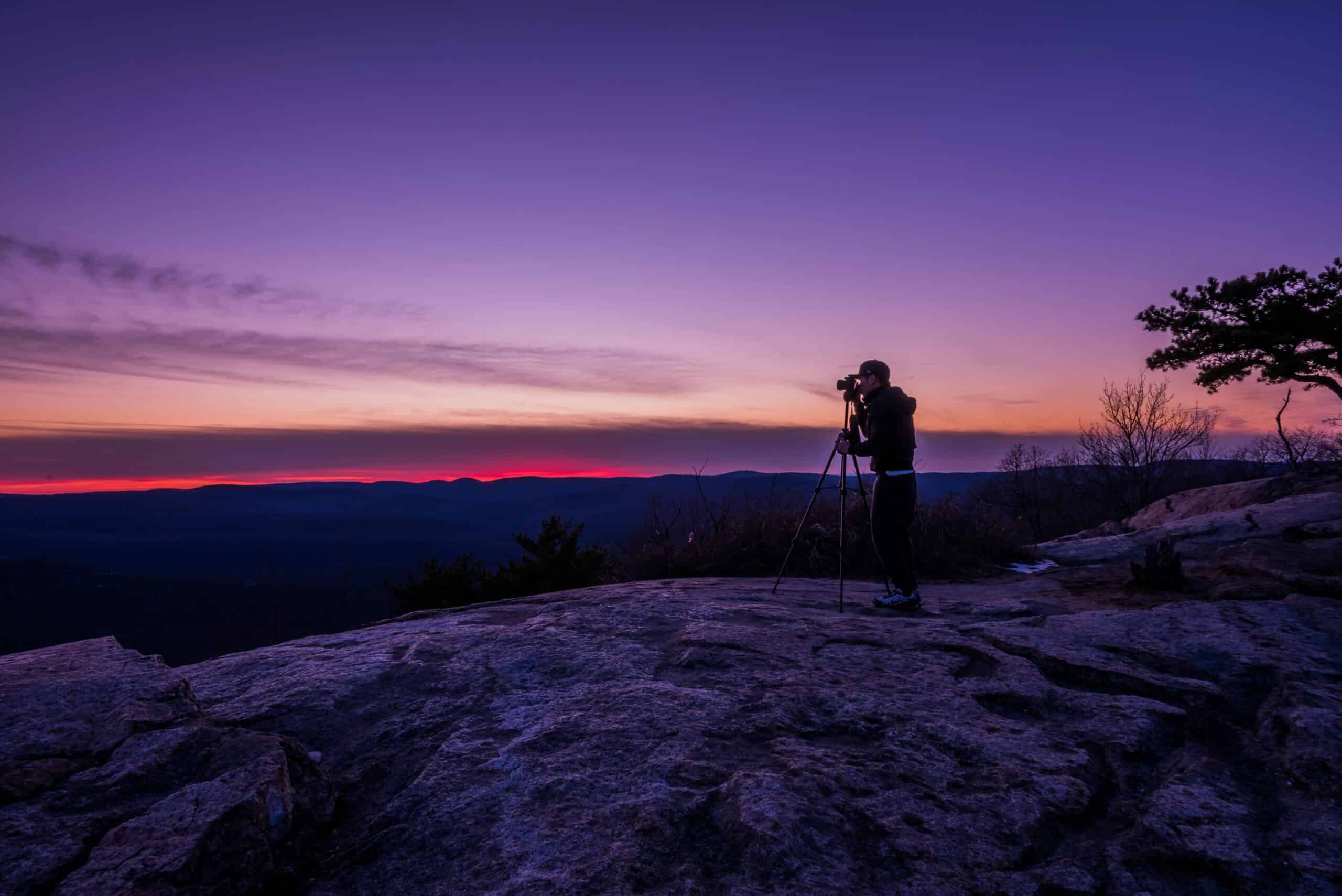
Quick Setup Overview
- Camera: Fujifilm GFX 100 II — 44×33 mm medium format, ~102MP, ~3.76 µm pixels, base ISO 80, ~14 stops DR, IBIS.
- Lens: Fujifilm XF 8–16mm f/2.8 R LM WR — rectilinear ultra-wide (X-mount APS‑C). Note: not mountable on GFX. Use on X-series (X-T5/X-H2), or use GF 20–35mm/23mm on GFX for similar coverage.
- Estimated shots & overlap (rectilinear ultra-wide, 25–35% overlap):
- On X-series at 8mm (≈12mm FF eq): 3 rows × 8 around (45° steps) + zenith + nadir ≈ 26 frames.
- On X-series at 16mm (≈24mm FF eq): 3 rows × 10 around + Z + N ≈ 32 frames.
- On GFX with GF 20–35 at 20mm (≈16mm FF eq): 3 rows × 8 around + Z + N ≈ 26 frames.
- On GFX with GF 23mm (≈18mm FF eq): 3 rows × 10 around + Z + N ≈ 32 frames.
- Difficulty: Intermediate (precise nodal calibration and consistent exposure required).
Planning & On-Site Preparation
Evaluate Shooting Environment
Survey the scene before you deploy the tripod. Watch for reflective surfaces (glass, polished floors), moving elements (people, leaves, cars), and strong light sources that may flare. If shooting through glass, place the front element close to the glass (1–2 cm) and shade it with your hand or a flexible hood to reduce internal reflections. In interiors with mixed lighting (tungsten + daylight), anticipate color shifts across the scene and plan to lock white balance.
Match Gear to Scene Goals
The GFX 100 II thrives in high dynamic range and ultra-detailed work: real estate, architecture, gigapixel landscapes. Its ISO 80–400 range is exceptionally clean, and ISO 800–1600 remains very usable for night or events if shutter speeds must rise. The XF 8–16mm on an X-series body is faster to operate and covers very tight interiors with less stepping back; you’ll simply shoot more frames for a spherical panorama compared to a fisheye lens. Rectilinear lenses minimize curvature of straight lines, which many architectural shooters prefer.
Pre-shoot Checklist
- Charge batteries; bring spares. Format large, fast cards (UHS-II/CFexpress for GFX 100 II).
- Clean the lens and sensor; smudges can multiply across stitched frames.
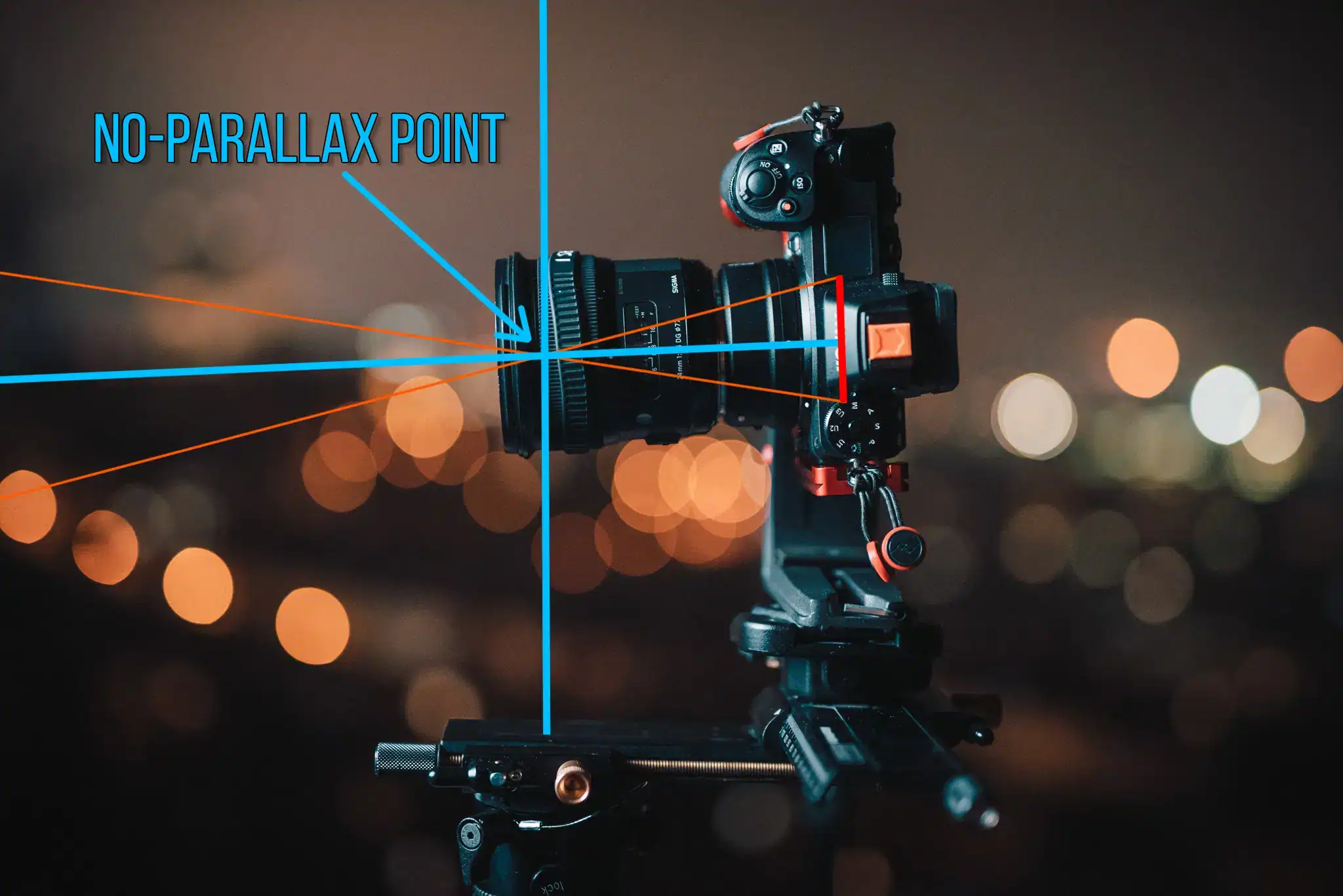
- Level the tripod using a leveling base. Calibrate the panoramic head for the lens’s no-parallax (nodal) point.
- Safety checks: if on rooftops or near traffic, tether the camera to the tripod; avoid edges and strong wind. For car mounts, use redundant straps and check vibration dampers.
- Backup workflow: after your main capture, do a quick second pass as insurance (especially the nadir and any areas with movement).
Essential Gear & Setup
Core Gear
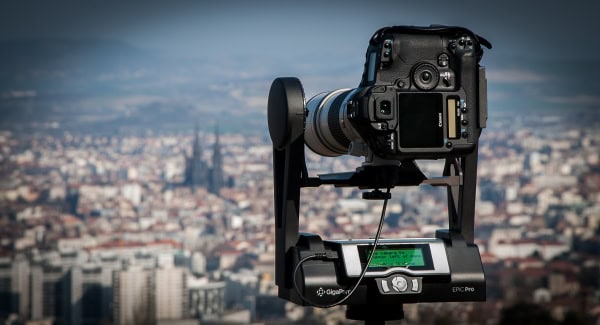
- Panoramic head: Enables rotation around the lens’s nodal point to eliminate parallax. This is critical for stitching near objects, railings, or door frames.
- Stable tripod with leveling base: A leveling base wins you speed and accuracy, keeping rows consistent and stitch-friendly.
- Remote trigger or camera app: Fire the shutter without touching the camera to avoid micro-shake, especially at slower speeds.
Optional Add-ons
- Pole or car mount: Fantastic for elevated vantage points or vehicle-based captures. Use a safety tether; be conservative in wind and avoid overhead power lines.
- Lighting aids: Small LED panels or bounced flash for interiors, used sparingly to avoid inconsistent lighting across frames.
- Weather covers: Keep rain/dust off the GFX body and the front element of the 8–16mm; water spots are hard to retouch across many frames.
Step-by-Step Shooting Guide
Standard Static Scenes
- Level and align: Level the tripod via the leveling base. Mount your panoramic head and set the lens to the previously measured nodal point. Confirm by rotating and checking that foreground and background retain alignment.
- Manual exposure and WB: Switch to M mode and fix exposure based on a mid-tone reading. Lock white balance (Daylight, Cloudy, or a Kelvin value). Disable auto-ISO. Consistency is vital, especially when blending multiple rows.
- Focus: Switch to manual focus and set to the hyperfocal distance at your working aperture (f/8 is a great starting point). Use magnified live view to confirm distant detail.
- Capture pattern:
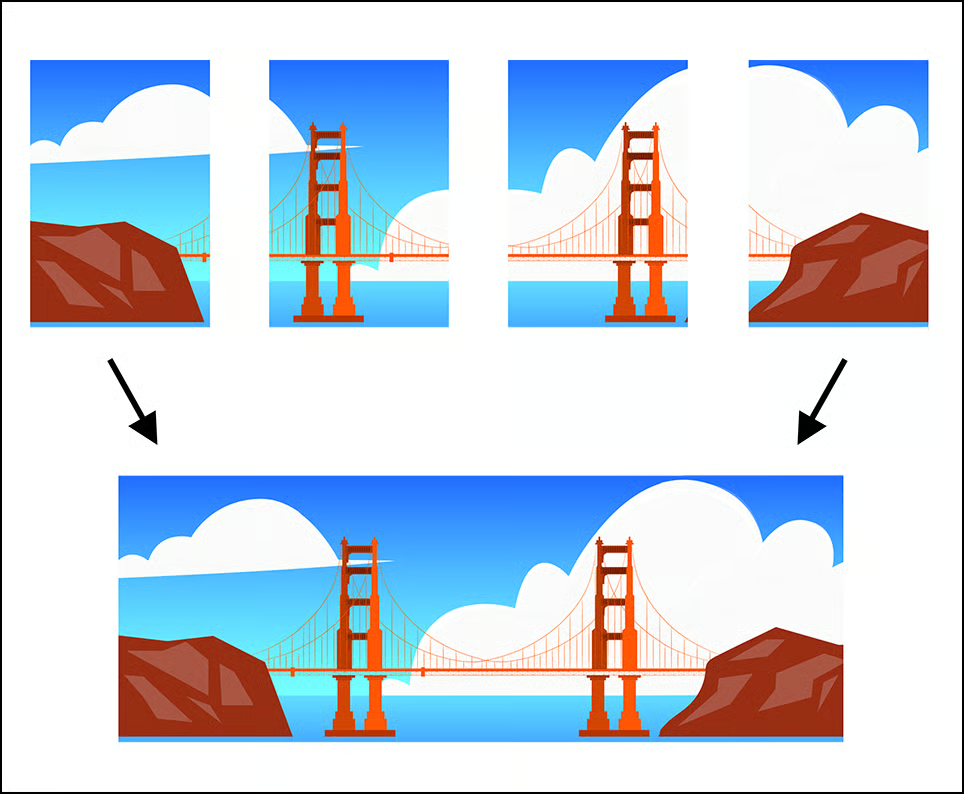
- Rectilinear ultra-wide (e.g., XF 8mm or GF ~20mm): 3 rows at +45°, 0°, −45°, 8–10 frames per row with 25–35% overlap. Add a zenith frame (tilt up) and a nadir frame (tilt down after moving the tripod slightly or using a nadir offset plate).
- Nadir shot: After finishing the rows, use a nadir offset or move the tripod slightly and capture the ground to patch the tripod later.
HDR / High Dynamic Range Interiors
- Bracket exposures: Use ±2 EV (3 or 5 frames) at each camera position to balance bright windows and interior shadows.
- Keep WB locked: Mixed lighting can shift bracket-to-bracket; a fixed WB prevents color inconsistencies across the pano.
- Sequence discipline: For every position, shoot all brackets before rotating. Name/flag bracket sets in-camera if possible.
Low-Light / Night Scenes
- Lower ISO first: On GFX 100 II, ISO 80–400 is pristine; 800–1600 remains clean with careful exposure. On X bodies, ISO 160–800 is generally safe; 1600 is workable with NR.
- Stabilize: Turn off IBIS/OIS when on a tripod to avoid micro-jitter. Use a remote or self-timer. Enable electronic front-curtain shutter to reduce vibration if available.
- Long exposures: Don’t be afraid of 1–10s exposures for static scenes. Just watch for moving cars/people that could ghost.
Crowded Events
- Two-pass method: First pass for composition and coverage, second pass patiently capturing frames with fewer people in each sector.
- Mask in post: Use masks in PTGui or Photoshop to pick the cleanest pixels where movement occurred.
- Faster shutter: Aim for 1/200s+ and ISO 400–800 to freeze motion when you can’t control foot traffic.
Special Setups (Pole / Car / Drone)
- Pole work: Keep the pole vertical; use a light, rigid carbon pole and shoot fewer but carefully overlapped frames to minimize sway artifacts. Tether the camera.
- Car mount: Use vibration-damping mounts; avoid rough roads; keep shutter speeds high (1/500s+) and shoot in short bursts between vibrations.
- Safety: Always prioritize safety on rooftops, near edges, or in traffic. A fall or collision costs more than a reshoot.
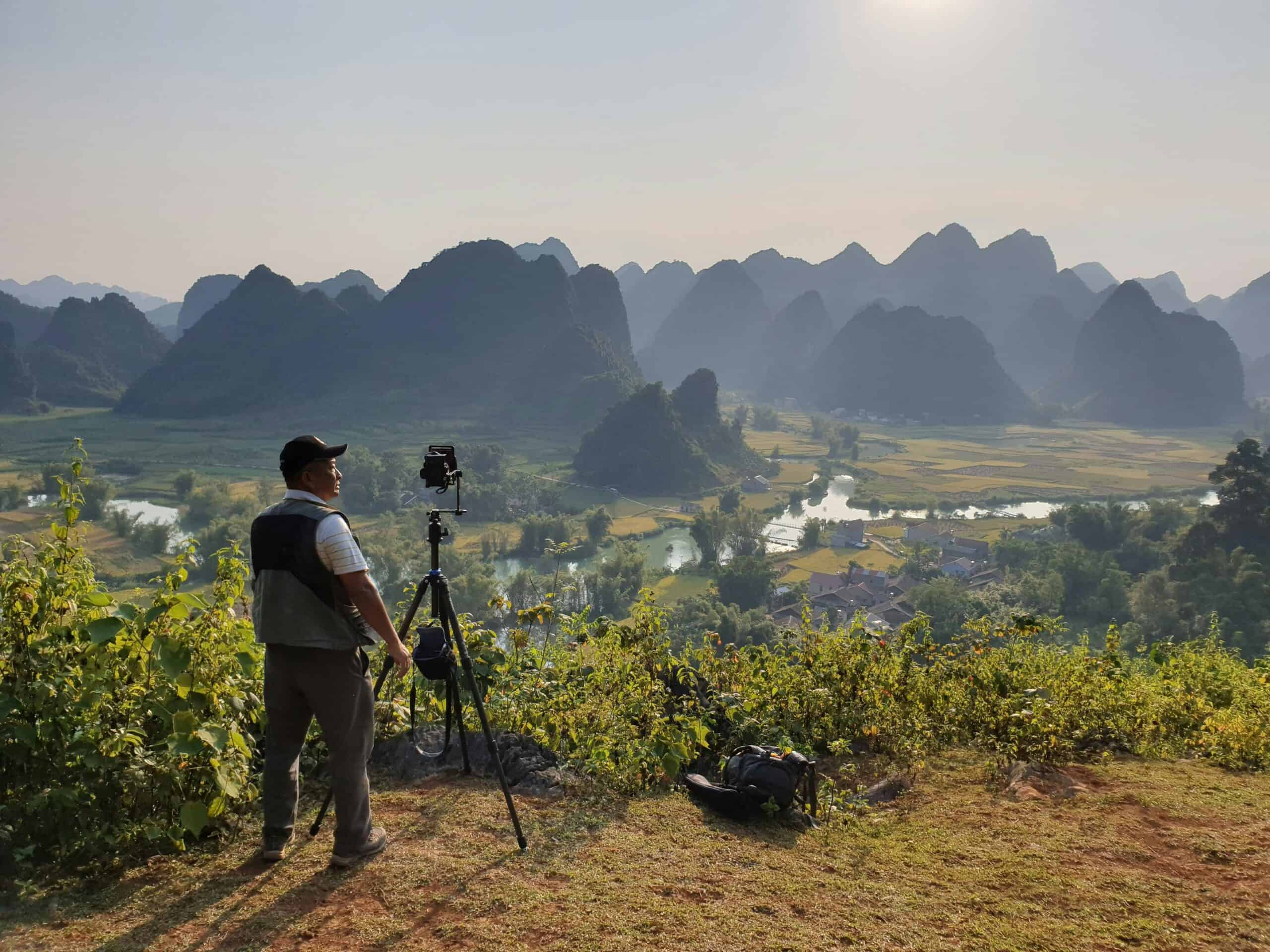
Recommended Settings & Pro Tips
Exposure & Focus
| Scenario | Aperture | Shutter | ISO | Notes |
|---|---|---|---|---|
| Daylight outdoor | f/8–f/11 | 1/100–1/250 | 80–200 (GFX), 160–200 (X) | Lock WB (Daylight/Kelvin). Shoot RAW 14/16‑bit. |
| Low light/night | f/4–f/5.6 | 1/30–1/60 (tripod) or longer | 400–800 (GFX), 400–1600 (X) | Tripod & remote; IBIS off on tripod. |
| Interior HDR | f/8 | Bracket ±2 EV (3–5 frames) | 80–400 (GFX), 160–400 (X) | Bracket every position; keep WB fixed. |
| Action / moving subjects | f/5.6–f/8 | 1/200+ | 400–800 | Freeze motion; consider two-pass capture. |
Critical Tips
- Manual focus at hyperfocal: At 12–18mm FF equivalent, f/8 focused a few meters out keeps near-to-far sharp.
- Nodal point calibration: Mount the camera on a panoramic rail. Aim at a near object against a far background, rotate left/right, and slide the camera fore/aft until relative motion vanishes. Mark the rail position for your lens.
- White balance lock: Prevents color shifts between frames, especially under mixed light. Use a Kelvin value or a manual preset.
- RAW over JPEG: The GFX 100 II’s 16‑bit RAW files preserve highlight headroom and micro-contrast—ideal for HDR and tricky interiors.
- IBIS/OIS on tripod: Turn off to avoid drift or micro-blur during long exposures.
Stitching & Post-Processing
Software Workflow
PTGui and Hugin are the workhorses for panoramic stitching. Rectilinear ultra-wides like the XF 8–16mm or GF 20–35mm stitch well if your overlap is consistent and the nodal point is correct. Industry guidelines: aim for ~25–30% overlap with ultra-wides; with longer focal lengths, 30–40% can improve control point quality. After stitching, export an equirectangular 2:1 image for VR or a rectilinear/cylindrical projection for standard panoramas. For a deep dive on why PTGui remains a top choice, see this review of PTGui in professional workflows. PTGui in professional pano workflows
Cleanup & Enhancement
- Nadir patch: Use the dedicated nadir frame to replace the tripod footprint. Many pros export a layered PSD from PTGui and patch in Photoshop, or use AI tools to remove the tripod cleanly.
- Color and noise: Sync baseline corrections across all frames before stitching if you HDR-merge first. For night panos, apply mild noise reduction after the stitch to avoid seam mismatches.
- Level horizon: Correct roll/pitch in your stitcher’s optimizer. Use vertical lines (architectural columns) to refine yaw/pitch.
- Export formats: Equirectangular JPEG/TIFF for VR platforms; high-bit-depth TIFF or PSB for retouching; tiled multi-resolution for web viewers.
Want to master panoramic head setup and perfect rotations? This tutorial is a great reference. Panoramic head fundamentals
For an overview of DSLR/mirrorless capture to VR-ready equirectangular output, Meta’s guide is concise and current. From capture to 360 photo for VR
Disclaimer: Always check your software’s latest documentation; versions change and new features (AI seam masks, zenith/nadir helpers) can significantly speed up your workflow.
Useful Tools & Resources
Software
- PTGui panorama stitching
- Hugin (open source)
- Lightroom / Photoshop for RAW and retouching
- AI tripod removal/cleanup tools
Hardware
- Panoramic heads (Nodal Ninja, Leofoto, Really Right Stuff)
- Carbon fiber tripods with leveling bases
- Wireless remotes or app control
- Pole extensions / car suction mounts with tethers
Disclaimer: brand names are examples for research; verify specs and compatibility for your specific camera and lens.
Common Mistakes & How to Avoid Them
- Parallax error: Calibrate the nodal point; avoid moving the camera between rows except for the final nadir offset.
- Exposure flicker: Always shoot in full manual with fixed ISO and WB.
- Tripod shadows: Rotate timing or reposition slightly; patch with a nadir shot if needed.
- Ghosting: For crowds or trees in wind, shoot multiple frames per sector and mask in post.
- Night noise: Keep ISO conservative and expose longer on a solid tripod; add modest NR post-stitch.
Frequently Asked Questions
- Can I shoot handheld panoramas with the GFX 100 II?
Yes for single-row panos, but for 360° or multi-row work the success rate drops due to parallax and alignment errors. Use a tripod and panoramic head for consistent, professional results.
- Is the XF 8–16mm f/2.8 wide enough for single-row 360?
Not for a full spherical 360 with rectilinear projection. At 8mm (≈12mm FF eq), you’ll typically need 3 rows (±45° and 0°) at ~8 frames per row, plus zenith and nadir, for about 26 total frames.
- Do I need HDR for interiors with bright windows?
Usually yes. Bracketing ±2 EV (3–5 frames) at each position helps hold window detail while maintaining clean interior shadows, especially with the GFX 100 II’s excellent 16‑bit headroom.
- How do I avoid parallax issues?
Calibrate and rotate around the lens’s no-parallax point. Use a panoramic rail with fore/aft adjustment. Keep near objects out of the extreme frame edges where parallax is hardest to stitch.
- What ISO range is safe on the GFX 100 II in low light?
ISO 80–400 is pristine; ISO 800–1600 is still very clean with accurate exposure. For critical commercial work, try to stay ≤800 and extend shutter on a sturdy tripod.
- Can I set up custom modes for pano?
Yes. Configure a custom mode with Manual exposure, Manual focus at hyperfocal, fixed WB, IBIS off (tripod), and self-timer/remote—then recall it on location to speed up setup.
- What’s the best tripod head for this setup?
A panoramic head with rotator detents (e.g., 45°/60°), vertical arm, and fore/aft rail for nodal alignment. Load capacity should comfortably exceed the GFX 100 II + lens weight for rigidity.
Real-World Scenarios & Field Notes
Indoor Real Estate (Tight Bathroom, Mixed Light)
Use X-series + XF 8–16mm at 8–10mm to maximize coverage. Shoot 3 rows × 8 around + Z + N (26 frames), f/8, ISO 160–400, brackets ±2 EV. Keep WB fixed (e.g., 4200–4800K). Shade any spotlights from hitting the front element to avoid flare streaks.
Outdoor Sunset (High Dynamic Range)
GFX 100 II + GF 20–35 at ~20–24mm. Shoot 3 rows × 8 around + Z + N. Base ISO 80, f/8, bracket 5 frames if the sun is in-frame. Expose to preserve highlights; GFX’s 16‑bit RAW will recover shadow detail gracefully.
Event Crowds (Moving Subjects)
Use faster shutter (1/200–1/500) and ISO 400–800. Two-pass method: first for coverage, second for cleaner sectors between foot traffic. In PTGui, mask the least crowded pixels across overlapping images.
Rooftop / Pole Capture (Wind Considerations)
Keep the pole short if wind exceeds a gentle breeze; increase overlap to 35–40% to compensate for micro-sway. Always tether the camera. Consider shooting fewer, faster frames at slightly higher ISO to beat movement.
Compatibility Notes & Recommended Alternatives
Because the XF 8–16mm f/2.8 (X-mount) does not mount on the GFX 100 II (G-mount), consider these options for a similar field of view on GFX:
- GF 20–35mm f/4 R WR (≈16–28mm FF eq): extremely sharp, weather-sealed, ideal for architecture and landscapes.
- GF 23mm f/4 R LM WR (≈18mm FF eq): prime with excellent micro-contrast and minimal distortion.
If you must use the XF 8–16mm f/2.8, pair it with an X-series body (X-T5, X-H2). The pano process is identical: careful nodal setup, consistent exposure, and reliable stitching in PTGui/Hugin. For broader pano fundamentals and body/lens choices, see this DSLR/mirrorless panorama guide. Camera/lens choices for 360 virtual tours