Why This Camera & Lens Are Great for Panoramas
The Fujifilm GFX 100 II is a medium-format mirrorless powerhouse with a 43.8 × 32.9 mm, 102 MP BSI-CMOS II sensor, superb 15-stop-class dynamic range at base ISO, and 16-bit RAW files. That combination makes it ideal for ultra-detailed 360 photos, gigapixel panoramas, and demanding HDR scenes. Its in-body image stabilization (IBIS), refined manual controls, and reliable interval/bracket features are perfect for tripod-based panoramic work. The Fujifilm XF 10–24mm f/4 OIS WR is a rectilinear, ultra-wide zoom known for sharpness by f/5.6–f/8, controlled CA, and weather sealing—excellent characteristics for panoramic stitching.
Important compatibility note: The XF 10–24mm f/4 OIS WR is an X-mount APS‑C lens and cannot be mounted on the G-mount Fujifilm GFX 100 II. The flange distance and image circle are incompatible. To achieve the same field of view on GFX, use the GF 20–35mm f/4 R WR (at 20 mm ≈ 16 mm FF equivalent). Alternatively, adapt a full-frame ultra-wide (e.g., Canon EF 16–35mm f/4) via a proper EF→GFX adapter and shoot in full sensor or 35 mm crop mode. If you specifically want to use the XF 10–24, pair it with an X-mount body (X‑T5/X‑H2). The shooting workflow in this guide applies directly to the GFX 100 II with an equivalent rectilinear UWA, and conceptually to X-mount with the XF 10–24.
Quick Setup Overview
- Camera: Fujifilm GFX 100 II — Medium format 43.8 × 32.9 mm; 102 MP; pixel pitch ~3.76 µm; superb DR at base ISO 80–100; 16‑bit RAW; IBIS up to ~8 stops (lens dependent).
- Lens: Fujifilm XF 10–24mm f/4 OIS WR — Rectilinear APS‑C UWA zoom; constant f/4; OIS; good corner performance by f/5.6–f/8; low CA. Not mountable on GFX. GFX alternatives: GF 20–35mm f/4 (at 20 mm ≈ 16 mm FF eq) or adapted FF UWA.
- Estimated shots & overlap (rectilinear UWA on GFX):
- At ~20 mm on GFX (≈16 mm FF eq): single-row 360 requires multiple rows. Field-tested: 8 around at 0°, 4 at +45°, 4 at −45°, plus zenith + nadir = 18 frames with ~30% overlap.
- At ~24 mm on GFX: 10–12 around per row; plan 3 rows + zenith + nadir = 26–36 frames.
- XF 10–24 at 10 mm on X-mount (≈15 mm FF eq): similar to the 20 mm GFX plan above (≈18 frames total).
- Difficulty: Moderate (tripod + panoramic head recommended).
Planning & On-Site Preparation
Evaluate Shooting Environment
Walk the scene and note light direction, bright specular sources (sun, streetlamps), reflective surfaces (glass, polished floors), and moving elements (people, cars, foliage). For glass viewpoints, keep the front element close—within 3–5 cm—to minimize reflections; use a rubber lens hood if possible. In busy spaces, plan for multi-pass captures to handle motion in post.
Match Gear to Scene Goals
The GFX 100 II excels when you need maximum detail, clean shadows, and flexible tonality for HDR panorama work—real estate interiors, sunset cityscapes, or night skylines. Its DR at base ISO 80–100 lets you safely bracket ±2 EV without banding or excessive noise. Rectilinear ultra-wides (like GF 20–35 at 20 mm) preserve straight lines for architecture and are easier to blend without fisheye defishing artifacts. The XF 10–24 behaves similarly on X‑mount: fewer shots at the wide end, low geometric distortion, and consistent sharpness from f/5.6–f/8.
Pre-shoot Checklist
- Charge batteries and carry spares; bring high-speed, high-capacity cards (102 MP files are large).
- Clean lens and sensor; bring a blower and microfiber cloth.
- Level tripod; verify panoramic head calibration (nodal point alignment).
- Safety: weigh down the tripod in wind; use a tether/leash on rooftops; verify car/pole mounts are rated for your load.
- Backup workflow: shoot a second safety round (especially for HDR interiors or windy exteriors) to hedge against motion/blur.
Essential Gear & Setup
Core Gear
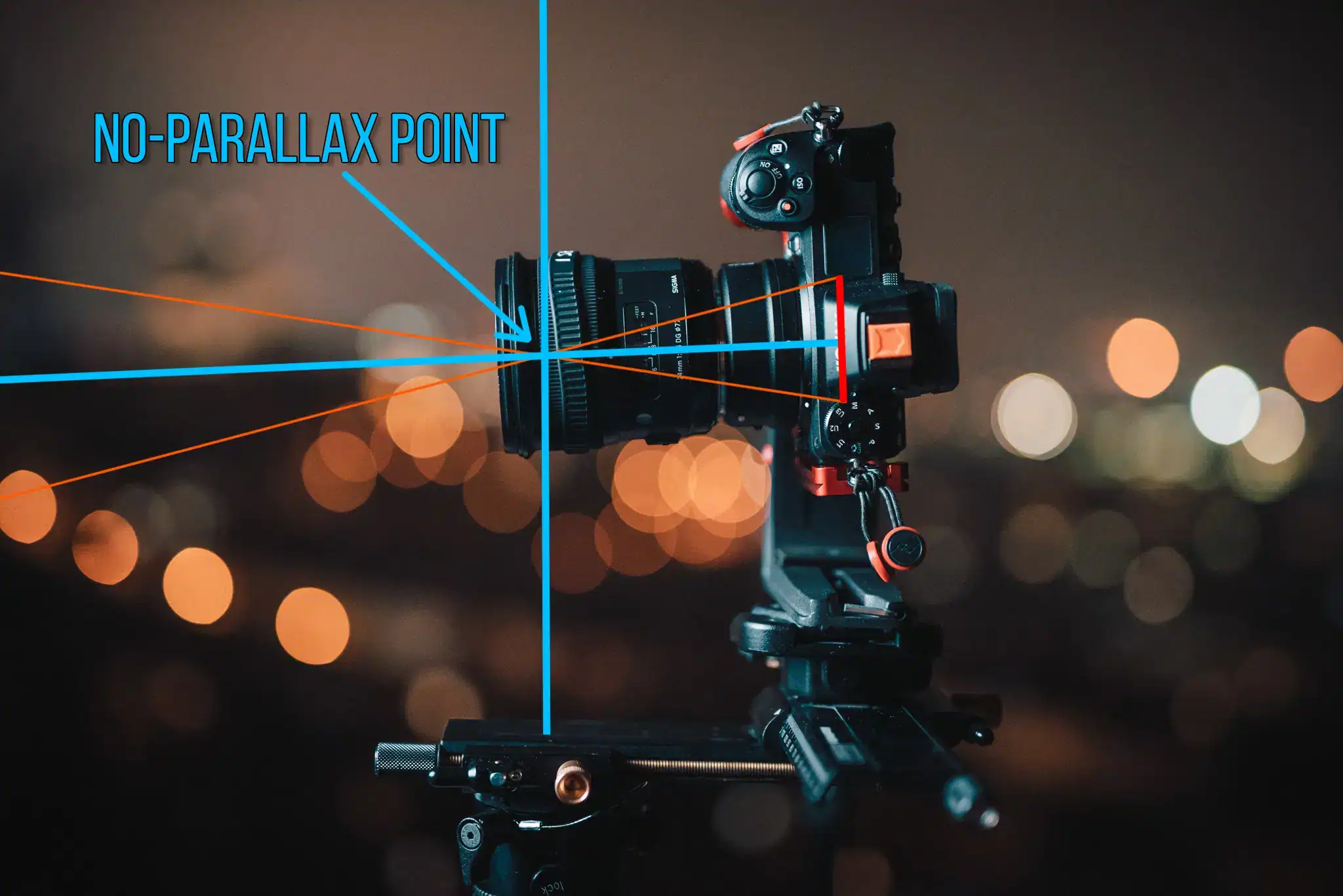
- Panoramic head: Lets you rotate the camera around the lens’s no-parallax point (entrance pupil) to eliminate parallax and ease stitching. Calibrate once and mark your rails.
- Stable tripod with leveling base: A leveling base speeds setup and keeps your rows consistent.
- Remote trigger/app: Fire via cable or the Fujifilm app to avoid vibrations and to automate bracketing.
Optional Add-ons
- Pole or car mount: Only use rated gear; add guy-lines; watch wind load and vibrations; use faster shutter speeds.
- Lighting aids: Small LEDs to balance interior shadows; keep color temperature consistent.
- Weather protection: Rain covers, lens hood, microfiber towels for mist/spray.
Step-by-Step Shooting Guide
Standard Static Scenes
- Level the tripod and align the nodal point. Place a vertical object in front and a second far away; rotate the camera. Adjust fore–aft on the panoramic rail until nearby and distant objects stop shifting relative to each other. Mark this position for your lens setting (e.g., 20 mm).
- Set manual exposure and lock white balance. Meter the average frame (not the brightest window or darkest corner). Shoot RAW; turn off auto ISO, auto WB, and auto DR. For architecture, start around f/8 for optimal sharpness.
- Capture frames with consistent overlap:
- GFX at ~20 mm (≈16 mm FF eq): 8 shots around at 0° (every 45°), 4 at +45°, 4 at −45°, plus zenith and nadir. Aim 25–35% overlap.
- GFX at ~24 mm: 10–12 around per row; similar rows at +45°/−45°; zenith+nadir.
- XF 10–24 at 10 mm on X‑mount: 8 around + 4 up + 4 down + zenith+nadir.
- Take a dedicated nadir (ground) shot for tripod removal. If your pano head supports it, offset the camera over the tripod footprint for a cleaner nadir capture.
HDR / High Dynamic Range Interiors
- Bracket ±2 EV, 3–5 exposures per angle. The GFX 100 II’s latitude handles window pulls and deep shadows with minimal noise at ISO 80–200.
- Lock WB (e.g., 4000–4500K under mixed LEDs) to avoid color shifts across brackets. Keep all brackets identical in focus and framing.
Low-Light / Night Scenes
- Use f/4–f/5.6, shutter 1–10 s (depending on wind), and ISO 100–800. The GFX 100 II remains clean to ~ISO 800–1600; for 360 panoramas prefer longer shutter over higher ISO if the scene is static.
- Turn off OIS/IBIS on a locked tripod to prevent micro-blur. Use a remote trigger and delay (2 s) to dampen vibrations.
Crowded Events
- Shoot two passes: one fast pass to capture coverage; a second pass waiting for gaps in moving crowds. Keep the pano head index marks consistent between passes.
- Mask or blend moving subjects in PTGui/Hugin to remove ghosts. If motion is strong, raise shutter to 1/200–1/500 and ISO 400–1600, accepting minor noise over blur.
Special Setups (Pole / Car / Drone)
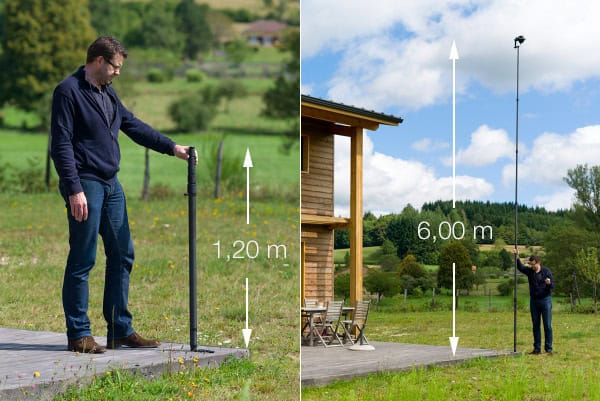
- Secure all gear with tethers, check load ratings, and reduce sail area. On poles, rotate more slowly and use faster shutter speeds (≥1/250) to tame flex-induced blur.
- For car mounts, choose smooth roads, damp vibrations, and shoot short exposures. Always prioritize safety over the shot.
Recommended Settings & Pro Tips
Exposure & Focus
| Scenario | Aperture | Shutter | ISO | Notes |
|---|---|---|---|---|
| Daylight outdoor | f/8–f/11 | 1/100–1/250 | 80–200 | Lock WB (daylight); avoid clipping highlights |
| Low light/night | f/4–f/5.6 | 1/30–10 s | 100–800 | Tripod, remote; turn OIS/IBIS off on tripod |
| Interior HDR | f/8 | Bracket ±2 EV | 80–400 | 3–5 frames per angle; keep WB fixed |
| Action / moving subjects | f/5.6–f/8 | 1/200+ | 400–1600 | Freeze motion; double-pass method |
Critical Tips
- Manual focus at or near the hyperfocal distance. At ~20 mm on GFX, f/8, setting focus around 1.5–2 m keeps most of the scene sharp to infinity.
- Nodal point calibration: With your chosen focal length, align the entrance pupil once and mark your rail. Recheck if you change zoom or focus distance on a rectilinear zoom.
- White balance lock: Prevents color banding and patchwork skies. Set WB to a fixed Kelvin that matches the scene.
- RAW over JPEG: 16‑bit RAW from GFX gives headroom for HDR blending, color grading, and de-noising.
- Stabilization on a tripod: Disable IBIS and lens OIS to avoid drift. Re-enable IBIS/OIS for handheld scouting frames.
Stitching & Post-Processing
Software Workflow
Import and cull in Lightroom or Capture One. If doing HDR, merge brackets per angle first (Lightroom HDR or exposure fusion in PTGui). Stitch with PTGui for advanced control points, masking, and exposure fusion, or Hugin for an open-source solution. Rectilinear ultra-wides need more frames than fisheyes but produce straighter lines—expect ~20–30% overlap per frame. Export an equirectangular 2:1 master (e.g., 16000×8000 px) for VR or virtual tour platforms. For a deep dive on panoramic heads and technique, see this panoramic head tutorial by 360 Rumors.
Panoramic head calibration and usage guide (360 Rumors)
PTGui remains a gold standard for pro stitching and masking, especially for multi-row rectilinear sets and HDR interiors. Fstoppers’ review outlines why PTGui is favored for complex work.
Why PTGui excels for complex panorama stitching (Fstoppers)
Cleanup & Enhancement
- Nadir patch: Shoot a clean ground plate and patch with Photoshop; or use AI tripod removal tools.
- Color and noise: Normalize WB across rows, apply selective noise reduction for night frames, and correct any local casts.
- Leveling: Use pitch/roll/yaw controls in PTGui/Hugin to level horizons and straighten architecture.
- Export: Save a 16‑bit TIFF master and a high-quality JPEG for web. For VR, keep the 2:1 ratio and embed proper metadata.
For platform-ready tips (file sizes, metadata, and export), consult Meta’s DSLR/mirrorless 360 photo guidelines.
DSLR/mirrorless 360 photo workflow (Meta Creator)
Useful Tools & Resources
Software
- PTGui panorama stitching
- Hugin (open source)
- Lightroom / Photoshop (HDR, cleanup, color)
- AI tripod removal or content-aware fill tools
Hardware
- Panoramic heads (Nodal Ninja, Leofoto) with fore–aft rails
- Carbon fiber tripod + leveling base
- Wireless remote shutter or intervalometer
- Pole extensions / car suction mounts (rated, with safety tethers)
Disclaimer: Brand names are examples for search; confirm specs and compatibility on official sites.
Common Mistakes & How to Avoid Them
- Parallax error → Calibrate the nodal point for your focal length and focus distance; don’t change zoom mid‑shoot.
- Exposure flicker → Use full manual exposure, fixed ISO, and locked WB.
- Tripod shadows or footprints → Capture a dedicated nadir and patch cleanly in post.
- Ghosting from moving subjects → Shoot two passes and use masks in PTGui/Hugin.
- Night noise → Prefer longer shutter over high ISO on a tripod; keep ISO ≤800 where possible on GFX 100 II for super-clean results.
- Stabilization drift → Disable IBIS/OIS on a locked tripod.
Frequently Asked Questions
- Can I shoot handheld panoramas with the Fujifilm GFX 100 II?
For simple single-row stitches, yes—IBIS helps—but for 360×180 spheres, handheld is risky. Use a tripod and panoramic head for consistent overlap, nodal alignment, and easier stitching. Handheld multi-row sets often suffer parallax and misalignment.
- Is the Fujifilm XF 10–24mm f/4 OIS WR wide enough for a single-row 360?
On an X‑mount APS‑C body at 10 mm (≈15 mm FF eq), you’ll still need multi-row capture for a full 360×180. Expect 8 around, plus an upper and lower row, plus zenith and nadir. On GFX, use an equivalent UWA (e.g., GF 20–35 at 20 mm) and plan on multi-row as outlined.
- Do I need HDR for interiors with bright windows?
Usually. Bracket ±2 EV (3–5 frames) to retain highlights outside and shadow detail inside. The GFX 100 II’s dynamic range gives you cleaner merges with less noise and banding.
- How do I avoid parallax issues?
Mount the camera on a panoramic head and align the rotation axis to the lens’s entrance pupil (no‑parallax point). Calibrate at your working focal length and focus distance. Recalibrate if you change zoom on a rectilinear lens.
- What ISO range is safe on the GFX 100 II in low light?
For tripod-based panoramas, aim for ISO 80–400. Up to ISO ~800 remains very clean; ISO 1600 is usable with mild noise reduction. Prefer longer exposure over higher ISO for static scenes.
- Can I set Custom Shooting Modes for faster pano work?
Yes. Save a “Pano” custom set with Manual exposure, fixed ISO, manual WB, single-shot or bracket mode, RAW+JPEG, IBIS off (tripod), and a 2 s self-timer. This reduces setup time and prevents missed settings.
- Should I turn off stabilization on a tripod?
Yes. Disable IBIS and lens OIS for tripod captures to avoid correction drift. Re-enable when shooting handheld scouting frames.
- What’s the best tripod head for this setup?
A two-rail panoramic head (e.g., Nodal Ninja, Leofoto) with precise fore–aft and lateral adjustment. Ensure it supports the weight of the GFX and chosen lens. A leveling base will speed up deployment.
Field-Proven Scenarios
Indoor Real Estate
Use GFX 100 II at ISO 80–200, f/8, multi-row with ±2 EV bracketing. Lock WB to a known Kelvin to avoid color shifts under mixed lighting. Shoot two complete rounds to protect against people walking through frames. PTGui’s exposure fusion plus manual masks will handle windows and light fixtures cleanly.
Outdoor Sunset Cityscape
Expose for mid-tones at base ISO and bracket for highlights. Work quickly during changing light; start with sky frames first to avoid clipped highlights and then wrap the lower rows. Use 25–30% overlap and verify histogram for each bracket set.
Event Crowds
Increase shutter speed to ≥1/200 and ISO to 400–1600 as needed. Capture a fast coverage pass, then a second pass waiting for gaps. In PTGui, mark one pass as “primary” and use masks to suppress ghosts from the other pass.
Rooftop or Pole Capture
Tether the camera. Add counterweights to reduce sway. Use 1/250–1/500 to freeze pole flex or wind movement, accepting a slightly higher ISO. Plan fewer, faster frames by increasing overlap but keeping rows minimal—cleaner is better than maximal resolution when stability is marginal.
For fundamentals on focal length choices and panorama geometry, this explainer from B&H is a helpful reference.
Panoramas, focal lengths, and stitching basics (B&H Explora)
About Using the Fujifilm GFX 100 II & Fujifilm XF 10–24mm f/4 OIS WR Together
While this guide repeatedly mentions how to shoot panorama with Fujifilm GFX 100 II & Fujifilm XF 10–24mm f/4 OIS WR, the two are not physically compatible. The XF lens is for X‑mount APS‑C bodies; it cannot be adapted to GFX with infinity focus and does not cover the 44×33 mm sensor area. To achieve equivalent results on GFX, use the GF 20–35mm f/4 (at 20 mm) or an adapted full-frame ultra-wide via a suitable adapter. If you specifically want the XF 10–24 mm look, pair it with an X‑series body (e.g., X‑T5) and follow the same multi-row capture, overlap, and stitching workflow described above.
Safety, Care, and Data Integrity
- Wind and edges: Use a weighted tripod and a safety tether—especially on rooftops and cliffs.
- Weather sealing: The GFX body and GF lenses are weather resistant; wipe off spray promptly and keep silica packs in your bag.
- Data redundancy: Shoot dual card slots if available; after the session, back up to two locations (external SSD + cloud).
- Workflow redundancy: For critical scenes, capture a second full pano round as insurance against misfires or unexpected motion.
For broader DSLR/mirrorless 360 photo capture guidance that aligns with platform requirements, see Meta Creator’s documentation linked above. For a curated camera/lens overview relevant to virtual tours, also see this DSLR/virtual tour FAQ from 360 Rumors.
DSLR/virtual tour camera & lens guide (360 Rumors)
Key Takeaways
- Use a panoramic head and align the entrance pupil to eliminate parallax.
- Shoot manual exposure, manual WB, and consistent overlap; plan multi‑row for rectilinear UWA.
- On GFX with ~20 mm, expect ~18 total frames (8 around + 4 up + 4 down + zenith + nadir).
- HDR brackets of ±2 EV tame interiors and sunset transitions.
- Turn off IBIS/OIS on a tripod; use a remote or timer to prevent vibration.
- Stitch with PTGui/Hugin; export a 2:1 equirectangular master for VR and virtual tours.