
Why This Camera & Lens Are Great for Panoramas
The Fujifilm GFX 100 II is a powerhouse for panoramic and 360° imaging: its 43.8 × 32.9 mm “large format” sensor delivers 102 MP RAW files (16-bit), superb base ISO dynamic range (~15 stops at ISO 80–100), and excellent tonal latitude for sky and interior window recovery. The pixel pitch is approximately 3.76 μm, giving crisp detail when you stitch multiple frames into gigapixel panoramas. In-body image stabilization (IBIS) rated up to ~8 stops helps with handheld tests and windy conditions—but for tripod work, you’ll typically disable it to avoid micro-blur.
The Canon RF 14–35mm f/4L IS USM is a rectilinear ultra-wide zoom with very good sharpness stopped down (f/5.6–f/8), minimal lateral CA after profile correction, and a useful zoom range for multi-row panoramas. Important compatibility note: this lens is not natively compatible with Fujifilm G-mount. As of 2025 there is no widely available RF→GFX electronic adapter that supports aperture/AF control. Even if adapted, the RF 14–35mm’s full-frame image circle will not cover the 44×33 mm sensor—so the camera must be used in 35mm crop mode (about 60 MP) to avoid extreme vignetting. Many GFX pano shooters therefore use native GF ultra-wides (e.g., GF 20–35mm f/4) or adapted EF lenses via smart EF→GFX adapters. For this guide, we’ll explain the workflow as if you’re using a rectilinear ultra-wide zoom comparable to the RF 14–35 on the GFX 100 II, with honest notes on limitations and workarounds.
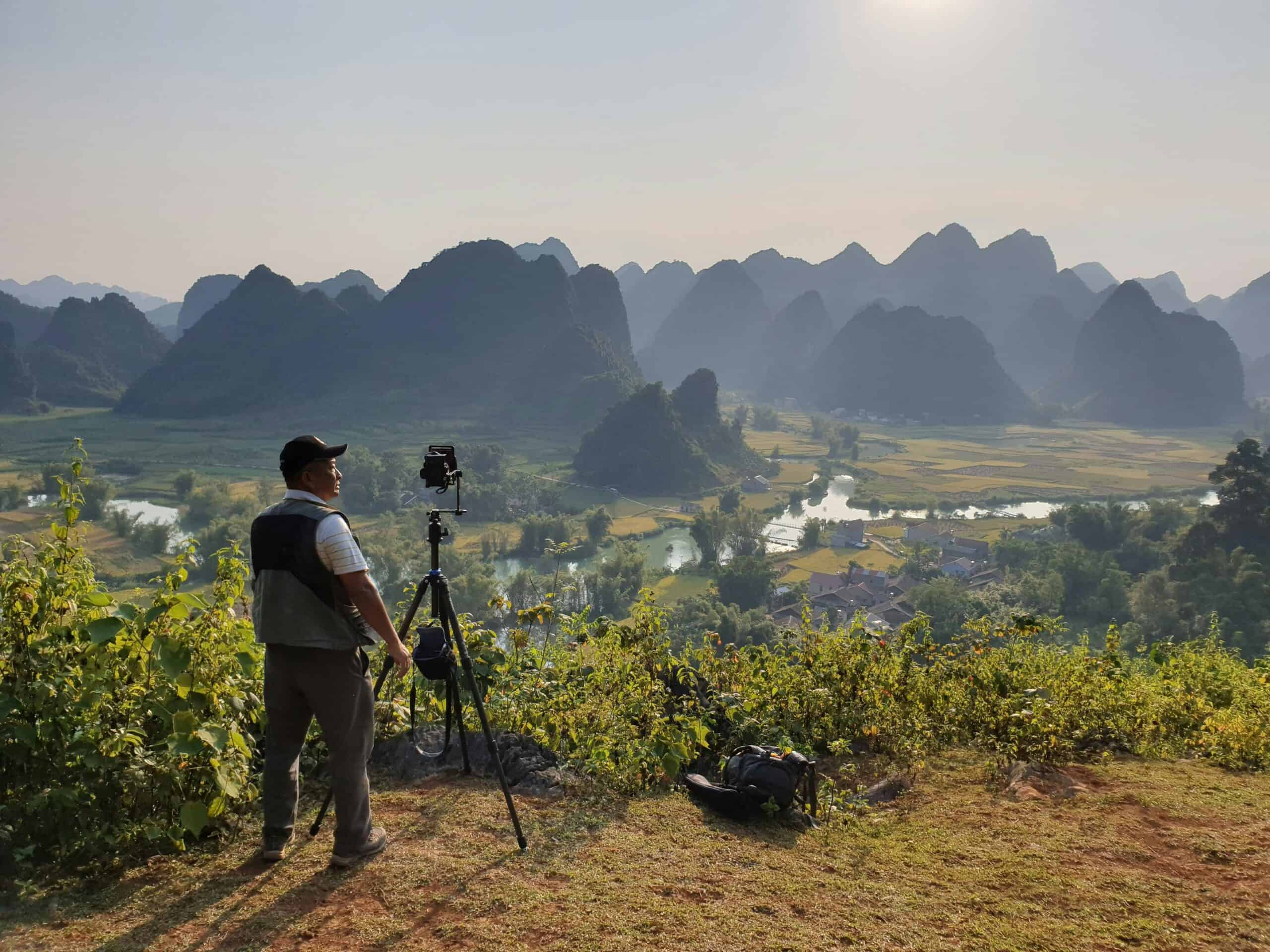
Quick Setup Overview
- Camera: Fujifilm GFX 100 II — 43.8 × 32.9 mm sensor, 102 MP (approx. 60 MP in 35mm crop mode), 16-bit RAW, excellent dynamic range at base ISO 80–100, strong IBIS.
- Lens: Canon RF 14–35mm f/4L IS USM — rectilinear ultra-wide zoom, best at f/5.6–f/8; good CA control with profiles; note: no native RF→GFX electronic adapter as of 2025; coverage limited to 35mm crop mode if adaptation were possible.
- Estimated shots & overlap (rectilinear UWA on 35mm crop):
- At ~14mm (FF-equivalent): 3 rows × 8 shots per row (45° yaw steps) + 1 zenith + 1–2 nadir patch.
- At ~20mm: 3 rows × 10 shots per row + zenith + nadir.
- At ~35mm: 3 rows × 16 shots per row + zenith + nadir (very high detail, more time on site).
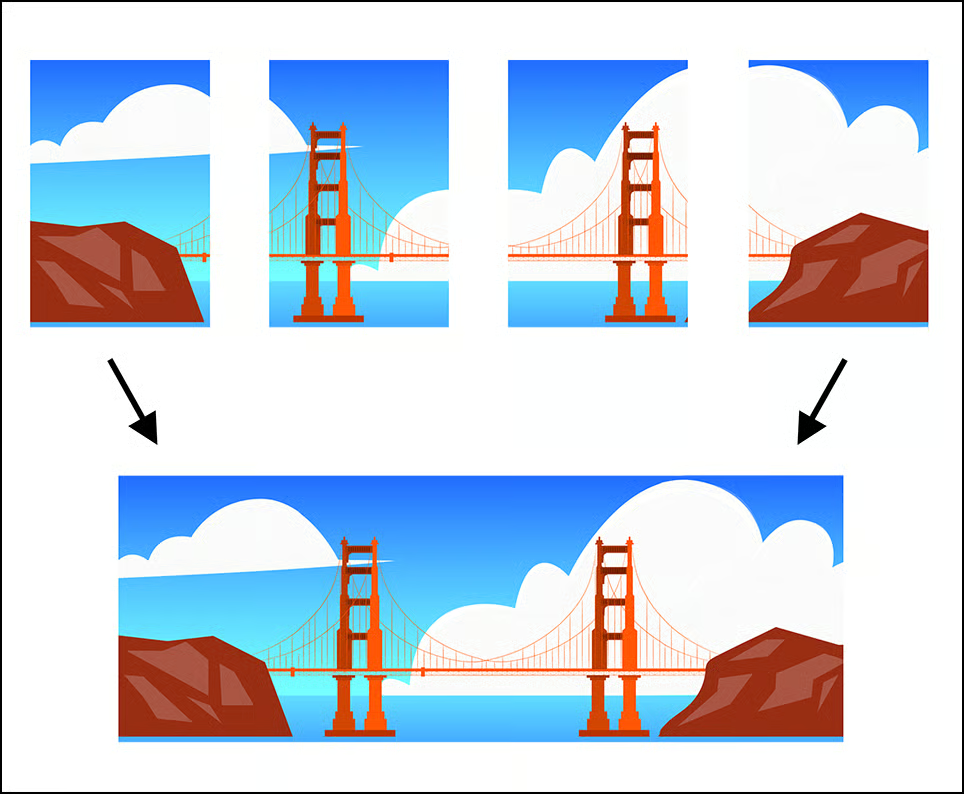
- Overlap: ~30% horiz/vert for robust stitching.
- Difficulty: Intermediate (requires nodal calibration and multi-row shooting).
Planning & On-Site Preparation
Evaluate Shooting Environment
Walk the scene first. Note light direction, reflective surfaces (glass, polished floors), moving subjects, and wind exposure. In interiors with glass, keep the front element close to the glass (1–2 cm) at a slight angle to minimize reflections and ghosting. For sunsets or night skylines, check where strong point lights may cause flare; plan your multi-row order to minimize exposure changes across the panorama.
Match Gear to Scene Goals
The GFX 100 II shines in high dynamic range scenes and massive output size—ideal for real estate, fine art wall prints, and gigapixel cityscapes. Its base ISO dynamic range is excellent; indoors, ISO 200–800 stays very clean on a tripod. The RF 14–35mm f/4L (or a comparable rectilinear UWA on GFX) helps maintain straight lines—preferred for architecture—at the cost of more shots than a fisheye. If you must shoot fast with fewer frames (e.g., crowds), consider a fisheye alternative; if precision and straight lines matter most, a rectilinear ultra-wide is the correct choice.
Pre-shoot Checklist
- Charge batteries, carry spares; use fast, redundant storage (dual cards).
- Clean lens and sensor; a single dust spot will repeat across the stitch.
- Level tripod and calibrate your panoramic head’s nodal alignment.
- Safety: verify wind and structure stability for rooftops/poles; use tethers and sandbags.
- Backup: shoot an extra safety pass and a full bracket set for critical scenes.
Essential Gear & Setup
Core Gear
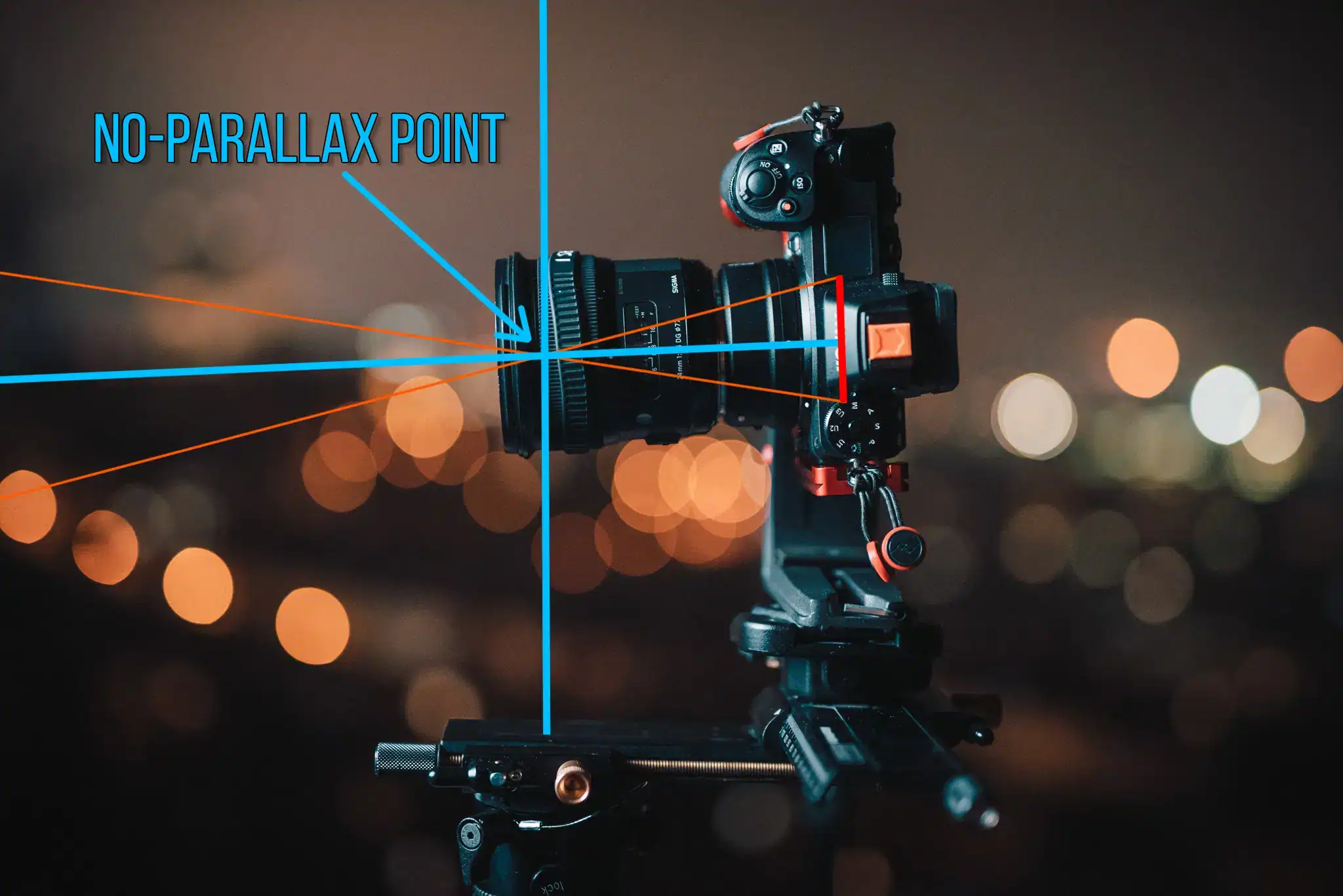
- Panoramic head with nodal (entrance pupil) adjustment: This removes parallax by placing the lens’ entrance pupil over the yaw axis. Without it, close objects won’t align in the stitch.
- Stable tripod with a leveling base: Leveling the base keeps each row parallel, simplifying stitching and reducing seam stress.
- Remote trigger or app: Use a 0–2 s shutter delay or remote release to stop vibrations, especially at 1/10–1/2 s shutter speeds where shutter shock can occur.
Optional Add-ons
- Pole or car mount: Always tether your camera, avoid high winds, and plan slow rotations to reduce blur. Consider a pole with guy lines.
- Lighting aids: Constant LED or off-camera flash for interiors; flag windows to reduce hotspots.
- Weather protection: Rain covers, microfiber cloths, and silica packs for condensation management.
Step-by-Step Shooting Guide
Standard Static Scenes
- Level and align nodal point: On the panoramic head, point the lens at two vertical objects (one near, one far). Rotate the yaw 30–45°. Slide the rail fore/aft until the relative position of the two objects doesn’t shift. Mark this position for your focal lengths. With ultra-wides, the entrance pupil is typically forward of the aperture, often near the front element—expect ~55–75 mm from the sensor plane as a starting estimate.
- Manual exposure & white balance: Set M mode, lock shutter/aperture/ISO. Lock WB (Daylight/Tungsten/Custom) to avoid color shifts between frames. Shoot RAW.
- Capture with tested overlap:
- 14mm: Three rows at -45°, 0°, +45°, 8 shots per row (45° yaw steps), then 1 zenith and 1–2 nadir patch frames.
- 20mm: Three rows, 10 shots per row (36° steps), plus zenith/nadir.
- 35mm: Three rows, 16 shots per row (22.5° steps), plus zenith/nadir for maximal detail.
- Nadir capture: Tilt down for a clean ground frame after moving the tripod slightly or use a hand-held nadir patch. This makes tripod removal in post simpler.
HDR / High Dynamic Range Interiors
- Bracket ±2 EV (3–5 frames): Protect both window highlights and deep shadows. The GFX 100 II’s 16-bit files handle aggressive recovery at base ISO, but bracketing gives cleaner results and fewer stitching artifacts.
- Lock WB and focus: Keep consistency across brackets and frames. Use exposure delay or remote to prevent movement between brackets.
Low-Light / Night Scenes
- Use a stable mount and longer exposures: Prefer ISO 80–200 at f/5.6–f/8, letting shutter extend as needed. If you must raise ISO, ISO 400–800 is generally clean; ISO 1600 is usable with careful noise reduction.
- Disable IBIS on tripod to avoid micro-movements; use 2 s delay or remote. Consider EFCS to reduce shutter shock for 1/60–1 s exposures.
Crowded Events
- Two passes: First for base alignment; second for “clean plates” when gaps appear. You’ll mask in post to remove overlaps of moving subjects.
- Use faster shutter (1/200 s+) and ISO 400–800 at f/5.6–f/8 to freeze motion, especially in the central row.
Special Setups (Pole / Car / Drone)
- Secure gear & tether: Use a safety line and check all clamps. Wind forces are amplified on poles; avoid gusts and keep the camera’s rotation slow and deliberate.
- Vibration management: On vehicles, add vibration damping and shoot at higher shutter speeds; plan your yaw steps while stationary to avoid smear.
Recommended Settings & Pro Tips
Exposure & Focus
| Scenario | Aperture | Shutter | ISO | Notes |
|---|---|---|---|---|
| Daylight outdoor | f/8–f/11 | 1/100–1/250 | 80–200 | Lock WB (Daylight); disable IBIS on tripod |
| Low light/night | f/4–f/5.6 | 1/30–several s | 200–800 | Remote release, EFCS; prefer low ISO for DR |
| Interior HDR | f/8 | Bracket ±2 EV | 80–400 | Protect windows; keep WB fixed |
| Action / moving subjects | f/5.6–f/8 | 1/200+ | 400–800 | Double pass; mask in post |
Critical Tips
- Manual focus at the hyperfocal distance: For 14–20mm at f/8 on 35mm crop, focusing ~1 m–1.5 m keeps most of the scene sharp. Use magnified live view to confirm.
- Nodal calibration: Mark the rail position for 14, 20, and 35mm to switch quickly. Ultra-wides often need fine fore/aft tweaks to eliminate residual parallax.
- White balance lock: Mixed lighting will stitch poorly if WB varies. Shoot RAW and set a custom WB where possible.
- RAW over JPEG: The GFX 100 II’s 16-bit RAW retains highlight detail and smooth gradients—ideal for skies and interior HDR blends.
- IBIS/IS: Turn off IBIS and lens IS on tripod. For handheld test mosaics, stabilization helps, but keep shutter speeds high and overlap generous.
For deeper fundamentals on pano technique and planning, see this panoramic head setup guide and video resources at the end of this article.
Stitching & Post-Processing
Software Workflow
Import and pre-process RAWs in Lightroom or Capture One: apply consistent lens profile, remove chromatic aberration, and equalize exposure if needed. Export 16-bit TIFFs to a dedicated stitcher. PTGui is a mature standard for spherical panos with powerful control-point editing, masking, HDR fusion, and viewpoint correction; Hugin is a capable open-source alternative. Rectilinear lenses typically need 20–30% overlap and careful nodal alignment; fisheyes can use 25–30% overlap and fewer frames, but require de-fishing and careful edge management. After stitching to an equirectangular projection, round-trip back to Photoshop/Affinity for retouching. Read a practical PTGui review for tips on complex stitches.
Cleanup & Enhancement
- Nadir patch: Use PTGui’s Viewpoint Correction or patch the tripod area in Photoshop. AI-based content-aware tools can speed this up.
- Color/Noise: Balance color casts, apply mild noise reduction on shadow rows, and use selective sharpening—avoid over-sharpening sky seams.
- Horizon leveling: Re-set pitch/roll in the stitcher; use gridlines to align architectural features.
- Export: For VR platforms, export 16k–32k equirectangular JPEG/TIFF depending on use; retain layered source files for future edits.
For a thorough primer on panoramic head usage and shooting-to-stitch workflow, see this practical tutorial. Panoramic head tutorial (360 Rumors)
Useful Tools & Resources
Software
- PTGui (stitching, masking, HDR integration)
- Hugin (open-source stitching)
- Lightroom / Photoshop / Affinity Photo (RAW and retouching)
- AI nadir removal and object removal tools
Hardware
- Panoramic heads: Nodal Ninja, Leofoto, and similar modular rails
- Carbon fiber tripod with leveling base
- Wireless remote shutter or app control
- Pole extensions and car mounts with safety tethers
Disclaimer: product names are for reference; check official sites for compatibility and current specs. For a broader overview of DSLR/mirrorless 360 shooting and stitching, the Meta/Oculus creator docs are a solid reference: set up a panoramic head to shoot high-end 360 photos and using a mirrorless camera to shoot and stitch a 360 photo.
Common Mistakes & How to Avoid Them
- Parallax error: Calibrate the entrance pupil for your focal length; re-check after zoom changes.
- Exposure flicker: Shoot full manual; lock WB and ISO; avoid auto-ISO.
- Tripod shadows or feet in frame: Plan sun angle; shoot a nadir patch afterward.
- Ghosting from motion: Do a second pass and mask in the stitcher; shoot faster shutter speeds for crowd rows.
- Night noise and color shifts: Keep ISO low and exposures long on tripod; apply consistent color correction across the set.
Frequently Asked Questions
- Can I shoot handheld panoramas with the GFX 100 II?
Yes for simple mosaics, but for 360° with multi-rows you’ll get better results on a tripod with a panoramic head. If you must go handheld, use 1/250 s+ shutter, IBIS on, generous overlap (40–50%), and expect more cleanup in post.
- Is the Canon RF 14–35mm f/4L wide enough for single-row 360?
For a full spherical 360 with a rectilinear UWA, single-row is rarely sufficient. At ~14mm you typically need 3 rows (−45°, 0°, +45°) plus zenith/nadir to cover poles and ground cleanly. Fisheye lenses can achieve single-row 360s but with more distortion and different stitching needs.
- Do I need HDR for interiors with bright windows?
Usually, yes. Even with the GFX 100 II’s excellent DR, bracketing ±2 EV (3–5 frames) yields cleaner window detail and less noise in shadows. Merge HDRs per angle before stitching, or use PTGui’s built-in HDR fusion.
- How do I avoid parallax issues with this setup?
Use a panoramic head and align the entrance pupil for your chosen focal length. Re-calibrate if you zoom. Keep near objects from touching the frame edges where overlap is critical. A tutorial with visual examples helps a lot. See a panoramic head alignment guide
- What ISO range is safe on the GFX 100 II in low light?
On tripod, prefer ISO 80–200 with longer shutter to preserve DR. If motion demands faster speeds, ISO 400–800 stays very clean; ISO 1600 is workable with careful noise reduction. Always check histograms and expose to protect highlights.
- Can I set up custom modes for panoramas?
Yes. Save a pano preset with M mode, WB locked, IBIS off (tripod), 2 s delay, and your typical aperture/ISO. A second preset can store HDR bracketing and 0 s delay for remote triggering—faster and consistent on-site.
- What about lens compatibility—can I really use the RF 14–35 on GFX?
Practically speaking, not without a specialized adapter that supports electronic aperture and AF—none widely available as of 2025. Also, the RF lens’ image circle won’t cover 44×33 mm. If adapted, you’d use 35mm crop (~60 MP). Consider a native GF 20–35mm f/4 or an EF ultra-wide with an EF→GFX smart adapter for a reliable workflow.
- Which tripod head works best?
A two-rail panoramic head (e.g., Nodal Ninja, Leofoto) that allows fore/aft and vertical adjustments. Look for positive click stops, a leveling base, and an Arca-compatible system for fast, repeatable setup.
Real-World Case Studies
Indoor Real Estate (Windows + Mixed Lighting)
Set the GFX 100 II to ISO 80–200, f/8, and bracket ±2 EV at each angle. Use a three-row capture at ~14–20mm with 30% overlap. Keep WB fixed (Tungsten or Custom). In PTGui, fuse HDRs per angle or pre-merge in Lightroom. Mask any blown window areas using the darker bracket, then patch the nadir. Expect a final 16k–24k equirectangular export with clean window detail and low shadow noise. For standards and planning tips, see panoramic head setup references in this article. Using a mirrorless camera to shoot and stitch a 360 photo
Outdoor Sunset Cityscape
Shoot quickly around blue hour transitions: lock exposure slightly under for highlights (−0.3 to −0.7 EV). Use f/8, ISO 100–200, and longer shutter times. Capture order: zenith, upper row, middle, lower, then nadir to keep sky color consistent across rows. In post, equalize sky gradient and verify horizon leveling before export.
Event Crowds
At ~20–24mm, shoot a fast first pass at 1/200 s, ISO 400–800, then a second pass waiting for gaps. In PTGui, use the masking tool to prioritize cleaner frames where people align. This reduces double limbs and ghosting on seams.
Rooftop on a Pole
Wind is the big risk. Keep the center of gravity low and tether the pole. Use faster shutter speeds (1/250–1/500 s) and ISO 400–800 to fight vibration. Rotate slowly and avoid stopping mid-row. Do a safety second pass. Never operate near power lines or roof edges without proper safety lines and an assistant.
Compatibility, Limitations & Honest Workarounds
The Canon RF 14–35mm f/4L IS USM is not natively usable on the Fujifilm GFX 100 II due to mount electronics and image circle coverage. If future adapters appear, you’ll still need 35mm crop mode (~60 MP). For a seamless experience today, use:
- Native GF 20–35mm f/4 R WR (rectilinear ultra-wide, weather-sealed)
- Adapted Canon EF ultra-wides via a smart EF→GFX adapter (with aperture control)
- Fisheye alternative if you need fewer shots (accepting distortion and different stitching needs)
The techniques in this guide apply to any rectilinear ultra-wide on GFX. For additional field-proven tips, this panorama Q&A is a worthwhile read. Best techniques to take 360 panoramas
Safety & Backup Workflow
High-resolution multi-row panos mean time on site and sensitive gear in public places. Always tether on rooftops and poles, weigh down the tripod in wind, and keep a low profile in crowds. Back up cards immediately (dual slots on-site, offload to SSD the same day). Shoot a second safety pass for critical work—if a single frame is soft or blocked by a passerby, that pass can save the whole panorama.