
Why This Camera & Lens Are Great for Panoramas
The Fujifilm GFX 100 II paired with the AstrHori 12mm f/2.8 Fisheye is an unusual but powerful combo for 360 photo and panoramic work. The GFX 100 II’s 44×33 mm medium-format BSI CMOS sensor delivers 102MP of resolution with approximately 3.76 μm pixel pitch, superb 14+ stops of real-world dynamic range, and clean base ISO 80 for maximal highlight headroom. It also supports 16-bit RAW capture for ultra-smooth gradients—great for skies, interior HDR blends, and low-light scenes.
The AstrHori 12mm f/2.8 is a fully manual diagonal fisheye lens that covers full-frame (36×24 mm). On the GFX sensor, coverage varies: some copies will vignette heavily on the full 44×33 area. The practical approach is to enable 35mm crop mode on the GFX 100 II to use the central image circle cleanly. As a diagonal fisheye, it offers a very wide field of view with strong barrel distortion—useful in panoramas because you can cover the sphere with fewer shots, speeding up shooting in dynamic environments (crowds, changing light). The trade-off is managing fisheye distortion during stitching and being meticulous about nodal point alignment to prevent parallax.
Mount compatibility and handling are straightforward: the AstrHori 12mm comes in multiple mirrorless mounts; use the appropriate G-mount adapter if needed and be prepared to shoot fully manual (no EXIF). Manual focus is actually helpful for consistency across frames. Combined with a calibrated panoramic head, the pair can produce high-resolution equirectangular files that stitch cleanly in PTGui or Hugin.
Quick Setup Overview
- Camera: Fujifilm GFX 100 II — 44×33 mm medium-format BSI sensor, 102MP, approx. 14+ stops DR, base ISO 80, 16-bit RAW, IBIS. Turn IBIS off on a tripod.
- Lens: AstrHori 12mm f/2.8 Fisheye — manual focus, diagonal fisheye coverage on full-frame; expect vignetting on full GFX. Best results in 35mm crop mode. Good central sharpness stopped down; expect some CA on high-contrast edges.
- Estimated shots & overlap:
- 35mm crop mode (recommended): 6 around at 60° yaw spacing + 1 zenith + 1 nadir (25–35% overlap).
- Full GFX (if usable coverage): test 6 around; some scenarios permit 5 around, but coverage near zenith/nadir may be tight—verify on-site.
- Difficulty: Moderate. Fewer shots than rectilinear lenses, but requires careful nodal alignment and fisheye-aware stitching.
Planning & On-Site Preparation
Evaluate Shooting Environment
Before you begin, scan the scene for bright light sources near the frame edges (fisheyes flare easily), reflective surfaces like glass, and moving elements (people, cars, foliage). If shooting through glass, keep the front element as close as safely possible (within a few centimeters) to reduce reflections; use a rubber lens hood or a dark cloth to block stray light. Watch for the sun: a small change in camera angle can avoid veiling flare and purple ghosts.
Match Gear to Scene Goals
This combo is ideal when you want minimal shot count and top-tier image quality. The GFX 100 II’s high resolution and 16-bit files retain fine detail for large prints or immersive VR. Its dynamic range helps scenes with challenging windows or bright skies. Indoors, you can safely use ISO 100–400 for HDR stacks; outdoors, base ISO 80–200 is optimal. The fisheye’s advantage is speed—6 around + zenith + nadir is efficient compared to 12–24 shots with rectilinear lenses—but you must manage distortion and entrance-pupil alignment carefully for perfect stitches.
Pre-shoot Checklist
- Battery and storage: bring spares; 16-bit RAW and bracketing consume space fast.
- Clean optics: remove dust from the front element and sensor; fisheyes show dust and flare easily.
- Tripod & pano head: level your base and confirm your rail settings for this lens to eliminate parallax.
- Safety: weigh down the tripod in wind; use a safety tether for rooftop, pole, or vehicle setups.
- Backup workflow: shoot a second full round if time allows, especially in dynamic scenes.
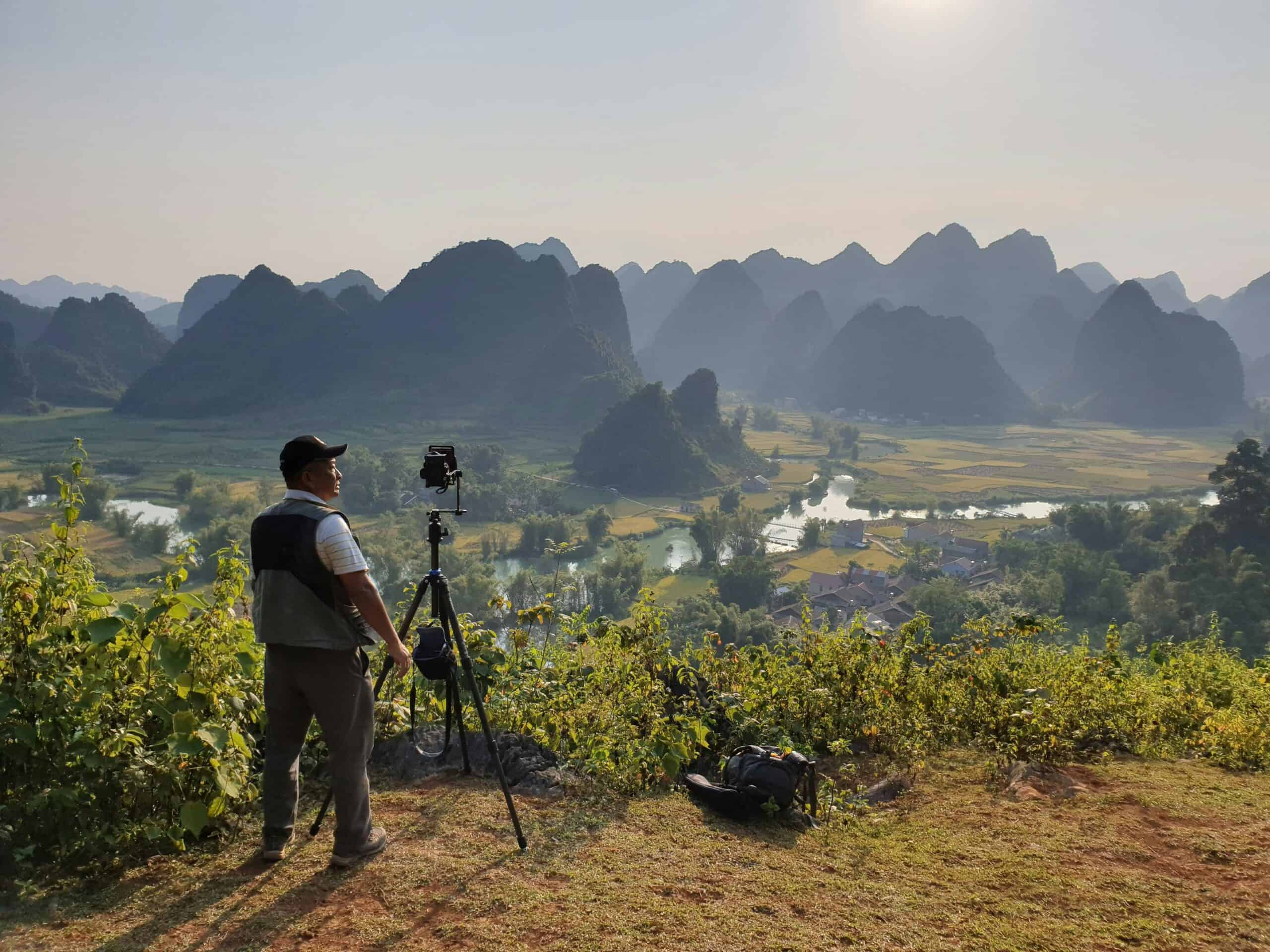
Essential Gear & Setup
Core Gear
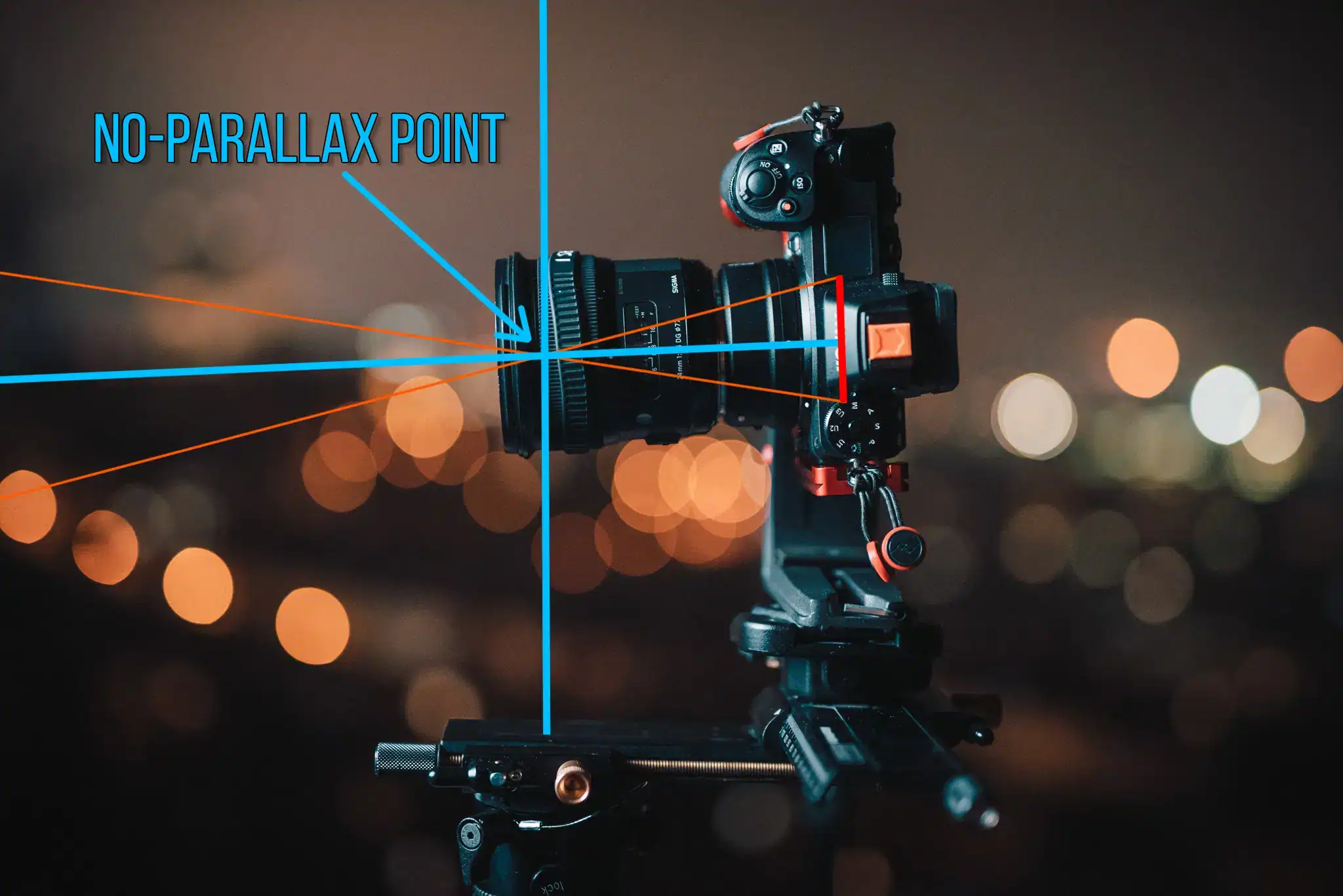
- Panoramic head: A proper pano head lets you align the lens’s entrance pupil (nodal point) over the rotation axis. This prevents parallax when foreground objects overlap the background, making stitching clean and repeatable.
- Stable tripod with leveling base: Level first, then rotate. Leveling bases speed up setup; bubbles and digital levels help keep horizons straight.
- Remote trigger/app: Use a cable release or the Fujifilm app to avoid vibrations. Consider using the electronic shutter for zero mechanical shake, but beware rolling shutter if people are moving quickly.
Optional Add-ons
- Pole or car mount: Only if you can secure it safely. Use a safety tether, tighten clamps, and watch wind loads; the GFX body is heavier than most mirrorless cameras.
- Lighting for interiors: LED panels bounced off ceilings can lift shadows for single-exposure panos if bracketing isn’t allowed.
- Weather protection: Rain covers and microfiber cloths are essential; a single drop on a fisheye can ruin a set.
For an in-depth primer on panoramic head basics, this illustrated tutorial is excellent: Panoramic head setup and theory.
Step-by-Step Shooting Guide
Standard Static Scenes
- Level and align nodal point: Mount your GFX 100 II on the pano head. Slide the camera along the rail until foreground and background elements maintain alignment during a left–right test at 0° yaw. Mark the rail stop for your AstrHori 12mm for future speed.
- Manual exposure and white balance: Switch to M mode. Meter the scene for the brightest region you need to preserve (ETTR if you’re not bracketing) and set a fixed WB (daylight for outdoors, custom Kelvin for interiors). This avoids flicker and color shifts across frames.
- Focus: Manual focus at or near the hyperfocal distance. With a 12mm fisheye, f/8–f/11 gives generous depth; use magnified live view to nail infinity and near-field sharpness.
- Capture sequence: Shoot 6 around at 60° yaw spacing. Keep the camera level for the row. Add 1 zenith (tilt up) and 1 nadir (tilt down). Maintain at least 25–35% overlap between frames.
- Nadir patch helper: After the standard nadir, take a handheld offset nadir shot by moving the tripod slightly out of frame (or shoot a clean floor tile). This makes tripod removal easier later.
HDR / High Dynamic Range Interiors
- Bracket ±2 EV (3 or 5 frames). The GFX 100 II’s DR is excellent, but bright windows still clip. Bracketing at each yaw position preserves both exterior view and interior detail.
- Lock WB and focus: Keep all variables constant across the bracket and around the full rotation to prevent stitching seams.
- Shoot efficiently: For interiors, 6 around + zenith often suffices if the floor is uniform and you plan to patch the nadir. Reduce movement between brackets by using a remote trigger and a short self-timer.
Low-Light / Night Scenes
- Stabilize: Weight the tripod and turn IBIS off to prevent micro-corrections on a locked-down setup.
- Exposure: Open to f/4–f/5.6, use shutter speeds down to 1–4 seconds if necessary, and keep ISO in the 100–800 range. The GFX 100 II is clean up to ISO 800; ISO 1600 is usable with careful noise reduction.
- Trigger: Use the electronic shutter and a remote to eliminate shake. Shoot an extra clean pass as a safety in case lights flicker or people move.
Crowded Events
- Two-pass approach: First pass fast at 1/200–1/400 to freeze motion. Second pass slower, waiting for gaps to reduce ghosting.
- Mask in post: In PTGui or Photoshop, mask the clean bits from the second pass over the first for ghost-free results.
Special Setups (Pole / Car / Drone)
- Safety first: Secure with a tether, tighten every clamp, and mind overhead obstacles. With a pole or roof mount, wind becomes a major risk due to the GFX’s weight and surface area.
- Vibration control: Use faster shutter speeds on moving platforms. On cars, shoot at stops or very slow speed. Consider additional padding or dampers under the mount.
Recommended Settings & Pro Tips
Exposure & Focus
| Scenario | Aperture | Shutter | ISO | Notes |
|---|---|---|---|---|
| Daylight outdoor | f/8–f/11 | 1/100–1/250 | 80–200 | Lock WB (daylight); avoid pointing into the sun if possible |
| Low light/night | f/4–f/5.6 | 1/30–1s | 100–800 | Tripod & remote; IBIS off on tripod; consider extra pass |
| Interior HDR | f/8 | Bracket ±2 EV | 100–400 | Preserve window highlights; 16-bit RAW recommended |
| Action / moving subjects | f/5.6–f/8 | 1/200+ | 400–800 | Freeze motion, then mask in post if needed |
Critical Tips
- Manual focus at hyperfocal: With a 12mm fisheye, focusing a little before infinity at f/8–f/11 keeps the whole scene sharp.
- Nodal calibration: Do a simple L/R parallax test with a near and far object. Slide the camera along the rail until relative positions don’t shift while panning. Mark that rail position for the AstrHori 12mm.
- White balance lock: Avoid AWB. Mixed lighting can shift frame to frame, creating stitch seams. Use a fixed Kelvin value or a custom preset.
- RAW over JPEG: The GFX 100 II’s 16-bit RAW files preserve subtle gradients and make HDR blending cleaner.
- IBIS off on tripod: In-body stabilization can introduce micro-blur or shift; turn it off for pano sequences.
- Lens profile: In PTGui/Hugin, set lens type to fisheye and test equisolid vs equidistant models for the cleanest fit. Disable in-camera distortion/vignette corrections for consistent processing.
Stitching & Post-Processing
Software Workflow
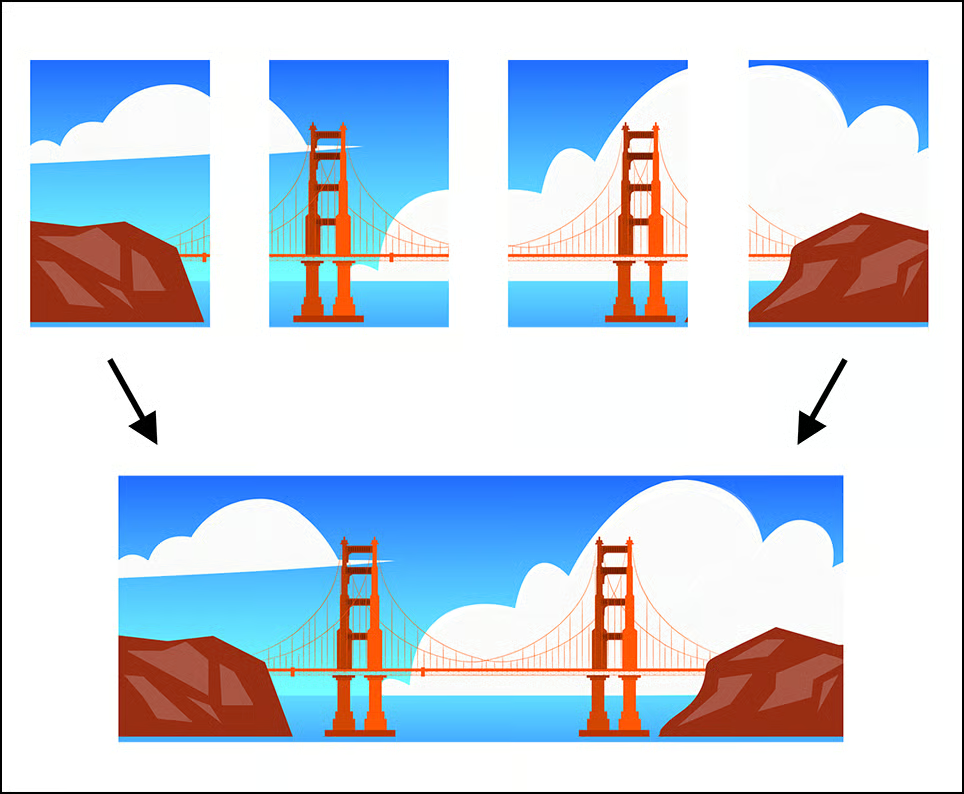
Import RAWs into Lightroom or Capture One, apply consistent basic adjustments (exposure, WB, lens CA removal if needed), and sync across the set. Export 16-bit TIFFs to a dedicated stitcher like PTGui or Hugin. Fisheye images generally stitch more reliably with fewer shots; select the proper fisheye lens model and set overlap at ~25–35%. Rectilinear lenses often need more frames but produce less edge distortion. PTGui’s optimizer and control point generation are excellent for complicated scenes. For an overview of why many pros rely on PTGui, see this review: PTGui for high-end panoramas.
Cleanup & Enhancement
- Nadir patch: Use PTGui’s Viewpoint correction, clone/heal in Photoshop, or AI-based tripod removal tools for speed.
- Color and noise: Apply gentle noise reduction for ISO 800+ shots. Match color across frames before stitching to avoid seams.
- Leveling: Correct horizon and roll/yaw/pitch in the stitcher. A fisheye exaggerates small leveling errors.
- Export: For VR, export an equirectangular at 12k–16k width if you want crisp detail. The GFX 100 II supports very high resolution if you captured sufficient coverage.
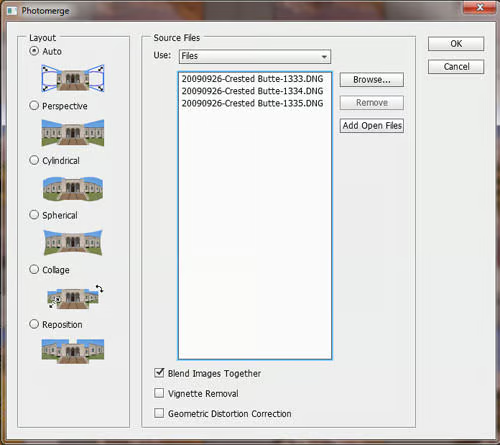
If you are new to spherical panoramas, this guide explains DSLR/mirrorless 360 pipeline end-to-end: Using a mirrorless camera to shoot and stitch a 360 photo.
Useful Tools & Resources
Software
- PTGui panorama stitching
- Hugin (open source)
- Lightroom / Photoshop
- AI tripod removal or content-aware fill tools
Hardware
- Panoramic heads (Nodal Ninja, Leofoto, Sunwayfoto)
- Carbon fiber tripods with leveling bases
- Wireless remote shutters
- Pole extensions / car suction mounts (with safety tethers)
Disclaimer: names provided for search reference. Always check official specs and instructions before purchase or use.
For a step-by-step panoramic head setup tutorial, this in-depth resource is helpful: Set up a panoramic head for high-end 360 photos.
Video walkthrough: panorama shooting and stitching fundamentals
Common Mistakes & How to Avoid Them
- Parallax error: Not aligning the entrance pupil causes misaligned edges and ghosting. Calibrate and mark your rail position.
- Exposure flicker: Using auto exposure/WB leads to visible seams. Lock both and shoot manual.
- Tripod shadows: Plan your nadir shot or patch later; move the tripod slightly for a clean floor capture.
- Fisheye flare: Keep bright light sources off the frame edges when possible; shade the lens or recompose.
- Over-stopping aperture: Diffraction softens detail beyond f/11. With the GFX 100 II’s pixel density, f/8–f/11 is the sweet spot.
- IBIS left on: Turn it off on a tripod to avoid micro-blur or frame-to-frame shifts.
Frequently Asked Questions
- Can I shoot handheld panoramas with the Fujifilm GFX 100 II?
Yes, but it’s risky with a fisheye. The large sensor magnifies small alignment errors. Handheld is feasible for quick partial panos; for 360s, use a leveled tripod and pano head. If you must go handheld, shoot extra overlap (40%+), use fast shutter speeds (1/250+), and expect more post-work.
- Is the AstrHori 12mm f/2.8 wide enough for a single-row 360?
In 35mm crop mode, yes: 6 shots around plus zenith and nadir is a reliable pattern. If you attempt full GFX coverage, test on-site for vignetting and edge coverage; you may still need 6 around to ensure clean zenith/nadir fill.
- Do I need HDR for interiors with bright windows?
Often, yes. Even with the GFX 100 II’s strong DR, windows can clip. Bracket ±2 EV (3–5 frames) at each position and keep WB/focus locked. Merge to HDR before stitching or let PTGui handle exposure fusion.
- How do I avoid parallax issues with this combo?
Use a panoramic head and align the entrance pupil of the AstrHori 12mm over the rotation axis. Do a simple near/far alignment test and mark the rail position. Re-check if you change focus or aperture significantly.
- What ISO range is safe on the GFX 100 II in low light?
For tripod-based panos, ISO 80–400 is ideal; ISO 800 is still very clean. ISO 1600 remains usable with careful denoising. Prefer lowering shutter speed over raising ISO when the scene allows.
- Can I store a custom “Pano” setup on the GFX 100 II?
Yes. Assign a custom mode with manual exposure, fixed WB, IBIS off, electronic shutter on, and your preferred bracketing pattern. This speeds up repeatable results under pressure.
- How do I reduce flare with a fisheye?
Avoid placing the sun or bright fixtures near frame edges; shade the lens with your hand just outside the frame; clean the front element; and slightly re-angle the camera to shift ghosts off critical areas.
- What’s the best tripod head for this setup?
A two-axis panoramic head with fore–aft and lateral rails (e.g., Nodal Ninja or similar) is ideal. Look for solid clamps, precise scales, and a leveling base. The GFX’s weight benefits from a robust, non-flexing head.
Real Field Advice and Case Studies
Indoor Real Estate
Use 6 around + zenith. Bracket ±2 EV at each yaw. Set WB to around 4000–4500K if there’s mixed daylight/tungsten or create a custom preset. Keep the lens close to door frames to minimize reflections. For small rooms, be extra careful with nodal point alignment because fisheye distortion exaggerates near-field parallax.
Outdoor Sunset Landscape
Shoot at base ISO 80–100 with f/8–f/11. Consider two exposures around the horizon—one for sky, one for foreground—and blend with masks. The GFX 100 II’s 16-bit files let you push highlights and shadows gracefully without banding.
Event Crowds
Time your rotations between crowd surges. A two-pass method works: fast exposures to freeze people, then a second pass to capture cleaner gaps for masking. Keep shutter at 1/200+ and ISO 400–800 if needed.
Rooftop or Long Pole
Balance the pole and monitor wind. Use higher shutter speeds to counter sway (1/250+), shoot 6 around as quickly as possible, and rely on overlap to accommodate slight movement. Safety tethers are non-negotiable.
Car-Mounted Capture
Capture at low speeds or stops, use a vibration-damped mount, and favor faster shutters. Expect to mask moving vehicles and people. If you must shoot while moving, reduce shot count and accept some compromises in sharpness.
For more background on focal length choices and stitching considerations, this primer is handy: Panoramas, focal lengths, and stitching basics.
Safety, Limitations, and Workflow Confidence
The GFX 100 II is heavier than typical mirrorless bodies; always tighten clamps and weigh the tripod. Turn off IBIS on a tripod and avoid extending center columns in wind. The AstrHori 12mm can show CA and edge softness wide open; stop down to f/8–f/11 for best consistency. On full GFX sensor area you may get heavy vignetting—use 35mm crop mode for predictable coverage. Always shoot a backup pass, especially for commercial jobs, and consider redundant storage. Keep firmware and stitching software updated; consult official docs or community guides for the latest workflows. A well-explained, field-tested foundation is here: Best techniques for 360 panoramas (community discussion).
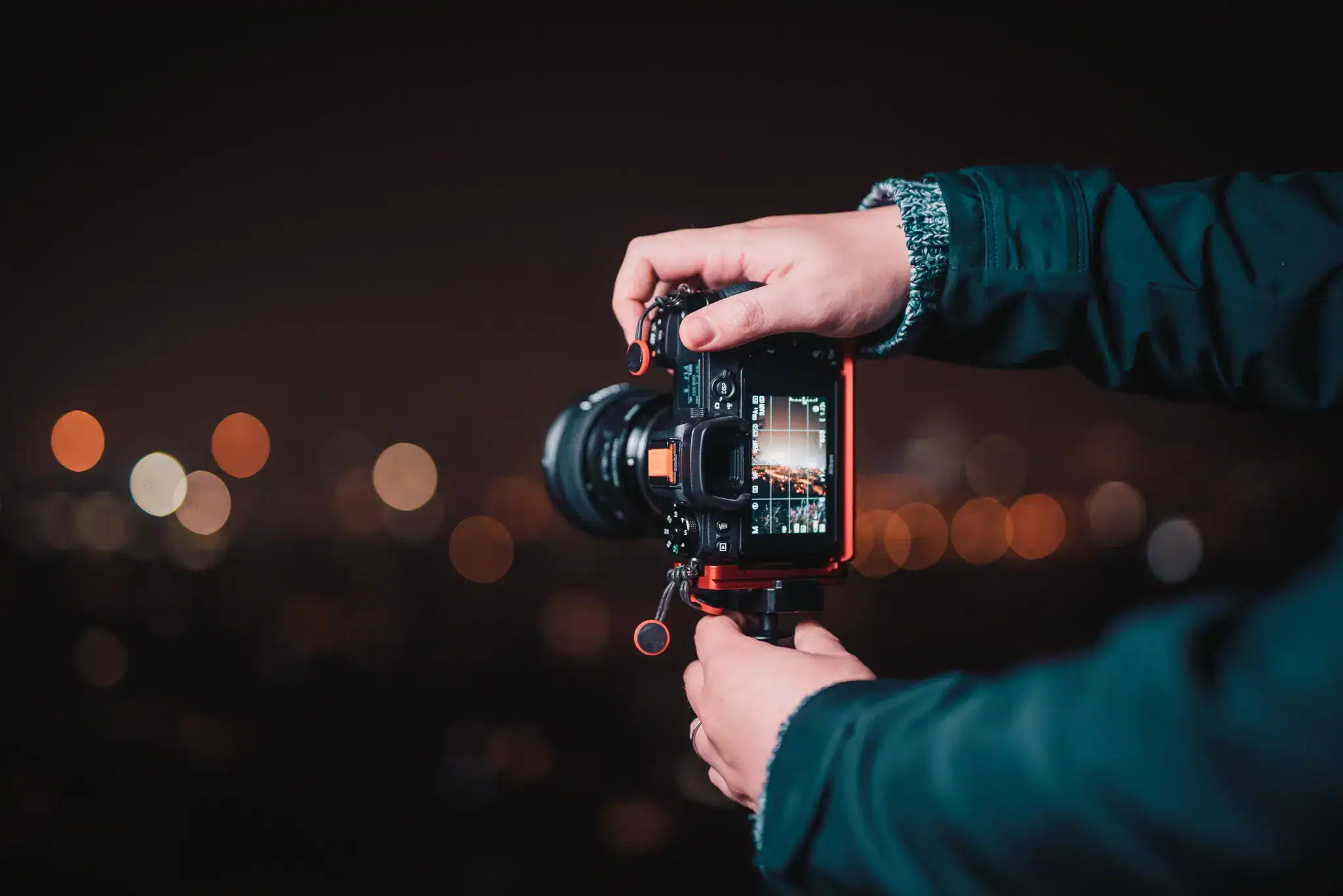
Wrapping Up: How to Shoot Panorama with Fujifilm GFX 100 II & AstrHori 12mm f/2.8 Fisheye
For efficient, high-resolution spherical panoramas, this combo shines when you leverage the GFX 100 II’s DR and 16-bit color with the fisheye’s speed. Use 35mm crop mode, calibrate your nodal point, lock exposure and WB, and capture 6 around + zenith + nadir with solid overlap. Bracket when windows or sunsets demand it; turn IBIS off and keep the workflow consistent from capture to stitch. With careful technique, you’ll create clean, immersive 360s ready for VR, virtual tours, or massive prints.