Why This Camera & Lens Are Great for Panoramas
If you’re figuring out how to shoot panorama with Canon EOS RP & Tokina ATX-i 11-20mm f/2.8, you’ve chosen a compact, travel-ready kit that can deliver crisp, high-coverage multi-row 360° images. The Canon EOS RP is a 26.2 MP full-frame mirrorless body with Dual Pixel AF, a responsive touch UI, and solid low-ISO image quality (about 11.5 stops of dynamic range at ISO 100, with a pixel pitch around 5.76 µm). It’s light, easy to balance on a panoramic head, and the ergonomics make manual control fast when you need to lock exposure and white balance across a full pano sequence.
The Tokina ATX-i 11-20mm f/2.8 is a constant-aperture, ultra-wide rectilinear zoom designed for APS-C DSLRs. Mounted to the EOS RP via an EF–RF adapter, the camera will operate in a crop mode. In practice that gives you an effective field of view equivalent to about 17.6–32mm on full-frame, and the RP’s output resolution drops to roughly 10–11 MP while shooting with this lens. That’s OK for many virtual tour and web uses, and multi-row stitching builds back plenty of final resolution. The Tokina is sharpest stopped down to f/5.6–f/8, exhibits mild barrel distortion at the wide end, and moderate lateral CA that is easily corrected in post. As a rectilinear lens (not fisheye), it maintains straight lines—great for architecture and interiors—but requires more frames than a fisheye to complete a full spherical panorama.
Compatibility note: The lens has no optical stabilization and the EOS RP has no in-body stabilization, so a steady tripod and a good panoramic head are essential, especially for low light or HDR bracketing.
Quick Setup Overview
- Camera: Canon EOS RP — Full-frame sensor (26.2 MP), Dual Pixel AF, approx. 11.5 EV DR at base ISO, pixel pitch ~5.76 µm. Auto crop to APS-C when using APS-C lenses via adapter.
- Lens: Tokina ATX-i 11-20mm f/2.8 — rectilinear APS-C ultra-wide zoom, sharpest at f/5.6–f/8, constant f/2.8 for low light, moderate CA/distortion correctable in post.
- Estimated shots & overlap (rectilinear):
- At 11mm (APS-C): 6 shots around × 2 rows (±30–45° pitch) + zenith + nadir = 14–16 shots (safe coverage). For complex interiors, 3 rows (−30°, 0°, +30°) + Z/N = 20 shots.
- At 14–20mm (APS-C): expect 8–10 shots around × 3 rows + Z/N = 26–32 shots.
- Overlap: 25–35% horizontal; 25–35% vertical. More overlap helps in feature-poor areas (white walls, sky).
- Difficulty: Moderate — rectilinear panorama requires careful nodal alignment and multi-row capture for full spherical coverage.
Planning & On-Site Preparation
Evaluate Shooting Environment
Before you shoot, walk the scene. Note light direction and contrast, especially windows or bright signs (for HDR decisions). Watch for reflections (glass, polished floors), repeating patterns (tiles), and moving elements (people, trees, cars). When shooting through glass, place the lens as close as possible (a few centimeters) and shade the lens to reduce internal reflections and ghosting. Avoid direct sun hitting the front element; step your position or time your rotation so flare is minimized across the set.
Match Gear to Scene Goals
The EOS RP’s clean low-ISO files and sensible high-ISO up to about 800 make it a good choice for natural-light interiors and twilight exteriors. The Tokina ATX-i 11-20mm f/2.8 provides flexible framing. Use 11–14mm when you want speed (fewer shots) and key architectural lines to stay straight. The constant f/2.8 is helpful for focusing or low ambient, but stop down to f/5.6–f/8 for best edge-to-edge sharpness in the final stitched panorama.
Pre-shoot Checklist
- Power and storage: fully charged batteries, spare card; consider tethered USB-C power for long sessions.
- Clean optics: blow dust from sensor and lens; wipe front element to avoid flare and stitchable dust spots.
- Tripod and leveling: set a stable stance; dial the leveling base bubble dead center before mounting the pano head.
- Pano head calibration: pre-calibrate the nodal (no-parallax) point for your common focal lengths (11, 14, 20mm) and mark rail positions.
- Safety: on rooftops or poles, tether the gear; mind wind gusts; keep people clear of the tripod radius; never shoot from a moving vehicle without a proper mount.
- Backup workflow: if time allows, shoot a second pass or an extra row as insurance against stitching gaps or motion artifacts.
Essential Gear & Setup
Core Gear
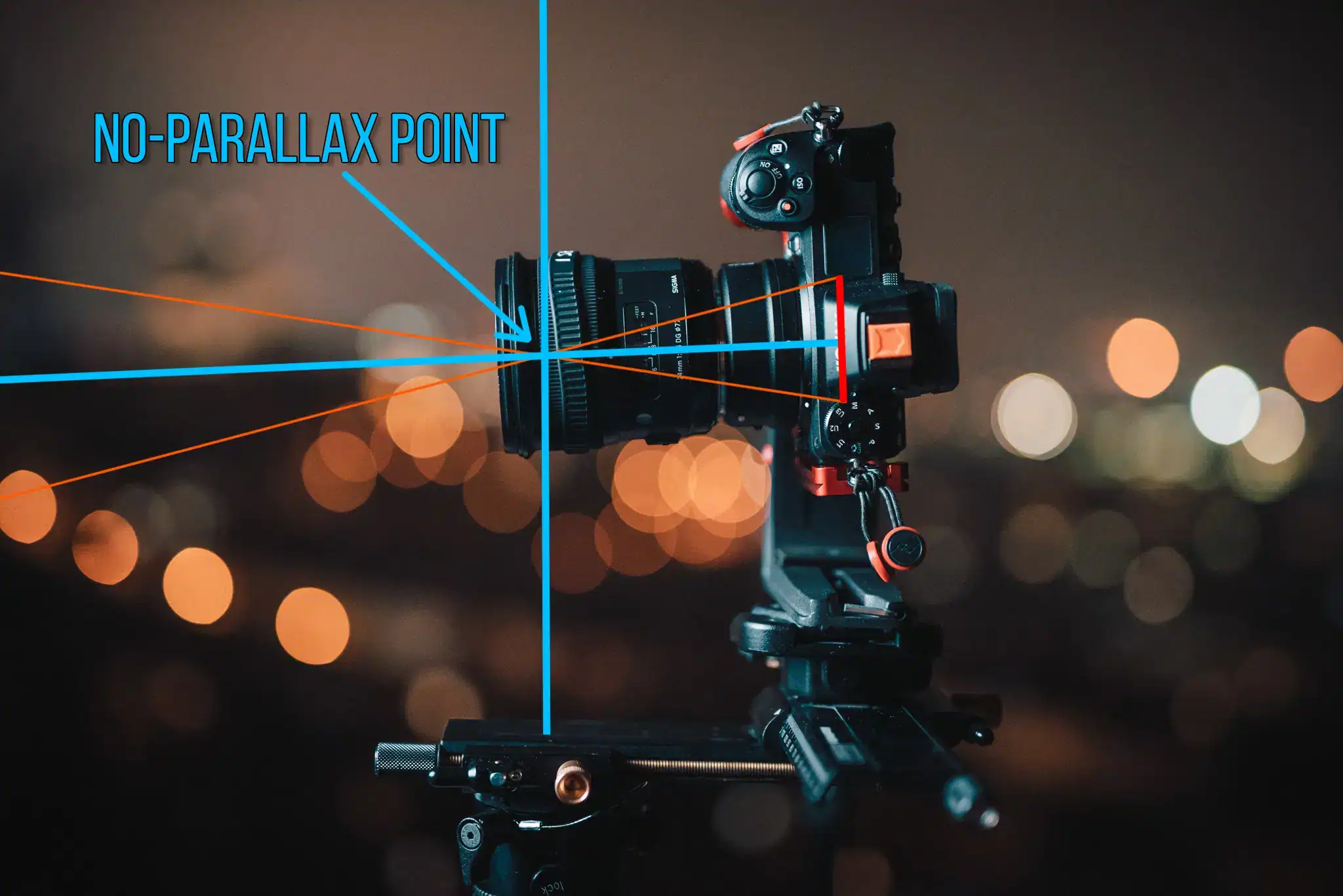
- Panoramic head: A multi-row panoramic head lets you rotate around the lens’s no-parallax point, eliminating parallax and simplifying stitching. Adjust the fore–aft rail so near and far objects stay aligned while panning.
- Stable tripod with leveling base: A leveling base speeds setup and keeps the horizon consistent. Carbon fiber reduces vibration when shooting on rooftops.
- Remote trigger or Canon Camera Connect app: Prevents vibration. Enable a 2-second timer if you don’t have a remote.
Optional Add-ons
- Pole or car mount: Great for elevated or moving perspectives. Use safety tethers and consider wind load. Keep shutter speeds higher and rotation slower to reduce blur.
- Lighting aids: LED panels or bounced flash can lift interior shadows, but keep lighting consistent between frames. Avoid mixed color temperatures when possible.
- Weather protection: Rain cover, lens hood, microfiber cloth, and a small collapsible shade to block flare when sun is near frame.
Step-by-Step Shooting Guide
Standard Static Scenes
- Level the tripod and align the nodal point: On your pano head, slide the camera along the rail while observing a near and far object. Pan the head: if the near object shifts against the far background, adjust fore–aft until it stays stationary relative to the background.
- Switch to manual exposure: Meter the brightest important area, then set a balanced exposure for the whole set. Lock white balance (Daylight/Tungsten/Custom) to avoid color shifts between frames. Shoot RAW to maximize latitude.
- Focus: Use AF to lock on a mid-distance subject at f/8, then switch to MF. Alternatively, set manual focus at the hyperfocal distance for 11–14mm. Disable focus-by-wire changes during the sequence.
- Capture sequence with consistent overlap: For 11mm, shoot 6 frames per row at 60° yaw intervals. Use two rows at +30° and −30° pitch for efficient coverage. Finish with a zenith shot (tilt +90°) and a nadir shot (tilt −90°).
- Nadir strategy: Either shoot a single nadir frame after moving the tripod slightly and using viewpoint correction in PTGui, or capture a handheld nadir and patch later.
HDR / High Dynamic Range Interiors
- Bracket ±2 EV (3–5 frames) at each position to preserve window highlights and interior shadows. Use the EOS RP’s AEB or shoot in manual with the shutter speed varied.
- Keep WB locked and use a remote to avoid movement between brackets. Consider 2-second timer with silent shutter if the scene has reflective surfaces.
- Merge brackets per position first (either in PTGui Pro or Lightroom), then stitch the merged set to reduce ghosting and keep exposure consistent.
Low-Light / Night Scenes
- Use a tripod and remote; disable any stabilization (none here) and ensure firm footing. Aim for ISO 100–400 when possible; ISO 800 is still workable on the EOS RP with moderate noise reduction.
- Shutter speeds of 1–8 seconds are common at f/5.6–f/8. Wait a second after each rotation for vibrations to settle before exposing.
- Watch for moving lights (cars, signs). Take multiple frames where necessary and mask later for clean light trails.
Crowded Events
- Do two passes: a quick base pass for plate coverage, then a second pass waiting for gaps in the crowd. Mark your head’s zero points so you can re-align easily.
- In post, use masks to keep a single person per overlap area; avoid cut-off limbs and repeated ghosts.
Special Setups (Pole / Car / Drone)
- Pole: Use a lightweight pano head with a safety tether. Keep the pole vertical, rotate slowly, and increase shutter speed (1/125s+) to mitigate sway.
- Car mount: Only on secured mounts and private/controlled spaces. Use higher shutter speeds (1/250s+) and consider burst capture for each yaw position to pick the sharpest frame.
- Drone: This lens/body combo is not drone-friendly; instead use dedicated aerial systems. For car/pole solutions, pre-focus and lock settings before elevating.
Recommended Settings & Pro Tips
Exposure & Focus
| Scenario | Aperture | Shutter | ISO | Notes |
|---|---|---|---|---|
| Daylight outdoor | f/8–f/11 | 1/100–1/250 | 100–200 | Lock WB (Daylight); watch for flare |
| Low light/night | f/4–f/5.6 | 1/30–1/2s+ | 400–800 | Tripod, remote; wait for vibrations to settle |
| Interior HDR | f/8 | Bracket ±2 EV | 100–400 | Merge brackets before stitching or in PTGui Pro |
| Action / moving subjects | f/5.6–f/8 | 1/200+ | 400–800 | Freeze motion; consider two-pass capture |
Critical Tips
- Manual focus: After AF, switch to MF. At 11–14mm, set focus ~1–1.5 m at f/8 for near–far sharpness (hyperfocal-ish). Take a quick test shot at 100% to confirm edge sharpness.
- Nodal calibration: Tape or engrave reference marks on the pano rail for 11, 14, and 20mm. Re-check if you change the adapter or quick-release plate depth.
- White balance lock: Pick a Kelvin value or Daylight/Tungsten preset to avoid color shifts frame-to-frame, especially important in HDR brackets.
- RAW over JPEG: RAW preserves highlight recovery and color consistency, especially critical at base ISO on the EOS RP where pushing shadows can reveal banding if underexposed.
- Stabilization: The EOS RP has no IBIS; the Tokina lacks IS. Use a remote and let vibrations damp before each exposure. On windy rooftops, hang a small weight from the center column.
Video: Set Up Your Pano Head
Seeing the moves helps. This tutorial covers practical alignment and capture discipline that directly translates to the RP + Tokina workflow.
Stitching & Post-Processing
Software Workflow
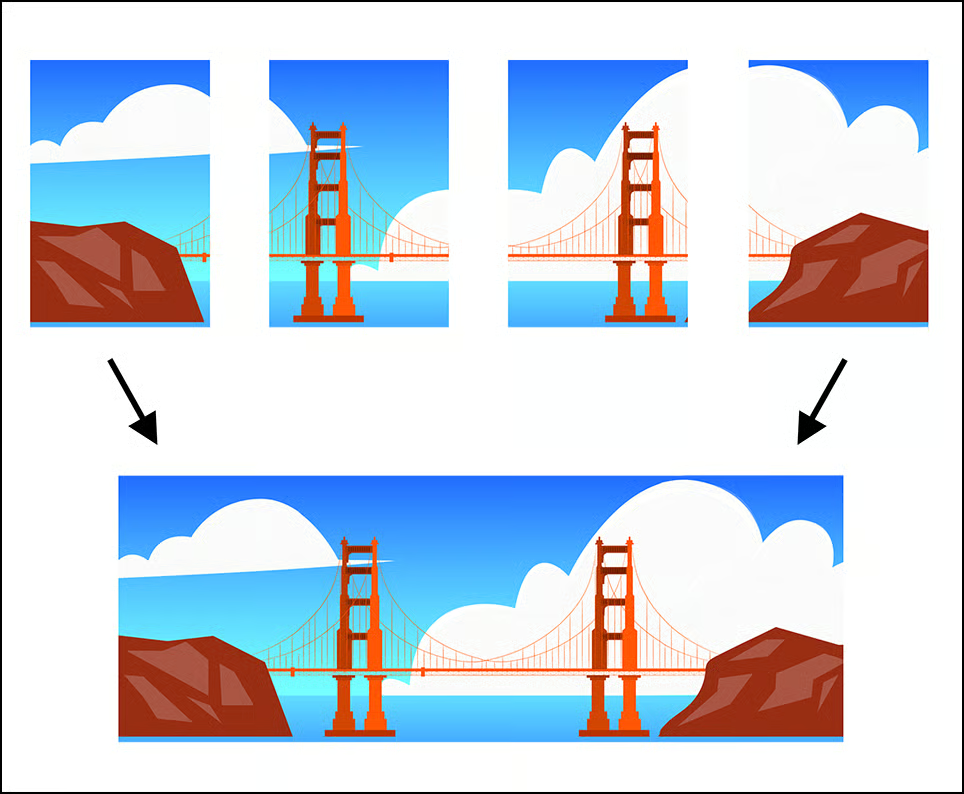
PTGui and Hugin are the mainstays for spherical panoramas. With this rectilinear Tokina, you’ll typically stitch more images than a fisheye but get straighter architecture and fewer edge distortions. In general, target ~25–35% overlap horizontally and vertically for robust control point detection. PTGui’s lens parameter estimation works well if you shoot a calibration set at each focal length you plan to use. For Lightroom/Photoshop workflows, pre-sync WB/exposure across frames and consider HDR merge first for bracketed sets before stitching. For background reading and tool comparisons, see a practical PTGui review and panorama software notes at Fstoppers. PTGui: an industry favorite for complex panos
Cleanup & Enhancement
- Nadir patch: Use PTGui’s Viewpoint Correction by shooting an offset nadir frame, or patch in Photoshop with clone/heal. Some AI tools speed up tripod removal.
- Color and noise: Apply a gentle contrast curve and uniform WB. For EOS RP files at ISO 800, use moderate luminance NR and mask sharpening to edges only.
- Geometry: Level the horizon (pitch/roll), then fine-tune yaw for composition. Straighten verticals for real estate.
- Export: For VR players, export 2:1 equirectangular JPG/TIFF at 8K (8000×4000) or higher. If your capture set is multi-row, you can easily exceed 10K horizontal resolution.
If you’re new to panoramic heads and nodal alignment, this illustrated tutorial deepens the concepts and setup steps. Panoramic head best practices and no-parallax alignment
For VR publishing specifics (projection, metadata, and platform delivery), Meta’s creator guide is a reliable reference. Using a mirrorless camera to shoot and stitch a 360 photo
Useful Tools & Resources
Software
- PTGui (Pro) for multi-row spherical panoramas and viewpoint correction
- Hugin (open source) for cost-free stitching
- Lightroom / Photoshop for RAW prep, HDR merges, and nadir patching
- AI tripod removal tools for fast nadir cleanup
Hardware
- Panoramic heads: Nodal Ninja, Leofoto, Sunwayfoto
- Carbon fiber tripods with leveling base (Benro, Gitzo, Leofoto)
- Wireless remotes or intervalometers
- Pole extensions and car suction rigs with safety lines
Disclaimer: Product names are provided for reference; consult official sites for specs and compatibility.
Common Mistakes & How to Avoid Them
- Parallax error: Always rotate around the no-parallax point. Re-check after changing focal length or quick-release plates.
- Exposure flicker: Use full manual exposure and fixed white balance; avoid auto ISO.
- Tripod shadows and footprints: Shoot a dedicated nadir and patch later; consider moving the tripod for a viewpoint-corrected nadir.
- Ghosting from people/cars: Take multiple frames and mask the cleanest areas in post.
- Insufficient overlap: Keep at least 25–30% overlap; add more in low-texture scenes.
- Flare at ultra-wide: Use your hand or a small flag to shade the front element when the sun is near the frame edge.
Frequently Asked Questions
- Can I shoot handheld panoramas with the Canon EOS RP?
Yes, but it’s not ideal for 360° multi-row panoramas. Handheld single-row panos can work outdoors at fast shutter speeds. For full spherical 360 photos, use a tripod and pano head to avoid parallax and stitching headaches.
- Is the Tokina ATX-i 11-20mm f/2.8 wide enough for a single-row 360?
Not for a complete sphere. At 11mm on APS-C, vertical FOV is roughly 68°, which won’t cover zenith and nadir in one row. Plan at least two rows (±30–45°) plus dedicated zenith and nadir frames.
- Do I need HDR for interiors with bright windows?
Usually yes. Bracket ±2 EV (3–5 frames). Merge each bracket set first to control noise and haloing, then stitch the tonemapped frames. This preserves highlight detail outside while keeping interiors clean.
- How do I avoid parallax issues with this combo?
Calibrate the no-parallax point on your panoramic head for 11, 14, and 20mm. Align using a near object against a distant background and fine-tune the fore–aft rail until there’s no relative shift when panning.
- What ISO range is safe on the EOS RP in low light?
ISO 100–400 is the sweet spot. ISO 800 is still quite usable with modest noise reduction. Above 1600, noise and banding risk increase if you need to push shadows, so rely on tripod and longer exposures instead.
- Can I save a custom “pano mode” on the EOS RP?
Yes. Use the RP’s Custom modes (C1/C2/C3) to store manual exposure, fixed WB, manual focus, drive mode, and AEB settings. That way you can switch from general shooting to pano-ready instantly.
- Will using an APS-C lens on the RP hurt final resolution?
The camera crops to APS-C, so single-frame resolution is about 10–11 MP. But multi-row stitching multiplies total pixel count; a typical 16–24 frame set can easily yield 8K–12K equirectangulars suitable for web and VR.
- Best tripod head for this setup?
A compact multi-row panoramic head with fore–aft and vertical rails (e.g., Nodal Ninja or Leofoto) works well. Make sure it supports the RP’s weight and allows precise, repeatable detents (e.g., 30°/45° stops).
Real-World Case Studies
Indoor Real Estate
At 11–14mm, shoot two rows (±30°) plus Z/N to keep lines rectilinear and minimize wall distortion. Bracket ±2 EV for windows. Lock WB around 4000–4500K for mixed LED/tungsten rooms and correct later globally.
Outdoor Sunset
Meter the sky just off the sun, then expose for midtones to keep flexibility in RAW. Bracket if the sun is in frame. Use your hand or a flag to shade the lens during frames that point near the sun to prevent veiling flare.
Event Crowds
Two-pass method: a quick base pass, then a patience pass. Lock exposure and WB between passes. In PTGui, use masks to keep a single instance of a subject per overlap region.
Rooftop/Pole Shooting
Shorten the center column, widen tripod legs, and add a small weight for stability. On a pole, shoot faster shutter speeds (≥1/125s) and pause briefly at each stop. Safety tethers are mandatory.
Car-Mounted Capture
Use a rated suction rig, tether, and only shoot on private property with full safety control. Keep 1/250s+ and consider burst mode to pick the sharpest frame per yaw position.
Expert Notes & Standards
The shot counts in this guide follow industry practice for rectilinear ultra-wides: expect more frames than with fisheyes, but straighter lines and better architecture rendering. For deeper background on DSLR/mirrorless 360 photography pipelines and platform requirements, see Meta’s DSLR 360 documentation and long-standing community tutorials. Set up a panoramic head for high-end 360 photos