
Why This Camera & Lens Are Great for Panoramas
The Canon EOS RP is a compact, full-frame mirrorless body with 26.2MP resolution and a friendly control layout—perfect for tripod-based, methodical work like 360° panoramas. Its full-frame sensor (approx. 36 × 24 mm) offers good color depth and usable dynamic range at base ISO; with ~5.76 µm pixel pitch, it tolerates longer exposures without excessive noise compared to smaller sensors. While the RP lacks in-body stabilization (IBIS), for tripod shooting that’s actually an advantage—no risk of stabilization-induced blur when the camera is perfectly still.
The Sony FE 16–35mm f/2.8 GM is a professional, rectilinear ultra-wide zoom with excellent edge-to-edge performance once stopped to f/5.6–f/8. It controls CA well and has predictable distortion (mild barrel at 16mm, pincushion toward 35mm) that stitches cleanly with proper overlap. Rectilinear lenses preserve straight lines—ideal for interiors and architecture—even though you’ll need more frames than with a fisheye.
Compatibility note: This lens is designed for Sony E-mount. The Canon EOS RP uses the RF mount. As of early 2025, there is no widely available, reliable smart adapter for mounting Sony E-mount lenses on Canon RF bodies with full electronic control. If you attempt this pairing, expect to work in full manual with a “dumb” adapter (no aperture/AF control) or a third-party adapter with its own iris (which can degrade optical quality). For professional results, the technique in this guide applies equally well to a native Canon RF alternative (e.g., RF 15–35mm f/2.8L IS) or an EF 16–35mm via EF–RF adapter. We’ll still detail settings tailored to a full-frame body at 16–35mm so you can execute confidently with either approach.
Quick Setup Overview
- Camera: Canon EOS RP — Full-frame 26.2MP, pixel pitch ~5.76 µm, good base-ISO DR (~11.8 EV), Dual Pixel AF, no IBIS.
- Lens: Sony FE 16–35mm f/2.8 GM — Rectilinear UWA zoom; sharpest around f/5.6–f/8; well-controlled CA; predictable distortion patterns that stitch well.
- Estimated shots & overlap (full spherical, portrait orientation):
- At 16mm: 3 rows of 8 shots each (yaw step ≈ 45°) at +45°, 0°, −45° + 1 zenith + 2 nadir cleanup = ~27 frames total (safe 30–35% overlap).
- At 24mm: 3 rows of 10 shots each + zenith + 2 nadir = ~32 frames.
- At 35mm: 4 rows of 12 shots each + zenith + 3 nadir = ~51 frames (for very high detail or gigapixel-like coverage).
- Difficulty: Intermediate (due to nodal alignment and, with this specific pair, potential mount-adapter limitations).
Planning & On-Site Preparation
Evaluate Shooting Environment
Look for lighting contrast (e.g., bright windows vs. dark interiors), reflective surfaces (glass, polished stone), and moving elements (people, vehicles, trees in wind). For glass walls/windows, get the lens as close as safely possible to reduce reflections and ghosting; use a rubber lens hood when feasible. Watch for direct sun in frame at ultra-wide angles; consider timing (golden/blue hour) to balance dynamic range.
Match Gear to Scene Goals
The EOS RP’s base-ISO files are clean and grade well; ISO 100–400 is ideal. Indoors, the RP remains usable in the ISO 400–800 range, but for premium deliverables, prioritize longer shutter speeds over high ISO. The 16–35mm GM, as a rectilinear lens, minimizes curvature of straight lines, which is advantageous for real estate and architecture—just plan for more frames than a fisheye. For outdoor sunrises/sunsets, expect to bracket ±2 EV to protect highlights and shadows.
Pre-shoot Checklist
- Battery charged and a spare (tripod work and bracketing drain faster than you expect).
- Large, fast SD card; shoot RAW (and RAW+JPEG if you need quick previews).
- Clean front/rear elements; blow dust off the sensor; bring microfiber and a rocket blower.
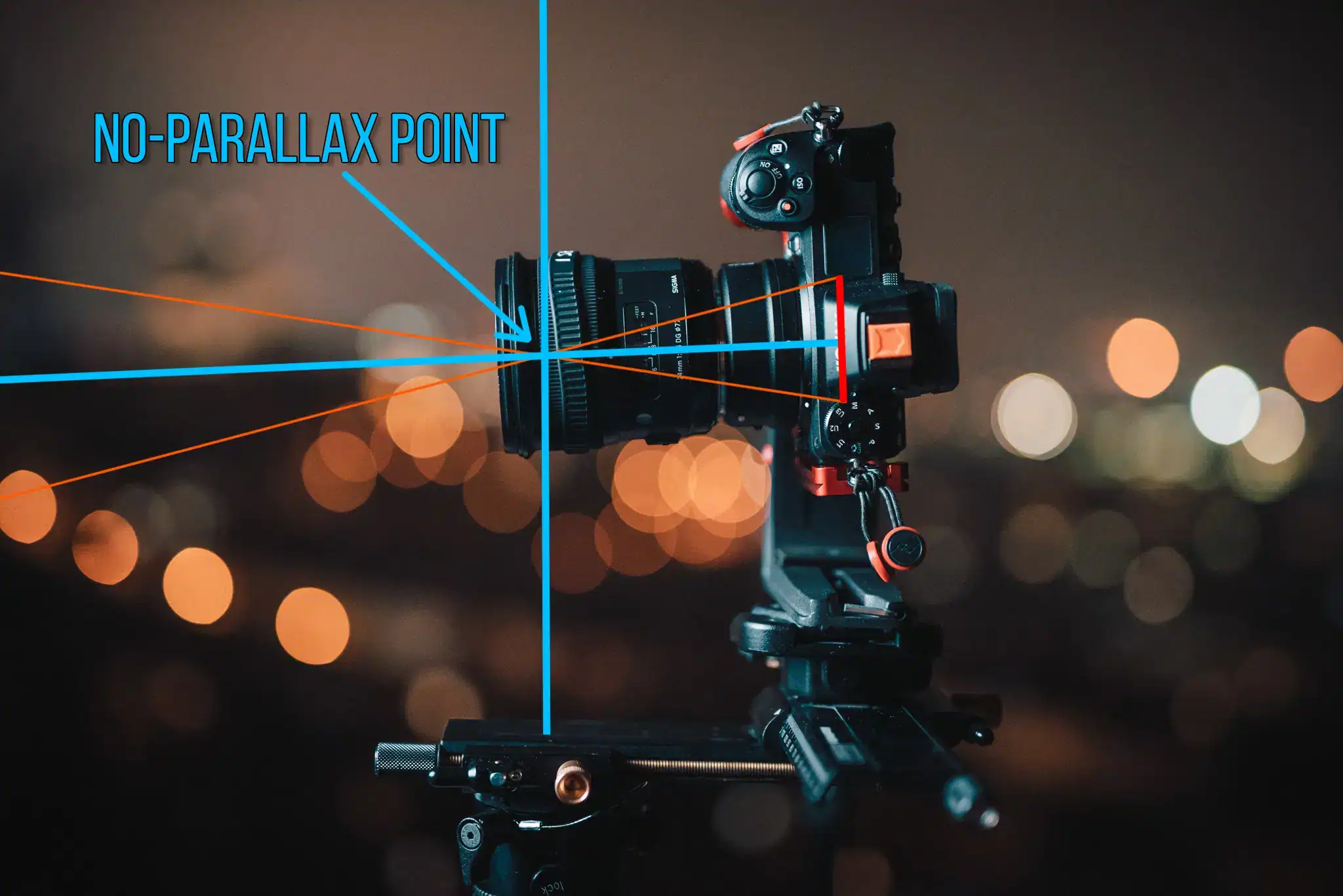
- Tripod levelled; panoramic head calibrated for the lens’s entrance pupil (no-parallax point).
- Safety checks: wind conditions, rooftop railings, pole or car mounts well-secured with tethers.
- Backup workflow: if time allows, shoot a second full round as insurance (especially when crowds move).
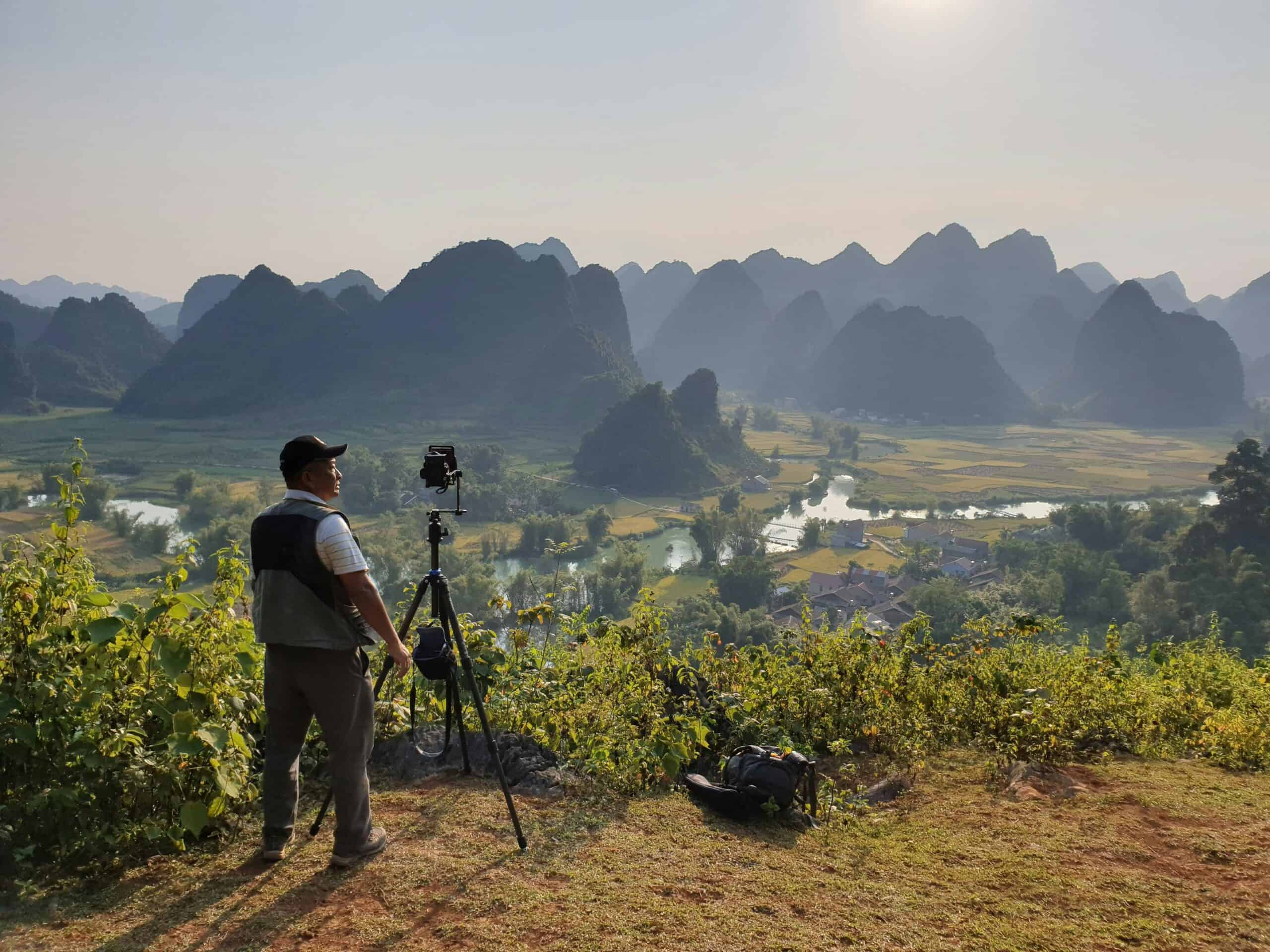
Essential Gear & Setup
Core Gear
- Panoramic head: Lets you rotate the camera around the lens’s entrance pupil (“nodal point”) to eliminate parallax—critical for stitching success in tight interiors and near objects.
- Stable tripod with a leveling base: A level platform means evenly spaced rows and fewer horizon corrections later.
- Remote trigger or app: Fire the shutter without touching the camera; use 2-sec timer if you lack a remote.
Optional Add-ons
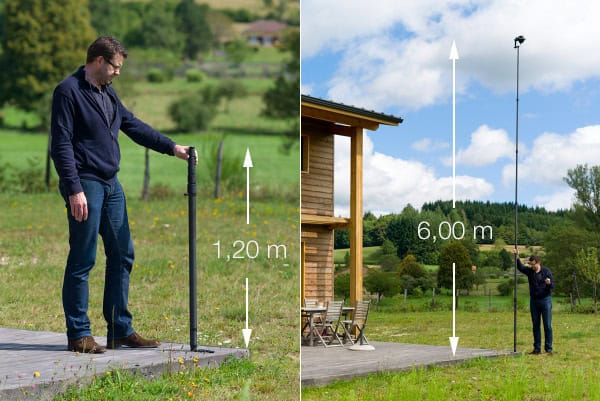
- Pole or car mount: Great for crowds or elevated perspectives. Use guy lines and a safety tether; watch wind loads and vibrations.
- Lighting aids: Small LED panels for dim interiors; keep color temperature consistent with available light.
- Weather protection: Rain cover and silica gel packs for sudden weather changes.
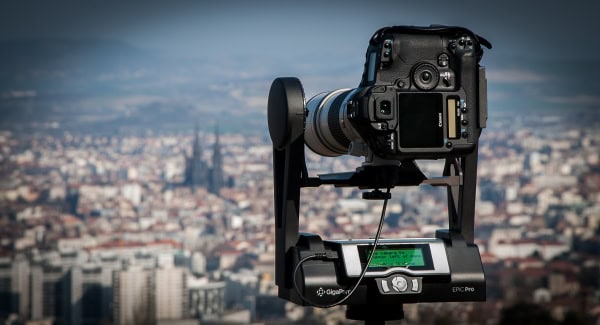
Step-by-Step Shooting Guide
Standard Static Scenes
- Level the tripod: Use the EOS RP’s electronic level and the leveling base. A level yaw axis reduces stitching warp and speeds post.
- Align the nodal point: Slide the camera along the panoramic head’s rail until foreground and background elements stop shifting when you pan. Mark the rail for 16mm, 24mm, and 35mm. As a starting point, many 16mm rectilinear lenses on full frame land near 70–75 mm forward of the sensor mark (Φ) to the entrance pupil—refine by testing.
- Manual exposure + locked white balance: Set M mode. Choose RAW, fixed WB (Daylight/Tungsten/Custom), and disable Auto Lighting Optimizer. Use the histogram; expose for the highlights if you’re not bracketing.
- Portrait orientation: Maximize vertical coverage; plan rows at +45°, 0°, and −45° for 16mm.
- Capture sequence with overlap: For 16mm, 8 shots per row (yaw 45°) at +45°, 0°, −45°. Add one zenith (straight up), and two offset nadirs (tilt down and rotate 90° between them) for clean tripod removal.
- Notes on the specific combo: If you cannot control the Sony lens aperture on the RP, it will likely stay wide open. Consider using an adapter with its own iris (accepting some loss of contrast) or switch to a native Canon UWA lens for sharper corners at f/5.6–f/8.
HDR / High Dynamic Range Interiors
- Bracket ±2 EV (3–5 frames): Keep ISO fixed (100–200) and vary shutter speed. The RP’s AEB is sufficient for windows and mixed lighting.
- Lock WB and use a custom WB if possible: Prevent color shifts across brackets that complicate stitching.
- Disable Long Exposure NR: It doubles capture time; do noise reduction later in post for consistency across frames.
Low-Light / Night Scenes
- Use a sturdy tripod and remote: Exposures may drop to 1–4 seconds or longer; the RP’s files remain clean at ISO 100–400. If wind affects the rig, increase ISO to 800 and keep shutter ≥ 1/2–1 sec to reduce motion blur.
- Turn off stabilization: The 16–35 GM has no OSS; if you switch to a stabilized lens, disable stabilization on a tripod to avoid micro-blur.
- Mind star movement: For astro elements, keep shutter under ~15 sec at 16mm to minimize star trails (if you intend to preserve star points).
Crowded Events
- Two-pass method: First pass for coverage, second pass capturing gaps when people move. In PTGui/Hugin, mask preferred areas from the cleaner pass.
- Keep cadence: Call out your rotation to avoid people bumping the rig; a bright vest helps in public spaces.
Special Setups (Pole / Car / Drone)
- Pole work: Use a carbon pole and a light panoramic head. Secure a safety tether to your harness; avoid gusty conditions above 3–4 m elevation.
- Car-mounted: Use vibration-damped suction mounts, safety cables, and shorter shutter times (1/200–1/500) if traffic or wind is present.
- Drone note: This guide focuses on tripod rigs; for drones, use in-camera sphere modes or plan multi-row sequences with high overlap.
Recommended Settings & Pro Tips
Exposure & Focus
| Scenario | Aperture | Shutter | ISO | Notes |
|---|---|---|---|---|
| Daylight outdoor | f/8–f/11 | 1/100–1/250 | 100–200 | Lock WB (Daylight); RAW for latitude |
| Low light/night | f/4–f/5.6 | 1/4–1/30 (tripod) | 100–800 | Remote trigger; disable stabilization on tripod |
| Interior HDR | f/8 | Bracket ±2 EV | 100–400 | Protect highlights; blend in post |
| Action / moving subjects | f/5.6–f/8 | 1/200+ | 400–800 | Faster shutter to freeze movement; shoot two passes |
Critical Tips
- Manual focus near hyperfocal: At 16mm and f/8 on full frame, hyperfocal is roughly ~1.1 m; focus slightly beyond 1 m and leave MF on.
- Nodal calibration workflow: Place two light stands at different distances; pan while sliding the rail until relative alignment remains constant. Mark rail positions for 16, 24, and 35mm.
- White balance lock: Use a custom WB card or fixed preset—mixed auto WB across frames causes color stitching seams.
- RAW over JPEG: More DR for HDR merges and better highlight recovery—vital for windowed interiors and sunsets.
- Shutter practice: Use EFCS (electronic first curtain) to minimize shutter shock; 2-sec timer if no remote.
Stitching & Post-Processing
Software Workflow
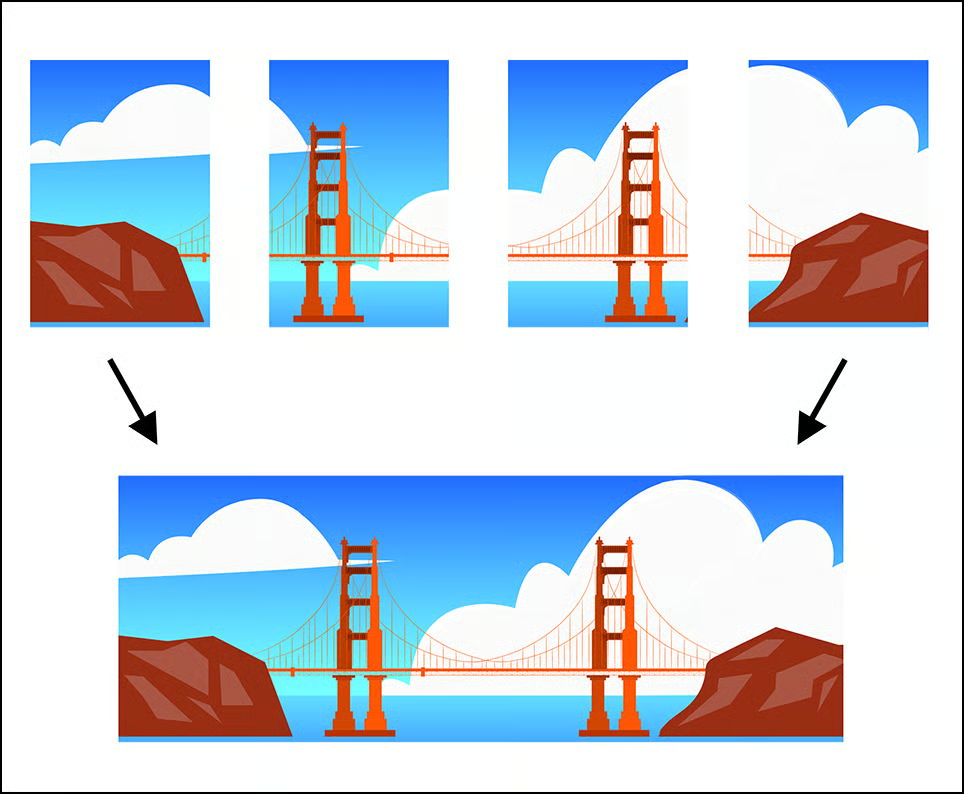
Import and organize by row and yaw order. For HDR brackets, either pre-merge to HDR (e.g., Lightroom) or hand brackets to PTGui/Hugin and let the stitcher fuse exposures. Rectilinear lenses generally need more images than fisheyes, but reward you with straighter lines. For reliable control points, industry guidance suggests ~25–30% overlap for fisheye and ~20–35% for rectilinear; more overlap helps in low-texture scenes. PTGui’s optimizer and masking tools are industry standards for precision control, while Hugin is a powerful open-source alternative. For a deeper look at PTGui’s capabilities in practice, see a professional review at the end of this paragraph. Fstoppers: PTGui review
Cleanup & Enhancement
- Nadir/tripod patch: Use viewpoint correction in PTGui or clone/AI patch tools to remove the tripod footprint.
- Color consistency: Sync white balance and tone across all frames; apply gentle noise reduction for shadow areas.
- Level & orientation: Set horizon, then correct roll/pitch/yaw for a comfortable viewing angle in 360 viewers.
- Export: Equirectangular 2:1 JPEG/TIFF. For web VR, 8K (8192 × 4096) is common; go 12–16K if your stitch supports it and hosting allows.
If you’re new to panoramic heads and perfecting parallax-free capture, this concise tutorial is a great visual companion. Oculus: Set up a panoramic head for high‑end 360 photos
Useful Tools & Resources
Software
- PTGui (fast, powerful stitching and masking)
- Hugin (open-source control point and optimizer powerhouse)
- Lightroom / Photoshop (HDR merges, tonal work, nadir cleanup)
- AI tripod removal tools (content-aware fill and modern generative methods)
Hardware
- Panoramic heads: Nodal Ninja, Leofoto, Sunwayfoto, Fanotec
- Carbon fiber tripods with leveling bases
- Wireless remotes or camera apps
- Pole extensions and vehicle mounts with safety tethers
For a deeper dive into panoramic head fundamentals and choosing the right gear, this practical guide is well-regarded. 360Rumors: Panoramic head tutorial
Disclaimer: names above are for research convenience—verify compatibility and current specs on the manufacturers’ sites.
Common Mistakes & How to Avoid Them
- Parallax error: Always align the entrance pupil with a calibrated panoramic head—especially near objects.
- Exposure flicker: Manual exposure and fixed white balance; avoid auto ISO/WB during a pano sequence.
- Tripod shadows or rig in frame: Capture dedicated nadir shots and patch later.
- Ghosting from movement: Shoot two passes and mask; increase overlap in busy scenes.
- High-ISO noise: Prefer longer shutter times on a tripod; the EOS RP looks best at ISO 100–400 (800 when needed).
- Insufficient overlap: Stick to 25–35% or more for rectilinear UWA, especially in low-texture walls/ceilings.
Frequently Asked Questions
-
Can I shoot handheld panoramas with the Canon EOS RP?
You can, but it’s a compromise. The RP has no IBIS and the 16–35 GM lacks OSS, so keep shutter at 1/200+ and use generous overlap (50%+). Handheld is fine for simple cylindrical panos outdoors; for precise 360×180° work—especially indoors—use a tripod and panoramic head.
-
Is the Sony FE 16–35mm f/2.8 GM wide enough for single-row 360?
Not for full spherical coverage. At 16mm on full frame, you’ll need multi-row capture (commonly three rows at +45°, 0°, −45°) plus zenith and nadir. A fisheye can do it in far fewer shots, but rectilinear keeps architecture straight.
-
Do I need HDR for interiors with bright windows?
Yes—bracket ±2 EV (3–5 frames) at ISO 100–200 to preserve window highlights and interior shadows. Merge before stitching or let PTGui/Hugin handle exposure fusion.
-
How do I avoid parallax issues?
Mount the camera on a panoramic head and align the entrance pupil (no-parallax point). Use two vertical objects at different distances and pan; adjust the rail until there’s no relative shift. Mark the rail positions for 16, 24, and 35mm. For fundamentals and diagrams, see this concise primer. Oculus: Using a mirrorless to shoot & stitch a 360 photo
-
What ISO range is safe on the EOS RP in low light?
For high-quality pano work, ISO 100–400 is ideal; ISO 800 is still very usable. If wind or vibrations force faster shutter speeds, ISO 1600 can work with noise reduction, but expect some grain in shadows.
-
Can I create custom modes for pano on the EOS RP?
Yes. Save a “Pano” setup with M mode, fixed WB, RAW, EFCS on, drive to single shot, MF enabled, and exposure tuned for your environment. It speeds up on-site setup.
-
How do I handle the Sony lens on the Canon body?
Because there’s no mainstream smart E-to-RF adapter, you’ll likely lose aperture/AF control. That’s a real limitation for sharpness (you want f/5.6–f/8). If possible, use a native Canon RF/EF ultra-wide for the RP and apply the same pano technique. If you must use the Sony GM via a manual adapter with its own iris, expect some contrast/edge softness.
-
What tripod head is best for this setup?
A two-axis panoramic head with fore–aft and lateral rails (e.g., Nodal Ninja/Fanotec, Leofoto) and an indexed rotator. Ensure it supports the RP + lens weight with minimal flex, and add a leveling base for fast setup.
Real-World Scenarios & Field Notes
Indoor Real Estate (Mixed Light)
Use 16–20mm to minimize visible room distortion while preserving clean lines. Set f/8, ISO 100–200, and bracket ±2 EV. Watch for color casts from tungsten lamps vs. daylight windows—lock WB and correct later with local adjustments. Add a zenith shot to clean ceiling fixtures smoothly.
Outdoor Sunset (High DR, Wind)
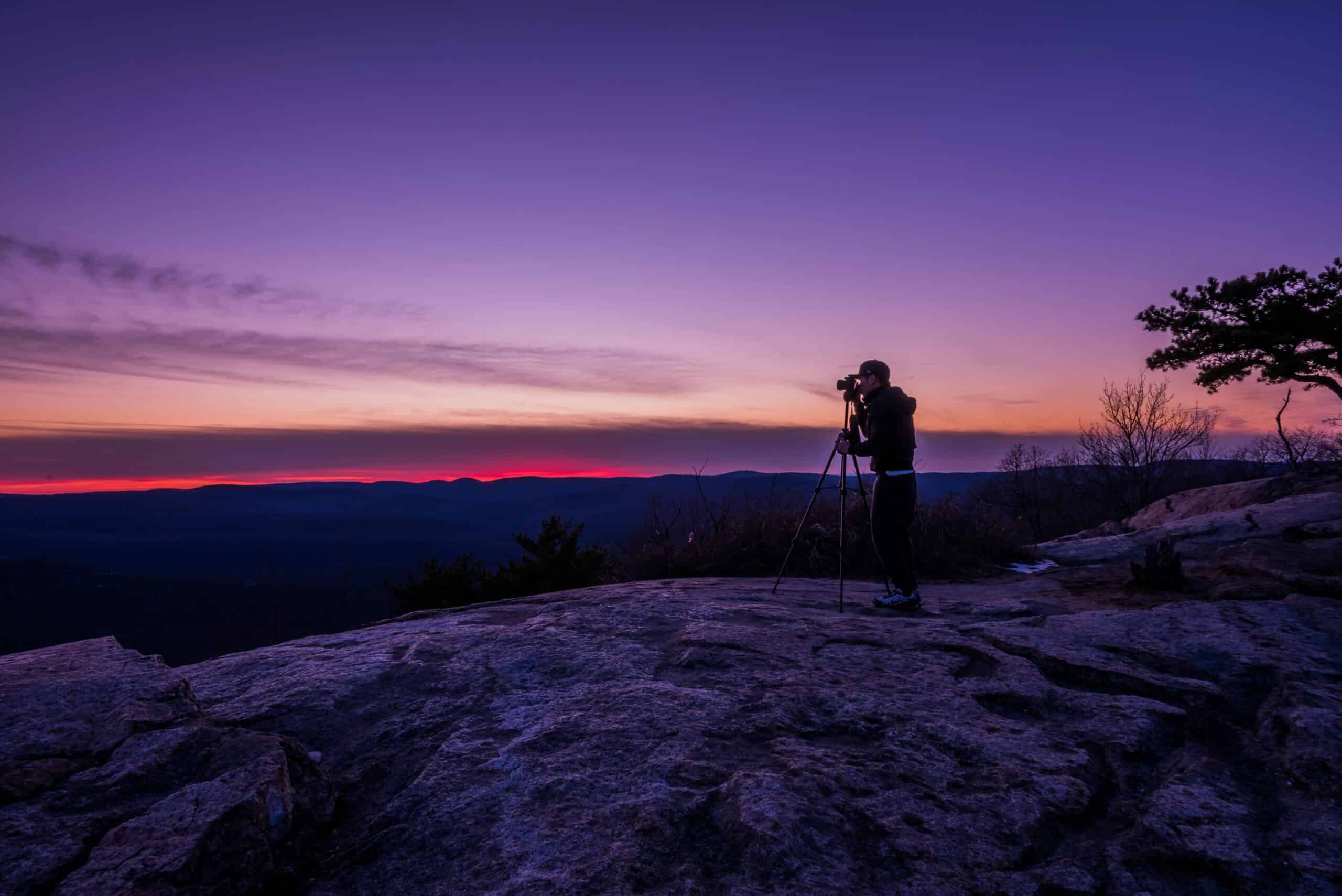
Arrive early to secure a stable spot. At 16mm, shoot 3 rows × 8 shots with ±2 EV bracketing. If wind shakes the rig, shorten shutter time and raise ISO to 400–800 to maintain sharpness; you can denoise later. Consider a lens hood to reduce flare when the sun sits low in-frame.
Events & Crowds
Establish a small perimeter with your tripod legs. Shoot two full sequences: first fast to lock coverage, second waiting for subject spacing. In post, use masks to bring through clean areas. Keep your nadir shots—foot traffic often obscures the tripod area in at least one frame.
Safety, Quality Control & Backup
Use a weighted hook on your tripod in wind. On rooftops, never lean over parapets; tether expensive gear. For car mounting, use three-point suction plus safety cables. Keep a shot log or voice memos for rows and offsets, and when time allows, repeat a full sequence as a backup. Redundancy beats reshoots.
If you’re planning ultra-high-resolution spheres, understanding the relationship between focal length, sensor pitch, and final equirectangular resolution is key. The Panotools community has a classic knowledge base on spherical resolution math. PanoTools: DSLR spherical resolution