Why This Camera & Lens Are Great for Panoramas
The Canon EOS RP is a lightweight full-frame mirrorless camera with a 26.2 MP sensor, Dual Pixel AF, and approachable controls—excellent attributes for tripod-based panorama work. Its full-frame sensor yields lower noise at base ISO and good color depth, which helps when you stitch many frames or bracket for HDR. The Sony FE 14mm f/1.8 GM is a stellar ultra‑wide prime with a rectilinear projection, superb edge-to-edge sharpness stopped down, minimal coma (great for night skies), and low lateral CA. For 360 photo capture, a rectilinear 14mm lens gives natural-looking lines for architecture and interiors while still being wide enough to reduce the total number of frames compared to longer lenses.
Important compatibility note: The Sony FE 14mm f/1.8 GM is a native Sony E-mount lens. There is no standard, fully functional E‑to‑RF adapter for the Canon EOS RP—flange distances and electronic protocols make this combination effectively incompatible. If you already own the GM and want the best results, use it on a Sony E‑mount body. If you must shoot on the EOS RP, choose a comparable RF/EF‑mount 14mm rectilinear lens (e.g., Canon RF 14–35mm f/4L IS at 14mm, EF 14mm f/2.8L, or Samyang/Rokinon 14mm) and apply the same workflow below. The settings, shot counts, and stitching guidance in this guide are tailored to full‑frame at 14mm rectilinear and translate directly.
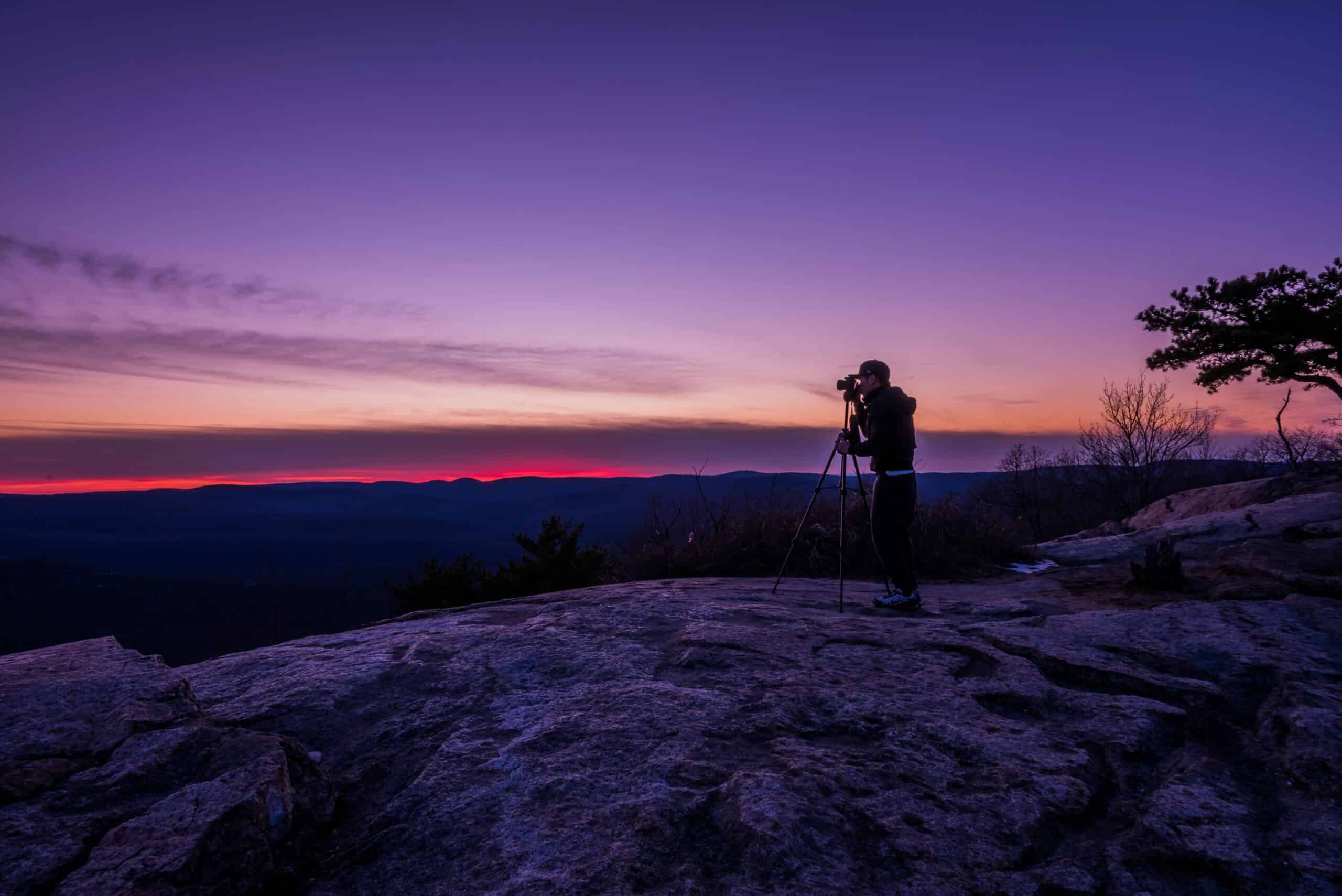
Quick Setup Overview
- Camera: Canon EOS RP — Full Frame 26.2 MP CMOS; Dual Pixel AF; no IBIS; pixel pitch ~5.76 µm; base ISO 100 with ~11.5–12 EV dynamic range.
- Lens: Sony FE 14mm f/1.8 GM — rectilinear ultra‑wide prime; razor sharp from f/2.8–f/8; low coma/CA; mild vignetting wide open. Note: E-mount; use an RF-mount 14mm equivalent on EOS RP.
- Estimated shots & overlap (full 360×180 at 14mm rectilinear, full-frame):
- Efficient: 6 shots at 0°, 6 at +45°, 6 at −45°, plus 1 zenith + 1 nadir = ~20 images (≈25–30% overlap).
- Extra-safe: 8 shots per row (0° / +45° / −45°) + zenith + nadir = 26 images for difficult scenes.
- Partial/cylindrical: 5–6 shots around (no zenith/nadir) for banner panos.
- Difficulty: Moderate — single‑row stitching is straightforward; multi‑row 360s require nodal alignment and careful overlap.
Planning & On-Site Preparation
Evaluate Shooting Environment
Identify moving elements (people, leaves, waves), reflective surfaces (glass, polished floors), and light extremes. Indoors, watch for mixed color temperatures (window daylight vs. tungsten). If shooting near glass, get the lens as close as possible without touching to reduce reflections and ghosting, and use a rubber lens hood if available. For sunsets or night scenes, expect higher dynamic range and plan an HDR panorama with bracketing.
Match Gear to Scene Goals
The Canon EOS RP performs best at ISO 100–800 for panoramas. The full-frame sensor handles shadows well at base ISO, and the 14mm rectilinear FOV helps control perspective lines in interiors. While the Sony FE 14mm f/1.8 GM excels wide open for astro, for panoramas you’ll typically stop down to f/8 for maximum sharpness and consistent corners. Since the RP lacks IBIS, prioritize a solid tripod and remote triggering. If you need fewer frames and can accept fisheye curvature, consider a 7.5–8mm circular fisheye alternative; but for straight architecture lines, rectilinear at 14mm is preferred.
Pre-shoot Checklist
- Charge batteries; bring spares and ample memory (RAW + bracketed shooting multiplies file count).
- Clean lens and sensor; inspect for dust—spot removal is tedious across 20+ frames.
- Level your tripod, calibrate your panoramic head’s nodal (no-parallax) point, and verify index marks.
- Safety: assess wind; weigh down tripod; tether gear on rooftops; use safety lines on poles and car mounts.
- Backup workflow: shoot a second pass if the light or crowd allows; redundancy saves reshoots.
Essential Gear & Setup
Core Gear
- Panoramic head: Lets you rotate around the lens’s entrance pupil to minimize parallax between near and far objects. This is critical when foreground elements are within a few meters.
- Stable tripod with leveling base: A half‑ball or leveling base makes multi‑row capture faster and reduces roll/pitch errors during stitching.
- Remote trigger or app: Prevent vibrations. The RP’s self‑timer works, but a wired remote or Canon Camera Connect app is faster between frames.
Optional Add-ons
- Pole or car mount: Great for overhead or vehicle-based panos, but use tethers and avoid high winds. Rotate slowly and shoot at faster shutter speeds to counter vibrations.
- Lighting aids: Small LED panels can lift shadows for real estate; keep lighting consistent across frames.
- Weather protection: Rain covers and microfiber cloths protect gear and keep your lens clean for consistent stitches.
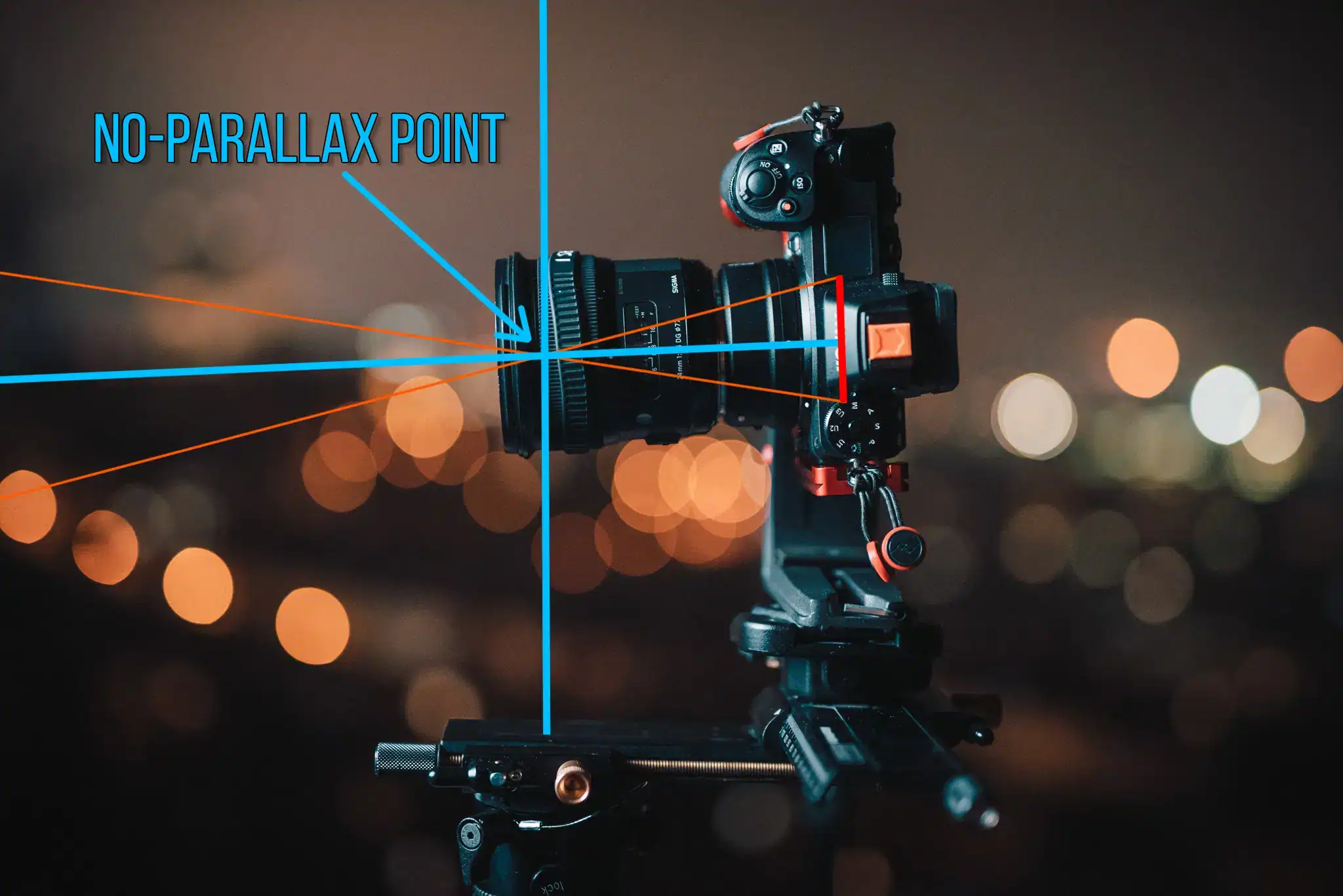
For a deeper primer on panoramic heads and parallax control, see this panoramic head tutorial, which illustrates the concepts with simple field tests. Panoramic head fundamentals
Step-by-Step Shooting Guide
Standard Static Scenes
- Level your tripod and head. Use the leveling base bubble or the camera’s electronic level to ensure your yaw rotation stays in one plane.
- Calibrate and align the nodal point. With a near and far object in view, adjust the fore–aft rail so the near object does not shift relative to the far object as you pan. Mark this setting on your rail for “14mm – full frame”.
- Set manual exposure: Meter the brightest non-specular area you want to retain detail in (often the sky/windows), then dial a base exposure in M mode. Lock white balance (e.g., Daylight, Tungsten, or set a custom Kelvin) to avoid color shifts between frames.
- Focus: Switch to manual focus, magnify live view, focus slightly beyond the hyperfocal distance, then stop down to f/8. At 14mm, hyperfocal at f/8 is roughly ~0.8 m; focusing near 0.8–1.0 m yields sharpness from ~0.4 m to infinity.
- Capture sequence with consistent overlap:
- Row plan A (efficient): 6 around at 0°, then +45° row (6), −45° row (6), one zenith, one nadir.
- Row plan B (high-overlap): 8 per row at each pitch angle, then zenith and nadir.
Use a consistent rotation interval; your panoramic head’s click-stops help.
- Take the nadir (ground) shot by tilting the camera downward, or shoot a separate handheld nadir and later patch the tripod footprint.
HDR / High Dynamic Range Interiors
- Bracket ±2 EV (3 or 5 frames) for each camera position to balance bright windows and interior shadows. The RP’s AEB plus continuous drive works well; alternatively, bracket manually in M mode.
- Lock white balance and keep aperture constant (e.g., f/8). Vary shutter speed only to avoid depth-of-field and vignetting changes.
- Disable long exposure NR to maintain cadence; apply noise reduction in post where needed.
Low-Light / Night Scenes
- Use a solid tripod, remote trigger, and wind shielding. Start at f/4–f/5.6, ISO 100–400, with shutter as needed (1–8 s typical). On the EOS RP, ISO 100–800 is the “safe” pano range; ISO 1600 is usable with careful noise reduction.
- Turn off lens breathing aids (no IBIS on RP; if your lens has IS, disable it on tripod). Use exposure delay or electronic first curtain shutter to reduce vibration.
- Capture extra overlap in very dark scenes; software has more control point options when there’s sufficient detail across frames.
Crowded Events
- Do two passes: a fast pass to capture composition, and a second pass to wait for cleaner gaps. Keep your tripod planted—do not shift position between passes.
- In post, mask moving people across frames to minimize ghosting. A higher-overlap pattern (8 per row) gives you more masking options.
Special Setups (Pole / Car / Drone)
- Pole: Use a carbon pole rated for your load; add a safety tether and keep the camera centered over the pole. Rotate slowly; use faster shutter (1/200–1/500) and a wider aperture if needed to counter sway.
- Car mount: Use industrial suction mounts and safety lines. Avoid highways; shoot at low speeds on smooth surfaces. Consider a shorter sequence (single row + zenith/nadir) to reduce motion mismatch.
- Drone: If your platform supports it, lock exposure/WB and shoot in RAW. Mind prop shadows; rotate with small increments and allow enough time between frames.
Recommended Settings & Pro Tips
Exposure & Focus
| Scenario | Aperture | Shutter | ISO | Notes |
|---|---|---|---|---|
| Daylight outdoor | f/8–f/11 | 1/100–1/250 | 100–200 | Lock WB (Daylight); avoid polarizer for 360 skies |
| Low light / night | f/4–f/5.6 | 1/30–8 s | 100–800 | Tripod + remote; add overlap; watch star trails if >10 s |
| Interior HDR | f/8 | Bracket ±2 EV | 100–400 | Balance windows & lamps; keep aperture constant |
| Action / crowds | f/5.6–f/8 | 1/200+ | 400–800 | Freeze motion; shoot two passes for masking |
Critical Tips
- Manual focus at or near hyperfocal: At 14mm/f/8, ~0.8–1.0 m focus keeps everything sharp from ~0.4 m to infinity.
- Nodal point calibration: Use two vertical objects (one close, one far). Pan left/right; adjust fore–aft until there’s no relative shift. Mark the rail for repeatability.
- White balance lock: Mixed lighting can vary frame to frame. Set one WB (Kelvin or preset) and keep it locked.
- RAW capture: Gives latitude for shadow recovery and color consistency when blending HDR and stitching.
- Stabilization: The EOS RP has no IBIS. If your RF/EF lens has IS, switch it off on a tripod to prevent micro-blur during long exposures.
Stitching & Post-Processing
Software Workflow
Import RAWs; apply basic lens corrections and identical color treatment per bracket set. For HDR panoramas, either merge brackets first (HDR per view, then stitch) or use a stitcher that supports bracketed merging directly (e.g., PTGui Pro). Rectilinear 14mm frames stitch well when you maintain 25–30% overlap. If control points fail around the zenith/nadir, add manual control points or increase overlap in future shoots. PTGui, Hugin, Lightroom/Photoshop, and Affinity Photo all support multi‑row workflows and equirectangular output. DSLR/mirrorless 360 photo stitching overview
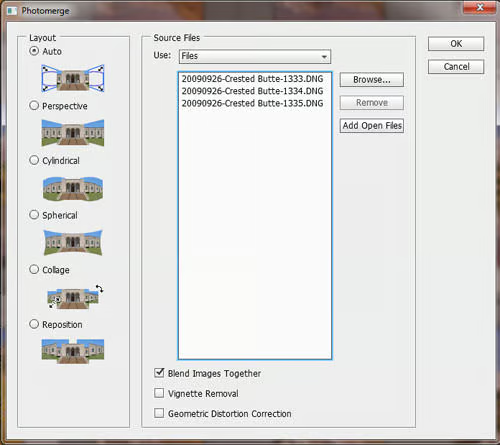
PTGui is a top-tier stitcher known for speed, masking, and excellent control point optimization. If you’re choosing a dedicated tool, compare its features and performance on a small test set before committing. Why many pros pick PTGui
Cleanup & Enhancement
- Nadir patch: Clone out the tripod or use a logo patch. Many modern AI tools can accelerate this step.
- Color and noise: Apply consistent white balance and color grading. Use selective noise reduction for shadow regions in night panos.
- Horizon leveling: Use the stitcher’s optimizer to correct yaw/pitch/roll and ensure the horizon is flat.
- Export: Deliver 2:1 equirectangular at 8K–16K for VR/virtual tours. Save layered masters (TIFF/PSB) and a web-optimized JPEG.
For more reading on focal lengths and pano behavior across software, this reference is helpful. Focal length and panorama considerations
Useful Tools & Resources
Software
- PTGui panorama stitching
- Hugin (open source)
- Lightroom / Photoshop / Affinity Photo
- AI-based tripod removal or object cleanup tools
Hardware
- Panoramic heads: Nodal Ninja, Leofoto, Sunwayfoto
- Carbon fiber tripods with leveling bases
- Wired/wireless remote shutters
- Pole extensions and vehicle mounts with safety tethers
If you want a concise decision guide for DSLR/mirrorless virtual tours and pano heads, this FAQ is a solid overview. Virtual tour camera & lens guide
Common Mistakes & How to Avoid Them
- Parallax error: Always align the entrance pupil on a pano head, especially with near foregrounds.
- Exposure flicker: Shoot in full manual and lock white balance; use fixed aperture for HDR brackets.
- Tripod shadows or footprints: Capture a proper nadir frame and patch it in post.
- Ghosting from movement: Take two passes and mask moving subjects during stitching.
- Night noise and color shifts: Keep ISO low on the EOS RP (≤800 when possible); correct mixed lighting with a consistent WB.
Field-Proven Scenarios
Indoor Real Estate (Mixed Light)
Use f/8, ISO 100–200, and 3–5 bracketed exposures at ±2 EV. Shoot 6×3 rows + zenith/nadir (≈20 frames). Place the camera slightly forward in rooms to minimize mirror reflections. Keep the lens close to window glass (without touching) to reduce reflections and ghosting.
Outdoor Sunset (High DR)
Lock WB to Daylight, f/8, ISO 100. Bracket ±2 EV. Consider 8×3 rows to increase overlap for smooth gradient transitions in the sky. Start capture a few minutes before peak color and shoot a second safety round after peak.
Event Crowds (Motion Control)
Go f/5.6–f/8, ISO 400–800, 1/200+. Two passes: one fast for coverage, one patient for gaps. Mask in post. If the scene is chaotic, consider a shorter cylindrical pano to avoid stitching over moving elements behind the camera.
Rooftop or Pole (Safety First)
Use a tether and sandbags. Shorten exposure times (raise ISO to 400–800) to fight sway. Rotate slower and allow time for vibrations to settle. Avoid gusty conditions.
Entrance Pupil and Resolution Targets
At 14mm rectilinear on full frame, you can complete a full sphere with 18–26 frames depending on overlap and scene complexity. More overlap increases control point density and makes masking easier—particularly useful in foliage or water scenes.
There’s no official factory “no-parallax point” for every lens/body combo; use the two‑object method and document your rail marks. As a rough starting point for many 14mm rectilinears, the entrance pupil is often a few centimeters behind the front element—verify with your setup on the panoramic head. For background reading on spherical resolution planning versus focal length, consult the PanoTools Wiki. Spherical resolution planning
Frequently Asked Questions
- Can I shoot handheld panoramas with the Canon EOS RP?
Yes for simple single-row or cylindrical panos, but for 360×180 spheres, use a tripod and pano head. Handheld shots introduce parallax and stitching errors, especially indoors with close foregrounds.
- Is the Sony FE 14mm f/1.8 GM wide enough for single-row 360?
Not for a full sphere. At 14mm rectilinear, you’ll need multi‑row coverage to capture zenith and nadir. Expect ~20 frames (6×3 rows + zenith/nadir) or ~26 with extra overlap.
- Do I need HDR for interiors with bright windows?
Often yes. Bracket ±2 EV (3 or 5 frames) per position to retain detail in highlights and shadows. Merge the HDR sets consistently before or during stitching.
- How do I avoid parallax issues?
Use a panoramic head and align the entrance pupil. Calibrate by aligning near/far subjects and eliminating their relative shift during yaw rotation, then mark the rail for your “14mm – full-frame” setting.
- What ISO range is safe on the EOS RP for panos?
ISO 100–800 is the sweet spot for clean 360 work. ISO 1600 is usable with careful denoising; beyond that, noise and color shifts increase rapidly in stitched results.
Compatibility & Safety Notes
Because the Sony FE 14mm f/1.8 GM is an E‑mount lens, it’s not natively compatible with the Canon EOS RP’s RF mount. Use an RF/EF 14mm rectilinear lens to replicate the results described here, or mount the GM on a Sony E‑mount body. Always secure your gear in windy or elevated locations, use safety tethers for pole/car setups, and keep bystanders clear of your working area.
Behind-the-Scenes Visuals