
Why This Camera & Lens Are Great for Panoramas
If you’re learning how to shoot panorama with Canon EOS RP & Sony FE 12-24mm f/4 G, you’re aiming for a high-quality, high-coverage setup. The EOS RP is a 26.2MP full-frame mirrorless body with Canon’s Dual Pixel AF, good color science, and a compact form factor that makes it easy to carry on long location days. Its 35mm full-frame sensor (approx. 36×24mm) delivers a pixel pitch of about 5.7µm, which, combined with careful exposure, yields clean files at ISO 100–400 and usable results up to ISO 800 for low-noise panoramas.
The Sony FE 12–24mm f/4 G is a rectilinear ultra-wide zoom. At 12mm on full frame, it provides an expansive horizontal field of view of around 112°, with a vertical FOV of about 90°. That means fewer frames compared to longer focal lengths, while the rectilinear projection preserves straight lines—great for architecture and real estate. It’s impressively sharp across the frame stopped to f/5.6–f/8, with moderate lateral CA that’s easily corrected, and a bulbous front element with built-in hood (no front filters). The combination excels for 360 photos, HDR panoramas, and large single- or multi-row stitches where straight lines must remain straight.
Important compatibility note: the Sony FE 12–24mm f/4 G is a Sony E-mount lens and cannot be natively adapted to Canon RF mount (EOS RP) because of flange distance constraints. In practice, you have two solid options: 1) use a Sony E-mount body with the FE 12–24mm f/4 G or 2) use a similar rectilinear ultra-wide on the EOS RP, such as the Canon RF 14–35mm f/4L IS, Canon EF 11–24mm f/4L (via EF–RF adapter), or Laowa 12mm f/2.8 (EF) via adapter. The shooting workflow below applies directly to the 12–24mm rectilinear class on a full-frame body and translates 1:1 to the EOS RP with an equivalent RF/EF lens.

Quick Setup Overview
- Camera: Canon EOS RP — Full-frame 26.2MP (approx. 6240×4160), base ISO 100, DR roughly 11.5–12 EV at base, Dual Pixel AF, no in-body stabilization.
- Lens: Sony FE 12–24mm f/4 G — rectilinear ultra-wide zoom, best sharpness f/5.6–f/8, built-in hood, strong flare resistance for an ultra-wide, moderate lateral CA.
- Estimated shots & overlap (full-frame, rectilinear):
- At 12mm: Multi-row recommended. Standard reliability: 6 around at 0°, 6 around at +60°, 6 around at −60° + 1 zenith + 1 nadir ≈ 20 frames (30–40% overlap). Interiors: do 8 per row for extra overlap (26 frames).
- At 18mm: 8 around at 0°, 8 at +45°, 8 at −45° + Z/N ≈ 26 frames.
- At 24mm: 10–12 around at 0°, 8–10 at +45°, 8–10 at −45° + Z/N ≈ 30–36 frames.
- Difficulty: Moderate — rectilinear ultra-wide needs careful nodal alignment and overlap planning.
Planning & On-Site Preparation
Evaluate Shooting Environment
Survey light direction, highlight extremes, moving subjects, reflective/glass surfaces, and tight spaces. For glass, shoot at a slight angle and keep the lens a few centimeters from the pane to reduce flare and ghosting. Note any dynamic elements (people, trees, water) and plan for masking or multiple passes. Indoor shoots with bright windows almost always benefit from HDR brackets to balance interiors and exterior daylight.
Match Gear to Scene Goals
For how to shoot panorama with Canon EOS RP & Sony FE 12-24mm f/4 G in mixed lighting or high-contrast scenes, take advantage of the RP’s clean base ISO and the lens’s wide FOV. The EOS RP files are best at ISO 100–400; ISO 800 is acceptable when you need it. The 12mm rectilinear view reduces shot count versus 24–35mm while keeping verticals straight—ideal for architecture, interiors, and real estate. Outdoor sunsets benefit from bracketed exposures and stable tripod usage to maximize detail.
Pre-shoot Checklist
- Charge batteries; carry spares. Format high-speed cards.
- Clean lens (front and rear) and sensor; the 12–24’s bulbous front demands careful wipe-down.
- Level your tripod and verify pano head calibration (no-parallax point).
- Scout wind exposure and secure your rig (especially rooftops or balconies). Use a safety tether if elevated or near crowds.
- Backup workflow: shoot an extra safety round (especially zenith/nadir) in case of misalignment or moving objects.
Essential Gear & Setup
Core Gear
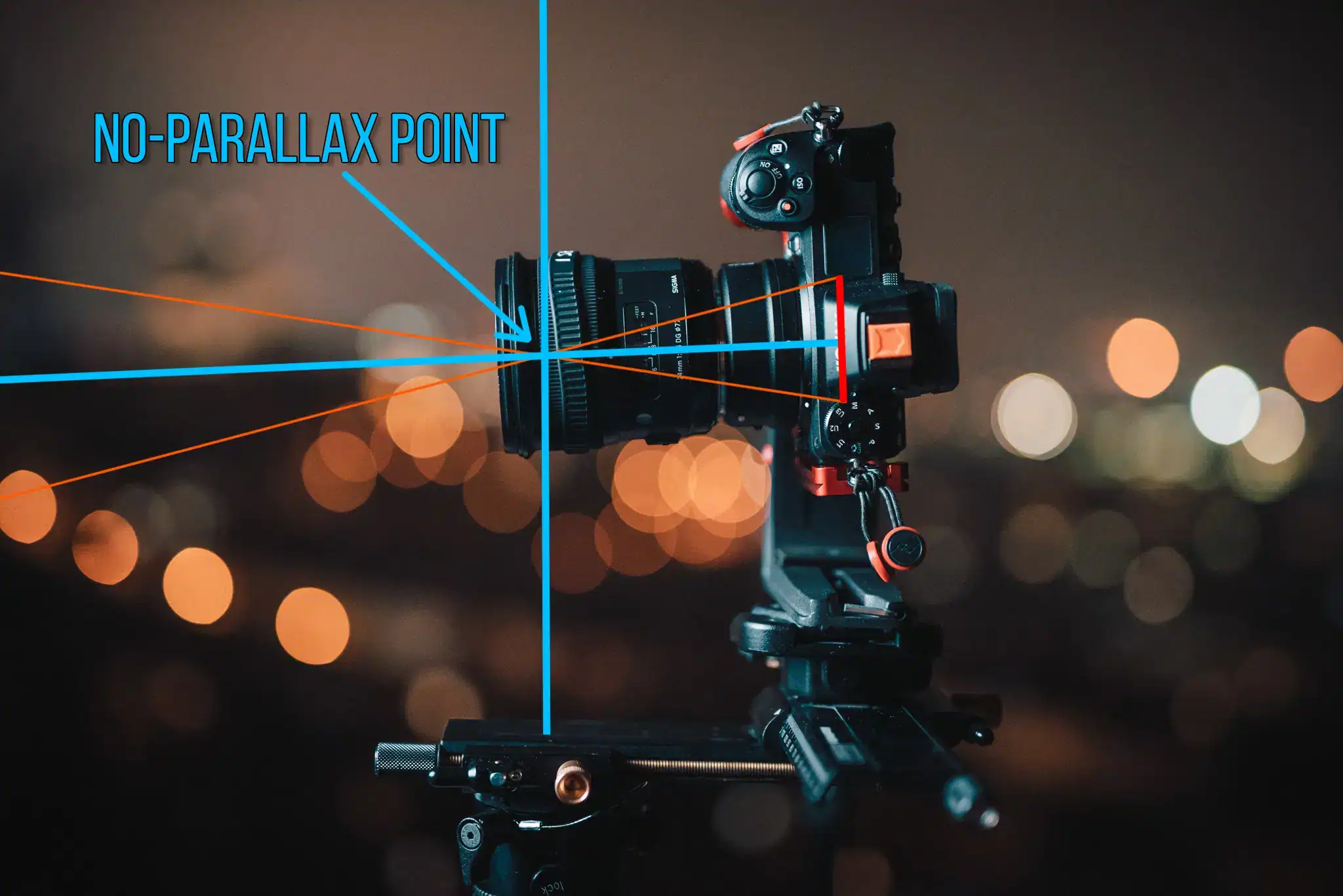
- Panoramic head: This allows rotation around the lens’s no-parallax point (nodal point), preventing foreground/background shifts when you pan. Calibrating this once for your camera/lens combo saves hours of fixing parallax in post.
- Stable tripod with a leveling base: Leveling the base means you can pan smoothly without your horizon drifting frame to frame.
- Remote trigger or app: Reduce vibrations, especially in low light. The EOS RP’s self-timer or smartphone app also works well.
Optional Add-ons
- Pole or car mount: Great for elevated or moving perspectives. Always use a safety tether, mind wind gusts, and drive slowly if car-mounting to reduce vibration.
- Lighting aids: Continuous lights or off-camera flash can lift dim corners in interiors, but keep light positions consistent across frames.
- Weather gear: Rain covers and microfiber cloths for the 12–24’s exposed front element.
Step-by-Step Shooting Guide
Standard Static Scenes
- Level and align: Level the tripod, then adjust your panoramic head so the rotation axis is perfectly horizontal. Verify nodal alignment using a near object and a far object—rotate the camera; if their relative positions shift, fine-tune until they don’t.
- Manual exposure and white balance: Meter for the mid-tones, then set manual exposure and lock white balance (Daylight for sun, Tungsten for warm interiors). Consistency avoids stitching seams and color banding.
- Capture sequence with overlap: At 12mm, shoot 6 frames around at 0°, then a row at +60° and a row at −60° with the same number of frames. Use at least 30% overlap; 40% for interiors or complex patterns.
- Nadir and zenith: Shoot one frame pointing straight down (nadir) for tripod removal and one straight up (zenith) if your upper rows don’t fully cover it.
HDR / High Dynamic Range Interiors
- Bracket ±2 EV: Use 3-frame AEB where possible or manual bracketing. Keep shutter speed as the variable; do not change aperture or ISO mid-pan.
- Lock WB and focus: Prevent color and focus changes between brackets to maintain perfect alignment and color continuity.
- Workflow tip: Either merge brackets into HDR DNGs first (Lightroom) then stitch, or let PTGui handle exposure fusion on raw files for excellent window retention.
Low-Light / Night Scenes
- Use longer exposures on a solid tripod. On EOS RP, ISO 100–400 is optimal; ISO 800 is the practical upper range before noise reduction is needed.
- Remote release or 2s timer: Prevent micro-shake. Turn off image stabilization if you’re using a stabilized lens; the EOS RP body doesn’t have IBIS.
- Mind star movement: If including stars, keep shutter speeds under the 500 rule equivalent for your focal length (e.g., at 12mm, around 30–40s, but bracket and test).
Crowded Events
- Two-pass approach: Do a full clean pass for structure, then a second pass waiting for gaps to capture “clean plates” for areas with people movement.
- Mask in post: In PTGui/Photoshop, use masks to replace blurred or ghosted subjects with the clean plates.
Special Setups (Pole / Car / Drone)
- Pole work: Use a lightweight head and safety tether. Rotate slowly to minimize flex. If you cannot perfectly nodal-align, shoot extra overlap and plan for masking.
- Car-mounted: Drive slowly on smooth pavement. Use higher shutter speeds (1/250–1/500) and increase overlap to counter vibration.
Recommended Settings & Pro Tips
Exposure & Focus
| Scenario | Aperture | Shutter | ISO | Notes |
|---|---|---|---|---|
| Daylight outdoor | f/8–f/11 | 1/100–1/250 | 100–200 | Lock WB to Daylight; watch for flare at 12mm |
| Low light/night | f/4–f/5.6 | 1/30–30s | 100–800 | Tripod and remote; use longer shutters before pushing ISO |
| Interior HDR | f/8 | Bracket ±2 EV | 100–400 | Balance windows and lamps; keep aperture fixed |
| Action / moving subjects | f/5.6–f/8 | 1/200+ | 400–800 | Freeze motion; consider two passes for masking |
Critical Tips
- Manual focus at hyperfocal: At 12mm and f/8 on full-frame, you can set focus near 1m and keep most of the scene sharp to infinity. Use magnification and focus peaking to confirm.
- Nodal point calibration: Mount the camera, place a near object in front of a far object, and pan—adjust the rail until there’s no relative shift. Mark your rail for 12mm and 24mm positions for repeatability.
- White balance lock: Mixed lighting interiors can cause color casts frame to frame. Pick the dominant light and lock WB; adjust globally in post.
- RAW over JPEG: RAW retains highlight and shadow detail for cleaner HDR merges and color correction.
- Stabilization: The EOS RP has no IBIS. If you use a stabilized RF/EF lens, turn stabilization off on a tripod to avoid micro-motions during long exposures.
Stitching & Post-Processing
Software Workflow
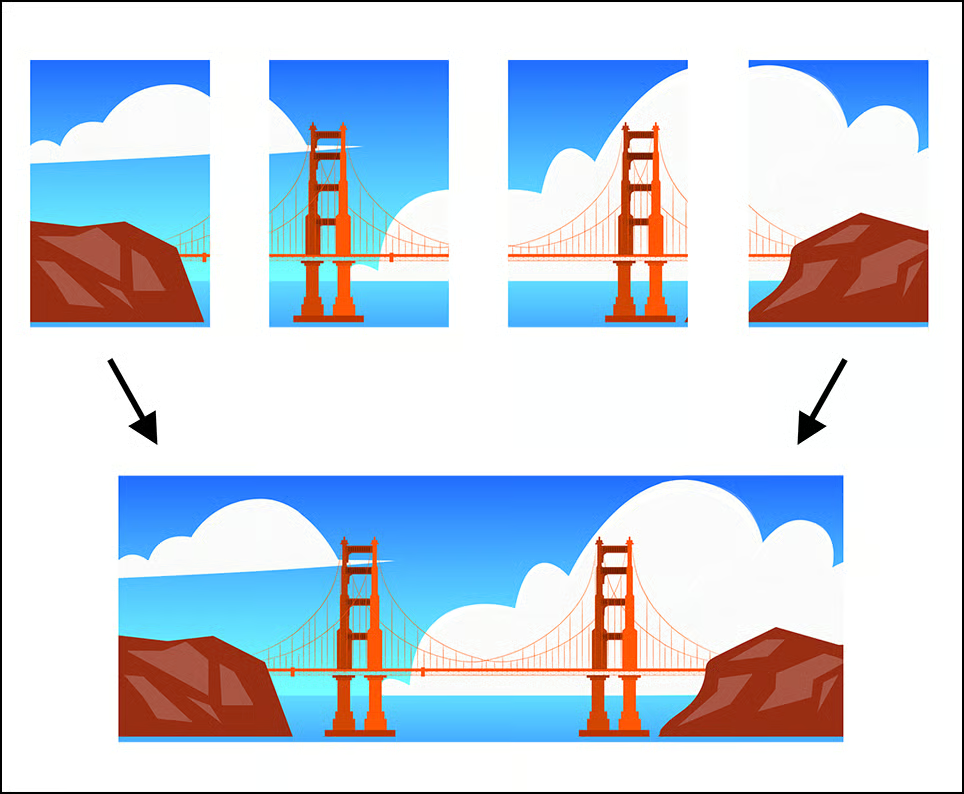
For professional control and reliability, PTGui is the gold standard; Hugin offers a capable open-source alternative, while Lightroom/Photoshop handle simpler stitches. With rectilinear ultra-wide frames, plan for 30–40% overlap to give the optimizer sturdy control points. A typical flow is: ingest RAWs, cull, lens-correct CA and vignetting if desired, optional HDR merge, then stitch to equirectangular. Export a high-bit TIFF for retouching and downsample for web delivery.
Fisheye lenses require fewer shots but curve straight lines; rectilinear lenses like the FE 12–24mm keep architecture honest at the cost of more frames. Industry recommendations are about 25–30% overlap for fisheye and 30–40% overlap for rectilinear ultra-wide. See community-tested resolution notes for focal length vs. frame count planning at Panotools’ DSLR spherical resolution page. Reference: Panotools DSLR spherical resolution
Cleanup & Enhancement
- Nadir patch: Shoot an offset nadir or use a logo/AI patch. Clone or content-aware fill remaining tripod legs.
- Color and noise: Apply a global WB tweak, lift shadows carefully to preserve noise levels, and apply modest noise reduction for ISO 800 night sequences.
- Level and horizon: Use the stitching software’s horizon tool or roll/pitch/yaw adjustments to level the final equirectangular.
- Export: Save a 16-bit TIFF master and a JPEG equirectangular (2:1 ratio) in 8K–12K width for VR and virtual tour platforms.
For a thorough panoramic head primer and a visual guide to achieving high-end 360° shots with DSLRs and mirrorless bodies, see these resources: 360Rumors panoramic head tutorial and the Oculus panoramic head setup guide. For PTGui-specific tips and a review from a working pro’s perspective, read the Fstoppers review. PTGui review on Fstoppers
Useful Tools & Resources
Software
- PTGui for professional stitching and masking
- Hugin (open-source) for budget workflows
- Lightroom / Photoshop for RAW prep and retouch
- AI tripod removal or logo patching tools
Hardware
- Panoramic heads: Nodal Ninja, Leofoto, Fanotec
- Carbon fiber tripods with leveling base
- Wireless remote shutters or intervalometers
- Pole extensions and car mounts with safety tethers
Disclaimer: product mentions are for search reference; check official sites for current specs and compatibility.
Recommended video walkthrough on tripod leveling and nodal alignment:
Common Mistakes & How to Avoid Them
- Parallax errors: Always align to the lens’s no-parallax point and lock down the head before rotating.
- Exposure flicker: Manual exposure and locked WB across all frames, especially during HDR brackets.
- Tripod shadows or footprints: Shoot an extra nadir and use patching; step aside from direct sun angles when possible.
- Ghosting from moving subjects: Shoot a clean plate pass and mask in post.
- High ISO noise at night: Prefer longer shutter over high ISO; keep EOS RP at ISO ≤ 800 when possible.
Field-Proven Scenarios
Indoor Real Estate
At 12mm rectilinear, vertical lines remain straight, which keeps walls and door frames natural. Use f/8, ISO 100–200, and HDR brackets ±2 EV. Do three rows: +60°, 0°, −60° (8 shots per row) plus Z/N for a robust 26-frame set that stitches clean even around stair rails and furniture. Keep the lens a touch higher than eye level to avoid too much ceiling/floor dominance.
Outdoor Sunset
Meter for the highlights and bracket. At 12mm, use 6 per row × 3 rows for efficiency. Time your capture to when the dynamic range compresses just after sunset for fewer blown highlights. Use a shutter release and wait a second after each rotation for vibrations to settle.
Event Crowds
Lock exposure and WB; shoot two passes. In post, blend frames with fewer moving subjects. If people approach too closely, increase overlap and speed up rotation to minimize subject displacement between adjacent frames.
Rooftop or Pole Shooting
Wind is the main danger. Add ballast to the tripod center hook and use a short interval between frames. On a pole, keep rotations slow and smooth; consider shooting more overlap (8 per row instead of 6) to give the stitcher extra matching points.
Frequently Asked Questions
- Can I shoot handheld panoramas with the Canon EOS RP?
Yes, but expect more stitching errors. Use faster shutter speeds (1/200+), high overlap (50%+), and lock exposure/WB. For critical work (interiors, architecture), use a tripod and panoramic head to control parallax.
- Is the Sony FE 12–24mm f/4 G wide enough for single-row 360?
No. At 12mm rectilinear, a single row at 0° covers roughly −45° to +45° vertically. You’ll need at least three rows (+60°, 0°, −60°) plus zenith and nadir for a full 360×180.
- Do I need HDR for interiors with bright windows?
Usually, yes. Bracket ±2 EV (3–5 frames) to capture both interior shadows and exterior highlights. Merge to HDR before stitching or use PTGui’s exposure fusion.
- How do I avoid parallax issues with an ultra-wide rectilinear lens?
Calibrate the no-parallax point on your panoramic head. Align a close object against a distant background and adjust the fore-aft rail until there’s no relative movement when you pan. Mark the rail for 12mm and 24mm so you can repeat it quickly. A solid panoramic head tutorial is here. Panoramic head tutorial
- What ISO range is safe on the EOS RP in low light?
For panoramic quality and easy stitching, ISO 100–400 is ideal; ISO 800 is workable with noise reduction. Prefer longer exposures over pushing ISO.
- Can I set custom modes on the EOS RP for pano?
Yes. Save a custom mode with manual exposure, manual focus, RAW, WB locked, and drive set to a 2s timer or remote. This speeds up consistent results in the field.
- Any advice about lens flare with the 12–24mm?
Avoid direct strong light just outside the frame; shade the lens with your hand or body when possible. Shoot a second frame with a slightly different angle to replace flared areas during masking if needed.
- What’s the best tripod head for this setup?
A two-axis panoramic head with rails for fore-aft and lateral adjustment (e.g., Nodal Ninja / Fanotec, Leofoto) lets you dial the no-parallax point accurately and repeat settings across shoots.
Mount Compatibility & Practical Alternatives
Because Sony FE lenses cannot be natively adapted to Canon RF bodies (the EOS RP’s flange distance is longer), this exact lens/body pairing isn’t practical in the real world. To follow this guide directly, pair the FE 12–24mm with a Sony E-mount full-frame body, or use an equivalent RF/EF ultra-wide on the EOS RP. The capture principles, overlap counts, and post-processing workflow remain identical for rectilinear ultra-wides in the 11–14mm range on full frame.
For a broader look at DSLR/mirrorless 360 pipelines and lens/body planning, see this overview of virtual tour gear considerations. DSLR/mirrorless 360 virtual tour FAQ
Safety, Care, and Backup Workflow
- Wind safety: Use a weighted hook on the tripod and a tether on rooftops or near edges.
- Lens care: The 12–24’s large front element is exposed—use the built-in hood, keep a microfiber cloth handy, and avoid salty spray if possible.
- Redundancy: For mission-critical work, shoot an extra pass and a second nadir. Back up to dual cards (if available on your body) or immediately to a laptop/SSD after the shoot.
- Weather: Carry rain covers and consider silica gel packs for humid shoots to avoid fogging.