Why This Camera & Lens Are Great for Panoramas
If you’re learning how to shoot panorama with Canon EOS RP & Sigma 14-24mm f/2.8 DG DN Art, you’ve picked a powerful wide-angle combo for high-quality 360 photos and immersive landscapes. The Canon EOS RP is a compact full-frame mirrorless camera with a 26.2MP sensor (approx. 6240×4160 pixels, ~5.76µm pixel pitch) that offers solid base ISO dynamic range (~12 EV at ISO 100) and reliable Dual Pixel autofocus for quick setup before switching to manual focus. While the EOS RP lacks in-body image stabilization (IBIS), its light body makes it a great travel and vertical/pole rig companion.
The Sigma 14-24mm f/2.8 DG DN Art is a rectilinear ultra-wide zoom. Rectilinear lenses preserve straight lines (unlike fisheye), which is ideal for architecture and interiors where edge distortion must be controlled. At 14mm, you get an expansive field of view (~114° diagonal, ~104° horizontal, ~81° vertical) that reduces the number of frames compared with longer focal lengths while keeping verticals straight and minimizing the fisheye “bubble” look. The lens is very sharp stopped down to f/5.6–f/8, with good control of chromatic aberration and coma for night scenes.
Important compatibility note: the Sigma 14-24mm f/2.8 DG DN Art is made for mirrorless mounts like Sony E and L-Mount. It does not natively mount to Canon RF (EOS RP) and cannot be adapted across these mounts in a simple way. If you own the EF-mount DG HSM Art version (not DN), you can adapt it to the EOS RP with Canon’s EF–RF adapter and expect very similar optical performance. All shooting guidance in this article applies equally to the EF DG HSM 14-24mm and to any rectilinear ultra-wide in the 14–16mm range on full frame.
Quick Setup Overview
- Camera: Canon EOS RP — Full Frame, 26.2MP, Dual Pixel AF, no IBIS, good base ISO DR (~12 EV), usable ISO for pano on tripod: 100–800.
- Lens: Sigma 14-24mm f/2.8 DG DN Art — Rectilinear ultra-wide zoom; excellent sharpness from f/5.6–f/8; bulbous front element (no standard front filter); low coma/CA for night sky and city lights.
- Estimated shots & overlap (full spherical 360×180):
- 14mm: 8 around at 0° pitch (45° yaw steps) + 1 zenith + 1 nadir = 10 shots. For interior safety, 2 rows of 8 (±30° pitch) + zenith + nadir = 18 shots.
- 18mm: 10–12 around (30–36° yaw steps) + zenith + nadir; or 2 rows 10–12 each + zenith + nadir.
- 24mm: 12–16 around per row; expect two rows + zenith + nadir.
- Difficulty: Intermediate (precise nodal alignment required; exposure discipline for clean stitches).
Planning & On-Site Preparation
Evaluate Shooting Environment
Scan the scene for moving elements (people, cars, trees in wind), reflective surfaces (glass, polished floors), and light sources you may need to balance. If shooting through glass, get the lens hood as close as safely possible (without touching) and keep the front element clean to reduce reflections and flare. When close to glass, shoot slightly off-axis rather than straight-on to minimize self-reflections and ghosting.
Match Gear to Scene Goals
The EOS RP’s full-frame sensor provides clean files at ISO 100–400, with ISO 800 still very usable for night/pole work if needed. Its Dual Pixel AF lets you quickly lock focus on a mid-distance object before switching to manual focus to maintain consistency across frames. The Sigma 14-24mm rectilinear field of view keeps straight lines straight—great for interiors and architecture. While a fisheye requires fewer shots, the 14-24mm keeps horizons and walls natural, which reduces post-correction and looks more realistic in tours.
Pre-shoot Checklist
- Charge batteries, clear or replace memory cards, bring a microfiber cloth for the bulbous front element.
- Level your tripod and verify panoramic head calibration for the lens focal length you’ll use.
- Safety: assess wind, rooftop edges, crowds. Use a safety tether on pole or car mounts. Avoid overhanging obstacles.
- Backup: when time allows, capture a second full round at the same settings in case of motion or stitch misalignment.
Essential Gear & Setup
Core Gear
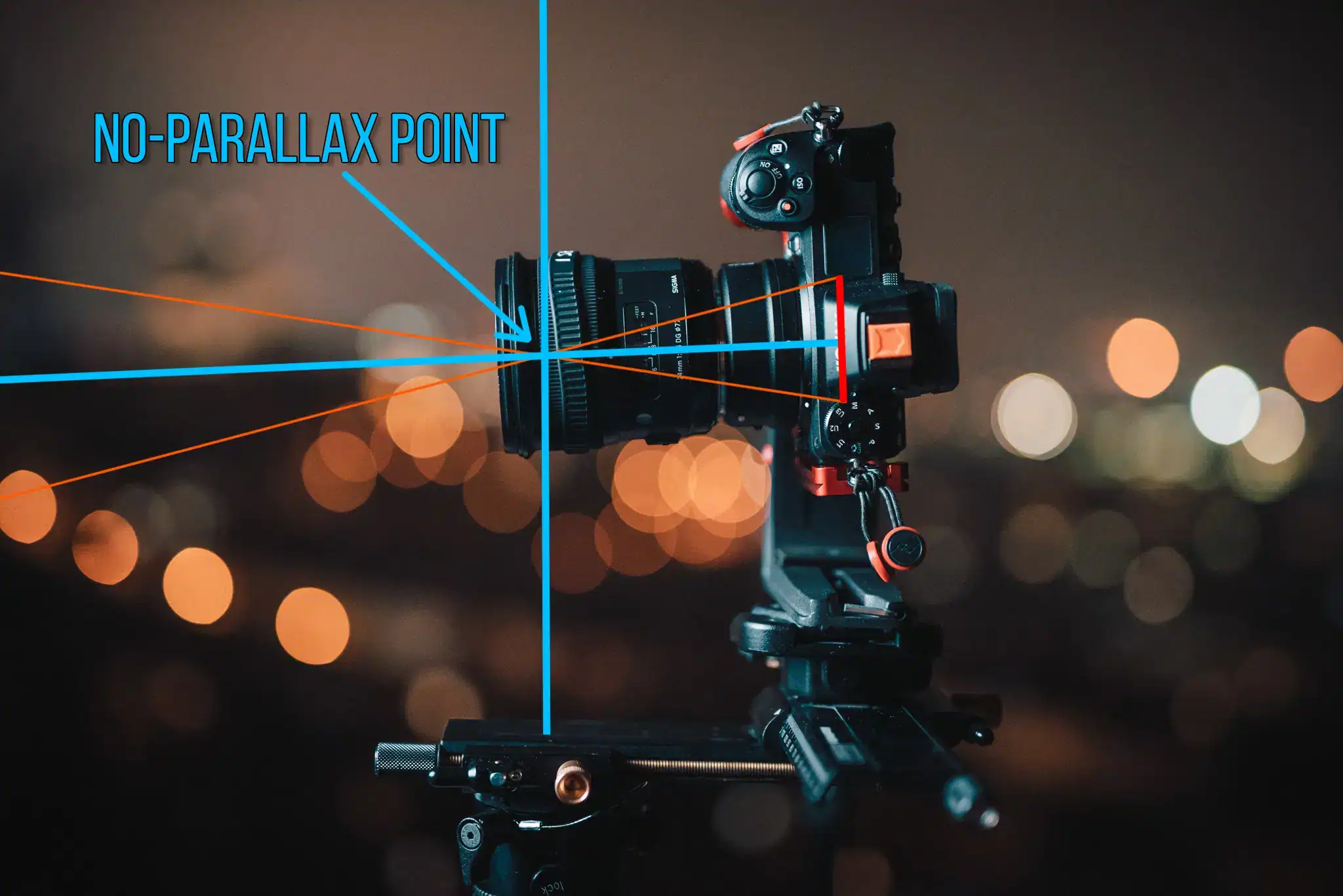
- Panoramic head: enables rotation around the lens’s no-parallax (entrance pupil) point to minimize parallax and stitching errors. Calibrate once per focal length and mark your rails.
- Stable tripod with leveling base: quick leveling saves time and reduces mistakes, especially on uneven ground.
- Remote trigger or Canon Camera Connect app: prevents camera shake during long exposures or HDR brackets.
Optional Add-ons
- Pole or car mount: great for elevated or motion shots. Use a safety tether, avoid high winds, and keep speeds low to reduce vibration.
- Lighting aids: small LED panels or bounced flash for dark corners in interior tours; keep lighting consistency across frames.
- Weather protection: rain cover, lens hood, and a towel. The lens’s bulbous element needs extra care in rain or sea spray.
Compatibility reminder: The Sigma 14-24mm DG DN cannot be mounted on the EOS RP without specialized and impractical adapters. For Canon RF, use the EF-mount Sigma 14-24mm DG HSM via the Canon EF–RF adapter or an RF ultra-wide such as 15-35mm. All workflow steps below remain valid for any rectilinear 14–24mm on full frame.
Step-by-Step Shooting Guide
Standard Static Scenes
- Level the tripod: use a leveling base or the camera’s virtual horizon. A level starting point reduces horizon tilt in stitches.
- Align the nodal point:
- Place a vertical object (light stand or a stick) close in foreground and align it with a distant edge.
- Rotate the head left/right. If the foreground shifts relative to the background, adjust the sliding rail until the shift disappears.
- Mark positions for 14mm and 24mm on your rail for repeatability. As a starting point, the entrance pupil at 14mm is typically around ~100–110 mm forward from the sensor plane on many 14-24s; fine-tune on your specific copy.
- Set manual exposure and lock white balance:
- Meter the brightest part you need to retain detail (e.g., sky), then open up as needed for mid-tones. Or use HDR brackets (see below).
- Set white balance to Daylight/Tungsten/Custom—never Auto—to avoid color shifts between frames.
- Focus:
- Use AF to focus on a subject roughly at the hyperfocal distance, then switch to MF to lock. At 14mm and f/8 on full frame, the hyperfocal is roughly ~0.8 m—focus just beyond arm’s length for front-to-back sharpness.
- Capture the sequence:
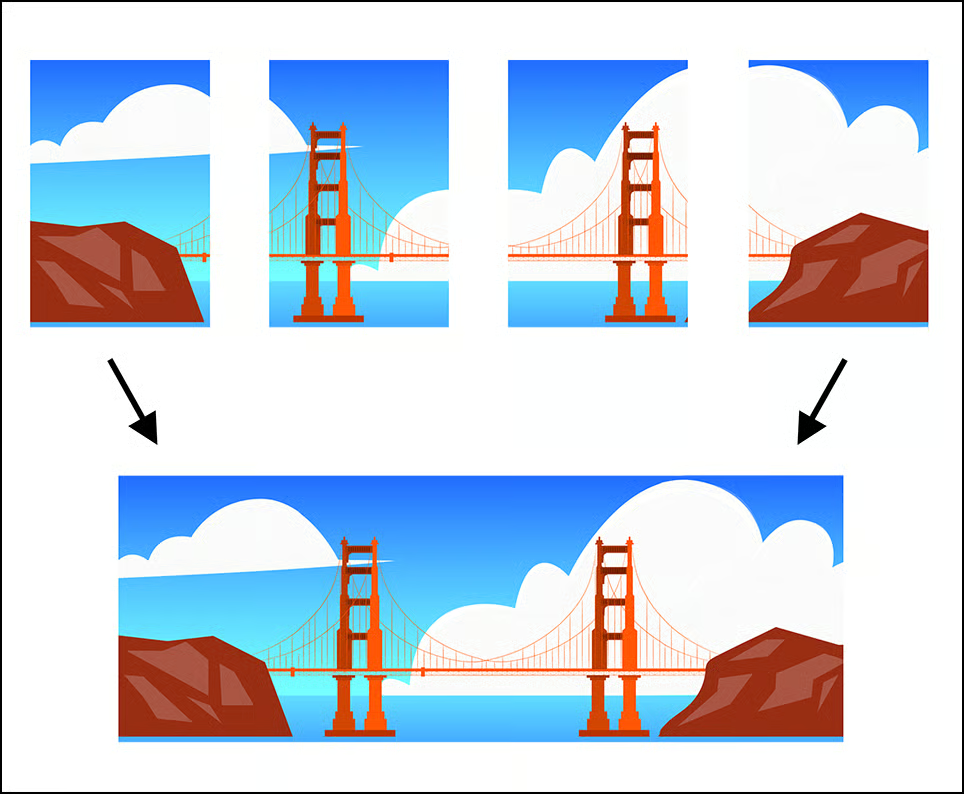
- At 14mm: 8 shots around at 45° yaw increments with 25–30% overlap. Add 1 zenith (tilt +90°) and 1 nadir (tilt -90°), or use a nadir technique (see below).
- Use a consistent cadence: shoot, wait a beat for vibrations to settle, rotate smoothly to the next click-stop.
- Nadir (tripod) shot:
- Option A: shoot a dedicated nadir with the camera offset on the head to reveal the floor under the tripod, then patch in post.
- Option B: take a handheld nadir plate from above the tripod center using the same exposure/WB, then blend during stitching.
HDR / High Dynamic Range Interiors
- Bracket exposures: on the EOS RP, use AEB with 3–5 frames at ±2 EV. This balances bright windows and dark interior shadows.
- Keep WB locked and aperture constant (e.g., f/8). Let shutter speed vary across brackets; avoid changing ISO mid-sequence.
- Trigger with a remote or 2s timer to avoid micro-shake. Wait for swinging lights or moving blinds to settle before each set.
Low-Light / Night Scenes
- Use a sturdy tripod and remote trigger. The EOS RP files are clean at ISO 100–400; ISO 800 is still fine if you need to keep shutter above ~1/15s to avoid light trail artifacts.
- Open to f/4–f/5.6 if needed, but be mindful of corner sharpness and coma at f/2.8; test your copy.
- Turn off any lens stabilization (if present) when on a tripod. The EOS RP has no IBIS, so stability is all about your support and wind control.
Crowded Events
- Shoot two passes: first for coverage, second for clean plates when gaps appear in moving crowds.
- Use shorter shutter speeds (1/125–1/250) at ISO 400–800 to freeze motion, especially if you plan to mask moving people later in post.
- Favor higher overlap (30–40%) so the stitcher has more control points when elements move between frames.
Special Setups (Pole / Car / Elevated)
- Secure the rig with a safety tether. On a pole, keep the camera mass low and rotate slowly to minimize sway.
- On car mounts, shoot when stationary or at very low speed on smooth pavement. Use faster shutter speeds (1/250–1/500). Consider shooting multiple full rounds and choosing the least distorted frames for blending.
- Wind management: the bulbous front element catches wind—shield with your body during long exposures.
Field-Tested Scenarios
Indoor Real Estate
At 14–16mm, shoot 2 rows of 8 with ±30° pitch, plus zenith and nadir. Bracket ±2EV (3–5 frames). Lock WB (Tungsten/Mixed Custom). Keep verticals straight; aim to place the camera near room center at standard eye height (1.5–1.6 m) for natural perspective.
Outdoor Sunset Lookout
Use ISO 100–200, f/8–f/11, 8 shots around + top + bottom. Consider a second bracketed pass if the sun is in frame. Avoid flare by shading the lens with your hand or body, or timing shots when the sun is just below a building edge.
Event Crowds
Single-row at 14mm often suffices; go for 10–12 around if people are close. Shoot a second pass for clean plates. In post, use masks to reduce ghosting. Keep shutter 1/200+ when possible.
Rooftop/Pole
Use lighter accessories. Favor 14mm to minimize the number of frames. Shoot at 1/250 or faster if the pole flexes. Consider two full rounds to ensure at least one clean set per yaw angle.
Recommended Settings & Pro Tips
Exposure & Focus
| Scenario | Aperture | Shutter | ISO | Notes |
|---|---|---|---|---|
| Daylight outdoor | f/8–f/11 | 1/100–1/250 | 100–200 | Lock WB to Daylight; watch for flare |
| Low light/night | f/4–f/5.6 | 1/30–1/60 (tripod) | 400–800 | Remote trigger; wind shield; consider multi-exposure blending |
| Interior HDR | f/8 | Bracket ±2 EV | 100–400 | Balance windows and lamps; keep WB fixed |
| Action / moving subjects | f/5.6–f/8 | 1/200+ | 400–800 | Two-pass strategy for masking movement |
Critical Tips
- Manual focus near the hyperfocal distance for maximum consistency; verify with 10x magnified live view.
- Nodal point calibration: measure and mark rail positions for 14mm and 24mm. Keep a small card taped to your pano head with your numbers.
- White balance lock: Auto WB can shift between frames and cause color discontinuities. Use a custom WB when rooms have mixed lighting.
- Shoot RAW for maximum dynamic range and white balance flexibility; export high-quality 16-bit TIFFs to your stitcher.
- Stabilization: EOS RP has no IBIS. If using a different lens with IS, turn IS off on a tripod to avoid micro-blur.
Stitching & Post-Processing
Software Workflow
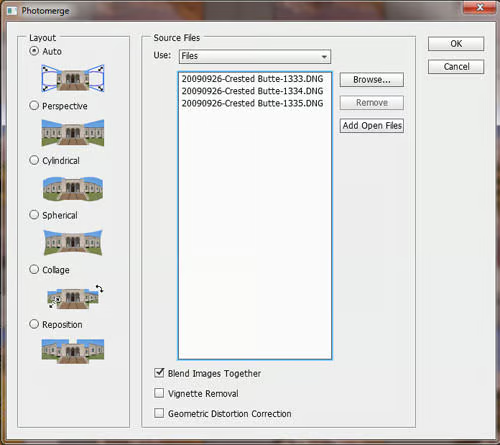
For rectilinear ultra-wides like the Sigma 14-24, modern stitchers handle control points and geometry very well. PTGui is a top-tier choice with robust HDR, masking, and control point editing. Hugin and Lightroom/Photoshop can also work for simpler panoramas. For 360 equirectangular output, maintain overlap of ~25–30% at 14mm and ~20–25% at longer focal lengths for reliable control point generation. After stitching, export equirectangular JPG/TIFF, then publish to your VR/tour platform. For an in-depth review of PTGui’s strengths for pro pano work, see this overview from Fstoppers at the end of this paragraph. PTGui review for creating incredible panoramas
Cleanup & Enhancement
- Nadir patch: use content-aware fill, a logo patch, or AI tools to remove the tripod. Many virtual tour platforms accept a patched nadir tile.
- Color & noise: balance interior color casts, remove color noise at ISO 800, and gently sharpen only after stitching.
- Level horizons: use the stitcher’s optimizer to set “straight line” constraints and zero roll/pitch for a level horizon.
- Output: export a 2:1 equirectangular at 8K–12K on 26MP files for most uses. Check VR platform guidelines for optimal size.
Learn by Watching
If you’re visual, this video demonstrates practical panoramic head setup and shooting discipline for high-end 360 images.
For standardized best practices on pano heads and 360 DSLR workflows, these resources are excellent primers. Panoramic head setup tutorial Using a DSLR or mirrorless to shoot and stitch a 360 photo
Disclaimer: software evolves—verify current features and recommended settings in each app’s latest documentation.
Useful Tools & Resources
Software
- PTGui panorama stitching
- Hugin open source
- Lightroom / Photoshop for pre/post adjustments
- AI tripod removal or content-aware tools for nadir patching
Hardware
- Panoramic heads (Nodal Ninja, Leofoto) with click-stops
- Carbon fiber tripods with leveling bases
- Wireless remote shutters or Canon Camera Connect
- Pole extensions / car suction mounts with tethers
Disclaimer: product names are for reference; check official sites for current specs and compatibility.
Common Mistakes & How to Avoid Them
- Parallax error: always rotate around the entrance pupil; recalibrate after changing focal length.
- Exposure flicker: use full manual exposure and lock WB; don’t let Auto ISO vary across frames.
- Tripod shadows: capture a dedicated nadir and patch; avoid shooting when your shadow dominates the frame.
- Ghosting from movement: take two passes and mask the clean plate in the stitcher.
- Night noise: keep ISO ≤800 on the EOS RP when possible; let shutter run longer on a stable rig.
Frequently Asked Questions
- Can I shoot handheld panoramas with the Canon EOS RP?
Yes for simple single-row landscapes, but for 360×180 or interiors, use a tripod and pano head. Handheld shots often suffer parallax and uneven exposure. If you must go handheld, use high overlap (40%), faster shutter (1/250+), and lock WB/exposure.
- Is the Sigma 14-24mm f/2.8 DG DN Art wide enough for a single-row 360?
At 14mm rectilinear, a single row will usually leave gaps at zenith and nadir. Plan 8 around plus dedicated top and bottom shots, or use two rows of 8 for bulletproof coverage, especially indoors with ceilings.
- Do I need HDR for interiors with bright windows?
Usually yes. Bracketing ±2 EV (3–5 frames) preserves both window detail and interior shadows. Keep aperture and WB constant and use a remote to avoid micro-shake across brackets.
- How do I avoid parallax issues with this lens?
Calibrate the no-parallax point for 14mm and 24mm and mark your pano head rails. Align a close foreground object with a distant edge and adjust until there’s no relative shift when rotating.
- What ISO range is safe on the EOS RP for low light panoramas?
Aim for ISO 100–400 on a tripod. ISO 800 is acceptable when you need faster shutters. Above ISO 1600, noise and reduced DR become more noticeable, especially when blending HDR brackets.
Further Reading
For pano math and spherical coverage expectations with various lenses and sensors, this classic reference is helpful. Panotools: DSLR spherical resolution
Want focal length guidance and artistic considerations for panoramic work? See this primer. B&H: Panoramas, focal lengths, and Photoshop