
Why This Camera & Lens Are Great for Panoramas
If you’re looking for how to shoot panorama with Canon EOS RP & Pentax DA 10-17mm f/3.5-4.5 ED Fisheye, this pairing can be surprisingly capable—especially for 360° work—provided you understand its strengths and limitations. The Canon EOS RP is a lightweight full-frame mirrorless camera with a 26.2 MP sensor (approx. 35.9 × 24 mm, ~5.7 µm pixel pitch). It delivers clean base-ISO files with around 11.5 EV of usable dynamic range at ISO 100, 14‑bit RAW, and reliable Dual Pixel AF for quick pre-focus. The Pentax DA 10–17mm is an APS‑C fisheye zoom that reaches a 180° diagonal field of view at 10mm on APS‑C. On the EOS RP, this means two practical routes:
- Use APS‑C crop mode (1.6×). You’ll avoid full-frame vignetting, get a diagonal fisheye at 10mm, and still retain sufficient resolution for virtual tours (about 10–11 MP output per frame on the RP in crop mode).
- Use full-frame mode at the wider end. Expect heavy vignetting or near-circular coverage at 10–12mm. This can be workable for 360° panos if you mask the circle in PTGui/Hugin, but it’s less forgiving.
Because the DA 10–17mm is a Pentax K‑mount lens, you’ll need a K→RF adapter. For panorama work, being able to stop the lens to f/8 is important. Many simple adapters do not control the Pentax DA aperture (it has no aperture ring), leaving you stuck wide open. Use a K→RF adapter with an internal aperture lever or iris, or choose a variant/adapter that allows stop‑down. When set up correctly, a fisheye dramatically reduces the number of shots required for a full 360°, which speeds up capture and reduces stitching error in busy scenes.
Quick Setup Overview
- Camera: Canon EOS RP — Full-frame 26.2 MP CMOS (approx. 5.7 µm pixel pitch), 14‑bit RAW, ISO 100–40,000, no in‑body stabilization (use tripod), Dual Pixel AF for quick pre‑focus.
- Lens: Pentax DA 10–17mm f/3.5–4.5 ED Fisheye — APS‑C fisheye zoom. Very wide FOV (180° diagonal at 10mm on APS‑C), pronounced fisheye distortion by design; some lateral CA and edge softness typical of fisheyes.
- Estimated shots & overlap (tested guidelines):
- APS‑C crop mode, 10mm: 6 around (60° yaw) + zenith + nadir (25–35% overlap), robust for interiors and exteriors.
- Full-frame, ~11–12mm with circular coverage: 4 around (90° yaw) + zenith + nadir. Requires masking the circle; fast but less flexible.
- Zoomed to ~14–17mm (FF or crop): 8 around + Z + N for safer stitching and cleaner edges.
- Difficulty: Moderate, due to lens adaptation and the need to manage fisheye projection and nodal alignment.
Planning & On-Site Preparation
Evaluate Shooting Environment
Scan for reflective surfaces (glass, polished floors), moving subjects (people, traffic, trees in wind), and strong light sources (sun, point lights) that can cause flare in a fisheye. If you must shoot through glass, place the front element as close as safely possible (1–2 cm) to reduce reflections, and shade the lens with your hand or a black cloth. Avoid pointing directly at the sun when possible; slightly block or reframe to minimize flare streaks and contrast loss.
Match Gear to Scene Goals
The EOS RP’s base ISO performance suits daylight and controlled indoor lighting. For interiors with bright windows, bracketed HDR will expand dynamic range beyond what the sensor can capture in a single exposure. Indoors, ISO 400–800 is a practical ceiling for clean output on the RP; above ISO 1600 you’ll need more aggressive noise reduction. The fisheye’s advantage is speed: fewer shots reduce stitching seams and the chance of ghosting in moving scenes. The trade-off is the characteristic fisheye distortion, which is expected and handled well in pano software.
Pre-shoot Checklist
- Power and storage: fully charged battery, spare, and a high-speed card. The RP’s battery is modest; consider USB power if practical.
- Optics: clean front/rear elements. Check the sensor for dust—spots are far more visible in bright skies when stitched.
- Support: level your tripod; verify panoramic head calibration for this lens/focal length.
- Adapter: ensure your K→RF adapter can stop down the Pentax DA 10–17mm; confirm aperture operation before heading out.
- Safety: assess wind and foot traffic. On rooftops or poles, tether the camera and use a safety line. For car mounts, verify suction/cable redundancy.
- Backup plan: shoot an extra pass at the same yaw steps, especially in busy scenes. If someone walks through a frame, you’ll have a clean alternate.
Essential Gear & Setup
Core Gear
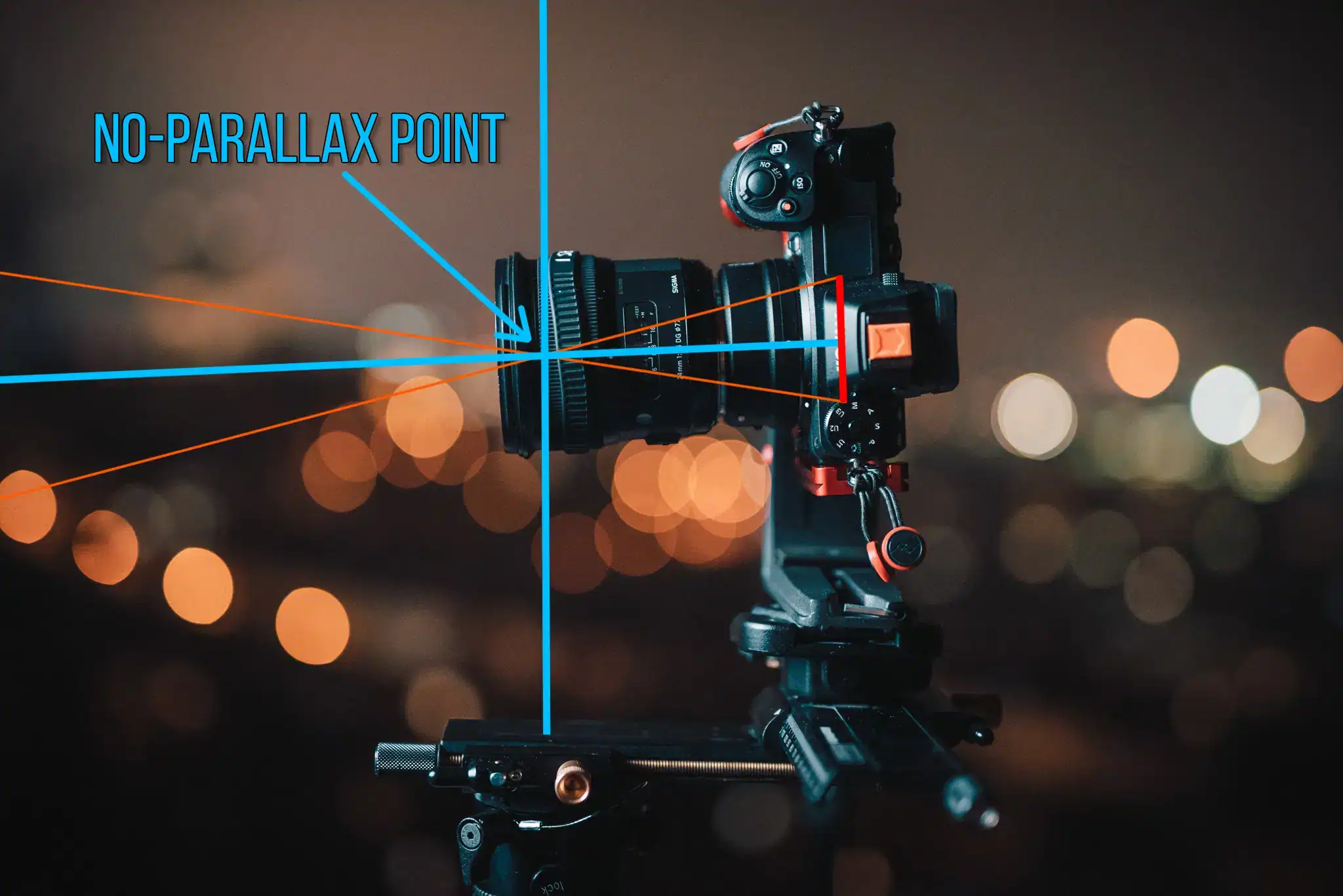
- Panoramic head: enables rotation around the lens’s entrance pupil (nodal point) to eliminate parallax. With a fisheye zoom, note the entrance pupil shifts with focal length—calibrate at the exact focal setting you’ll use.
- Stable tripod with leveling base: a half-ball or leveling base makes it faster to zero the bubble so each yaw step stays horizontal.
- Remote trigger or Canon Camera Connect app: avoid touching the camera to minimize vibrations and misalignment between frames.
Optional Add-ons
- Pole or car mount: always tether your rig; wind loads grow quickly with height and speed. Use high shutter speeds on moving platforms.
- Lighting aids: small LED panels can fill deep interior shadows to reduce HDR steps, but keep them consistent across the rotation.
- Weather and protection: lens hood (or a DIY shade) for flare control; rain covers; silica gel packs for humid environments.
Step-by-Step Shooting Guide
Standard Static Scenes
- Level and lock: level the tripod using the leveling base, then lock all axes except the pan yaw. Check level in live view if your head lacks a bubble.
- Calibrate nodal point: set the lens to the chosen focal length (e.g., 10mm in APS‑C crop mode). Use two vertical reference objects—one near, one far—and adjust the sliding rail until panning causes no relative shift. Mark this position.
- Manual exposure and WB: switch to M mode, meter the brightest frame (avoid clipping highlights), then lock shutter/aperture/ISO. Lock white balance (e.g., 5200K daylight outdoors, 3200–4000K tungsten indoors) to prevent color shifts between frames.
- Focus and shoot: set manual focus at or near hyperfocal. At 10mm APS‑C and f/8, hyperfocal is around 0.66–0.7 m; focus slightly beyond that. Capture 6 frames around at 60° yaw steps, then a zenith and a nadir. For nadir cleanup, offset the tripod and shoot a handheld nadir at the same nodal point if possible.
HDR / High Dynamic Range Interiors
- Bracket at ±2 EV (3–5 frames depending on scene DR). In the RP, use AEB and 2‑sec timer or a remote. Keep aperture and WB locked.
- Shoot all brackets before rotating to the next yaw. Consistency per yaw position helps PTGui/Hugin align stacks and reduces ghosting.
- Windows and mixed lighting: consider a dedicated “window exposure” one stop darker than the standard underexposed bracket for extra highlight headroom.
Low-Light / Night Scenes
- Use a sturdy tripod; there is no IBIS on the RP and the Pentax fisheye has no IS. Start at f/4–f/5.6, 1/30–1/60 s, ISO 400–800. If star points matter, keep shutter under ~15 s to avoid trails, but for city scenes you can go longer.
- Remote trigger or 2‑sec timer eliminates shake. Enable EFCS if available to minimize shutter shock (the RP uses mechanical shutter; reduce vibration with a cable release).
- Consider doing two passes at different times if moving elements (cars, signs) create light streaks you may want to control in post.
Crowded Events
- Two-pass strategy: first pass quickly to get coverage; second pass pause between shots to catch gaps in the crowd. You’ll mask people later.
- Favor faster shutter speeds (1/200 s or faster) at f/5.6–f/8 and ISO 400–800 to minimize motion blur.
- A fisheye’s fewer shots reduce ghosting chances—another reason this combo shines in busy venues.
Special Setups (Pole / Car / Drone)
- Pole: use a lightweight panoramic head or a rotator only. Tether the camera; avoid strong winds. Pre‑mark your yaw positions to minimize time aloft.
- Car mount: use redundant suction plus safety cables; choose 1/1000 s or faster and shoot a single fast row to reduce motion artifacts.
- Drones: the RP is not a drone payload; consider dedicated drone workflows. If shooting from a rooftop near drone paths, maintain safe distances.
Recommended Settings & Pro Tips
Exposure & Focus
| Scenario | Aperture | Shutter | ISO | Notes |
|---|---|---|---|---|
| Daylight outdoor | f/8–f/11 | 1/100–1/250 | 100–200 | Lock WB to Daylight; avoid pointing directly at the sun |
| Low light/night | f/4–f/5.6 | 1/30–1/60 | 400–800 | Tripod essential on RP; use remote or timer |
| Interior HDR | f/8 | Bracket ±2 EV | 100–400 | Expose to preserve window highlights; blend later |
| Action / moving subjects | f/5.6–f/8 | 1/200+ | 400–800 | Two-pass capture and mask moving subjects |
Critical Tips
- Focus: switch to manual and pre‑focus at hyperfocal. For 10mm APS‑C at f/8, set around 0.7 m to keep near‑to‑infinity sharp.
- Nodal calibration: the entrance pupil on fisheyes is often near the front element; however, it shifts across 10–17mm. Calibrate at your working focal length and mark the rail for repeatability.
- White balance: lock a fixed Kelvin or a preset; fisheye frames mix a lot of scene content—auto WB will shift between frames.
- RAW over JPEG: fisheye edges need careful CA/fringe control and tone latitude. 14‑bit RAW gives room for exposure and color corrections.
- Stabilization: the RP has no IBIS. If you ever adapt a stabilized lens, turn IS off on a tripod to prevent micro‑drift during exposure.
- Aperture control: confirm your K→RF adapter can stop down the DA 10–17mm. If not, you’ll be stuck wide open (f/3.5–4.5), which reduces edge sharpness and complicates HDR.
Stitching & Post-Processing
Software Workflow
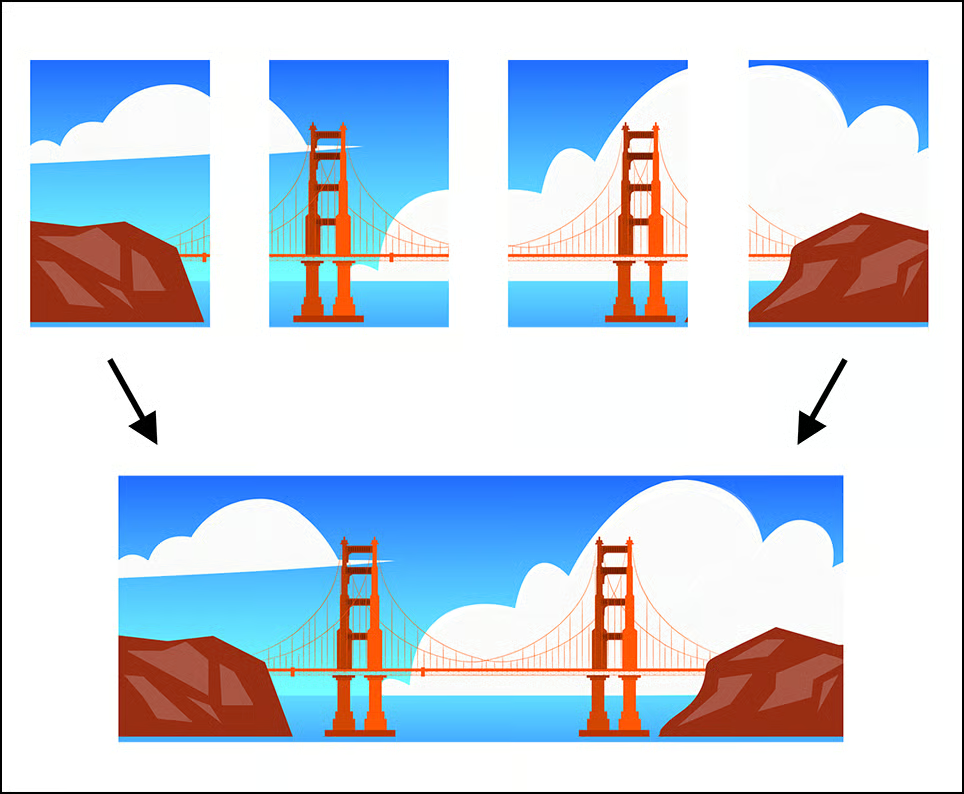
PTGui and Hugin are the most widely used stitchers for fisheye panoramas. A fisheye simplifies capture (fewer frames) and modern stitchers understand fisheye projection natively. With APS‑C 10mm frames, aim for 25–35% overlap. Circular frames (shot in full-frame mode at 10–12mm) require masking the black corners—most stitchers let you set a circular crop/mask per image before alignment. Export an equirectangular 2:1 image for VR viewers. For a deeper look at PTGui’s strengths and workflow, see this review at Fstoppers (end-to-end overview). PTGui review at Fstoppers
Cleanup & Enhancement
- Nadir patch: shoot a clean nadir plate and use PTGui Viewpoint Correction or clone/heal in Photoshop. AI tools can speed up tripod removal.
- Color and noise: apply a consistent profile; fisheye edges may need CA/fringe correction prior to stitching. In low-light panos, denoise before stitching if your tool supports it without breaking control point detection.
- Leveling: correct roll/pitch/yaw so the horizon is straight and the verticals are upright. PTGui offers “straighten” tools; confirm in a 360 viewer.
- Export: typical outputs include 8,192 × 4,096 (8K) equirectangular JPEG/TIFF for web or VR, or higher if your capture supports it.
Recommended Learning
For a practical walkthrough of panoramic head setup and capture technique, this video is a solid primer:
If you want pro-level guidance focused on 360 photo workflows, the Oculus Creator documentation covers DSLR/mirrorless capture and stitching concepts. Using a DSLR or mirrorless to shoot and stitch a 360 photo
Useful Tools & Resources
Software
- PTGui panorama stitching (fast, robust fisheye handling)
- Hugin open source panorama stitcher
- Lightroom / Photoshop for RAW, cleanup, and nadir patching
- AI tripod removal tools for fast nadir cleanup
Hardware
- Panoramic heads: Nodal Ninja, Leofoto, or similar compact rotators
- Carbon fiber tripods with a leveling base
- Wireless remote shutters or Canon Camera Connect
- Pole extensions and vehicle mounts (with safety tether)
For a comprehensive primer on panoramic heads and nodal alignment, see this respected tutorial. Panoramic head setup tutorial
Disclaimer: software/hardware names provided for search reference; check official sites for details.
Common Mistakes & How to Avoid Them
- Parallax error: always rotate around the entrance pupil; recalibrate if you change focal length.
- Exposure flicker: manual exposure and fixed WB prevent visible seams in stitched panos.
- Missed coverage: with a fisheye, it’s easy to under-rotate. Use a click‑stop rotator or mark your yaw steps.
- Tripod shadows and feet: capture a clean nadir and plan for patching.
- Noise at night: keep ISO ≤800 on the RP when possible; lengthen exposure instead (on a tripod).
- Flare with fisheyes: shade the lens, avoid direct sun when possible, or capture an extra frame to blend out flare artifacts.
- Aperture control oversight: verify your adapter can stop down the DA lens; shooting wide open degrades edges and complicates HDR.
Frequently Asked Questions
- Can I shoot handheld panoramas with the Canon EOS RP?
You can for partial panoramas, but for 360° work a tripod and panoramic head are strongly recommended. The RP has no IBIS, and without nodal alignment parallax will cause stitching errors—especially indoors or near objects.
- Is the Pentax DA 10–17mm wide enough for a single-row 360 on the RP?
Yes in APS‑C crop mode at 10mm: 6 shots around plus zenith and nadir is reliable. In full-frame mode near 11–12mm you can attempt 4 around + Z + N using the circular image with masking, but it’s less forgiving.
- Do I need HDR for interiors with bright windows?
Usually, yes. Bracket ±2 EV (3–5 frames) per yaw to retain window detail and clean interiors. Lock WB and aperture across the set to avoid stitch inconsistencies.
- How do I avoid parallax issues with this lens?
Use a panoramic head and align rotation around the entrance pupil. Calibrate at your chosen focal length (e.g., 10mm) and mark the rail. Recheck if you change zoom or focus distance significantly.
- What ISO range is safe on the EOS RP for low light panoramas?
ISO 100–800 is the sweet spot. ISO 1600 is usable with careful denoising, but fine detail may suffer. Prefer longer exposures on a tripod over pushing ISO.
- Can I create a Custom Shooting Mode (C1/C2) for pano?
Yes. Save manual exposure, manual focus, RAW, fixed WB, 2‑sec timer, and any bracketing setup to a Custom Mode. It speeds up repeatable field work.
- How do I reduce flare when using a fisheye?
Shade the front element with your hand or a small flag outside the frame, avoid direct backlight, and capture an extra frame to blend in if flare hits a key area.
- What panoramic head should I use with this setup?
A compact two-axis head with a sliding rail (e.g., Nodal Ninja, Leofoto) works well. Ensure it supports precise fore-aft adjustment for the entrance pupil and has a reliable click‑stop rotator (e.g., 60° for 6-around).
Field Notes and Case Studies
Indoor Real Estate (Bright Windows)
Use APS‑C crop mode at 10mm, f/8, manual focus ~0.7 m. Capture 6 around + Z + N with 5‑shot AEB at ±2 EV. This yields clean window detail and natural interior tones. Keep all lights either on or off per room to avoid color casts between frames, and lock WB around 3800–4200K for mixed tungsten/LED scenes. If a chandelier flickers across frames, try longer shutter speeds to average out PWM flicker.
Outdoor Sunset (High DR, Flare Risk)
Stay in full-frame mode only if you plan to circular-mask frames; otherwise use crop mode for predictable edges. Shoot at f/8, ISO 100, bracket ±2 EV. Compose the sun near a seam rather than center-frame to make blending easier. Capture an extra frame with the sun shaded by your hand, then mask your hand out while preserving the flare-free detail.
Event Crowds (Ghosting Control)
Work fast: 6-around single exposures at 1/200 s, f/5.6–f/8, ISO 400–800. Do a second pass, waiting for gaps to appear. In PTGui, use masks to favor the frame with fewer people in overlapping regions. The fisheye’s reduced shot count helps a lot here.
Rooftop or Pole Shooting (Safety First)
Use the lightest possible head and keep exposure short. Pre‑mark yaw positions (tape marks on the rotator). Tether the camera and never extend a pole near power lines or in strong wind. Consider shooting two shorter rows instead of one if overlap is marginal due to sway.
Technical Clarifications About This Combo
- Adapter behavior: Pentax DA lenses rely on the camera to control aperture. On the RP, you need a K→RF adapter with a mechanical lever or internal iris to stop down. Test at home to confirm the aperture changes correctly across the zoom range.
- Resolution math: In APS‑C crop mode, the RP outputs roughly 10–11 MP per frame. A 6-around + Z + N capture at f/8, well-stitched, still makes a crisp 8K equirectangular for web/VR. For ultra‑high‑res gigapixel work, consider a rectilinear lens on a multi‑row head instead of this fisheye combo.
- Dynamic range: while base ISO DR is solid, the RP’s shadows don’t push as cleanly as higher‑end bodies. If you need extreme tonal latitude, lean on HDR bracketing rather than ISO lifting.
Trusted Learning and Standards
Beyond the basics, professional pano workflows standardize overlap, nodal alignment, and leveling to minimize post fixes. These two resources summarize best practices and are worth bookmarking: Set up a panoramic head for high‑end 360 photos and Best techniques to take 360 panoramas