
Why This Camera & Lens Are Great for Panoramas
If you’re researching how to shoot panorama with Canon EOS RP & Nikon Z 20mm f/1.8 S, you’re already thinking about a lightweight full-frame mirrorless body paired with a critically sharp wide-angle prime. The Canon EOS RP brings a 26.2 MP full-frame sensor (approx. 36 × 24 mm, ~5.76 µm pixel pitch) with Canon’s Dual Pixel AF, a sensible base ISO of 100, and real-world dynamic range around 12 stops at base—plenty for detailed 360 photos when you expose and bracket properly. The Nikon Z 20mm f/1.8 S is a rectilinear prime known for excellent edge sharpness by f/4–f/8, low coma, and well-controlled chromatic aberration, making it superb for high-quality panoramas and astrophotography.
Important mount note: The Nikon Z 20mm f/1.8 S is a Nikon Z-mount lens and the Canon EOS RP uses the Canon RF mount. Because both are short-flange mirrorless mounts, there is no common passive adapter that preserves infinity focus for Z-to-RF. In practical terms, you cannot directly mount the Nikon Z 20/1.8 S on the EOS RP without an optical relay (rare, not recommended for image quality). If you must use this optical formula, use the Nikon Z 20mm on a Nikon Z body; otherwise pair the EOS RP with a comparable RF/EF 20–24mm rectilinear lens (e.g., RF 24mm f/1.8, RF 15–30mm, RF 16mm f/2.8, or EF 20mm f/2.8 via EF–EOS R adapter). The shooting workflow, overlap, and nodal alignment guidance below apply directly to any 20mm rectilinear lens on full frame.
Quick Setup Overview
- Camera: Canon EOS RP — full-frame 26.2 MP sensor, ~12-stop DR at ISO 100, Dual Pixel AF, EFCS (electronic first curtain shutter), no IBIS.
- Lens: Nikon Z 20mm f/1.8 S — rectilinear ultra-wide prime, sharp center-to-edge by f/4–f/8, low coma/CA, minimal distortion for a 20mm, no optical stabilization. Note: mount-incompatible with RP; use a comparable 20mm on RF/EF for this workflow.
- Estimated shots & overlap (full-frame, 20mm rectilinear):
- Conservative 360×180: 3 rows × 10 shots (yaw 36°) at pitch +50°, 0°, −50° + 1 zenith + 1–3 nadirs = 32–34 images (30–40% overlap).
- Minimal 360×180: 3 rows × 8 shots (yaw 45°) at pitch +55°, 0°, −55° + zenith + nadir = 26 images (still safe if carefully leveled).
- Difficulty: Intermediate (precise nodal alignment and multi-row capture required for a perfect sphere).
Planning & On-Site Preparation
Evaluate Shooting Environment
Walk the location before you set up. Identify bright windows, mirrors, and glass walls (watch for ghosting and flare). Note moving elements—people, trees, vehicles—and time your capture for minimal motion, or plan a double pass for masking. For glass shooting (view decks), keep the front element as close as safely possible to the glass (1–3 cm) and shoot slightly off-axis to avoid reflections; use a lens hood as a buffer and bring a microfiber cloth.
Match Gear to Scene Goals
For interiors and real estate, the EOS RP’s ~12-stop base DR is fine when you bracket ±2 EV; aim for ISO 100–400 to preserve shadow detail. Outdoors at sunset, keep ISO at 100–200 and shoot HDR brackets if you have sun in frame. A 20mm rectilinear lens yields minimal perspective bowing and clean lines—great for architecture—but requires multi-row shooting for a full sphere. If you prefer fewer shots, a fisheye (e.g., 8–12 mm) dramatically reduces the count but increases edge stretch and requires careful defishing.
Pre-shoot Checklist
- Power and storage: fully charged battery, fast SD card; carry spares.
- Optics hygiene: clean front/rear elements and the sensor; dust becomes very noticeable in skies.
- Leveling and calibration: ensure your tripod’s leveling base is calibrated and your panoramic head’s nodal rail marks are set for your 20mm lens.
- Safety checks: secure on rooftops and windy sites; use sandbags and a safety tether. For car mounts, double-check suction points, use safety lines, and avoid public roads for complex captures.
- Backup workflow: shoot a second full round or at least a few safety frames at each row in case of motion or missed focus.
Essential Gear & Setup
Core Gear
- Panoramic head: A proper pano head lets you rotate around the lens’s entrance pupil (often called the “nodal point”) to eliminate parallax. This is essential for stitching accuracy, especially with nearby objects.
- Stable tripod with leveling base: Level the base, not just the head, to keep your yaw rotation perfectly horizontal.
- Remote trigger or app: Use the Canon Camera Connect app or a simple wired remote. Enable self-timer if needed to quash vibrations.
Optional Add-ons
- Pole or car mount: Great for crowds or elevated views. Always use a safety tether; consider wind flex and vibration—shorter exposures and stiff carbon poles help.
- Lighting aids: Portable LED panels or flash for dark interiors; use bounced or diffused light to avoid hotspots.
- Weather protection: Rain covers, microfiber cloths, and silica gel packs for humid nights.
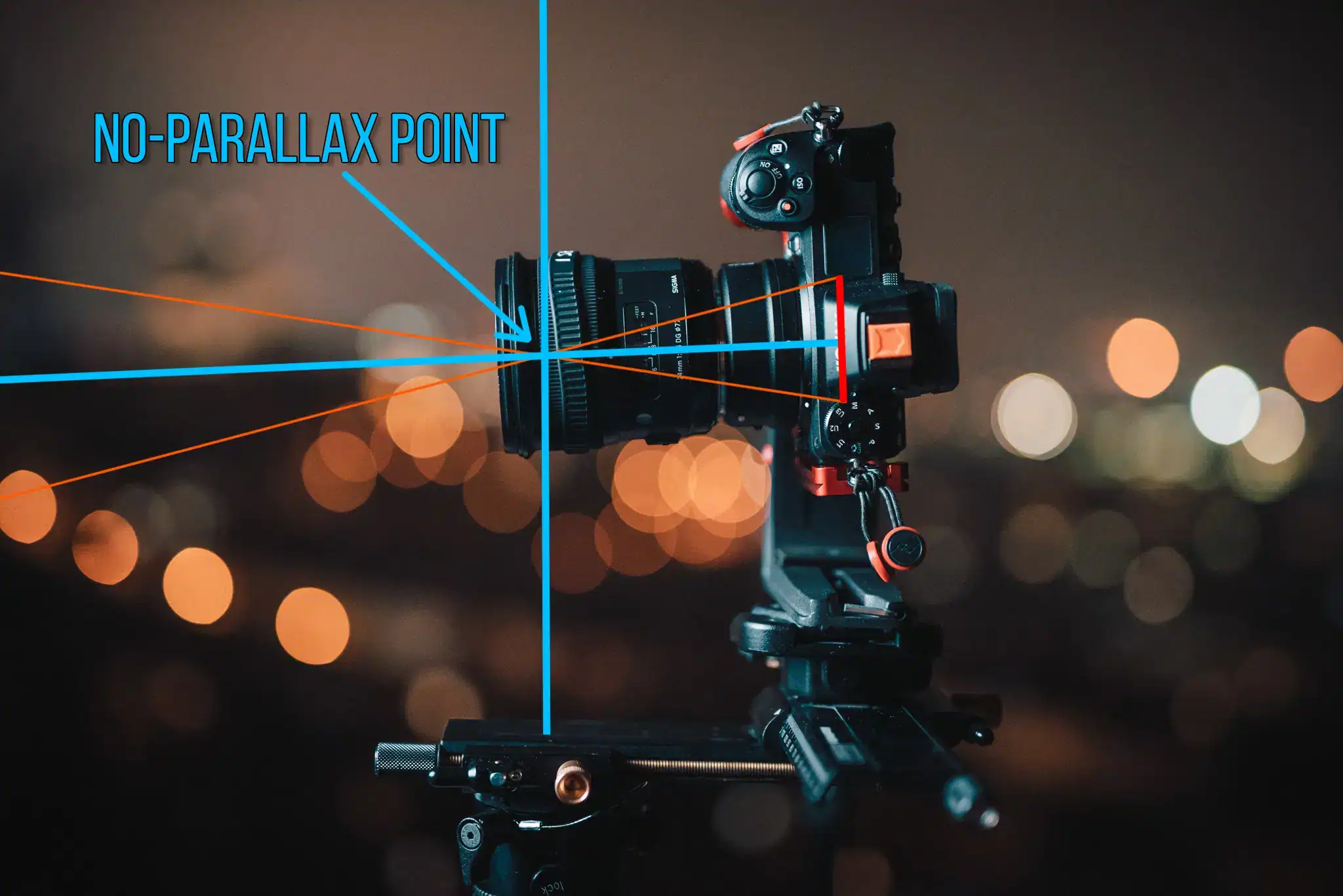
If you’re new to panoramic heads and entrance pupil alignment, this step-by-step video is a solid primer:
For further reading on panoramic head fundamentals, see this panoramic head tutorial for additional diagrams and tips. Panoramic head tutorial
Step-by-Step Shooting Guide
Standard Static Scenes
- Level tripod and align the entrance pupil: Mount the pano head on a leveled base. Slide the camera on the nodal rail and perform a parallax test with a near object and a far object—rotate ±30° and adjust until the foreground and background stay aligned. For a typical 20mm rectilinear on full frame, expect the entrance pupil roughly 70–85 mm forward of the sensor plane, but calibrate precisely for your lens.
- Manual exposure and white balance: Switch to M mode; meter the brightest part you want to retain (e.g., sky). Set WB to a fixed preset or Kelvin (e.g., 5200–5600K outdoors). Disable Auto Lighting Optimizer or any auto-exposure aids to avoid frame-to-frame changes.
- Focus and stabilize: Use manual focus, set around the hyperfocal distance. At 20mm and f/8 on full frame, hyperfocal is about 1.7 m; focusing there keeps everything from roughly 0.85 m to infinity acceptably sharp. Use EFCS on the RP; stabilization off (if your lens has IS) when on tripod.
- Capture with tested overlap:
- Conservative: 10 shots per row at yaw 36° for three rows at +50°, 0°, −50°, then 1 zenith and 1–3 nadirs for patching.
- Minimal: 8 shots per row at yaw 45° for three rows at +55°, 0°, −55°, plus zenith and nadir. Minimal sets demand perfect leveling and careful overlap.
- Nadir capture: Take one or more ground shots after offsetting the tripod or using a handheld nadir while keeping the entrance pupil over the rotation center. A thin light stand or monopod can help for a quick clean nadir.
HDR / High Dynamic Range Interiors
- Bracket ±2 EV or use 5–7 frames at 1 EV steps if windows are extremely bright. Keep the same aperture for every frame and lock WB.
- Use a 2-second self-timer or remote to avoid shake between brackets. Shoot all brackets at each yaw before rotating to the next position.
- For the EOS RP, ISO 100–400 keeps noise manageable. Merge HDR in PTGui or pre-merge to 32-bit in Lightroom before stitching.
Low-Light / Night Scenes
- Open up to f/4–f/5.6 if needed; use shutter speeds around 1/30–1/60 second for static scenes on a sturdy tripod. Favor longer shutter over higher ISO.
- ISO 100–800 is the “safe” range on the RP for pano work. If you must push to ISO 1600–3200, expect more noise in deep shadows—plan for denoising in post.
- Disable any long-exposure NR that introduces time gaps; instead, do noise reduction in post to keep the capture sequence consistent.
Crowded Events
- Do two passes: one quick pass to secure the full coverage, and a second “cleanup” pass waiting for gaps and cleaner sections.
- Mask moving people in post. Favor higher shutter speed (1/200+) and slightly higher ISO to freeze motion where needed.
- Consider elevated capture on a pole to reduce occlusions—safety first.
Special Setups (Pole / Car / Drone)
- Pole: Use a carbon pole, guy lines if possible, and a safety tether. Keep exposures short (1/125–1/500) to reduce shake. Rotate slowly and avoid gusts.
- Car: Only on private/controlled property. Use multiple suction mounts, a safety line, and soft mounts to dampen vibration. Keep shutter speed high (1/500+), and shoot at a stop or very low speed for alignment.
- Drone: If you need a true 360, use the drone’s spherical mode or a manual multi-row. Lock exposure and WB to avoid stitch seams.
Recommended Settings & Pro Tips
Exposure & Focus
| Scenario | Aperture | Shutter | ISO | Notes |
|---|---|---|---|---|
| Daylight outdoor | f/8–f/11 | 1/100–1/250 | 100–200 | Lock WB to Daylight; EFCS on |
| Low light/night | f/4–f/5.6 | 1/30–1/60 | 400–800 | Tripod, remote trigger; denoise in post |
| Interior HDR | f/8 | Bracket ±2 EV | 100–400 | Keep WB fixed; merge to 32-bit |
| Action / moving subjects | f/5.6–f/8 | 1/200+ | 400–800 | Double pass; mask in post |
Critical Tips
- Manual focus near hyperfocal: At 20mm f/8 on full frame, about 1.7 m. Confirm at 10x live view on a mid-distance object.
- Nodal calibration: Use a near object (0.5–1 m) and a far object aligned in the center, rotate, and adjust the rail until there’s no relative shift.
- White balance lock: Avoid Auto WB shifts across frames. Use Kelvin (e.g., 3200K tungsten interiors; 5600K daylight).
- RAW over JPEG: Gives you headroom for highlight recovery and consistent color across rows, essential for HDR panoramas.
- Stabilization: The Nikon Z 20mm f/1.8 S has no VR; the EOS RP has no IBIS. If you use an RF lens with IS, turn IS off on a tripod to avoid drift.
Stitching & Post-Processing
Software Workflow
Import all RAW files into Lightroom or your preferred RAW editor. Apply consistent baseline corrections (lens profile if available, WB, tone). For HDR sets, either let PTGui merge and stitch HDR, or pre-merge to 32-bit HDRs in Lightroom/Photoshop and then stitch the merged frames. Rectilinear 20mm lenses need more shots than fisheyes but reward you with straighter lines and less edge stretch. Aim for 25–35% overlap horizontally and at least 20–25% vertically between rows. PTGui remains an industry favorite for complex multi-row 360s, with robust control-point generation and masking tools. PTGui in-depth review and why pros rely on it
Cleanup & Enhancement
- Nadir patching: Export a layered panorama to Photoshop and use content-aware fill or a dedicated nadir patch. AI-based tools can accelerate tripod removal.
- Color consistency: Check for row-to-row shifts. Harmonize using HSL and local adjustments; keep highlights under control to avoid visible seams.
- Noise reduction: Apply denoising selectively to shadows after stitching; global NR can soften textures you may want to keep.
- Level and straighten: Use the horizon/vertical tool in your stitcher to remove roll/yaw/pitch; verify level by placing horizon lines on the equator.
- Export formats: For VR, export equirectangular JPEG (8-bit) or TIFF (16-bit) at 16k or 8k depending on platform limits.
For a concise big-picture guide on DSLR/mirrorless 360 photo workflows, see this platform-agnostic overview from Meta’s creator docs. Using a DSLR or mirrorless to shoot and stitch a 360 photo
Useful Tools & Resources
Software
- PTGui panorama stitching
- Hugin (open source)
- Lightroom / Photoshop / Affinity Photo
- AI tripod removal tools (content-aware fill, generative tools)
Hardware
- Panoramic heads (Nodal Ninja, Leofoto, Really Right Stuff)
- Carbon fiber tripods with leveling bases
- Wireless remote shutters
- Pole extensions / car mounts with safety tethers
Disclaimer: product names are provided for search reference; verify current features and compatibility on official sites. For deeper dives into spherical resolution and coverage planning, this technical reference is helpful. PanoTools: DSLR spherical resolution
Common Mistakes & How to Avoid Them
- Parallax error → Solve with exact entrance pupil alignment and a leveled base.
- Exposure flicker → Use manual exposure and fixed white balance; disable auto-optimizers.
- Tripod shadows → Capture multiple nadirs or move the tripod for a clean patch frame.
- Ghosting from movement → Double-pass capture; use PTGui masks to favor the clean pass.
- High ISO noise → Keep ISO ≤800 on the RP when possible; favor longer shutter on a tripod.
- Inconsistent overlap → Use a click-stop rotator and keep row pitch consistent (+/−50–55° for 20mm).
Field-Proven Case Studies
Indoor Real Estate (Bright Windows)
Set ISO 100–200, f/8, and bracket ±2 EV (or 5 frames in 1 EV steps for extreme contrast). Shoot a conservative 3-row pattern with 10 shots per row at +50°, 0°, −50° to guarantee generous overlap. Keep the lens close to the room’s nodal reference (e.g., center of a foyer) to reduce parallax from furniture. Stitch HDR in PTGui and patch the nadir with a branded logo.
Outdoor Sunset Overlook
Use ISO 100, f/8, 1/125–1/250; if the sun is in frame, bracket HDR for the row facing the sun only to save time. Time your capture so the brightest sky rows are taken last, minimizing rapid light changes. A graduated filter look can be emulated by blending the HDR correctly.
Crowded Event
Shoot the base sphere quickly at slightly higher shutter (1/200–1/320, ISO 400–800), then repeat selective frames when people clear. In PTGui, mask the quieter frames to minimize ghosts. Elevated pole shots help avoid occlusions; just mind wind and maintain short exposures.
Rooftop or Pole Capture
Use a compact carbon setup with a slim rotator. At 20mm, keep rows tight (8-per-row minimal set) and watch for flex—raise ISO to keep shutter ≥1/125. Always tether the rig. If wind gusts, pause and resume rather than fighting motion blur.
Car-Mounted Drive-Up
Mount on a stationary vehicle in a safe location. Lock exposure and WB; keep shutter fast (1/500+) even when parked to counter vibration. Avoid public roads for multi-row captures—safety is non-negotiable.
Frequently Asked Questions
-
Can I shoot handheld panoramas with the Canon EOS RP?
Yes for simple single-row panos, but for a seamless 360×180 sphere—especially indoors—use a tripod and panoramic head. Handheld multi-row at 20mm risks parallax and misalignment unless everything is very distant.
-
Is the Nikon Z 20mm f/1.8 S wide enough for single-row 360?
No. A single row at 20mm can’t cover zenith and nadir with sufficient overlap. Plan a multi-row pattern (e.g., three rows at +50°, 0°, −50° plus zenith and nadir).
-
Do I need HDR for interiors with bright windows?
Usually yes. Bracketing ±2 EV (or 5 frames at 1 EV steps) recovers window detail and balances interior shadows. Merge frames before or during stitching for the cleanest result.
-
How do I avoid parallax issues?
Use a panoramic head, align the entrance pupil for your 20mm lens, and rotate on a leveled base. Calibrate once and mark your rails for faster field setup. A detailed setup guide from pro workflows is helpful here. Set up a panoramic head for high-end 360 photos
-
What ISO range is safe on the EOS RP in low light?
For high-quality 360s, keep ISO ≤800 when possible. ISO 1600–3200 is usable with careful denoising but expect more shadow noise and reduced dynamic range.
-
Can I set up Custom Shooting Modes (C1/C2) for pano?
Yes. Save manual exposure, fixed WB, manual focus, and EFCS enabled to a custom mode. It speeds up repeats and keeps you from forgetting a setting.
-
What tripod head is best for this setup?
A multi-row panoramic head with fore–aft and lateral rails (e.g., Nodal Ninja, Leofoto, RRS) makes precise entrance pupil alignment easy. For 20mm rectilinear, you’ll appreciate click-stop rotators at 36° or 45° increments.
-
Can I really pair the Nikon Z 20mm with the Canon EOS RP?
Not natively. There’s no common passive adapter that keeps infinity focus for Z-to-RF. Either use the Nikon Z 20mm on a Nikon Z body, or use a comparable 20–24mm RF/EF lens on the EOS RP. The techniques and shot counts in this guide remain valid for any 20mm rectilinear on full frame.
Final Notes and References
Mastering multi-row 360s at 20mm pays off with straight lines, high resolution, and clean stitching. Your best results will come from solid nodal alignment, conservative overlap, fixed exposure and WB, and a deliberate HDR strategy. For other perspectives and pro-level checklists, see community-tested advice and field reports here: Techniques to take 360 panoramas.