
Why This Camera & Lens Are Great for Panoramas
If you want to move fast and still capture high‑quality 360° imagery, a full-frame body with a fisheye zoom is a proven formula. The Canon EOS RP brings a 26.2MP full-frame sensor (approx. 5.75 µm pixel pitch) with friendly ergonomics, reliable color, and usable dynamic range around 11.7–12 EV at base ISO. That’s sufficient headroom for single-exposure 360 photos and HDR brackets in high-contrast interiors. Paired with the Nikon AF‑S 8–15mm f/3.5–4.5E ED Fisheye, you get two useful modes in one lens: a circular fisheye at 8–10mm (covers the frame height with a 180° circle) and a diagonal fisheye at 12–15mm (fills the frame with a 180° diagonal field of view). Fewer shots are needed to complete a spherical panorama compared to rectilinear lenses, which speeds up capture and reduces stitching errors.
Important compatibility note: the Nikon AF‑S 8–15mm is an F‑mount E‑type lens (electromagnetic diaphragm). As of 2025, there is no widely available smart adapter that provides full electronic aperture control and autofocus from Nikon F (E‑type) to Canon RF. Passive F‑to‑RF adapters will leave the lens wide open and without electronic control. That can still work for low-light or fast event capture, but for controlled aperture (f/5.6–f/8) you will need to either: (a) use a Nikon body; or (b) rent a Canon EF 8–15mm f/4L Fisheye with Canon’s EF‑to‑RF adapter for full functionality. The shooting technique below applies equally, but we’ll call out settings for both “wide‑open only” and “stopped‑down” use cases.
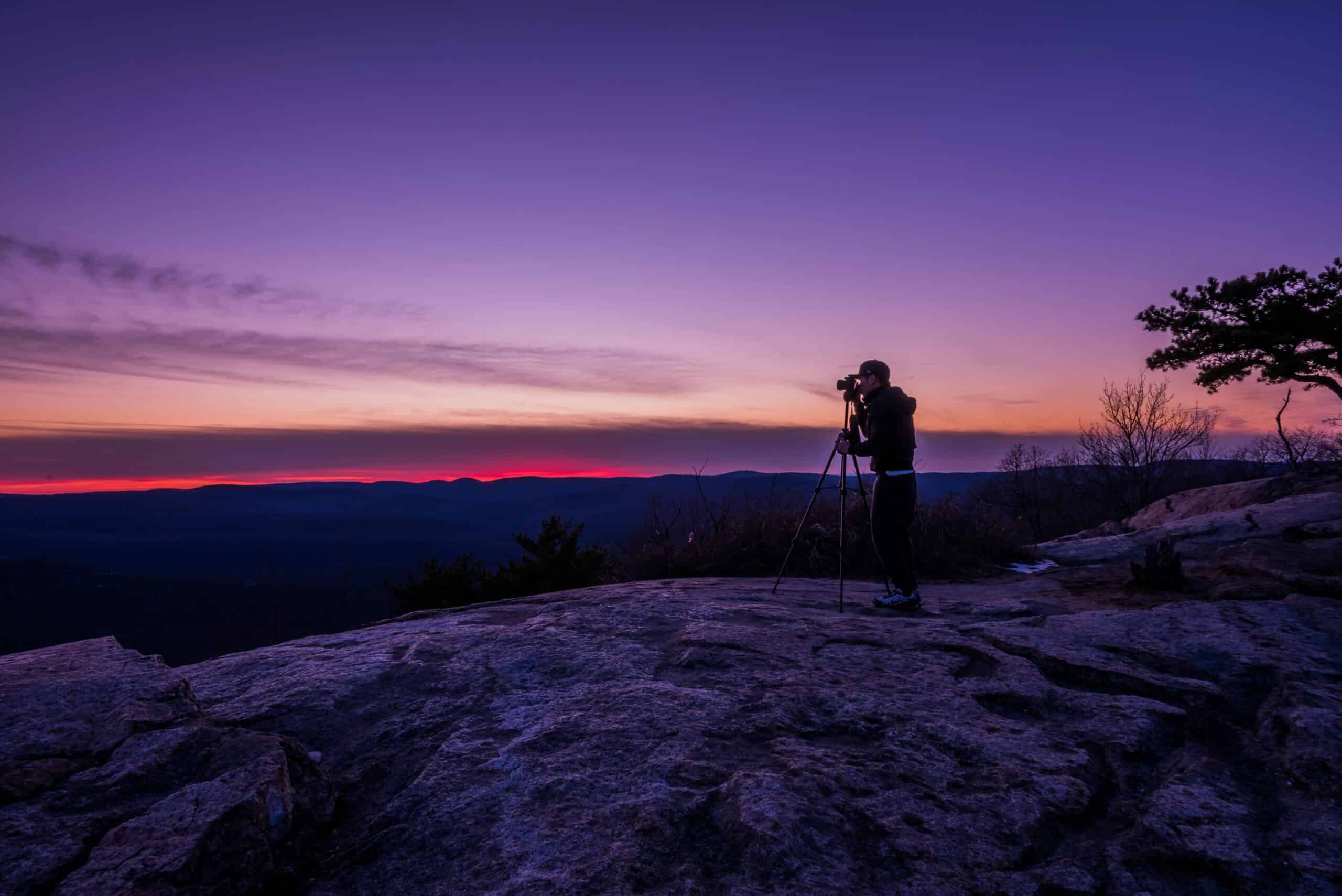
Quick Setup Overview
- Camera: Canon EOS RP — Full Frame, 26.2MP, approx. 5.75 µm pixels, EFCS shutter; good color and DR at ISO 100–400; no IBIS (tripod recommended).
- Lens: Nikon AF‑S 8–15mm f/3.5–4.5E ED Fisheye — fisheye zoom (circular at 8–10mm; diagonal at 12–15mm), very sharp stopped down, typical fisheye CA manageable in post; no VR.
- Estimated shots & overlap (tested guidelines on full frame):
- 8mm circular: 3 around (120° steps) + zenith + nadir; overlap ~30–35%. Safety option: 4 around + Z + N.
- 12mm diagonal: 6 around (60° steps) + zenith + nadir; overlap ~25–30%.
- 15mm diagonal: 8 around (45° steps) + zenith + nadir for highest detail and robust stitching.
- Difficulty: Easy–Medium. Fisheye minimizes shot count; careful nodal calibration and exposure locking are crucial.
Planning & On-Site Preparation
Evaluate Shooting Environment
Before you set up, scan for moving subjects, reflective glass, shiny floors, and strong backlight. In interiors with glass or glossy tiles, keep the lens or pole a little farther from reflective surfaces (0.5–1 m if possible) to reduce flare and ghost reflections. For sunsets and night scenes, anticipate large dynamic range differences; plan bracketing and ensure your tripod location minimizes shadows in the nadir area.
Match Gear to Scene Goals
The Canon EOS RP handles ISO 100–400 extremely well; ISO 800 remains usable with modest noise reduction. In dim churches or city twilight, you can keep ISO low by using a tripod and longer exposures. The fisheye’s 180° FOV (at 8mm circular or 12–15mm diagonal) dramatically reduces the number of shots needed—ideal for crowded events or rooftop pole work where speed matters. The trade-off is fisheye distortion, which is expected and handled in stitching software. If you must shoot stopped down (f/5.6–f/8 for maximum edge sharpness), consider the adapter limitation with this Nikon E‑type lens on Canon RF; otherwise, plan to run it wide open and compensate with shutter/ISO.
Pre-shoot Checklist
- Charge batteries; bring spares. The RP is efficient but 360 workflows involve more exposures per scene.
- Use fast, reliable UHS-II cards; shoot RAW for maximum latitude.
- Clean the fisheye front element—smudges and dust are magnified by the large FOV.
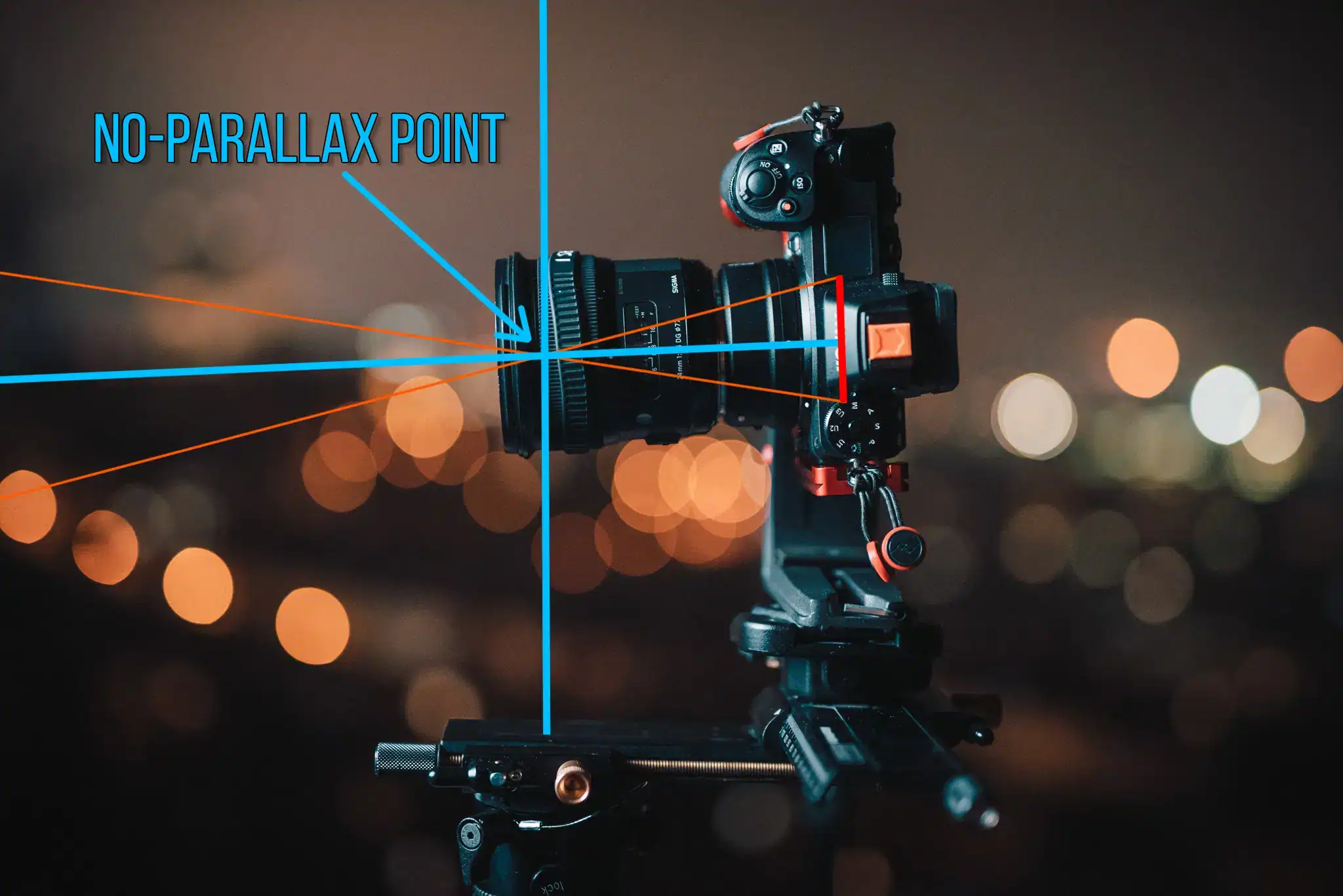
- Level your tripod; calibrate your panoramic head for the lens’ no‑parallax point.
- Safety: weigh down the tripod or tether on rooftops; avoid strong winds with pole setups; add a safety line to the camera.
- Backup workflow: in critical jobs, run a second capture pass for redundancy (especially if people or vehicles may cause ghosting).
Essential Gear & Setup
Core Gear
- Panoramic head: A rotator with fore‑aft and left‑right rail lets you align the entrance pupil (nodal point) over the yaw axis, preventing parallax when rotating. This is non‑negotiable for clean stitches with nearby objects.
- Stable tripod with leveling base: A leveling base speeds setup; keep the yaw axis vertical so horizon leveling is easy in post.
- Remote trigger or app: Use Canon’s app or a cable release to avoid micro‑shake. Enable EFCS on the RP to further reduce vibration.
Optional Add-ons
- Pole or car mount: For elevated or moving shots. Use guy lines and a safety tether; rotate more slowly to reduce vibration blur.
- Lighting aids: Small LED panels or bounced flash for dim interiors when HDR is undesirable.
- Weather protection: Rain cover for the RP; keep a microfiber cloth for the fisheye’s exposed front element.
Step-by-Step Shooting Guide
Standard Static Scenes
- Level and align: Level the tripod with a bubble or the leveling base. On the panoramic head, set the fore‑aft rail so the lens’ entrance pupil sits precisely above the rotation axis. Practical method: align two vertical objects (one close, one far) in the center of the frame; rotate 30–45° and adjust the rail until their relative alignment doesn’t shift.
- Manual exposure and white balance: Set M mode. Choose a target exposure from the midtones; keep ISO 100–200 for best quality on the RP. Lock white balance to a fixed preset (Daylight/Tungsten) or a Kelvin value (e.g., 5200K) to avoid stitching color shifts.
- Focus: Use manual focus with focus peaking in live view. For 12–15mm at f/8, hyperfocal is roughly 0.6–0.8 m; set focus just beyond 0.6 m and everything from ~0.3–0.4 m to infinity will be sharp. If your adapter forces you wide open, focus more carefully—take a test shot at 100% to confirm corner sharpness.
- Capture sequence:
- 8mm circular: 3 around at 0°/120°/240° + 1 zenith + 1 nadir, or 4 around for extra overlap.
- 12mm diagonal: 6 around at 60° steps + zenith + nadir.
- 15mm diagonal: 8 around at 45° steps + zenith + nadir.
Rotate consistently; use the rotator’s click-stops if available. Cover the nadir by tilting the head down or removing the camera and shooting straight down to patch later.
HDR / High Dynamic Range Interiors
- Bracket ±2 EV (3 or 5 frames). With large windows, consider ±3 EV to protect highlight detail. Keep the same brackets for every angle to ensure even tonality.
- Lock white balance and focus. Any shift between brackets creates color banding or focus breathing artifacts that complicate stitching.
Low-Light / Night Scenes
- Use a tripod and EFCS; turn off any stabilization (none on this Nikon fisheye). Start with f/4–f/5.6 (or wide open if adapter forces it) and ISO 100–400, letting shutter lengthen to 1–8 seconds as needed.
- Trigger remotely and wait a second after each rotation to let vibrations settle. Long exposures reduce noise better than pushing ISO high on the RP.
Crowded Events
- Do two passes: a fast base row for coverage and a second pass where you wait for gaps. Later, use masks to keep the clean parts from each frame.
- Favor 8mm circular (3–4 around) to shorten the time people have to move. Keep the tripod tucked in and visible signage for safety.
Special Setups (Pole / Car / Drone)
- Pole: Balance and guy the pole; attach a safety tether. Use faster shutter speeds (1/250–1/500) and higher ISO (400–800) if necessary to counter sway.
- Car mount: Soft mounts introduce vibration. Pre‑plan a route with smooth pavement; shoot at stops if possible. Rotate slower than usual.
Recommended Settings & Pro Tips
Exposure & Focus
| Scenario | Aperture | Shutter | ISO | Notes |
|---|---|---|---|---|
| Daylight outdoor | f/8–f/11 | 1/100–1/250 | 100–200 | Lock WB (Daylight). If aperture control isn’t available, use f/3.5–4.5 wide open and bump shutter speed. |
| Low light/night | f/4–f/5.6 | 1/30–8s | 100–400 | Tripod + EFCS; remote trigger; prefer longer shutter over higher ISO. |
| Interior HDR | f/8 | Bracket ±2 EV | 100–400 | Protect window highlights; consistent brackets per angle. |
| Action / moving subjects | f/5.6–f/8 | 1/200+ | 400–800 | Freeze motion; shoot a second pass for clean plates. |
Critical Tips
- Manual focus at or near hyperfocal. At 12–15mm and f/8, setting focus ~0.6–0.8 m keeps everything sharp from ~0.3 m to infinity.
- Nodal point calibration: Mark the fore‑aft rail position for 8mm and for 12–15mm on your pano head once you find it. For many 8–15mm fisheyes on full frame, the entrance pupil at 8–12mm is close to the front element; expect the camera to be pushed forward on the rail. Start around 60–70 mm from the sensor plane mark and fine‑tune.
- White balance lock: Set WB to a fixed preset or Kelvin value before the first shot. Mixed AWB frames can cause visible seams.
- RAW over JPEG: Gives you the dynamic range and color latitude needed for smooth panoramas and HDR merging.
- Stabilization: The RP lacks IBIS; the Nikon lens has no VR. The tripod must supply all stability; enable EFCS to minimize shutter shock.
Stitching & Post-Processing
Software Workflow
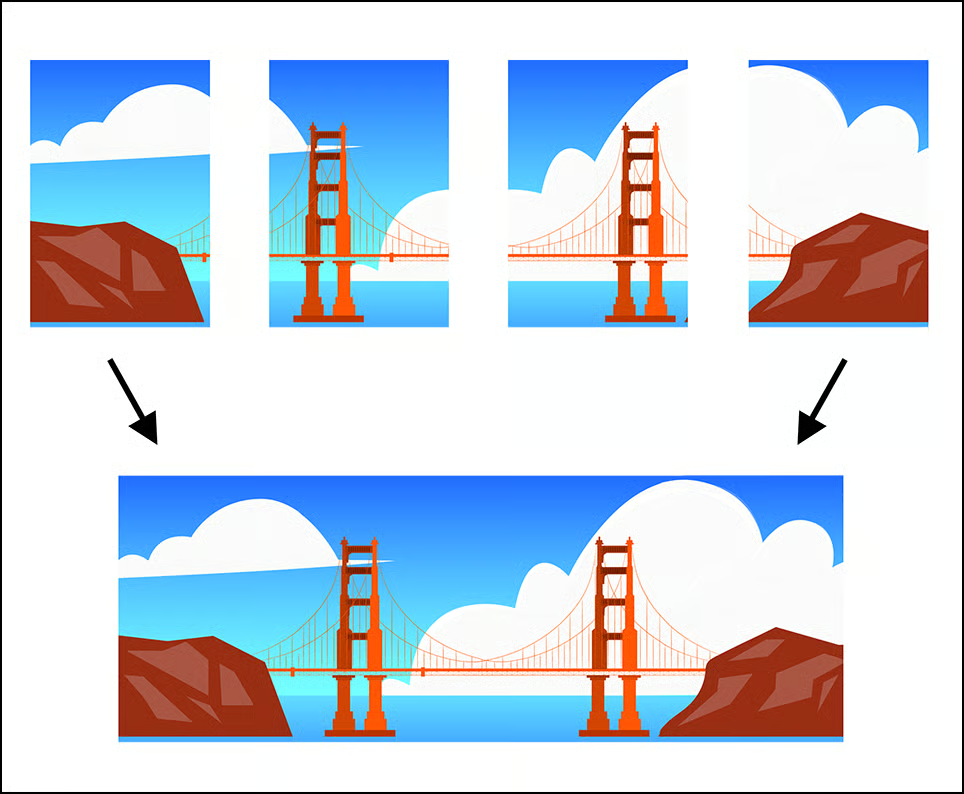
Import RAWs into Lightroom/ACR first for consistent white balance, lens chromatic aberration fixes, and noise reduction if needed. Then stitch in PTGui or Hugin. For fisheye input, set the proper lens type (circular or full‑frame/diagonal fisheye), and let the optimizer find control points. Industry practice uses 25–35% overlap for fisheyes and 20–25% for rectilinear lenses; with 3–6 shots around you’ll typically have more than enough overlap for solid control points.
PTGui’s Mask tool is excellent for removing moving people or tripods by blending clean regions from alternate frames. Export an equirectangular 2:1 image at 8K to 16K depending on your target platform and the detail you captured. For VR platforms, keep metadata and output JPEG (quality 90–95) or 16‑bit TIFF for further retouching.
For deeper dives, see a panoramic head setup walkthrough and stitching best practices: Panoramic head essentials (360 Rumors). For pro stitching, PTGui is a favorite in the industry; here’s a review discussing strengths and workflow: PTGui review on Fstoppers.
Cleanup & Enhancement
- Nadir patch: Capture a dedicated nadir shot after moving the tripod, then patch in PTGui (Viewpoint correction) or Photoshop. AI content-aware tools can help hide seams.
- Color and noise: Apply modest noise reduction for ISO 400–800 images from the RP; keep grain fine for texture realism.
- Leveling: Use the “Straighten” tool in PTGui or set yaw/pitch/roll numerically to level horizons.
- Export: Equirectangular 2:1 at 8192×4096 or 10240×5120 for web; 12–16K for high-end tours and large displays.
If you’re publishing to VR, Meta’s guide to DSLR capture and stitching offers helpful standards: Using a DSLR or mirrorless to shoot and stitch a 360 photo.
Useful Tools & Resources
Software
- PTGui for precision stitching, masks, and Viewpoint correction.
- Hugin (open-source) for robust control point generation and projection options.
- Lightroom / Photoshop for RAW prep, color, and nadir patching.
- AI tools (Content-Aware Fill, generative fill) for tripod removal.
Hardware
- Panoramic heads (Nodal Ninja, Leofoto) with fore‑aft rails and click‑stop rotators.
- Carbon fiber tripods for stiffness and lighter travel weight.
- Leveling bases to get the yaw axis vertical fast.
- Wireless remotes or intervalometers.
- Pole extensions and car suction mounts (with safety tethers).
Disclaimer: product names are for reference only—verify features and compatibility on official sites.
Field-Tested Scenarios & Settings
Indoor Real Estate (Bright Windows)
Use 12–15mm diagonal with 6 around + Z + N. Shoot RAW, f/8 (if you can control aperture), ISO 100–200, bracket ±2 EV. Keep white balance fixed (e.g., 4000–4500K if tungsten dominates). Capture an extra pass with blinds partially closed if glare is severe; blend in post. If forced wide open, increase shutter speed to avoid window blowout and use more aggressive bracketing (±3 EV).
Outdoor Sunset
At 12mm, shoot 6 around + Z + N at f/8, ISO 100. Bracket 5 frames (±2 EV). Time your rotation so the sun’s position doesn’t change much between frames—begin on the sun side and work quickly. Consider a partial sun block with your hand outside the frame to reduce flare, then mask during stitching.
Event Crowds
Go 8mm circular: 3 around + Z + N. Use 1/200s at ISO 400–800 to freeze motion, f/4–f/5.6 if possible; if stuck wide open, bump shutter speed a notch and keep focus nailed. Shoot a second pass to get plates without moving people for easy masking in PTGui.
Rooftop / Pole Shooting
Wind is the enemy. Use 8mm circular to minimize time aloft. Shutter 1/250–1/500s, ISO 400–800, and shoot in short bursts at each angle. A safety tether on both camera and pole is essential. Rotate slower and let oscillations settle before firing.
Car-Mounted Capture
Only on private property or controlled environments. Use the diagonal fisheye at 12mm and higher shutter speeds (1/1000s+) with ISO 800–1600 (accept some noise). Shoot during overcast for even light and fewer reflections. Stop the car for a clean nadir shot to patch later.
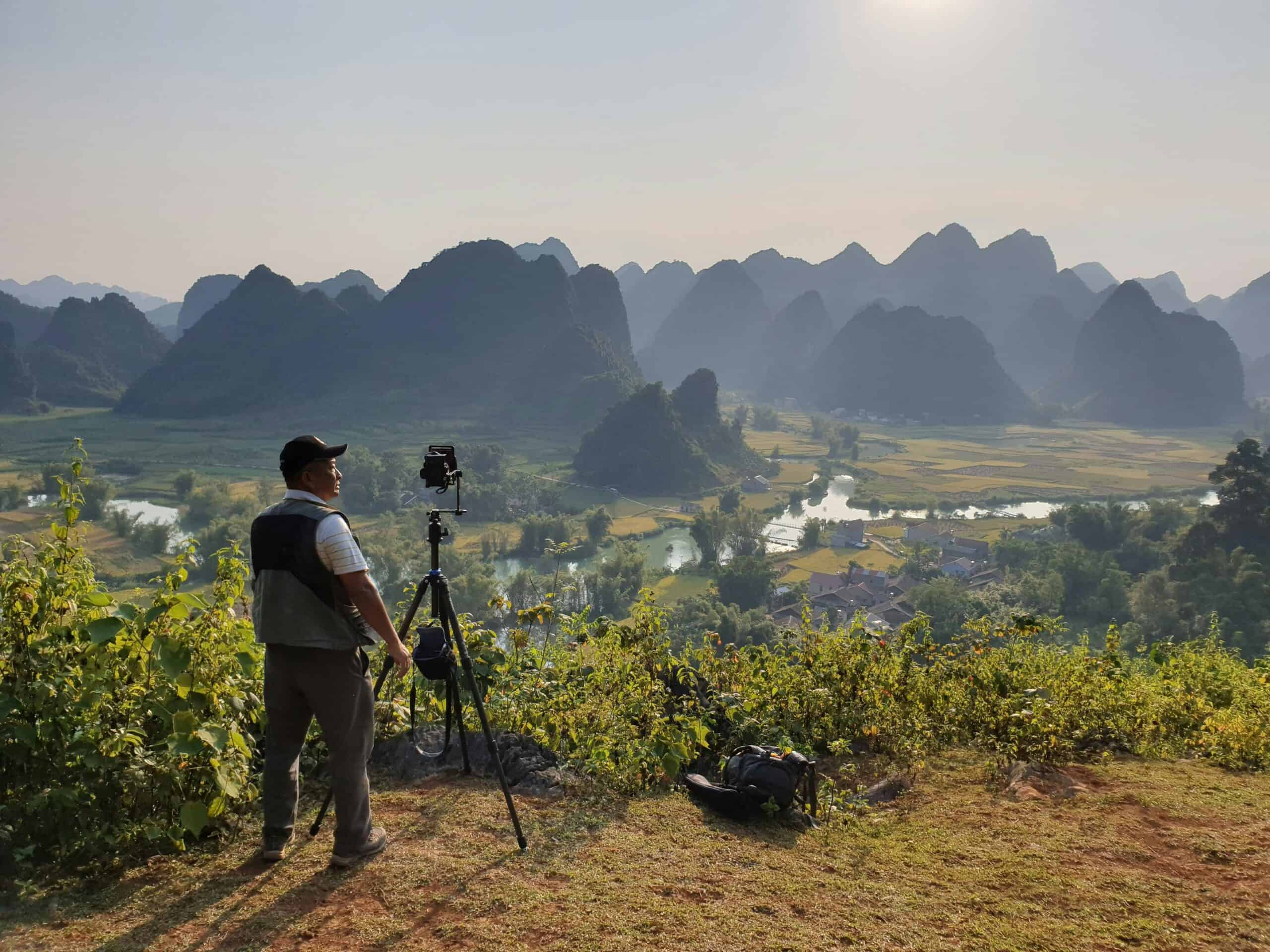
Video: Panoramic Head Basics
New to panoramic heads? This short walkthrough complements the steps above and shows how to control parallax and overlap efficiently.
For a broader DSLR/ mirrorless 360 workflow overview, see Meta’s practical guide: Set up a panoramic head to shoot high-end 360 photos.
Common Mistakes & How to Avoid Them
- Parallax error: Always align the entrance pupil. Test with near/far objects and adjust the rail until no relative shift occurs during rotation.
- Exposure flicker: Manual mode and locked white balance prevent seams and banding.
- Tripod shadows and nadir holes: Capture a dedicated nadir shot and patch with Viewpoint correction.
- Ghosting from moving subjects: Shoot two passes and use masks in PTGui; prioritize faster shutter speeds in busy scenes.
- High ISO noise: On the EOS RP, keep ISO ≤800 when possible. Favor longer exposures on a tripod over pushing ISO.
- Adapter pitfalls: With the Nikon 8–15 E‑type on RF, lack of aperture control can force wide-open shooting—plan shutter/ISO accordingly or use a compatible Canon fisheye for stopped‑down sharpness.
Frequently Asked Questions
- Can I shoot handheld panoramas with the Canon EOS RP?
Yes for basic stitches, but for 360×180 VR—especially with nearby objects—a tripod and panoramic head are strongly recommended. Handheld introduces parallax and inconsistent overlap, which become hard to fix with fisheye distortion.
- Is the Nikon AF‑S 8–15mm wide enough for a single-row 360?
Absolutely. At 8mm circular, 3–4 shots around plus zenith and nadir cover the sphere. At 12–15mm diagonal, a single row of 6–8 plus Z+N is standard and yields higher resolution.
- Do I need HDR for interiors with bright windows?
Often yes. Bracketing ±2 EV (or ±3 EV for very bright windows) maintains highlight detail while keeping interior tones clean. Keep WB locked and bracket consistently at every angle.
- How do I avoid parallax issues with this fisheye?
Calibrate the entrance pupil on your pano head. Start with the camera pushed forward on the rail (common for 8–12mm). Align near/far verticals and tweak until rotation causes no relative shift. Save the rail positions for 8mm and 12–15mm as marks on your head.
- What ISO range is safe on the EOS RP in low light?
ISO 100–400 is excellent; ISO 800 is still very usable with modest noise reduction. Prefer longer shutter times over ISO 1600+ for critical 360 work.
- Can I set up Custom Shooting Modes (C1/C2) for pano on the RP?
Yes. Save Manual exposure, fixed WB, RAW, EFCS on, and manual focus to C1. Save a bracketing profile for interiors (AEB ±2 EV, 5 shots) to C2 for quick recall.
- How do I reduce flare with a fisheye?
Avoid pointing directly at the sun when possible; shade the front element off-frame with your hand and mask later. Clean the front element and consider shooting two frames at that angle to have a flare-free plate.
- What panoramic head should I choose for this setup?
Pick a head with precise fore‑aft adjustment, click‑stop rotator (45°/60°/90°), and a compact design. Nodal Ninja and Leofoto offer reliable options that handle full‑frame bodies and fisheyes well.
Trust, Safety, and Quality Assurance
Always tether on rooftops and with poles; keep bystanders outside the rotation radius. Avoid wind gusts and wet surfaces that can topple gear. Back up your files on-site (dual cards if possible, or copy to a phone/SSD). If using the Nikon AF‑S 8–15mm on the Canon EOS RP via a passive adapter, verify you can live with wide-open apertures before client work. For critical jobs needing f/8 sharpness and exposure consistency, rent the Canon EF 8–15mm f/4L with Canon’s EF‑to‑RF adapter for full control.
For additional context on choosing camera/lens combos and best practices, see this practical field guide: DSLR and mirrorless 360/virtual tour gear guide.