Why This Camera & Lens Are Great for Panoramas
If you’re learning how to shoot panorama with Canon EOS RP & Laowa 4mm f/2.8 Circular Fisheye, you’ve chosen a combo that can create ultra-fast 360° captures with very few frames. The Canon EOS RP is a compact full-frame mirrorless body with a 26.2 MP sensor (approx. 6240×4160), Dual Pixel AF, and solid color response. Pixel pitch is about 5.76 µm, which keeps noise modest and detail crisp at low ISOs; base dynamic range is roughly 11.8–12 EV at ISO 100, enough to retain highlight detail for most daylight scenes when exposed carefully. Although the EOS RP doesn’t have in-body stabilization, its low weight and clean tethering/app control make it a nimble pano body on a tripod or pole.
The Laowa 4mm f/2.8 Circular Fisheye is a tiny manual lens with a circular projection and approximately 210° field of view. That extreme FOV is the secret to fast 360 capture: you can cover the entire sphere with as few as two shots around, plus a nadir patch if needed. The tradeoffs are strong fisheye distortion (expected and welcome for 360), pronounced edge stretching, and potential chromatic aberration toward the periphery. Because it’s manual focus/aperture, you get fully consistent frames with zero exposure or focus drift during a pano—great for stitching.
Mount compatibility note: the Laowa 4mm f/2.8 Circular Fisheye is primarily made for MFT/APS‑C mounts. If you’re using it on an EOS RP (RF full-frame), ensure you have the proper mount version or a dedicated RF/RF‑S version; otherwise, you will get a small circular image with heavy vignetting on full-frame. That’s not a problem for spherical panoramas—you actually want the circular image—but confirm physical mount compatibility before heading out. If you use a crop-compatible version, the EOS RP can be set to crop mode; in that case you may need an extra shot around for clean overlap.
Quick Setup Overview
- Camera: Canon EOS RP — Full-frame 26.2 MP CMOS, approx. 5.76 µm pixel pitch, base DR around 11.8–12 EV, Dual Pixel AF, no IBIS.
- Lens: Laowa 4mm f/2.8 Circular Fisheye — circular projection (~210° FOV), manual focus and aperture, very compact; expect strong distortion and some CA at edges.
- Estimated shots & overlap:
- Fastest: 2 shots around at 180° yaw; the 210° vertical FOV covers zenith/nadir. Add 1 nadir patch if the tripod footprint is intrusive.
- Safe: 3 shots around at 120° for better seam quality, plus optional nadir.
- Cropped use (APS‑C mode or crop-mount): 3–4 shots around at 90–120°, overlap 30–40% to ensure robust stitching.
- Difficulty: Easy to Moderate (manual lens control and nodal calibration required).
Planning & On-Site Preparation
Evaluate Shooting Environment
Look for light direction, high-contrast areas (sun, windows, lamps), and reflective surfaces like glass, lacquered wood, or polished metal. Fisheyes see everything—including your tripod and any stray light sources—so watch for flare from the sun or bright fixtures. If shooting through glass, get the front element as close as safely possible (1–2 cm) to reduce reflections and ghosting; a rubber lens hood pressed gently to glass can help block stray reflections.
Match Gear to Scene Goals
With the EOS RP’s full-frame sensor, clean results at ISO 100–400 are easy; ISO 800 is often fine; ISO 1600 is workable if you expose well. That complements the Laowa 4mm’s ability to shoot fast, especially outdoors or in interiors with stable tripods. The fisheye’s advantage is fewer shots—fantastic for minimizing moving-subject problems (people, cars, trees in wind). The tradeoff is edge stretching and the need for precise nodal alignment to avoid parallax. The RP’s manual controls, focus magnification, and touch interface make setup quick even with a fully manual lens.
Pre-shoot Checklist
- Charge batteries; bring spares. Use fast, redundant storage (e.g., dual cards via backup workflow on-site or immediate laptop offload).
- Clean the lens and sensor. Fisheye fronts show dust and fingerprints badly—pack a microfiber and a rocket blower.
- Level your tripod and pre-calibrate your panoramic head for the lens’s no-parallax point.
- Safety: check wind, tripod stance, pole clamps, rooftop railings. Tether gear on poles or cars. Don’t work near edges without a safety plan.
- Backup workflow: do at least one extra pass around if the scene is important; it’s cheap insurance.
Essential Gear & Setup
Core Gear
- Panoramic head: This lets you rotate the camera around the lens’s entrance pupil (often called the nodal point) to eliminate parallax. With a 4mm circular fisheye, even tiny alignment errors can create stitching issues near the tripod.
- Stable tripod with leveling base: Leveling speeds up rotation accuracy and keeps the horizon consistent across frames.
- Remote trigger or Canon app: Trigger from your phone or a cable release to avoid shaking the setup, especially for long exposures.
Optional Add-ons
- Pole or car mount: Use with a safety tether and be conservative in wind. The fisheye’s wide coverage magnifies any vibration—keep exposures short.
- Lighting aids: For interiors, consider small LED wands bounced off ceilings to lift shadows. Keep lights stationary during each bracket.
- Weather gear: A rain cover and lens cloth are essential. One raindrop on a fisheye covers a lot of pixels.
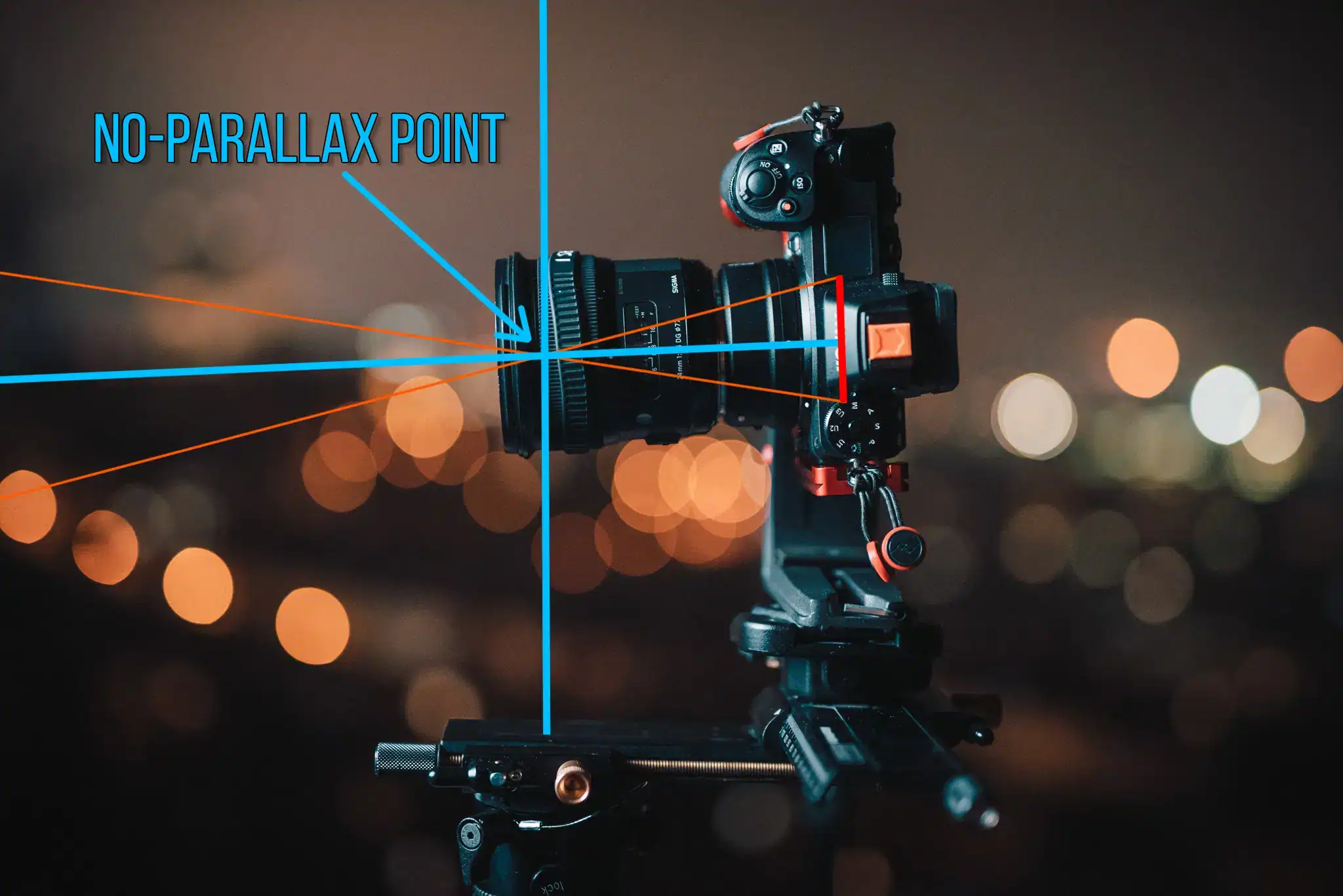
Want a deeper dive into panoramic head alignment? This concise tutorial on panoramic heads is excellent background reading at the end of this section: How a panoramic head works and how to set it up.
Video: Setting up a panoramic head
Visual learners often benefit from a quick setup demo. This video complements the steps below.
Step-by-Step Shooting Guide
Standard Static Scenes
- Level the tripod and align the nodal point. Use a pano head with fore-aft and left-right adjustments. To test, place two light stands (or poles) at different distances; rotate left-right: if they shift relative to each other, adjust the camera forward/back until the shift disappears.
- Set manual exposure and lock white balance. For daylight, start at ISO 100–200, f/8–f/11, 1/100–1/250s. Lock WB to Daylight or set K to a known value to avoid stitching color shifts.
- Focus once, then lock. With a 4mm fisheye, set manual focus near the hyperfocal at f/8–f/11; a small focus tweak using focus magnification helps if you have near foreground.
- Capture with tested overlap:
- Fast pass: 2 frames around at yaw 0° and 180°. This often covers the sphere with the 210° vertical FOV.
- Safe pass: 3 frames around at 120° increments for stronger control point distribution.
- Nadir cleanup: Shoot a downward frame after moving the tripod slightly, or hand-hold the camera above the original position, to patch out the tripod in post.
HDR / High Dynamic Range Interiors
- Bracket ±2 EV (3–5 exposures) to balance bright windows and interior shadows. Keep exposure bracketing identical for every yaw angle.
- Lock WB and focus across the entire bracket and rotation. Consistency is everything for clean stitching and tone mapping.
- Expose for highlights first; ensure at least one frame preserves window detail. Merge brackets before stitching, or stitch exposure stacks depending on your software preference.
Low-Light / Night Scenes
- Use a stable mount and longer exposure. Start at f/4–f/5.6, ISO 400–800, 1/30–1/60s. The EOS RP is clean to ISO 400; ISO 800 remains usable; ISO 1600 works if you expose to the right and denoise gently.
- Turn off lens IS when on a tripod (the EOS RP has no IBIS); use a 2s self-timer or remote trigger to avoid vibrations.
- Be mindful of star movement and light trails; if you want crisp stars, keep shutter speeds shorter and consider stacking exposures.
Crowded Events
- Shoot two passes: first for framing and control points; second during brief lulls to minimize duplicate moving subjects.
- Use faster shutter speeds (1/200s+) and slightly higher ISO (400–800) to reduce subject blur.
- In post, mask the cleanest people positions from either pass to reduce ghosting.
Special Setups (Pole / Car / Rooftop)
- Pole: Tighten all clamps, add a safety tether, and avoid strong winds. Keep exposures short (1/125s+) to minimize sway. Consider 3 shots around for redundancy.
- Car mount: Use high-grade suction mounts, check surfaces, tether the rig, and keep speeds low. Shoot when stationary if possible to avoid vibrations.
- Rooftops: Weight the tripod, avoid edges and gusts. Always prioritize safety over the shot.
Recommended Settings & Pro Tips
Exposure & Focus
| Scenario | Aperture | Shutter | ISO | Notes |
|---|---|---|---|---|
| Daylight outdoor | f/8–f/11 | 1/100–1/250 | 100–200 | Lock WB (Daylight or fixed Kelvin) |
| Low light/night | f/4–f/5.6 | 1/30–1/60 | 400–800 | Tripod & remote; expose to the right; denoise in post |
| Interior HDR | f/8 | Bracket ±2 EV | 100–400 | Balance windows & lamps; keep WB and focus locked |
| Action / moving subjects | f/5.6–f/8 | 1/200+ | 400–800 | Short shutter to freeze motion; consider 2-pass capture |
Critical Tips
- Manual focus at hyperfocal: With a 4mm fisheye at f/8–f/11, focus a bit short of infinity; much of the scene will be in focus.
- Nodal point calibration: Mark your pano head rails once dialed. This saves time and ensures repeatable, parallax-free rotations.
- White balance lock: Avoid auto WB; mixed lighting will otherwise shift between frames and complicate stitching.
- RAW over JPEG: The EOS RP’s RAW files give more latitude for highlight recovery and color balancing—especially vital for HDR panos.
- Stabilization: The EOS RP lacks IBIS; if your lens has IS, turn it off on tripod to prevent micro-blur from the system hunting.
Stitching & Post-Processing
Software Workflow
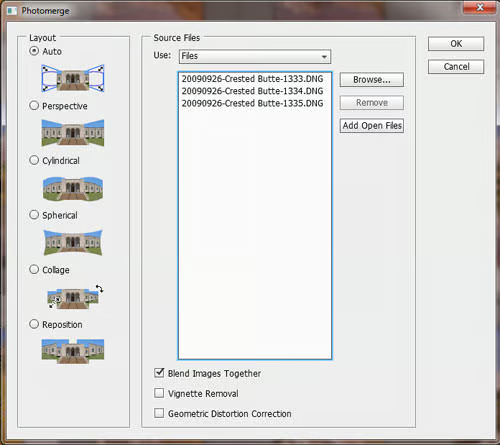
For 360 photos, PTGui and Hugin are industry standards. A circular fisheye simplifies stitching because you need fewer shots, but you must correctly set lens type and FOV. In PTGui, set Lens Type to Circular Fisheye and start with a FOV around 210°. Load your images, run Align Images, then inspect control points and seams. Aim for 25–35% overlap between frames. Export as equirectangular 2:1 for VR. A solid PTGui overview and review can help you get the best results: Why PTGui excels for complex panoramas.
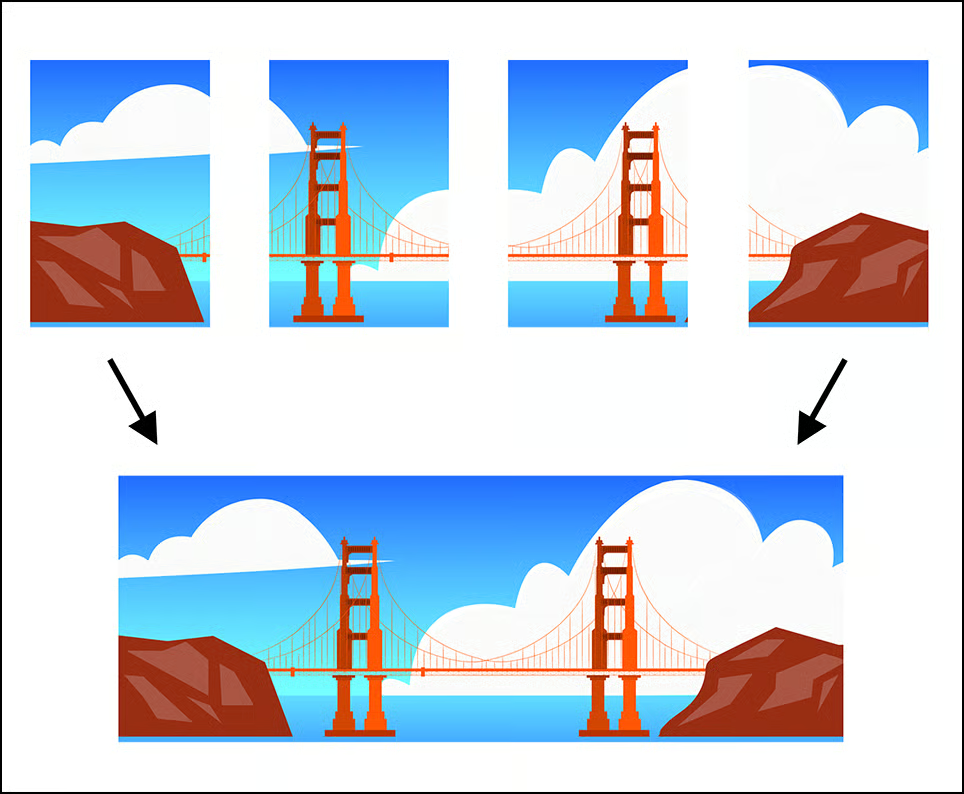
If you’re new to 360 VR outputs, this concise guide covers the full DSLR/mirrorless-to-VR workflow, including equirectangular export and metadata: Using a DSLR or mirrorless to shoot and stitch a 360 photo.
Cleanup & Enhancement
- Nadir patch: After stitching, patch out the tripod with a dedicated nadir shot or use content-aware/AI tools. Keep a small library of branded floor patches for speed.
- Color and noise: Use Lightroom/Photoshop noise reduction sparingly. Match color across brackets before stitching to minimize seam corrections.
- Horizon leveling: Use the optimizer to correct yaw/pitch/roll. Reproject to equirectangular and verify verticals in key areas (buildings, walls).
- Final export: Equirectangular JPEG at 8–12k width for web-based viewers, or 16–20k for high-end VR kiosks (watch performance and hosting limits).
For additional practical FAQs on virtual tour gear and planning, this resource is helpful: DSLR virtual tour FAQs and lens guidance.
Useful Tools & Resources
Software
- PTGui panorama stitching
- Hugin (open source)
- Lightroom / Photoshop / Affinity Photo
- AI tripod removal and sky replacement tools
Hardware
- Panoramic heads (e.g., Nodal Ninja, Leofoto)
- Carbon fiber tripods and monopods/poles
- Leveling bases (60–75 mm bowls or low-profile levelers)
- Wireless remote shutters or camera apps
- Pole extensions and vehicle-grade suction/car mounts
Disclaimer: product names are for search/reference. Check official sites for mount compatibility, specs, and current firmware.
Field-Proven Scenarios
Indoor Real Estate
Use a tripod and pano head, bracket ±2 EV at f/8, ISO 100–200. Two frames around with the 4mm can work, but consider three for cleaner seams on patterned floors and sharp window frames. Keep lights either all on or all off to avoid mixed color temperatures.
Outdoor Sunset
Expose for highlights to protect the sun and bright clouds. Shoot two passes if the sky is changing quickly; the second pass can fill any seam issues. A soft grad (in post) can help transition bright horizons.
Event Crowds
Go fast—2 shots around at 1/200s, ISO 400–800, f/5.6–f/8. Ask nearby subjects to hold still for a second; grab a second pass during a lull and mask later.
Rooftop/Pole
Keep exposures short and the rig balanced. Use a safety tether and don’t exceed comfortable wind limits. A three-shot sweep adds redundancy against micro-sway alignment issues.
Car-Mounted Capture
Prefer stationary shooting; if shooting while moving, expect stitching challenges from parallax and motion. Lower the pole to reduce wind load; secure all gear points and avoid busy traffic areas.
Common Mistakes & How to Avoid Them
- Parallax error → Align the nodal point precisely before serious shoots.
- Exposure flicker → Use manual exposure; lock WB and focus.
- Tripod/feet in frame → Shoot a nadir patch or capture an extra handheld nadir.
- Ghosting from motion → Shoot two passes and mask; or increase shutter speed to freeze motion.
- Night noise → Stay at ISO 100–800 when possible; expose to the right and denoise lightly.
Frequently Asked Questions
-
Can I shoot handheld panoramas with the Canon EOS RP?
Yes, but expect more stitching errors. With a 4mm circular fisheye, 2–3 handheld shots can work outdoors at fast shutter speeds (1/250s+). For critical results (interiors, straight lines), use a tripod and a pano head to eliminate parallax.
-
Is the Laowa 4mm f/2.8 wide enough for a single-row 360?
Yes. Its ~210° vertical coverage means 2 shots at 180° can cover the full sphere. For tighter seams or detailed interiors, 3 shots at 120° give a more robust stitch.
-
Do I need HDR for interiors with bright windows?
Often yes. The EOS RP’s base DR is around 12 EV, but interiors with sunlit windows can exceed that. Bracket ±2 EV (3–5 frames) and merge before or during stitching to retain window views and clean shadows.
-
How do I avoid parallax issues?
Use a panoramic head and calibrate the entrance pupil for the Laowa 4mm. Mark your rail positions. Keep the camera level and rotate only around the vertical axis. For quick reference on panoramic heads, see this practical primer: Panoramic head setup and theory.
-
What ISO range is safe on the EOS RP for low light?
ISO 100–400 is pristine; ISO 800 remains very good; ISO 1600 is workable with careful exposure and modest denoising. For critical commercial work, try to stay at ISO ≤800 on a tripod.
-
Can I set up Custom Shooting Modes (C1/C2) for panos?
Yes. Save manual exposure, fixed WB, RAW format, and release mode to a custom slot. You’ll be shoot-ready in seconds when the light is changing.
-
How do I reduce flare with a circular fisheye?
Avoid pointing directly at the sun where possible; shade the lens with your hand just off-frame if allowed; clean the front element meticulously. Slightly tilt your yaw angles to place the sun near a seam for easier masking.
-
What’s the best tripod head for this setup?
Use a dedicated panoramic head with fore-aft and lateral adjustment (e.g., Nodal Ninja or a compact two-rail system). A low-profile leveling base speeds up field setup dramatically.
Further Learning
For a beginner-friendly yet thorough walkthrough of high-end 360 capture, including head setup and shooting discipline, this is a great resource: Set up a panoramic head to shoot high-end 360 photos.
Safety, Limitations & Trust Notes
Confirm lens mount compatibility for the Laowa 4mm on your EOS RP before field work. If using an APS‑C/crop version, enable crop mode or accept a circular image (which is expected for 360 stitch workflows). In winds or on poles, prioritize safety and tether gear. The EOS RP lacks IBIS; turn off lens IS on tripods. For paid jobs, shoot redundant passes, carry spare storage, and keep at least two physical backups before leaving location. Always verify the latest firmware and consult your stitching software’s documentation for updates.
Wrap-Up
Learning how to shoot panorama with Canon EOS RP & Laowa 4mm f/2.8 Circular Fisheye is all about efficiency and precision: a properly calibrated panoramic head, locked-down manual settings, and a consistent workflow. With just 2–3 frames around, you can create clean, high-resolution 360° photos that stitch quickly. Keep exposure and white balance consistent, protect your gear, and rely on robust software like PTGui or Hugin. With practice, this compact kit becomes a reliable, fast solution for real estate, events, and travel panoramas.