Why This Camera & Lens Are Great for Panoramas
The Canon EOS RP paired with the 7Artisans 10mm f/2.8 II Fish-Eye is a compact, budget-friendly, and highly capable combo for anyone learning how to shoot panorama with Canon EOS RP & 7Artisans 10mm f/2.8 II Fish-Eye. The EOS RP’s 26.2MP full-frame sensor (approx. 36×24 mm) delivers solid detail for 360 photo work without enormous file sizes. With a pixel pitch around 5.7 μm, the camera produces clean files up to ISO 800–1600, and its Dual Pixel AF makes general shooting easy, even though you’ll set this lens to manual focus for panoramas. Dynamic range at base ISO is respectable for a camera in this class; for interiors and scenes with bright windows, bracketing (HDR panorama) compensates well.
The 7Artisans 10mm f/2.8 II is a full-frame diagonal fisheye covering roughly 180° across the diagonal. That extreme field of view means fewer shots to cover the full sphere, faster capture, and less stitching work—excellent for situations with moving subjects or changing light. As a manual, all-metal lens, it’s simple and robust: aperture and focus are direct, tactile, and repeatable. Stopped down to f/5.6–f/8, the lens is sharp across the frame with manageable chromatic aberration, and Version II improves flare resistance. Yes, fisheye distortion is strong, but spherical stitching software projects the final image to equirectangular format where this is expected and handled well.
Mount compatibility is perfect—this 7Artisans lens comes in RF mount, so it fits natively on the EOS RP. The RP doesn’t have in-body stabilization (IBIS), but for tripod-based panoramas you’ll stabilize the camera mechanically anyway. The relatively light RP body also balances nicely on panoramic heads and poles, reducing strain on your gear.
Quick Setup Overview
- Camera: Canon EOS RP — Full-frame 26.2MP sensor, pixel pitch ~5.7 μm, native ISO 100–40,000 (expandable), Dual Pixel AF, Electronic First-Curtain Shutter, no IBIS.
- Lens: 7Artisans 10mm f/2.8 II Fish-Eye — full-frame diagonal fisheye; manual focus/aperture; sharpest around f/5.6–f/8; moderate CA, improved flare resistance over V1.
- Estimated shots & overlap: with a 10mm diagonal fisheye on full frame, plan 6 shots around at 60° yaw increments, 25–30% overlap, plus 1 zenith and 1 nadir for clean tripod removal. Skilled operators can do 4 around + zenith + nadir in static scenes; on a pole, 6-around with a slight upward tilt often works, then patch the nadir.
- Difficulty: Easy–Moderate (fisheye minimizes shot count, but nodal alignment is still critical).
Planning & On-Site Preparation
Evaluate Shooting Environment
Start by reading the light and motion in your scene. Bright windows, backlit skies, and mixed artificial lighting can challenge dynamic range and white balance. Glass, water, and metallic surfaces produce reflections—keep your lens and panoramic head clear of those surfaces to avoid reflections and ghosting. If you must shoot against glass, get the front element as close as safely possible (a few centimeters), use a rubber lens shade if available, and watch for internal reflections from bright sources behind you.
Match Gear to Scene Goals
The EOS RP’s files are clean at ISO 100–400 in daylight and still very usable at ISO 800–1600 for low-light panoramas, especially if you stitch RAW files or use HDR bracketing. The 7Artisans fisheye reduces shot count—ideal for faster capture outdoors at sunset or in event environments where people move. The tradeoff is edge distortion and potential flare from strong light sources; manage this by shading the lens and careful framing. For real estate and interiors, HDR bracketing is your friend to balance bright windows with darker rooms without pushing ISO too high.
Pre-shoot Checklist
- Fully charged batteries and ample storage. The RP’s battery is modest; bring a spare for long sessions.
- Clean lens front/rear elements and check sensor for dust—360 photos show everything.
- Level your tripod and verify panoramic head calibration (entrance pupil/nodal point alignment).
- Safety checks: wind conditions for rooftop/pole work, leash/tether on pole or car mounts, avoid overhead lines.
- Backup workflow: when possible, shoot a second pass at the same settings in case of motion or flare artifacts.
Essential Gear & Setup
Core Gear
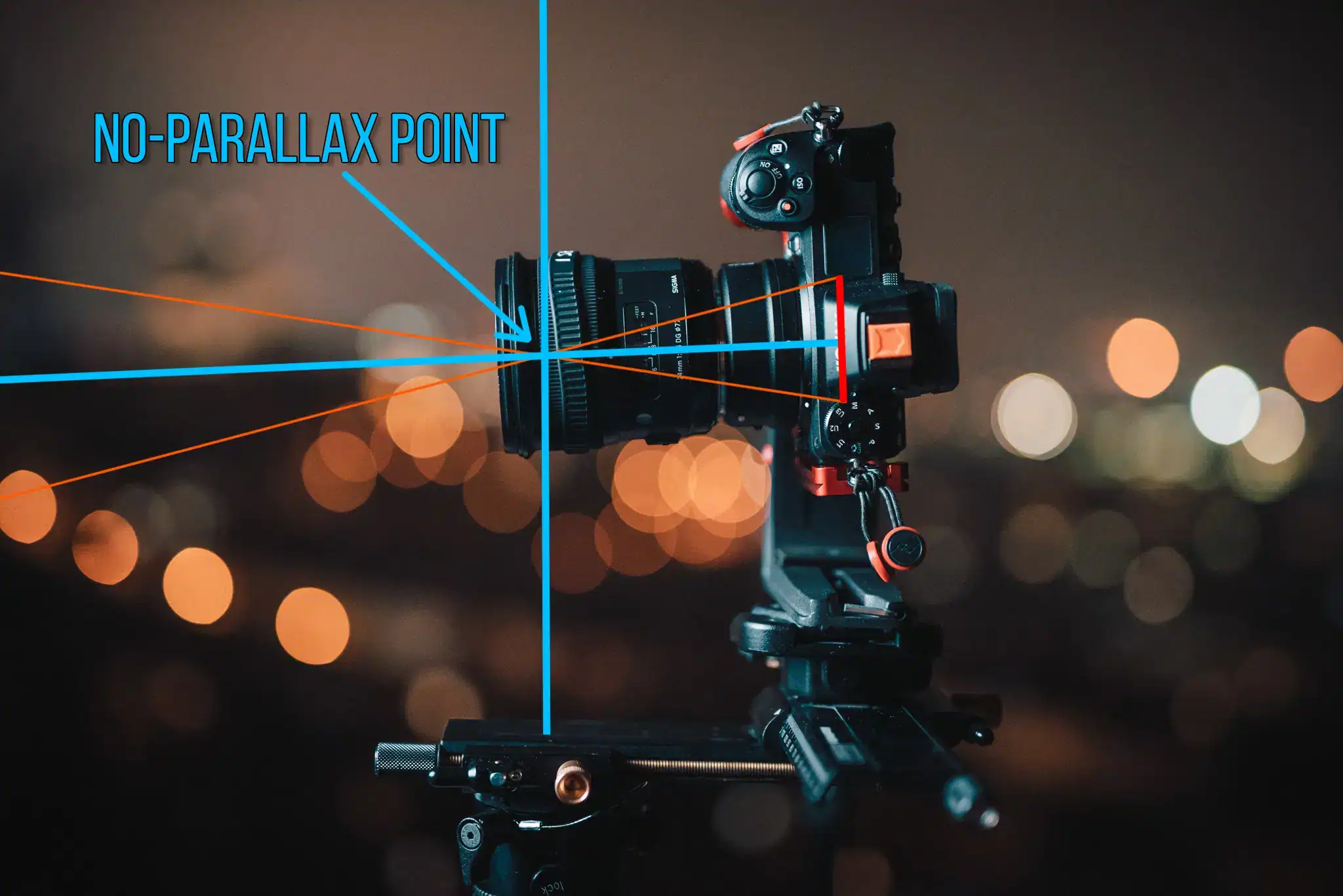
- Panoramic head: Enables rotation around the lens’s entrance pupil (nodal point), minimizing parallax. This is critical for stitching cleanly, especially with nearby objects.
- Stable tripod with a leveling base: Fast leveling keeps your horizon and verticals consistent and reduces post-processing time.
- Remote trigger or Canon Camera Connect app: Eliminates camera shake. The RP’s 2-sec timer is a good backup.
Optional Add-ons
- Pole or car mount: Fantastic for elevated viewpoints or drive-by mapping. Use a safety tether, mind wind load, and avoid high speeds that cause vibration.
- Lighting aids: Small LED panels for dim interiors; avoid mixed color temperatures if possible.
- Protective covers/weather gear: A simple rain sleeve can save a shoot from sudden showers.
Step-by-Step Shooting Guide
Standard Static Scenes
- Level and align:
- Level your tripod using the leveling base or the head’s bubble level.
- Set your panoramic head so the rotation is around the lens’s entrance pupil. A practical way: align two vertical objects—one near, one far—then rotate the camera. Adjust the fore-aft rail until the relative position of the near object against the far object doesn’t shift when you pan.
- Typical starting offset for full-frame fisheyes is in the ballpark of 50–70 mm from the sensor plane mark to the entrance pupil. Treat this as a starting guess and refine on-site.
- Manual exposure and white balance:
- Switch to Manual (M), set WB to a fixed preset or Kelvin (e.g., Daylight 5200K outdoors, 3200–4000K indoors). Avoid Auto WB and Auto ISO to prevent exposure flicker and color shifts.
- Meter the brightest part you need to retain detail in (e.g., sky), then raise exposure slightly if you plan to HDR bracket.
- Focus and aperture:
- Set the 7Artisans 10mm to manual focus near the hyperfocal distance. At f/8 on full frame, hyperfocal is roughly 0.45 m—set it slightly beyond 0.5 m and you’ll hold sharpness from close foreground to infinity.
- Use f/5.6–f/8 for best edge-to-edge sharpness and minimal aberrations.
- Capture the series:
- Take 6 shots around the horizon at 60° yaw steps with ~25–30% overlap. For clean coverage, add one zenith shot (tilt up) and one nadir shot (tilt down or do a tripod offset/patched nadir).
- For speed, 4-around + zenith + nadir can work in open scenes with minimal parallax, but 6-around is safer for interiors or complex spaces.
- Nadir (ground) capture:
- After the main round, move the camera laterally (tripod offset method) or use a handheld shot to capture the ground free of tripod legs. Keep settings identical and shoot fast to avoid lighting changes.
HDR / High Dynamic Range Interiors
- Bracket ±2 EV (3 or 5 frames): The EOS RP supports AEB; use 3 frames (−2/0/+2) for moderate contrast or 5 frames for extreme window highlights.
- Lock white balance and manual exposure baseline: Consistency across all frames is critical for seamless HDR panorama stitching.
- Use a remote release or 2-sec timer: Minimize vibration during brackets, especially at slower shutter speeds.
Low-Light / Night Scenes
- Use longer exposures at low ISO: Target ISO 100–400 if on a tripod; ISO 800 is fine on the RP when necessary. Expect 1–10 seconds depending on the scene.
- Enable Electronic First-Curtain Shutter: Reduces shutter shock; combine with remote release and a sturdy tripod.
- Watch for moving lights and people: Consider multiple passes to mask movement later.
Crowded Events
- Two-pass strategy: Do one quick pass for safety, then a second pass waiting for gaps in the crowd per angle. Later you can mask between passes.
- Use higher shutter speeds: Aim for 1/200 s+ at f/5.6–f/8 and ISO 400–800 to reduce motion blur in moving subjects.
- Keep your rotation smooth and consistent: Mark your head’s detents and avoid bumping the tripod.
Special Setups (Pole / Car / Drone)
- Pole/Rooftop: Secure a safety tether, check wind before elevating, and rotate slowly to prevent vibrations. With 10mm fisheye, 6-around with slight upward tilt often covers the zenith; patch the nadir later.
- Car-mounted: Reduce speed, use vibration-damping mounts, and keep exposures short (higher ISO if necessary) to avoid motion blur.
- Drone alternatives: The RP is not for drones, but if you must simulate elevated views, a tall pole is safer and legal in more places.
Recommended Settings & Pro Tips
Exposure & Focus
| Scenario | Aperture | Shutter | ISO | Notes |
|---|---|---|---|---|
| Daylight outdoor | f/8–f/11 | 1/100–1/250 | 100–200 | Lock WB (Daylight/Kelvin ~5200K) |
| Low light/night | f/4–f/5.6 | 1/30–multi-sec | 400–800 | Tripod + remote; enable EFCS; prefer longer shutter over high ISO |
| Interior HDR | f/8 | Bracket ±2 EV | 100–400 | Retain window highlights, clean shadows |
| Action / moving subjects | f/5.6–f/8 | 1/200+ | 400–800 | Freeze motion; consider two-pass capture for masking |
Critical Tips
- Manual focus at or just beyond the hyperfocal distance (≈0.45 m at f/8 for 10mm on full frame). Verify with magnified live view.
- Nodal calibration: Mark your panoramic head rails once you’ve found the entrance pupil for this combo so you can repeat it quickly at future shoots.
- White balance lock: Use a single WB across the set to avoid color seams. Mixed lighting? Consider a custom Kelvin that balances the dominant source.
- RAW over JPEG: RAW files offer better highlight recovery and color consistency—key for HDR panorama workflows.
- Stabilization: The RP has no IBIS and the 7Artisans lens has no IS—use a solid tripod, weighted if windy.
Stitching & Post-Processing
Software Workflow
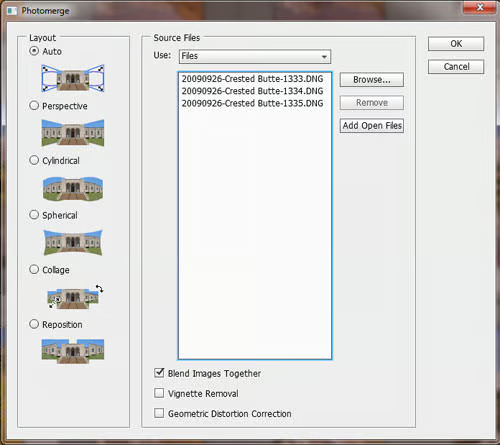
Import your RAW files and apply basic global adjustments (lens CA reduction, consistent WB). For stitching, PTGui, Hugin, Lightroom/Photoshop, and Affinity Photo all work. Fisheye images generally stitch easily when you used proper overlap and nodal alignment. Use about 25–30% overlap for fisheye sets; rectilinear lenses require more shots and careful overlap. In PTGui/Hugin, set lens type to “full-frame fisheye,” load images, run alignment, and check control point distribution around the frame. An auto horizon level plus fine yaw/pitch/roll tweaks will lock the view. Save your template for the EOS RP + 7Artisans 10mm for future shoots.
If you bracketed, merge exposures first (HDR merge) per angle before stitching, or use PTGui’s built-in HDR functionality. Masking tools help resolve moving subjects between passes. When all is aligned, export as 16-bit TIFF equirectangular for high-quality edits or JPEG for quick web use. After the stitch, finish color grading, apply noise reduction for low-light shots, and sharpen carefully for web delivery. For VR platforms, export 2:1 equirectangular at 8K (7680×3840) or 12K if your scene warrants the resolution and your system can handle it.
Want a deeper dive on panoramic head theory and PTGui best practices? See this panoramic head tutorial and a hands-on review of PTGui’s capabilities at the links below. Panoramic head setup guide. PTGui review and workflow tips.
Cleanup & Enhancement
- Tripod/nadir patching: Use content-aware fill, a cloned patch from a handheld nadir shot, or specialized AI tools to remove the tripod footprint.
- Color and noise: Ensure consistent WB across the whole sphere; apply modest noise reduction to shadow areas, especially HDR merges.
- Horizon & projections: Level the horizon and check verticals; switch to rectilinear/cylindrical views temporarily to check perspective, then return to equirectangular for export.
- Export: For web/VR viewers (e.g., Meta/Oculus), use JPEG equirectangular at 8K with good compression balance; keep a 16-bit master TIFF archived.
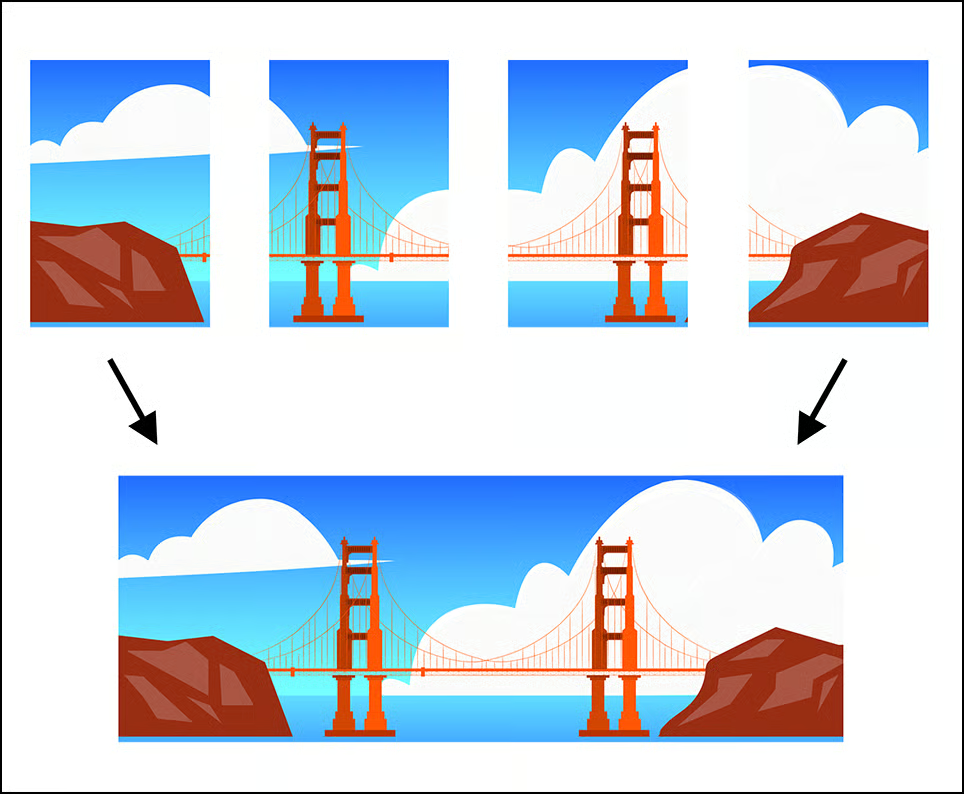
For platform-specific publishing guidance, Meta’s guide to DSLR 360 photos is helpful. Using a DSLR or mirrorless to shoot and stitch a 360 photo.
Disclaimer: Always check your chosen software’s latest documentation for current features and recommended workflows.
Real-World Scenarios & Field Notes
Indoor Real Estate (Mixed Light, Bright Windows)
Set f/8, ISO 100–200, and bracket −2/0/+2 EV per angle. Shoot 6-around + zenith, then a handheld nadir for patching. Keep WB fixed (e.g., 4000K if warm LEDs dominate). In PTGui, HDR merge each angle, then stitch. Mask window reflections if needed. The fisheye reduces the number of frames you must manage compared with a rectilinear ultrawide.
Sunset Rooftop (High Contrast, Wind)
Use f/8, ISO 100–200, and 6-around quickly as the sky changes color. If windy, hang a bag from your tripod and use a remote release. Add a separate, slightly underexposed pass for the sun side if you want extra highlight detail to blend in post. Watch for lens flare; shade the fisheye with your hand placed out of frame and keep the sun near the edge of a frame to reduce ghosts.
Event Crowds (Motion, Timing)
Shoot two passes at 1/200 s, f/5.6–f/8, ISO 400–800. First pass is quick for coverage; second pass you wait for gaps to reduce ghosting. In post, use masks to combine cleaner regions across passes.
Pole Shooting (Elevated Viewpoint)
With the 10mm fisheye, 6-around with a slight upward tilt often captures the sky well enough; patch the nadir afterward. Use a guy line or stabilizer if wind picks up, and rotate more slowly to avoid vibrations. Never shoot over crowds without permission and safety measures.
Useful Tools & Resources
Software
- PTGui panorama stitching
- Hugin (open source)
- Lightroom / Photoshop for RAW and finishing
- AI tripod removal or smart cloning tools
Hardware
- Panoramic heads (Nodal Ninja, Leofoto, Fanotec)
- Carbon fiber tripods with leveling bases
- Wireless remote shutters or Canon Camera Connect
- Pole extensions and car mounts (with tethers)
Video: Panoramic Head Setup (Recommended)
Visual learners will benefit from a concise demonstration of nodal alignment and panoramic capture flow.
Disclaimer: software/hardware names are for search reference; check official sites for current specs and compatibility.
Common Mistakes & How to Avoid Them
- Parallax error: Always align the entrance pupil and use a panoramic head; re-check when you change focus or aperture.
- Exposure flicker: Avoid Auto ISO and Auto WB; stick to manual exposure and locked WB for the entire set.
- Tripod shadows and footprints: Capture a nadir patch shot or plan to clone/AI patch in post.
- Ghosting from moving subjects: Shoot two passes and mask; for fast motion, use higher shutter speeds.
- Noise at night: Prioritize longer shutter times on a tripod over pushing ISO on the RP.
- Flare with fisheye: Shade the lens, avoid direct bright lights center-frame, and clean the front element.
Frequently Asked Questions
-
Can I shoot handheld panoramas with the Canon EOS RP?
Yes, for partial panoramas or quick tests—but for full 360 photos with foreground objects, a tripod and panoramic head are strongly recommended to avoid parallax issues and stitching seams.
-
Is the 7Artisans 10mm f/2.8 II wide enough for a single-row 360?
For full spherical coverage, plan on 6 shots around plus a zenith and nadir. In open outdoor scenes, you can sometimes tilt upward slightly and patch the nadir only, but interiors benefit from the extra zenith shot for clean ceilings.
-
Do I need HDR for interiors with bright windows?
Usually yes. Bracket −2/0/+2 EV (or 5 frames in extreme cases). The EOS RP handles low ISO HDR well, giving you clean shadows and protected highlights.
-
How do I avoid parallax issues with this lens?
Use a panoramic head and align rotation around the entrance pupil. Start with a fore-aft offset in the 50–70 mm range from the sensor plane, then refine using the near/far object test until there’s no relative shift when panning.
-
What ISO range is safe on the EOS RP for low light panoramas?
ISO 100–400 is ideal on a tripod; ISO 800–1600 is usable if you need faster shutter speeds. Favor longer exposures over pushing ISO whenever possible.
Safety, Limitations & Trust Notes
The EOS RP has no IBIS; rely on a sturdy tripod, and disable lens IS if you ever use a stabilized lens on a tripod. The 7Artisans 10mm is manual and simple—great for reliability, but ensure precise focus and do not bump the aperture ring mid-sequence. In wind or on rooftops, weight your tripod and use a safety tether for poles. For car-mounted work, obey local laws and keep speeds low to minimize vibration and risk. Finally, build a backup workflow: duplicate your card after each session and keep original RAWs and stitched masters in two locations.
For broader context on gear choices and virtual tour pipelines, this guide is worth reading at the end of your planning: DSLR/mirrorless virtual tour lens and workflow FAQ.
SEO Summary & Key Takeaways
If you’re learning how to shoot panorama with Canon EOS RP & 7Artisans 10mm f/2.8 II Fish-Eye, remember this: use a panoramic head for nodal alignment, lock exposure and white balance, shoot 6-around with 25–30% overlap plus zenith and nadir, and favor RAW+HDR for interiors. The EOS RP’s full-frame sensor offers clean results at low ISO, and the 10mm fisheye minimizes shot count and speeds up your workflow. With careful technique and smart post-processing, you can produce professional 360 photos, virtual tours, and immersive content reliably.