
Why This Camera & Lens Are Great for Panoramas
The Canon EOS R6 Mark II paired with a fast ultrawide like the Tamron 17–28mm f/2.8 Di III RXD is a highly capable combo for panoramic and 360° photography. The R6 Mark II’s 24.2 MP full-frame sensor (approx. 36 × 24 mm, pixel pitch ~6 µm) delivers excellent dynamic range at base ISO and very clean files up to ISO 800–1600. Dual Pixel CMOS AF II makes prefocusing quick and precise before locking to manual for consistency. In-body image stabilization (IBIS) is outstanding for handheld work, and can be disabled on a tripod to avoid micro-blur during long exposures.
The Tamron 17–28mm f/2.8 is a compact, rectilinear ultrawide zoom with a constant f/2.8 aperture. It is optically sharp from wide open, and very crisp across the frame by f/4–f/5.6 with low lateral CA and minimal coma—important for night cityscapes. At 17 mm you get a wide field of view that reduces the number of frames needed per row, while 24–28 mm provides a tighter perspective for high-resolution gigapixel stitches. Being rectilinear (not fisheye) means straight lines stay straight; the trade-off is that full spherical coverage requires more images than a fisheye.
Important compatibility note: the Tamron 17–28mm f/2.8 Di III RXD is natively a Sony FE-mount lens. There is no widely supported electronic FE-to-RF adapter as of this writing, which means you typically cannot use this exact lens on the EOS R6 Mark II with full electronic control. For the guidance below, treat the focal range as the primary factor. If you do not have a modified/third-party solution, consider an RF alternative with similar FOV (e.g., Canon RF 16mm f/2.8, RF 15–30mm, or RF 14–35mm f/4). All shooting, overlap, and stitching principles remain the same.
Quick Setup Overview
- Camera: Canon EOS R6 Mark II — full-frame 24.2 MP sensor, excellent AF, strong IBIS, clean ISO 100–1600 for pano work.
- Lens: Tamron 17–28mm f/2.8 Di III RXD — rectilinear ultrawide zoom; sharp from f/4–f/8; low CA; 67 mm filters; compact and light.
- Estimated shots & overlap:
- At 17 mm (vertical orientation): 8–10 shots per row with ~30% overlap, 2–3 rows for full 360×180°, plus zenith and nadir frames.
- At 24 mm (vertical): 10–12 shots per row, 3–4 rows for full sphere, plus zenith and nadir.
- At 28 mm (vertical): 12–14 shots per row, 4+ rows for very high-res stitches, plus zenith and nadir.
- Difficulty: Moderate (rectilinear ultrawide requires good nodal calibration and methodical shooting for spherical coverage).
Planning & On-Site Preparation
Evaluate Shooting Environment
Walk the location once before setting up. Note high-contrast areas (windows vs shaded interiors), reflective surfaces (glass, polished floors, cars), moving elements (people, trees in wind), and potential tripod hazards (slopes, traffic, water). If shooting through glass, keep the front element close (1–2 cm) and shield from side light to reduce reflections; a rubber lens hood can help.
Match Gear to Scene Goals
For interiors and VR tours, the R6 Mark II’s dynamic range and clean ISO help preserve window detail and shadow texture. Aim for ISO 100–400 for maximum quality; ISO 800–1600 is still clean when you must shorten shutter speeds. The Tamron’s f/2.8 helps with focusing and framing in dim light, but your final capture should usually be at f/5.6–f/8 for best edge-to-edge sharpness. Compared to a fisheye (fewer shots, more distortion), this rectilinear zoom needs more frames but produces straighter lines—great for architecture and real estate.
Pre-shoot Checklist
- Batteries charged; dual cards in camera set to redundant recording; lens and sensor cleaned.
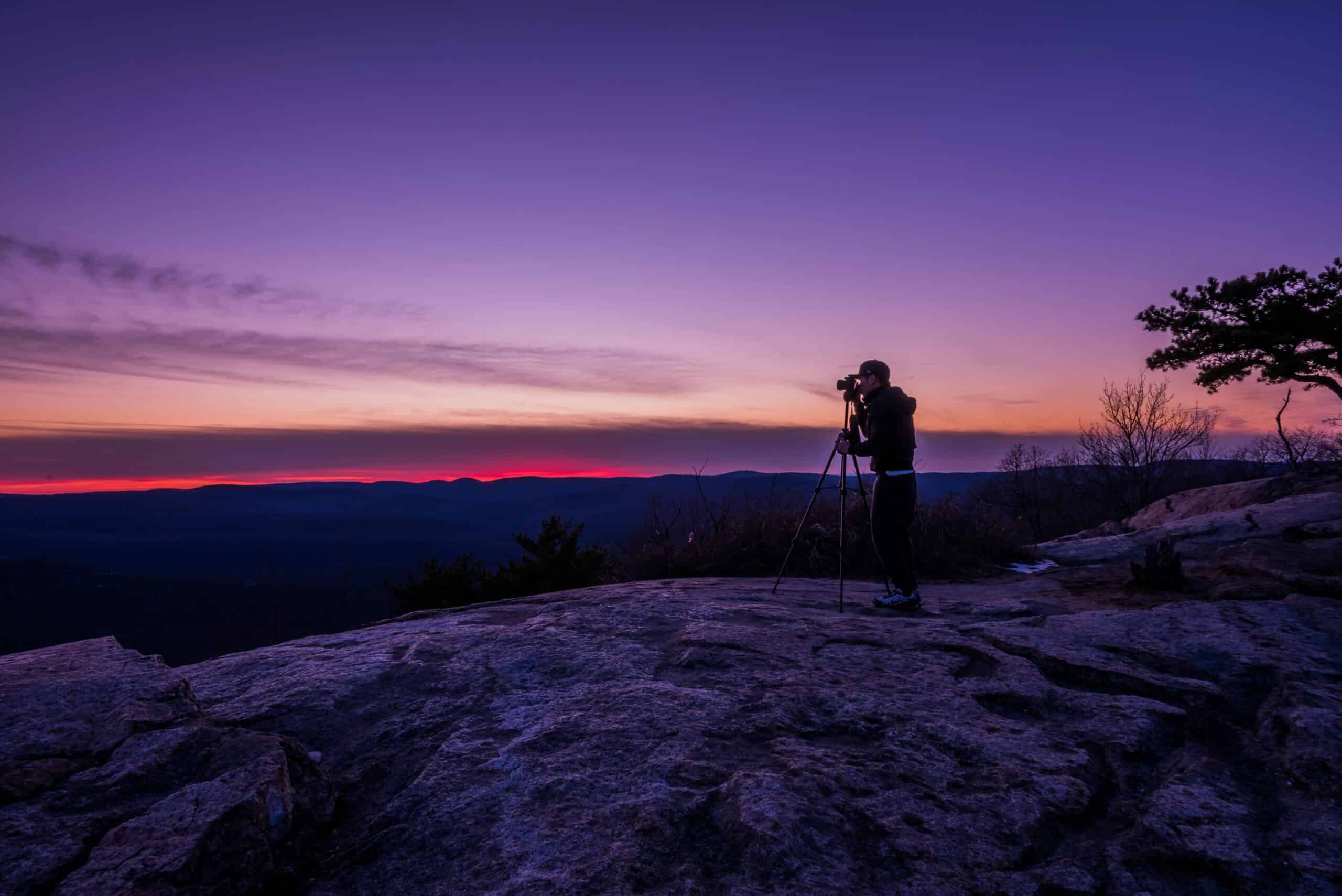
- Tripod leveled; panoramic head calibrated to the lens’s no-parallax point; L-bracket ready for vertical orientation.
- Safety: tether on rooftops, stable footing, avoid setting up in crowd flows; check wind conditions and tighten all locks.
- Backup workflow: capture a safety round at each row; for HDR, shoot a second bracket set in case of micro-movement.
Essential Gear & Setup
Core Gear
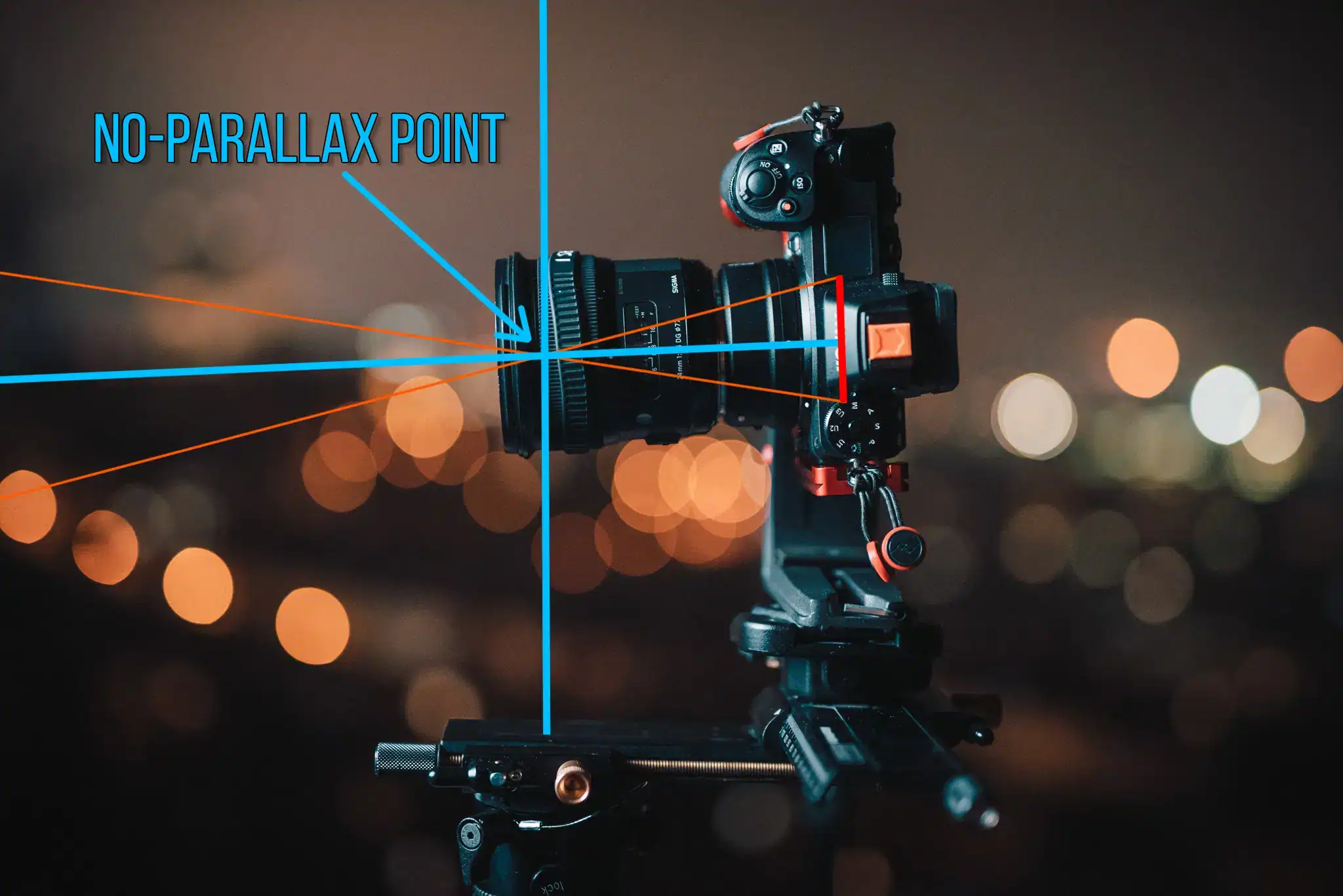
- Panoramic head: Lets you rotate around the lens’s entrance pupil (nodal point) to eliminate parallax. This is crucial for clean stitches with near and far objects.
- Stable tripod with leveling base: Leveling the base once makes multi-row shooting faster and keeps horizons straight.
- Remote trigger or app: Use a cable release, Bluetooth remote, or Canon Camera Connect app to avoid vibrations.
Optional Add-ons
- Pole or car mount: Use a safety tether and account for wind/vibration. For poles above crowds, keep the rig minimal and rotate slowly.
- Lighting aids: Small LED panels for interiors can balance dark corners. Keep lighting consistent across frames to avoid stitch marks.
- Weather protection: Rain covers, microfiber cloths, and silica gel packs ensure consistent optics in bad weather.
Step-by-Step Shooting Guide
Standard Static Scenes
- Level and align: Level your tripod at the base. Mount your panoramic head and set the camera vertical with an L-bracket.
- Calibrate nodal point: Place two markers (one near, one far) along a line. Rotate the camera while adjusting the fore-aft rail until the two markers don’t shift relative to each other. Mark your rail in millimeters for 17, 24, and 28 mm. As a starting point, expect around 85 mm forward from the sensor plane at 17 mm, slightly less at 24–28 mm. Always confirm in the field.
- Exposure and WB: Switch to Manual exposure. Meter the brightest important area (e.g., windows) and raise exposure until you preserve highlights you care about. Lock white balance (Daylight, Tungsten, or a custom Kelvin) so frames match.
- Focus: Use AF to focus about a third into the scene (or use live view magnification), then switch to Manual focus. For landscapes, set around the hyperfocal distance at f/8.
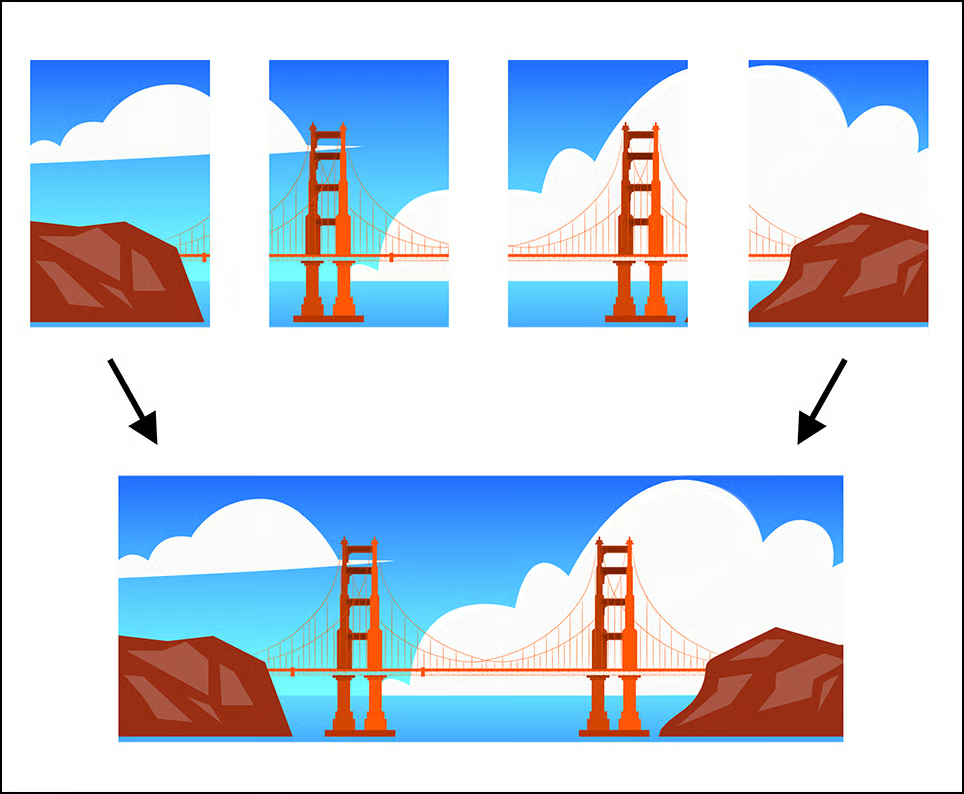
- Capture sequence: For 17 mm vertical, shoot 8–10 frames per row with ~30% overlap. For a full sphere, shoot 2–3 rows: e.g., -30°, 0°, +30° pitch. Add zenith (pointing up) and nadir (pointing down) shots. Use a consistent rotation increment (e.g., 36–45° at 17 mm; 25–30° at 24 mm).
- Nadir frame: After the main capture, move the tripod slightly or use an offset nadir adapter to capture a clean ground plate for patching.
HDR / High Dynamic Range Interiors
- Bracket exposures: Use AEB at ±2 EV (3 or 5 frames). For high-contrast interiors with bright windows, 5 frames at ±2 EV is a safe starting point.
- Lock WB and aperture: Keep white balance fixed and aperture constant (f/8). Only shutter speed should change between brackets.
- Sequence discipline: Complete all brackets for each view before rotating. Consider silent shutter to reduce vibration.
Low-Light / Night Scenes
- Turn off IBIS on a tripod: This avoids sub-pixel shifts during long exposures.
- Use longer shutters: f/4–f/5.6 at ISO 100–400 is preferred; let shutter run 1–8 s as needed. The R6 Mark II files remain very clean at ISO 400–800 if wind requires faster shutter.
- Remote release and timer: Use a 2 s timer or remote trigger. Enable exposure delay if your head/tripod is sensitive to touch.
Crowded Events
- Two-pass method: First pass for geometry; second pass waiting for gaps. Keep the tripod position fixed between passes.
- Masking later: In stitching software, use masks to prefer one frame where people are least intrusive.
- Faster shutter: Aim for 1/200 s or faster to reduce motion blur when people move across frames.
Special Setups (Pole / Car / Drone)
- Pole: Minimize weight; secure with a safety tether; avoid gusts. Rotate slowly and let vibrations damp before each exposure.
- Car mount: Use suction cups rated for your rig. Plan routes with smooth pavement and stop to capture. Avoid moving captures unless you’re using specialized rigs.
- Drone: Not applicable to this camera directly, but you can adapt the workflow if flying a platform that supports manual pano capture.
Recommended Settings & Pro Tips
Exposure & Focus
| Scenario | Aperture | Shutter | ISO | Notes |
|---|---|---|---|---|
| Daylight outdoor | f/8–f/11 | 1/100–1/250 | 100–200 | Lock WB (Daylight); prioritize DR and sharpness |
| Low light/night | f/4–f/5.6 | 1/30–8 s | 100–800 | Tripod & remote; turn off IBIS on tripod |
| Interior HDR | f/8 | Bracket ±2 EV | 100–400 | Balance windows and lamps; keep aperture fixed |
| Action / moving subjects | f/5.6–f/8 | 1/200+ | 400–800 | Freeze motion; consider two-pass capture |
Critical Tips
- Manual focus at hyperfocal: At 17 mm and f/8 on full frame, focusing around 1–1.5 m gives deep DOF for most scenes. Verify with magnified live view.
- Nodal calibration: Mark the rail positions for 17/24/28 mm. Recheck if you bump the rig or change the plate.
- White balance lock: Prevents frame-to-frame shifts that show up as banding after stitching, especially in mixed lighting.
- RAW capture: Always shoot RAW for maximum DR and color latitude; convert to 16-bit TIFF before stitching for best results.
- IBIS usage: On tripod, disable IBIS; handheld panos can benefit from IBIS but keep shutter speeds high and overlap generous.
Stitching & Post-Processing
Software Workflow
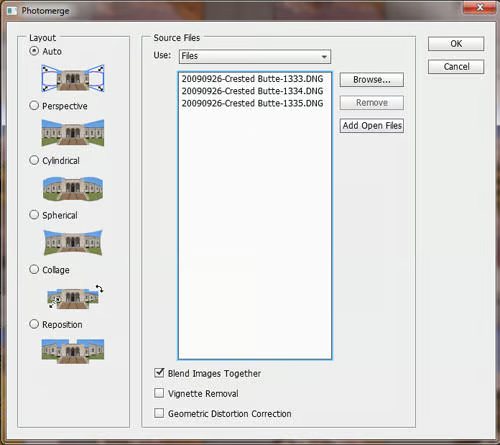
Import RAWs, apply global corrections (lens profile if available, chromatic aberration removal, identical white balance), and export 16-bit TIFFs for stitching. PTGui is industry-standard for speed, control points, masking, and HDR merges; Hugin is a solid open-source alternative. Rectilinear ultrawides generally need ~20–30% overlap; more overlap simplifies control point generation and reduces stitching errors. After stitching to an equirectangular 2:1 image, finish with horizon leveling, color grading, and nadir patching. For deeper dives into pano techniques and hardware choices, see this panoramic head tutorial and 360 DSLR guide at the end of this section. PTGui review: why it’s favored for complex panoramas
Cleanup & Enhancement
- Nadir patching: Shoot a clean ground plate and clone/patch in Photoshop. Some AI tools speed this up, but double-check textures and perspective.
- Color and noise: Use uniform color corrections across the entire pano. Apply noise reduction on shadows; the R6 Mark II handles ISO 800–1600 well.
- Leveling: Use the stitching app’s horizon/vertical optimization tools to correct roll/pitch/yaw.
- Export: Save a 2:1 equirectangular. Common deliverables: 8000 × 4000 (8K) for web, 12000 × 6000 (12K) or 16000 × 8000 (16K) for premium VR tours.
For a structured walk-through on setting up a panoramic head and best practices, these resources are helpful: Panoramic head setup tutorial. For end-to-end DSLR/mirrorless 360 workflow considerations, see: Using a mirrorless to shoot and stitch a 360 photo.
Useful Tools & Resources
Software
- PTGui panorama stitching
- Hugin open source
- Lightroom / Photoshop
- AI tripod removal and object cleanup tools
Hardware
- Panoramic heads (Nodal Ninja NN3/NN6, Leofoto)
- Carbon fiber tripods with leveling bases
- Arca-Swiss L-brackets and macro rails
- Wireless remote shutters
- Pole extensions / car suction mounts with safety tethers
Disclaimer: brand names are illustrative; confirm compatibility and specifications on official sites.
Common Mistakes & How to Avoid Them
- Parallax error: Not aligning the entrance pupil. Always calibrate and lock the fore-aft rail before a serious shoot.
- Exposure flicker: Forgetting Manual exposure or locked WB. Keep exposure constants and avoid auto ISO in multi-row panos.
- Tripod shadows and foot in frame: Shoot a dedicated nadir tile and patch in post.
- Ghosting from movement: Use masks in PTGui/Hugin to prefer one frame for moving subjects.
- Noise at night: Stick to ISO 100–400 on a tripod; if wind demands it, ISO 800–1600 on the R6 II still looks clean with NR.
- Inconsistent overlap: Maintain 25–35% overlap and consistent yaw increments for reliable control points.
Real-World Scenarios with This Setup
Indoor Real Estate
At 17–20 mm, shoot vertical with 10 frames per row and two rows at -25° and +25°, plus zenith and nadir. Bracket ±2 EV. Lock WB to Tungsten or a custom Kelvin to match ambient light. The rectilinear look preserves straight lines better than a fisheye, reducing architectural distortion—key for client satisfaction.
Outdoor Sunset
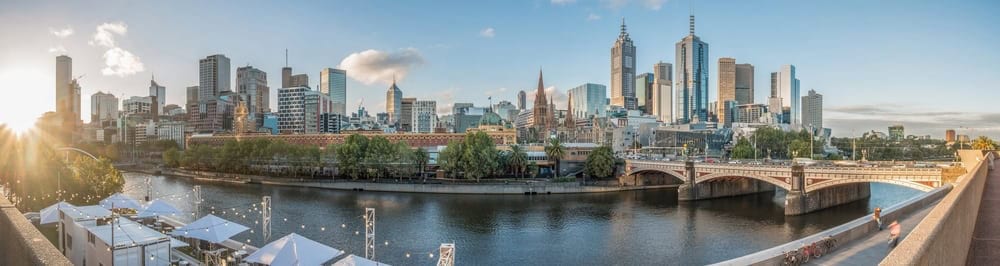
Arrive early, shoot a baseline pano at golden hour, then repeat during sunset and blue hour to blend sky and city lights. Manual focus to infinity-minus-a-hair at f/8. Keep ISO 100–200 and let shutter vary from 1/60 to multiple seconds as light drops. The R6 Mark II’s DR at base ISO preserves highlight color in the sky.
Crowded Events
Use 24–28 mm for less edge stretch on people near the frame edges. Aim 12–14 images per row. Shoot two passes, then mask in PTGui to select clean bodies/faces. Faster shutter (1/200 s) and ISO 800 on the R6 Mark II keep motion in check without sacrificing too much quality.
Rooftop or Pole Shooting
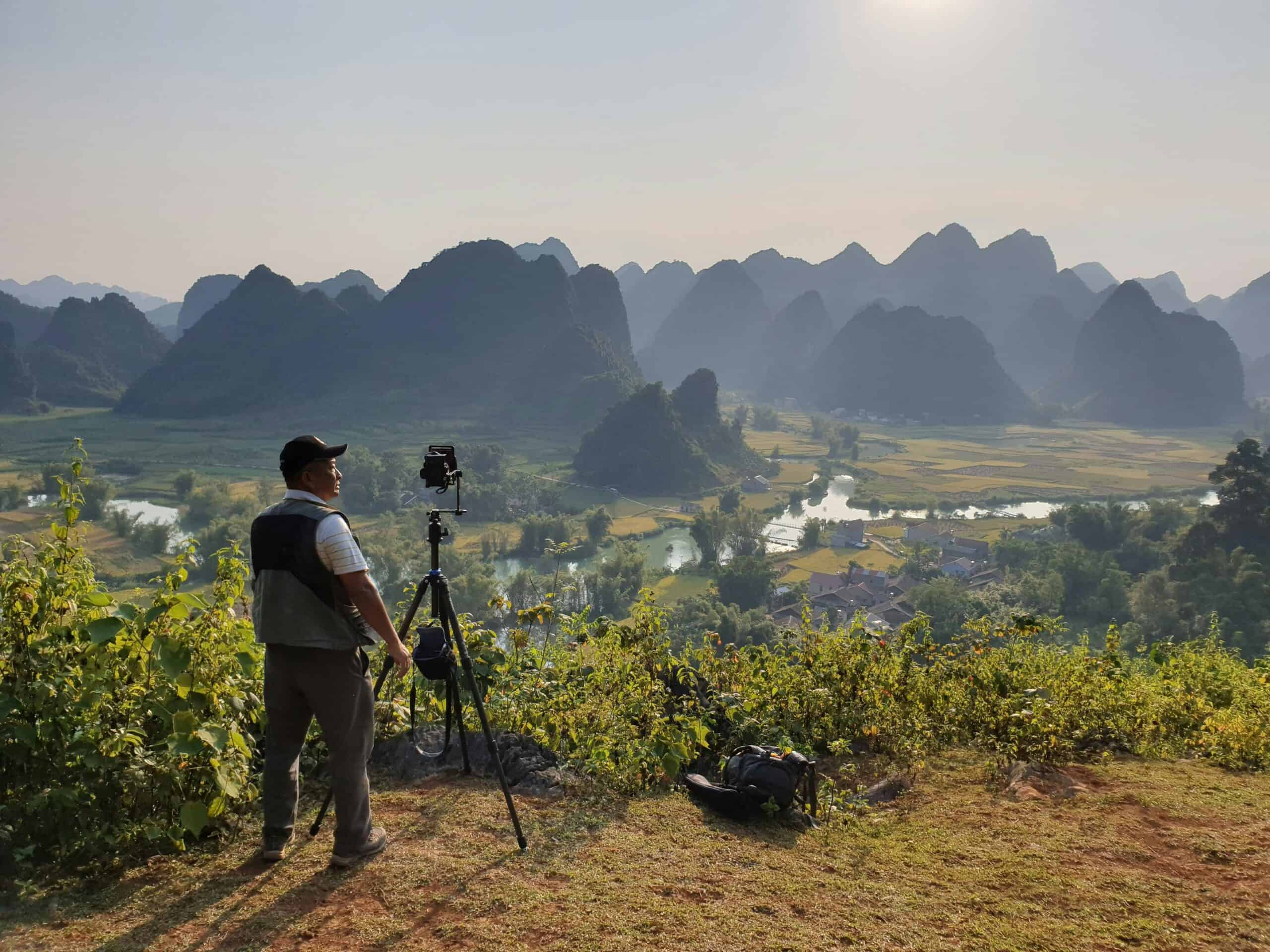
Keep the rig as light as possible. Secure a tether in case of wind gusts. Use high shutter speeds to combat vibration, even if that means ISO 800–1600; the R6 Mark II noise pattern responds well to modern NR. Rotate slower and allow 2–3 seconds for the system to settle between exposures.
Technical Gear Facts That Matter
- Canon EOS R6 Mark II sensor: 24.2 MP full frame, excellent highlight headroom around base ISO; practical pano ISO: 100–800; 1600 still good if needed.
- IBIS: Up to ~7–8 stops with compatible lenses handheld, but disable on tripod to avoid sensor micro-movement.
- Tamron 17–28mm f/2.8 Di III RXD: Sharp center at f/2.8; edge performance strong by f/4–f/5.6; low lateral CA; minimal coma streaking—useful for night city lights.
- Entrance pupil behavior: Moves slightly with zoom; calibrate at each focal length used. Expect values roughly 70–90 mm forward of the sensor plane; confirm on your rail.
For research on spherical resolution with different focal lengths and sensor sizes, see the Panotools reference. Understanding spherical resolution vs focal length
Frequently Asked Questions
- Can I shoot handheld panoramas with the EOS R6 Mark II?
Yes, especially outdoors in good light. Use high shutter speeds (1/250+), generous overlap (40–50%), and keep the camera’s entrance pupil roughly over a fixed point by rotating your torso, not stepping. For critical 360×180° or interiors, a tripod and pano head are strongly recommended.
- Is the Tamron 17–28mm f/2.8 wide enough for a single-row 360?
No—for a full spherical 360×180°, a single-row at 17 mm won’t capture zenith and nadir; you need multi-row plus dedicated zenith/nadir shots. For cylindrical panos (no zenith/nadir), one row can work.
- Do I need HDR for interiors with bright windows?
Usually yes. Bracketing ±2 EV (3–5 frames) preserves both window highlights and interior shadows. Keep aperture and WB fixed; only alter shutter speed between brackets for consistent blending.
- How do I avoid parallax issues with this lens?
Use a panoramic head and calibrate the entrance pupil at the focal length you’ll use. Place a near and far object and adjust the fore-aft rail until they don’t shift relative to each other when you pan. Mark your rail in millimeters for repeatability.
- What ISO range is safe on the R6 Mark II in low light?
For tripod work, keep ISO 100–400 and lengthen shutter. If wind or movement forces faster shutter, ISO 800–1600 remains very clean; apply light noise reduction in post.
- Can I set up Custom Modes for pano?
Yes. Save a Pano-HDR mode (Manual, f/8, AEB ±2 EV, fixed WB, self-timer 2 s, IBIS off) to C1, and a Pano-Daylight mode (Manual, f/8, ISO 100, 1/125, WB Daylight) to C2. This speeds up on-site setup.
- What tripod head should I get?
A multi-row panoramic head with an Arca rail and vertical arm (e.g., Nodal Ninja NN3/NN6 or similar) offers precise nodal alignment and repeatable increments. Add a leveling base for faster setups.
- Can I really use the Tamron 17–28 on the R6 Mark II?
Not directly—it’s a Sony FE lens and FE-to-RF electronic adapters are not widely supported. Use an RF-mount ultrawide with similar focal lengths or a modified solution. The techniques in this guide apply to any similar rectilinear ultrawide on the R6 Mark II.
Safety, Limitations, and Trust Tips
- Rooftops and poles: Always tether your rig and keep clear of edges; verify local regulations.
- Weather: Avoid rain droplets on the front element—tiny drops stitch into big artifacts. Carry a microfiber and a lens hood.
- Backup workflow: Duplicate cards or in-camera backup, and shoot a second pass for safety. Keep consistent naming and folders per location.
- Honest limitations: Rectilinear ultrawide requires more frames than a fisheye for full spheres. Plan extra time for capture and stitching.
For a broader perspective on lens/camera choices for virtual tours and why certain focal lengths shine, this guide is helpful: DSLR/mirrorless virtual tour camera & lens guide.