
Why This Camera & Lens Are Great for Panoramas
The Canon EOS R6 Mark II is a 24.2MP full-frame mirrorless camera with excellent in-body image stabilization (IBIS), fast and reliable autofocus, and very clean low-ISO performance. Those traits make it a strong platform for high-quality panoramas and 360 photos, where consistent exposure, low noise, and repeatable control matter more than sheer megapixels. Its 14-bit RAW files offer roughly 13.5–14 EV of dynamic range at base ISO, and the ~5.9 µm pixel pitch delivers robust tonal latitude—ideal for HDR panorama stacks and low-light scenes.
The Sony FE 14mm f/1.8 GM is a rectilinear ultra-wide prime with excellent sharpness across the frame, very low coma and chromatic aberration, and a huge diagonal field of view (~114°). Stopped down to f/4–f/8 it becomes a razor-sharp pano workhorse. Its optical character (rectilinear, not fisheye) means you’ll need more frames than you would with a fisheye, but you’ll get clean straight lines and minimal geometric distortion—great for architecture and interiors.
Important compatibility note: the Sony FE 14mm f/1.8 GM (Sony E-mount) cannot be mounted on a Canon RF body (EOS R6 Mark II) with a simple adapter. There is no reliable E-to-RF adapter that preserves geometry and electronic control. If you’re committed to the R6 Mark II, use an optically similar rectilinear 14mm on RF (e.g., Canon RF 14–35mm f/4 L at 14mm, or Laowa 14mm). All setup, shot counts, and techniques in this guide apply directly to any 14mm rectilinear on the R6 Mark II. If you already own the Sony 14mm, run the same approach on a Sony body; the shooting workflow is identical.
Quick Setup Overview
- Camera: Canon EOS R6 Mark II — Full-frame 24.2MP, ~5.9 µm pixel pitch, ~14 EV base-ISO dynamic range, 14-bit RAW, IBIS up to 8 stops.
- Lens: Sony FE 14mm f/1.8 GM (rectilinear ultra-wide prime) — very low coma and CA, excellent from f/4–f/8; note rear-gel filter support, no front filter threads. For RF mount, use an equivalent 14mm rectilinear.
- Estimated shots & overlap (tested patterns on FF 14mm rectilinear):
- Conservative full 360×180: 8 shots per row at yaw 45° × 3 rows (−45°, 0°, +45°) + zenith + nadir = 26 images.
- Efficient full 360×180: 6 shots per row at yaw 60° × 3 rows + zenith + nadir = 20 images.
- Architectural safety overlap: target 25–35% overlap.
- Difficulty: Intermediate — easy to master with a calibrated panoramic head.
Planning & On-Site Preparation
Evaluate Shooting Environment
Panoramas magnify small issues. Check light direction and quality, moving subjects (people, trees, traffic), reflective glass, and tight spaces that can reveal parallax errors. If shooting near glass, get the front element very close (1–3 cm) and shoot square-on to reduce reflections. Avoid direct bright light sources cutting across the frame unless you’re intentionally doing an HDR panorama to manage contrast.
Match Gear to Scene Goals
The R6 Mark II provides clean files through ISO 800–1600, but for maximum dynamic range keep ISO at 100–400 when possible. The 14mm f/1.8’s speed helps for night sky and cityscapes, yet for stitched panoramas you’ll typically stop down to f/5.6–f/8 for maximum edge-to-edge sharpness and consistent stitching. Rectilinear 14mm lenses render straight lines well, which is crucial for architecture and interiors, at the cost of more frames vs. a fisheye. If you need fewer frames (e.g., fast-moving events), consider a fisheye option instead.
Pre-shoot Checklist
- Charge batteries and carry spares; format fast UHS-II cards.
- Clean lens front/rear and sensor; dust shows up after stitching.
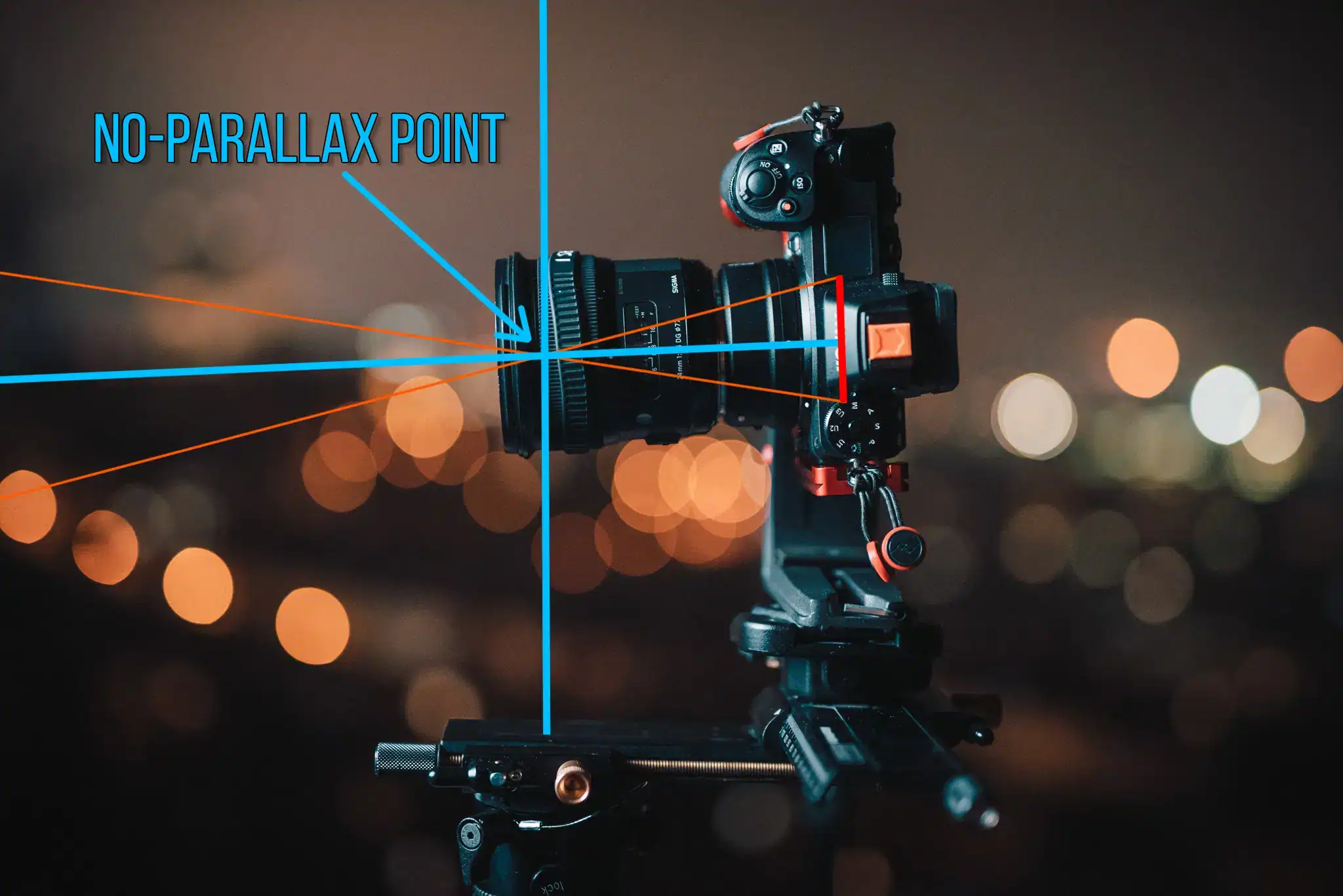
- Level tripod and calibrate your panoramic head’s nodal (no-parallax) point for this lens.
- Safety: Assess wind loads (especially with poles), rooftop/tethering needs, car-mount stability, and bystander safety.
- Backup: Shoot a second pass for redundancy; a small misalignment is cheaper to fix by re-stitching than by reshooting.
Essential Gear & Setup
Core Gear
- Panoramic head: Enables rotation around the lens’s entrance pupil (nodal point) to minimize parallax. This is critical for interiors and any scene with near and far objects.
- Stable tripod with leveling base: Fast, precise leveling reduces horizon correction later.
- Remote trigger or Canon Camera Connect: Prevents micro-shake, especially at slower shutter speeds.
Optional Add-ons
- Pole or car mount: Great for elevated or dynamic perspectives; use safety tethers and monitor wind loading and vibrations.
- LED panels or flash for low-light interiors: Even, indirect fill reduces HDR brackets and speeds workflow.
- Rain covers and lens cloths: Weather shifts can ruin stitching if water or smudges build up mid-sequence.
For a deeper dive on pano heads and nodal alignment, see this panoramic head tutorial. Panoramic head setup tips
Step-by-Step Shooting Guide
Standard Static Scenes
- Level and align: Level the tripod using the leveling base. On the panoramic head, align the camera so rotation is around the lens’s entrance pupil. Perform a quick parallax check with a near and far object: rotate slightly; if relative positions shift, adjust the fore-aft rail.
- Manual exposure: Switch to Manual mode. Meter a mid-tone and lock shutter, aperture, and ISO. Turn off Auto ISO and lock White Balance (e.g., Daylight 5200K outside or a fixed Kelvin inside) to prevent color/exposure flicker across frames.
- Focus: Use manual focus. At 14mm and f/8, set roughly the hyperfocal distance (~0.8–1.0 m) so everything from ~0.4 m to infinity is sharp. Use magnified Live View to confirm.
- Capture pattern: For full spherical coverage:
- Row 1: −45° pitch, 6–8 shots around (60° or 45° yaw steps).
- Row 2: 0° pitch, 6–8 shots around.
- Row 3: +45° pitch, 6–8 shots around.
- Zenith: 1–3 shots pointing straight up, overlapping 30–40%.
- Nadir: 1–3 shots pointing straight down for tripod removal.
- Nadir cleanup: If the head allows, offset the camera or do a slight tripod shift and take a clean ground plate image. This makes tripod removal trivial in post.
HDR / High Dynamic Range Interiors
- Bracket ±2 EV: On the R6 Mark II, enable AEB for 3–7 frames (2 EV steps). 3–5 frames are usually enough to balance windows and interior shadows.
- Maintain consistency: Keep WB locked. Shoot each pano position’s bracket set in rapid succession; use the 2-sec timer or remote to avoid shake.
- Merge strategy: Either pre-merge brackets to 32-bit HDR per angle before stitching or feed all brackets into PTGui and use exposure fusion. Both workflows work—test which matches your look and deadline.
Low-Light / Night Scenes
- Use the tripod and remote: IBIS helps handheld frames, but for tripod panoramas, turn IBIS off to avoid micro drift. Typical settings: f/4–f/5.6, ISO 200–800, shutter as needed (1/8–8s). Long exposure noise reduction off to keep cadence consistent.
- Watch for flare and starbursts: Streetlights may produce starbursts when stopped down; decide creatively and keep angles consistent around the horizon.
Crowded Events
- Two-pass method: Do a fast pass to lock geometry, then a second pass pausing for gaps. In post, mask moving people and ghosts.
- Increase overlap: Use 30–40% overlap so the stitcher has extra data for seam optimization.
Special Setups (Pole / Car / Drone)
- Secure everything: Use safety tethers. Check fasteners before lifting the pole or rolling the car.
- Vibration control: Use faster shutter speeds (1/250–1/500) to freeze shake when on vehicles or tall poles. Spin slower, shoot more frames for redundancy.
Recommended Settings & Pro Tips
Exposure & Focus
| Scenario | Aperture | Shutter | ISO | Notes |
|---|---|---|---|---|
| Daylight outdoor | f/8–f/11 | 1/100–1/250 | 100–200 | Lock WB (daylight); IBIS off on tripod |
| Low light / night | f/4–f/5.6 | 1/8–8s | 200–800 | Tripod & remote; wind blocks help stability |
| Interior HDR | f/8 | Bracket ±2 EV | 100–400 | Bracket 3–5 frames; keep cadence consistent |
| Action / moving subjects | f/5.6–f/8 | 1/200+ | 400–800 | Two-pass method; extra overlap |
Critical Tips
- Manual focus at hyperfocal: At 14mm and f/8, set ~0.8–1 m for near-to-infinity sharpness. Tape the ring if needed.
- Nodal point calibration: Place a light stand close and a distant object in line. Rotate; adjust the rail until there’s no relative shift. Mark the rail for your lens so you can repeat it quickly.
- White balance lock: Avoid mixed WB from frame to frame. Stick to one Kelvin or preset per scene.
- RAW over JPEG: Shoot RAW for HDR and color headroom; panoramas amplify small tonal mismatches.
- IBIS on or off? On tripod: off. Handheld panos: IBIS on can help, but expect more stitching warps; increase overlap.
Stitching & Post-Processing
Software Workflow
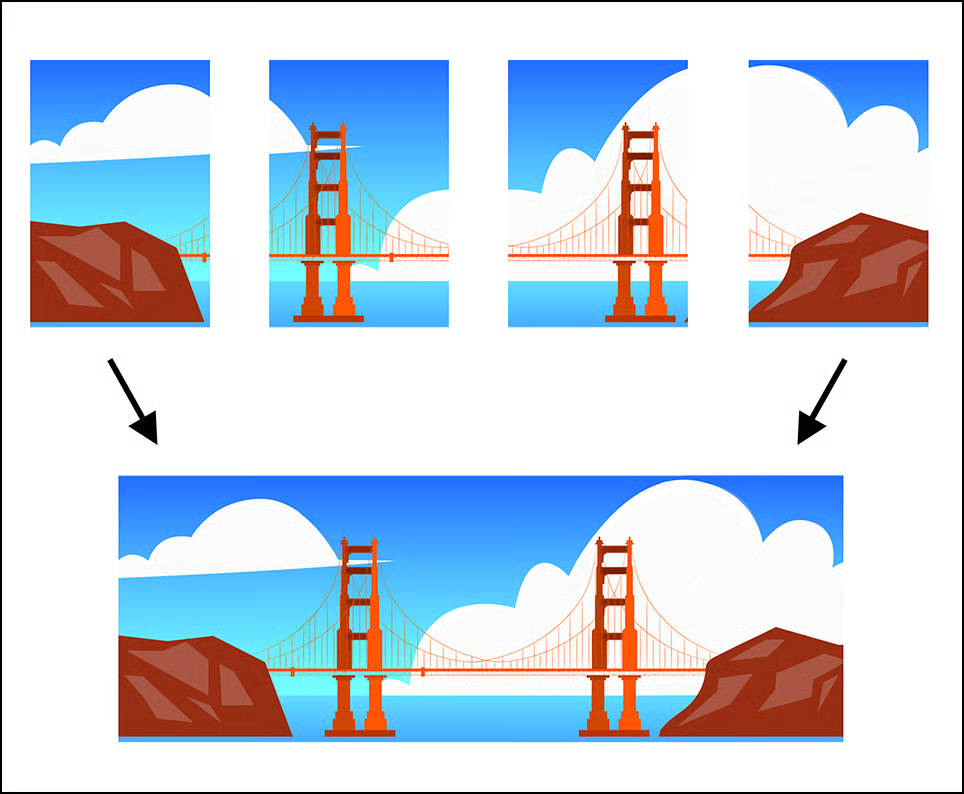
Import into your stitcher of choice. PTGui is an industry standard for speed and control; Hugin is a powerful open-source alternative. Lightroom/Photoshop can handle simple single-row pans but are slower for full 360×180 with multi-row HDR. With rectilinear ultra-wide shots, use 20–35% overlap; fisheye shots can typically work with 25–30% overlap and fewer frames. Build control points automatically, then inspect and add manual points on tricky seams (near objects, glass, foliage). Why many pros favor PTGui for complex panos
Cleanup & Enhancement
- Nadir patch: Patch the tripod using a clean ground plate image or an AI/content-aware fill. Clone carefully to avoid pattern repeats.
- Color and noise: Harmonize WB globally, then apply gentle noise reduction to HDR shadows. Avoid over-sharpening seams.
- Geometry: Level horizon, correct yaw/pitch/roll. Ensure straight verticals for interiors with rectilinear lenses.
- Export: Equirectangular 2:1 for VR. Common sizes: 8000×4000 or 16000×8000 JPEG/TIFF. Keep an uncompressed master TIFF for archival.
If you’re new to panoramic heads and alignment, these guides from Meta/Oculus are clear and current. Set up a panoramic head for high-end 360 photos
Useful Tools & Resources
Software
- PTGui panorama stitching
- Hugin open source
- Lightroom / Photoshop
- AI tools for tripod/nadir removal
Hardware
- Panoramic heads (Nodal Ninja, Leofoto)
- Carbon fiber tripods with leveling bases
- Wireless remote shutters
- Pole extensions / car mounts with safety tethers
Disclaimer: brand names are for search reference—verify specs and compatibility on official sites.
Want more on DSLR/mirrorless 360 best practices? This overview is solid. Using a DSLR/mirrorless to shoot and stitch a 360 photo
Field-Proven Case Studies
1) Interior real estate with bright windows
Use the 3×6 (or 3×8) pattern for full coverage. Set f/8, ISO 100–200, and bracket ±2 EV (3–5 frames). Lock WB at 4000–4500K for cool interiors or 5000–5500K for neutral daylight. Keep the lens square to key walls when possible to preserve verticals. In PTGui, use exposure fusion if you want faster turnaround; for maximum quality, merge brackets to 32-bit HDR per angle before stitching.
2) Outdoor sunset cityscape
Expect rapid light change. Work fast in Manual mode, update exposure every row if necessary and make a second pass as insurance. Wind gusts? Add weight to the tripod or lower the center column. For cleaner silhouettes, consider f/8, ISO 100, and 1/125–1/250. If highlight clipping is severe, do a quick 3-frame ±2 EV bracket on the horizon row only to save time.
3) Event with moving crowds
Increase overlap to 35–40%. Shoot two passes: one quick for coverage, one slower waiting for gaps and better subject positions. In post, mask seams on less busy frames and use the slower pass to fill holes.
4) Rooftop or pole work
Balance safety and coverage. Tether the rig and set faster shutters (1/250–1/500). Use 6 shots per row to slightly reduce total shoot time and the window for vibrations. If the pole flexes, add another full pass.
Advanced Notes, Limits, and Safety
- Mount compatibility: The Sony FE 14mm f/1.8 GM cannot be practically adapted to Canon RF. Use an RF-native 14mm rectilinear for the EOS R6 Mark II. Optical behavior and shot counts remain the same.
- Dynamic range vs. ISO: The R6 Mark II is very clean at ISO 100–800. For critical HDR interiors, stay at ISO 100–200 for best highlight roll-off.
- Vignetting and color: Correct lens vignetting prior to stitching or in the stitcher. Keep a consistent WB to prevent seam tints.
- Backup workflow: Redundancy wins—shoot an extra pass, keep original RAWs, and export a master 16-bit TIFF pano along with your delivery JPEG.
- Reference standards: For spherical resolution and coverage math, see community-validated notes. Panotools spherical resolution reference
Common Mistakes & How to Avoid Them
- Parallax error: Not rotating around the nodal point. Calibrate and mark your rail.
- Exposure flicker: Using auto modes; switch to Manual exposure and lock WB.
- Tripod shadows/footprints: Always shoot a nadir and plan a patch.
- Ghosting from movement: Take two passes and mask in post; add overlap.
- High ISO noise at night: Use tripod, longer shutter, lower ISO; avoid LENR if it slows cadence.
- Horizon tilt: Level at capture and correct in the stitcher’s pitch/roll tools.
Frequently Asked Questions
- Can I shoot handheld panoramas with the EOS R6 Mark II?
Yes, for single-row pans or quick coverage. Turn IBIS on, use 30–40% overlap, and faster shutter speeds (1/250+). For full 360×180 and precise interiors, use a tripod and pano head to avoid parallax issues.
- Is the 14mm rectilinear wide enough for a single-row 360?
No. A full spherical 360×180 at 14mm requires multiple rows (typically three: −45°, 0°, +45°) plus zenith and nadir. A single row at 14mm covers only a strip around the horizon.
- Do I need HDR for interiors with bright windows?
Usually. Bracket ±2 EV (3–5 frames) to hold both window highlights and interior shadows. Merge before or during stitching in PTGui/Hugin for consistent tone.
- How do I avoid parallax problems with near objects?
Use a panoramic head and align the camera so rotation occurs around the lens’s entrance pupil. Perform the near/far alignment test and mark the rail position for your 14mm lens.
- What ISO range is safe on the R6 Mark II in low light?
For top dynamic range, keep ISO 100–400. ISO 800–1600 is still clean for night scenes, but prioritize longer shutter times on a tripod to minimize noise.