Why This Camera & Lens Are Great for Panoramas
If you’re asking how to shoot panorama with Canon EOS R6 Mark II & Sigma 8mm f/3.5 EX DG Circular Fisheye, you’re already on the right track. This combo is purpose-built for fast, reliable 360° capture. The EOS R6 Mark II’s 24.2MP full-frame CMOS sensor (36×24 mm) delivers strong dynamic range (about 13.5 EV at base ISO) and excellent high-ISO performance with ~6.0 µm pixel pitch, so you can keep shutter speeds practical without turning your images noisy. The R6 Mark II’s responsive controls, reliable exposure metering, and quick bracketing make it a joy for HDR panoramas.
The Sigma 8mm f/3.5 EX DG is a circular fisheye that records a full 180° field of view across the image circle on full frame. Translation: far fewer shots per sphere and fewer stitching seams—ideal for real estate, events, and fast run‑and‑gun 360 photos. Distortion is intentional (fisheye), not a flaw, and modern stitchers model it perfectly; you’ll get seamless equirectangular outputs without needing to “defish” first. Mount the EF version to the R6 Mark II using Canon’s EF‑EOS R adapter; the lens doesn’t have optical stabilization, but the R6 Mark II’s IBIS can assist when handholding (turn it off on a tripod).
Quick Setup Overview
- Camera: Canon EOS R6 Mark II — Full-frame 24.2MP CMOS, ~6.0 µm pixel pitch, ~13.5 EV base DR, excellent ISO 100–3200, usable to 6400 for 360 work.
- Lens: Sigma 8mm f/3.5 EX DG Circular Fisheye — Circular fisheye for full-frame; sharpest around f/5.6–f/8; mild longitudinal CA and purple fringing at edges (manageable in post).
- Estimated shots & overlap (field-tested):
- Safe: 4-around at yaw 0/90/180/270 (pitch 0°) → full sphere; add 1 nadir if you want an easy tripod patch.
- Speed: 3-around at 120° (open sky/clean scenes) → faster, but tighter overlap at the poles.
- Overkill/complex interiors: 6-around at 60° if you need extra redundancy for glass/rails.
- Difficulty: Easy for beginners; quick for semi‑pros.
Planning & On-Site Preparation
Evaluate Shooting Environment
Start by reading the light and the space. Are you working in a high-contrast interior with bright windows? Plan for HDR bracketing. Are there reflective surfaces (glossy floors, glass walls, polished counters)? Minimize the distance between the camera and glass (or use a black cloth/flag) to reduce flare and ghost reflections. Watch for close foreground objects; circular fisheyes “see everything,” which can amplify parallax if your nodal alignment is off.
Match Gear to Scene Goals
The EOS R6 Mark II’s dynamic range and low-noise files make it ideal for sunset rooftops and moody interiors. You can comfortably run ISO 100–800 for critical quality; ISO 1600–3200 still stitches cleanly for 360 output, and ISO 6400 is usable with noise reduction. The Sigma 8mm’s fisheye projection means fewer frames, faster capture, and fewer moving‑subject artifacts to fix—huge for events or outdoor scenes with wind‑moved foliage and crowds. The tradeoff is fisheye distortion in the source frames, but modern stitchers use lens models that make this a non‑issue in your final equirectangular.
Pre-shoot Checklist
- Power & storage: Fully charged batteries; ample fast cards. Bring spares.
- Optics: Clean lens front element; check sensor for dust (f/8 shows spots).
- Support: Leveling base and calibrated panoramic head (nodal alignment).
- Safety: Weight your tripod in wind; tether when on rooftops/poles/car mounts; keep people clear of the rig before rotating.
- Backup capture: Shoot a second pass for safety—especially for paid real estate or once‑in‑a‑lifetime sunsets.
Essential Gear & Setup
Core Gear
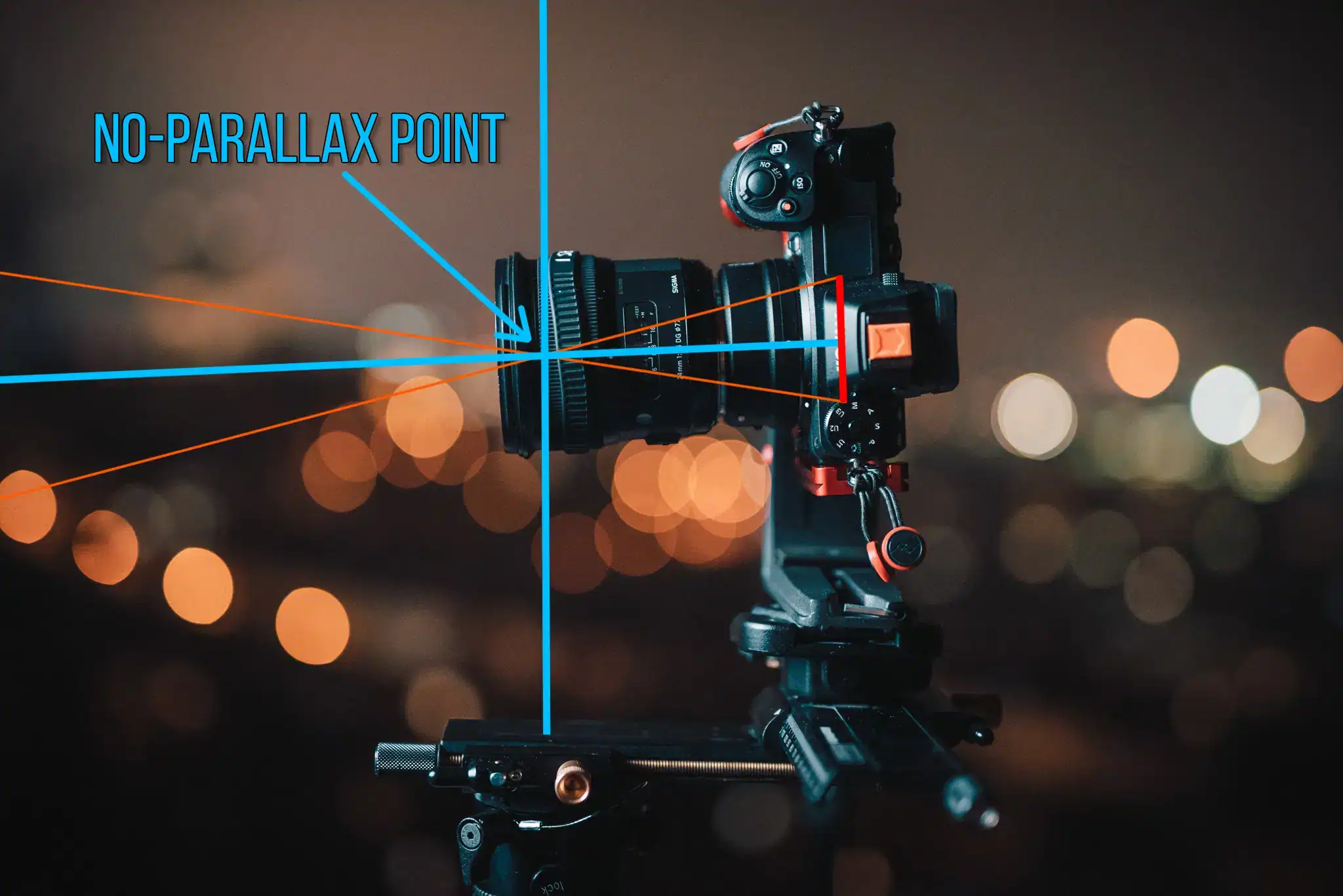
- Panoramic head: Lets you rotate around the lens’s entrance pupil (no‑parallax point) to eliminate foreground/background shifts. Calibrate once, then mark the rails.
- Stable tripod with leveling base: A bubble or half‑ball base speeds leveling so your yaw increments are true.
- Remote trigger or Canon Camera Connect app: Prevents shake at slower speeds or during brackets.
- EF‑EOS R adapter: Required for the Sigma 8mm EF mount on the R6 Mark II.
Optional Add-ons
- Pole or car mount: Great for elevated or car-top 360s. Use safety tethers and monitor wind load and vibration.
- Lighting aids: Small LED panels for dark interiors; keep them out of frame and consistent across shots.
- Weather protection: Rain cover, microfiber cloths, and lens hooding/flags for flare control.
Step-by-Step Shooting Guide
Standard Static Scenes
- Level & nodal alignment: Level the tripod. On the panoramic head, slide the lens so the rotation occurs through the entrance pupil. A practical starting point for the Sigma 8mm on a typical rail is around 55–65 mm forward of the sensor plane mark (Φ); fine‑tune by aligning two vertical objects at different distances and rotating to eliminate relative shift.
- Manual exposure & WB: Set Manual mode. Meter a mid‑tone and lock exposure across all frames to avoid flicker lines in the stitch. Lock white balance (Daylight/Cloudy/Tungsten) rather than AWB to keep color consistent.
- Capture sequence: With the circular 8mm, shoot 4-around at 90° yaw increments (0/90/180/270), pitch 0°. Overlap is generous with this lens; you’ll have robust control points in PTGui/Hugin.
- Nadir shot: For clean tripod removal, take 1 nadir frame by shifting the rig or using a nadir adapter, or plan to patch with a logo plate later.
HDR / High Dynamic Range Interiors
- Bracket ±2 EV (3–5 frames): For windows and mixed lighting, 3 frames (−2/0/+2 EV) usually suffice. For extreme contrast, use 5 (−4/−2/0/+2/+4). The R6 Mark II’s fast electronic shutter and AEB make this quick.
- Consistent color: Lock WB and picture style. RAW is preferred, but consistent in-camera choices reduce surprises in previews and batch processing.
- Stability: Use the remote/app. Turn off IBIS on a tripod to avoid micro‑vibrations during long exposures.
Low-Light / Night Scenes
- Exposure target: Aim for ISO 100–800 when possible; ISO 1600–3200 is still very usable on the R6 Mark II, with light noise reduction in post. Expect shutter speeds 1/4–1 s at f/5.6–f/8.
- Vibration control: Solid tripod, remote release, 2 s self-timer. Disable IBIS on tripod.
- Flare & hotspots: Avoid direct bright light into the fisheye. Flag the lens with your hand/hat outside the frame if needed.
Crowded Events
- Two passes: First pass quickly for coverage; second pass waiting for gaps in movement. The 8mm minimizes frames, reducing ghosting chances.
- Blend in post: Use PTGui’s mask/optimizer to keep clean areas from each pass and remove moving people.
Special Setups (Pole / Car / Elevated)
- Secure everything: Use clamps rated above your rig’s weight, secondary tethers, and safety lines. Check all knobs before lifting.
- Account for wind and vibration: Keep rotations slow, use higher shutter speeds (1/200+) if handholding or on a moving platform, and shoot extra overlap.
Recommended Settings & Pro Tips
Exposure & Focus
| Scenario | Aperture | Shutter | ISO | Notes |
|---|---|---|---|---|
| Daylight outdoor | f/8–f/11 | 1/100–1/250 | 100–200 | Lock WB to Daylight for consistency. |
| Low light/night | f/4–f/5.6 | 1/30–1 s | 400–1600 | Tripod, remote; disable IBIS on tripod. |
| Interior HDR | f/8 | Bracket ±2 EV | 100–400 | 3–5 bracketed frames cover bright windows. |
| Action / moving subjects | f/5.6–f/8 | 1/200+ | 400–800 | Freeze motion; consider a second pass for masking. |
Critical Tips
- Manual focus: Set the Sigma 8mm to the hyperfocal distance. At f/8 on full frame, hyperfocal is ~0.27–0.30 m—focus around 0.3 m and everything from ~0.15 m to infinity is sharp.
- Nodal calibration: Start ~55–65 mm forward of the sensor plane with this lens; adjust until near/far vertical edges don’t shift when you pan. Mark your rails for repeatability.
- White balance lock: Use a fixed WB to avoid color shifts between frames and brackets.
- RAW over JPEG: Maximizes dynamic range and gives better highlight recovery and color grading latitude.
- IBIS/IS: Turn off IBIS on tripod; leave it on only when handholding or on a pole with unavoidable movement.
- Anti-flicker: In interiors with LED/fluorescent lights, enable Anti‑Flicker to keep exposure consistent across frames.
Stitching & Post-Processing
Software Workflow
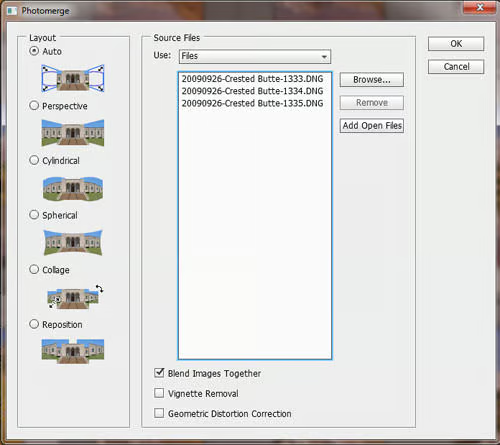
Import your RAWs to Lightroom/Capture One for initial white balance and exposure normalization; avoid local adjustments before stitching. Export 16‑bit TIFFs and stitch in PTGui or Hugin. Circular fisheye frames are straightforward—PTGui recognizes the lens model, finds control points quickly, and builds a seam‑free equirectangular. Industry guidance for overlap: about 25–30% for fisheyes (your 4-around provides plenty), and 20–25% for rectilinear lenses. After stitching, bring the equirectangular back to Lightroom or Photoshop for finishing and export to your VR platform.
For a deep dive on panoramic head setup and best practices, see this panoramic head tutorial. Panoramic head setup and theory
Cleanup & Enhancement
- Nadir patch: Use PTGui’s Viewpoint correction or clone/AI fill in Photoshop to remove the tripod. A dedicated nadir shot simplifies this step.
- Color & noise: Apply global color balance, lens CA correction, and modest noise reduction for ISO 1600–6400 night captures.
- Leveling: Use PTGui’s horizon tool or Photoshop’s adaptive wide angle to ensure a level horizon; correct yaw/pitch/roll.
- Output sizes: Common equirectangular exports range from 8K×4K to 12K×6K for virtual tours; 16K is possible from clean 24MP sources when optimized. For theoretical spherical resolution notes, see panotools. Understanding spherical resolution
Want a concise walkthrough? The Oculus Creator guide outlines an end‑to‑end DSLR/mirrorless 360 workflow. Using a DSLR/mirrorless to shoot and stitch a 360 photo
For tool selection and a review of PTGui’s capabilities, see this overview. PTGui reviewed as a top panorama tool
Useful Tools & Resources
Software
- PTGui panorama stitching
- Hugin (open source)
- Lightroom / Photoshop for RAW and cleanup
- AI-based tripod/nadir removal tools
Hardware
- Panoramic heads (Nodal Ninja, Leofoto)
- Carbon fiber tripods with leveling bases
- Wireless remotes or Canon Camera Connect
- Pole extensions and car mounts with safety tethers
Disclaimer: product names are provided for research; check official sites for specs and compatibility.
Common Mistakes & How to Avoid Them
- Parallax error: Always align the entrance pupil; mark your rail once calibrated.
- Exposure flicker: Manual exposure and locked WB across the entire set.
- Tripod shadows: Shoot a nadir or plan to patch; watch where sunlight falls.
- Ghosting: Take a second pass for moving people/cars and mask in post.
- High ISO noise: Keep ISO conservative when possible; use solid support and slower shutters.
- Flare: Avoid pointing the fisheye directly at the sun or strong fixtures; flag the lens when needed.
Field‑Tested Scenarios
Indoor Real Estate (Bright Windows)
Use 4-around + nadir, f/8, ISO 100–200, 3–5 AEB ±2 EV. Lock WB to Daylight if window light dominates, or 4000–4500K if tungsten/LED is primary. Place the rig away from mirrors and glass; if unavoidable, get close and use a black flag to block reflections. PTGui’s exposure fusion or HDR merge produces natural tonality without haloing.
Sunset Rooftop
Expose for highlights to preserve color in the sky; bracket if foreground falls too dark. Expect 1/30–1/125 s at f/8, ISO 100–400. Use 4-around. Level meticulously to keep the horizon straight, then refine in PTGui.
Event Crowds
Fast 3-around can work outdoors with clear sky for speed, but 4-around is safer. Use 1/200–1/500 s, f/5.6–f/8, ISO 400–800. Capture a second pass to fill gaps without people, then mask.
Rooftop Pole Capture
Limit pole height in wind; tie off with a safety line. Use 1/200+ s, ISO 400–1600 as needed. Expect some micro‑motion—shoot extra frames for overlap.
Safety & Gear Care
- Wind and height: Weight your tripod; use tethers for elevated or car‑mount work.
- Public spaces: Keep a perimeter so people don’t walk into the lens while you rotate.
- Weather: Keep a microfiber cloth handy; fisheyes are prone to water spots and flare.
- Data safety: Back up cards after each location; consider dual capture passes for mission‑critical scenes.
Frequently Asked Questions
-
Can I shoot handheld panoramas with the Canon EOS R6 Mark II?
Yes, in a pinch. The R6 Mark II’s IBIS helps, but for 360 spheres the priority is parallax‑free rotation, which requires a panoramic head. Handheld 3‑around can stitch outdoors with distant subjects, but interiors and close objects usually need a tripod and nodal alignment.
-
Is the Sigma 8mm f/3.5 wide enough for single‑row 360°?
Absolutely. On full frame, the circular 8mm covers 180° FOV. A single row of 4-around at 90° yaw typically covers the full sphere; add a nadir if you want an easier tripod patch.
-
Do I need HDR for interiors with bright windows?
Often, yes. Bracket ±2 EV (3–5 frames) to capture window highlights and interior shadows cleanly. The R6 Mark II handles brackets quickly, reducing ghosting risk.
-
How do I avoid parallax issues with this lens?
Use a panoramic head and align the entrance pupil. Start around 55–65 mm forward of the sensor plane and fine‑tune by watching near/far vertical lines as you pan. Once set, mark your rails for repeatable results.
-
What ISO range is safe on the R6 Mark II for low light?
For critical quality, ISO 100–800. ISO 1600–3200 remains very usable in 360 outputs, with light noise reduction. ISO 6400 can still work for dark scenes where shutter speed must be kept up.
-
Can I set custom modes for panorama on the R6 Mark II?
Yes. Save Manual exposure, fixed WB, disabled IBIS (for tripod), AEB settings, and the 2 s self‑timer to C1/C2. This speeds up your on‑site setup and keeps results consistent.
-
How do I reduce flare with a circular fisheye?
Avoid pointing directly at the sun or intense fixtures; shade the lens with your hand/flag outside the frame. Shoot an extra frame with a different rotation if a flare reflection falls on critical details.
-
Best tripod head choice for this setup?
A lightweight nodal head with precise fore‑aft and vertical adjustment (e.g., Nodal Ninja/Leofoto) works great. Add a leveling base to speed leveling before rotation.
Example Results & Inspiration
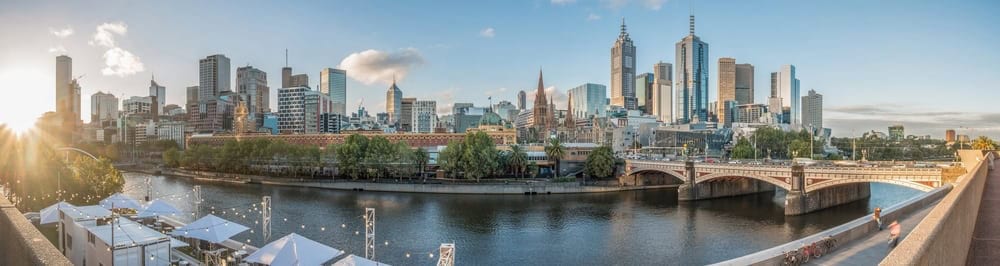
For more background on choosing cameras and lenses for virtual tours, this guide compares popular options and tradeoffs. DSLR/mirrorless lens guide for virtual tours