
Why This Camera & Lens Are Great for Panoramas
The Canon EOS R6 Mark II paired with a 14–24mm f/2.8 ultra‑wide zoom is a powerful combo for high‑quality panoramas and 360 photos. The R6 Mark II uses a 24.2MP full‑frame CMOS sensor (36×24 mm) with large ~5.94 µm pixels, excellent high‑ISO behavior, and robust dynamic range around base ISO that helps retain both sky highlights and shadow detail. Canon’s DIGIC X processor delivers fast, stable shooting and responsive previews, while the in‑body image stabilization (IBIS) is useful for handheld panos—though you should switch it off on a tripod.
The Sigma 14–24mm f/2.8 DG DN Art is a rectilinear ultra‑wide designed for mirrorless mounts, prized for high corner sharpness at f/5.6–f/11, low coma, and controlled distortion—ideal traits for stitching. Important mount note: the DG DN Art is made for Sony E and L‑mount; it does not natively fit Canon RF. On the Canon EOS R6 Mark II you should instead use the Sigma 14–24mm f/2.8 DG HSM Art (EF version) with a Canon EF‑to‑RF adapter. Optical behavior for pano purposes is very similar when stopped down, and you’ll get the same framing and overlap guidance below. If you only have the DG DN version, it will not adapt to RF; consider an RF‑native ultra‑wide (e.g., Canon RF 15–35mm f/2.8) or the EF HSM Sigma via adapter.
Because the Sigma is a rectilinear lens (not a fisheye), you’ll capture more frames than a fisheye but with straighter lines—great for architecture and real estate where geometric accuracy matters. The R6 Mark II’s intuitive controls, reliable manual focus aids (magnification/peaking), and stable exposure metering make it easy to lock consistent settings across an entire pano sequence.
Quick Setup Overview
- Camera: Canon EOS R6 Mark II — full‑frame (36×24 mm), 24.2MP, pixel pitch ~5.94 µm, excellent low‑light and ~14 EV base dynamic range.
- Lens: Sigma 14–24mm f/2.8 Art (use EF HSM + EF‑RF adapter on R6 Mark II). Rectilinear ultra‑wide, sharp stopped to f/8–f/11, low lateral CA, mild vignetting at f/2.8 that cleans up by f/5.6.
- Estimated shots & overlap (full 360×180):
- At 14mm rectilinear: 3 rows at pitch +50° / 0° / −50°, 8 shots per row (45° yaw steps) ≈ 24 shots + zenith + nadir = 26 images (≈30% overlap).
- At 18mm: 3 rows, 10 shots per row ≈ 30 + z/n = 32 (≈30% overlap).
- At 24mm: 4 rows (±60°/±20°), 10–12 around per row ≈ 40–48 + z/n (25–30% overlap).
- Single‑row cylinder (not full 360×180): at 14mm, 8–10 around with 30% overlap.
- Difficulty: Intermediate — rectilinear multi‑row shooting requires careful nodal alignment and exposure management.
Planning & On-Site Preparation
Evaluate Shooting Environment
Walk the scene before setting up. Identify reflective surfaces (glass walls, glossy floors), strong backlight sources (sun, direct lamps), and moving elements (people, traffic, foliage in wind). If shooting through glass, place the lens as close as practical without touching and shade with a jacket or hood to control flare and ghosting. For sunsets, anticipate rapidly changing brightness—compose and meter quickly to lock a consistent exposure plan.
Match Gear to Scene Goals
The R6 Mark II’s clean ISO up to 800–1600 is forgiving in dim interiors and night cityscapes. To maximize dynamic range, prefer ISO 100–200 for daylight landscapes and ISO 100–400 for interiors with bracketed HDR. The Sigma 14–24’s rectilinear rendering keeps architecture lines straight, which is ideal for real estate and urban scenes. Although fisheyes require fewer frames, rectilinear panos look more natural and avoid heavy defishing steps—especially helpful for clients sensitive to distortion.
Pre-shoot Checklist
- Charge batteries; bring at least one spare. Format cards in camera.
- Clean the front element and sensor; dust shows up in big skies and bright walls.
- Level the tripod; calibrate the panoramic head’s nodal alignment for 14, 18, and 24mm marks.
- Safety first: on rooftops or windy balconies, tether your camera and secure the tripod; avoid edges and public walkways.
- Backup plan: shoot an extra overlapping round—small time cost, big insurance against stitching gaps.
Essential Gear & Setup
Core Gear
- Panoramic head: A proper pano head lets you rotate around the lens’s entrance pupil (often called “nodal point”) to eliminate parallax when foreground and background overlap. This is crucial for stitching clean lines and avoiding ghosting in interiors.
- Stable tripod with leveling base: A leveling base speeds setup by letting you level the head independently of leg length—faster, safer, more accurate horizons.
- Remote trigger or Canon Camera Connect app: Fire shots without touching the camera to avoid micro‑shake, especially at slower shutters.
Optional Add-ons
- Pole or car mount: Great for elevated or moving perspectives. Use safety tethers, watch wind loads, and avoid high speeds. Check local regulations before mounting externally on vehicles.
- Lighting aids: Small LED panels for interiors; bounce cards to tame contrast near windows.
- Weather protection: Rain cover, lens hood for flare, microfibre cloths for sea spray.
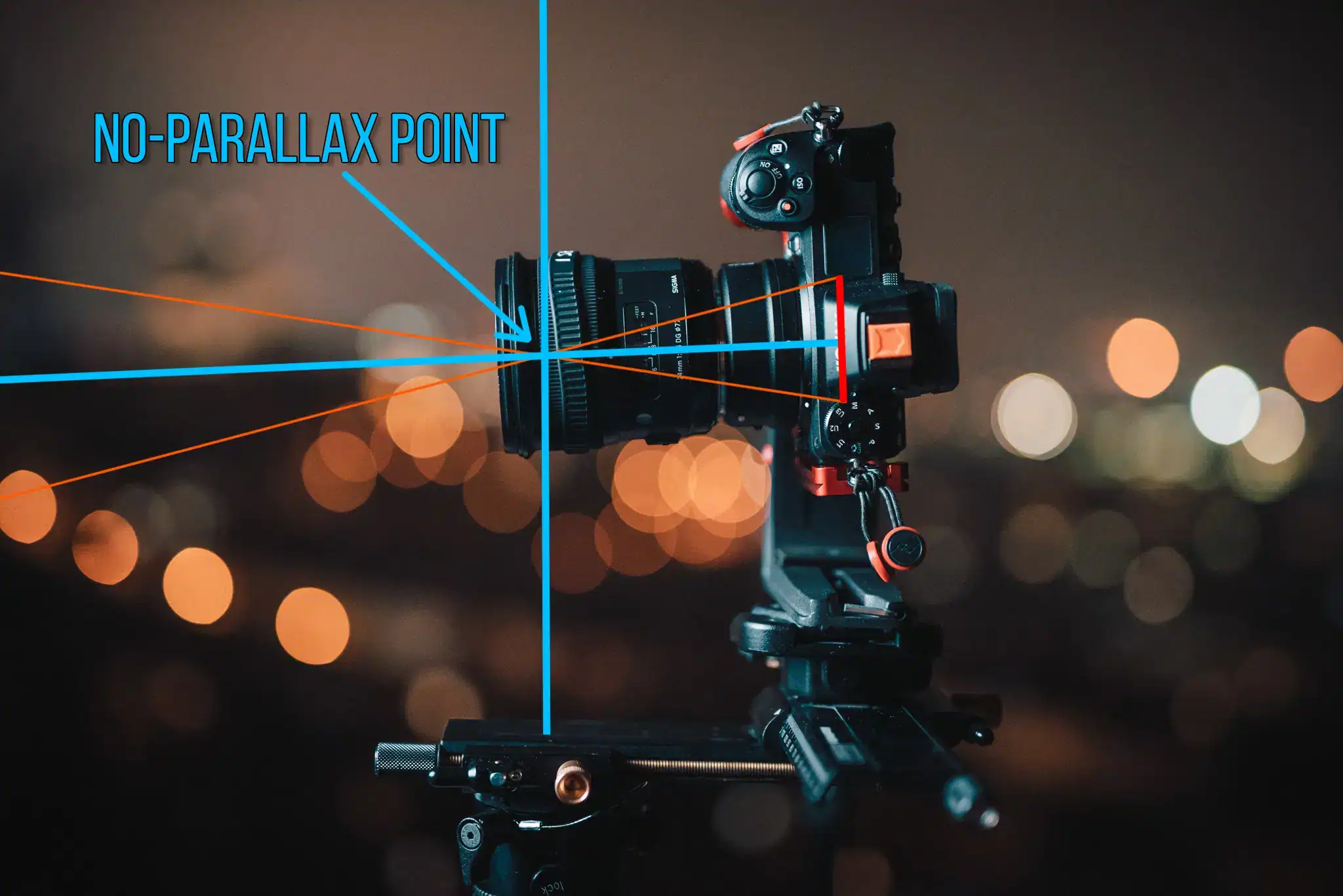
Nodal Alignment (Entrance Pupil) — Practical Steps
Mount the R6 Mark II and Sigma on your pano head. Place two vertical objects in line (light stand close, doorway edge far). Rotate the camera at your chosen focal length (e.g., 14mm) and adjust the rail until the near and far objects stay aligned in the frame as you pan. Mark those rail positions for 14, 18, and 24mm with tape or a silver marker. Expect a starting point around 80–95 mm forward of the sensor plane at 14mm for many setups—always verify on your own rig.
Want a deep dive on panoramic head setup? See this panoramic head tutorial for a step‑by‑step visual guide. Panoramic head tutorial (360 Rumors)
Step-by-Step Shooting Guide
Standard Static Scenes
- Level and lock: Level the tripod using the bubble/leveling base. Lock the pano head’s tilt and roll at your desired pitch row (e.g., +50°, 0°, −50°).
- Manual exposure: Switch to M mode. Meter the brightest area you need to retain (e.g., sky near sun), then open up until midtones look correct. For daylight: start ISO 100–200, f/8–f/11, 1/100–1/250. Lock white balance to a fixed Kelvin (e.g., 5200K daylight).
- Manual focus: Use magnified live view and focus ~1 m at 14mm (near the hyperfocal at f/8). Then set MF; turn off AF to keep focus consistent across frames.
- Capture sequence: Shoot the top row (e.g., +50°) around at equal yaw steps, then the middle row, then bottom row. Keep 25–30% overlap per frame. Use a remote or 2s timer.
- Nadir/zenith: Tilt up for a single zenith shot. Tilt down or remove the camera to capture a clean nadir patch for tripod removal later.
HDR / High Dynamic Range Interiors
- Bracket for windows: Use AEB on the R6 Mark II. A reliable pattern is 3–5 frames at ±2 EV. Keep shutter speed as the varying parameter; lock aperture (f/8) and ISO (100–400).
- Lock color: Fix WB (e.g., 3200–4000K for tungsten‑heavy interiors) to avoid bracket‑to‑bracket color shifts that complicate stitching.
- Order: Either bracket each angle before moving to the next, or shoot a full pass at each exposure and stack later. The first method is generally safer for alignment.
Low-Light / Night Scenes
- Base exposure: Start at f/4–f/5.6, ISO 200–800, shutter 1/30–1/60 on tripod. If stars or city lights, prefer ISO 100–400 and longer shutters for optimal quality.
- Stability: Disable IBIS on a tripod to avoid potential micro‑vibrations. Use a remote trigger. Windy? Hang a small weight under the tripod center column.
- Noise control: It’s safe to push the R6 Mark II to ISO 800–1600 if needed, but prioritize longer exposures at lower ISO for cleanest panos.
Crowded Events
- Two passes: Make a fast primary pass to secure geometry, then a second pass waiting for gaps to reduce ghosting. Note landmarks to mask moving people in post.
- Faster shutter: Use 1/200s+ at f/5.6–f/8, ISO 400–800 to freeze motion if people are prominent.
Special Setups (Pole / Car / Drone)
- Pole: Secure the camera with a safety tether; keep your body upwind to reduce sway. Rotate slower and shoot in bursts to minimize pole flex between frames.
- Car mount: Keep speeds low, avoid rough roads, and over‑engineer safety straps. Consider a shorter focal length or a stabilized rig for fewer frames and faster capture.
Field‑Tested Micro‑Case Studies
Indoor real estate with bright windows
At 14mm: f/8, ISO 100, bracket 5 frames at ±2 EV. 3 rows × 8 around + z/n. Turn off ceiling fans to avoid blade ghosting. Ask occupants to step aside during each row.
Outdoor sunset on a rooftop
At 14mm: f/11, ISO 100, 1/125s. Capture sky first while color is peaking. Add a second darker pass to preserve sun color if needed. Secure tripod from wind gusts.
Event crowd at a plaza
At 18mm: f/5.6, 1/250s, ISO 400. Two quick passes; choose frames with the fewest cross‑frame movers. Mask in PTGui or Photoshop later.
Recommended Settings & Pro Tips
Exposure & Focus
| Scenario | Aperture | Shutter | ISO | Notes |
|---|---|---|---|---|
| Daylight outdoor | f/8–f/11 | 1/100–1/250 | 100–200 | Lock WB (daylight 5200K); prioritize DR |
| Low light/night | f/4–f/5.6 | 1/30–1/60 | 200–800 | Tripod + remote; IBIS off on tripod |
| Interior HDR | f/8 | Bracket ±2 EV (3–5 shots) | 100–400 | Windows vs shadows balanced |
| Action / moving subjects | f/5.6–f/8 | 1/200+ | 400–800 | Freeze motion; double pass strategy |
Critical Tips
- Manual focus near hyperfocal: At 14mm and f/8 on full‑frame, hyperfocal is just under 1 m—set focus ~1 m and switch to MF.
- Nodal calibration: Mark rail positions for 14/18/24mm. Re‑check after transport or lens service.
- White balance lock: Kelvin WB avoids color drift across frames and brackets. Use 5200K outdoors, 3200–4000K indoors, or create a custom reading.
- RAW capture: Always shoot RAW for maximum dynamic range, color latitude, and consistent processing.
- Shutter mode: Prefer EFCS or mechanical on a tripod. Fully electronic can band under LED lighting.
- IBIS: Handy for quick handheld panos, but switch it OFF on a tripod to prevent micro‑blur from sensor corrections.
Stitching & Post-Processing
Software Workflow
Import and cull in Lightroom or your DAM of choice. For stitching, PTGui is the industry workhorse for complex multi‑row rectilinear sets, with strong control point generation and masking tools. Hugin is a powerful open‑source alternative. With rectilinear lenses, plan on 25–30% overlap to give the stitcher robust matches and minimize edge stretching. After stitching, export as equirectangular for VR or rectilinear for web banners and prints. For a practical review of PTGui’s strengths in pro workflows, see this overview: PTGui review on Fstoppers.
For creators publishing 360 photos to VR, this official guide covers the end‑to‑end flow from capture to export: Using a DSLR or mirrorless camera to shoot and stitch a 360 photo (Meta).
Cleanup & Enhancement
- Nadir patch: Capture a clean ground shot after moving the tripod, or use AI tools/clone stamping to remove the tripod.
- Color and noise: Match WB/tint across rows, apply selective noise reduction for shadow rows, and retain micro‑contrast in textures.
- Geometry: Level the horizon and fine‑tune yaw/roll/pitch; ensure verticals are truly vertical for architectural deliveries.
- Export formats: For VR, export a 16‑bit TIFF or high‑quality JPEG in equirectangular (2:1) at the project’s target resolution. Reference spherical resolution tables to estimate output size for your focal length and sensor. Panotools: DSLR spherical resolution
Useful Tools & Resources
Software
- PTGui panorama stitching (masking, control points, batch HDR)
- Hugin open source stitcher
- Lightroom / Photoshop for RAW, color, and retouching
- AI tripod removal or content‑aware fills for nadir patching
Hardware
- Panoramic heads (Nodal Ninja, Leofoto, Sunwayfoto)
- Carbon fiber tripod with a leveling base
- Wireless remote shutters or Canon Camera Connect
- Pole extensions or low‑vibration car mounts
Disclaimer: product names are for reference; check official sites for the latest specs and compatibility.
Common Mistakes & How to Avoid Them
- Parallax error: Always align the entrance pupil at your focal length and maintain constant camera height.
- Exposure flicker: Manual exposure and locked WB only; avoid auto ISO and auto WB.
- Tripod shadows or footprints: Plan your nadir shot and patch in post.
- Ghosting from movement: Use two passes and mask moving subjects in your stitcher.
- Night noise and blur: Lower ISO, use longer shutters with a rock‑solid tripod, and turn off IBIS on tripod.
Safety, Compatibility & Limitations
Mount compatibility: The Sigma 14–24mm f/2.8 DG DN Art is not native to Canon RF and cannot be adapted from Sony E or L‑mount to RF. For the EOS R6 Mark II, use the Sigma 14–24mm f/2.8 DG HSM Art (EF mount) with a Canon EF‑RF adapter, or an RF‑native ultra‑wide. Always confirm firmware updates for adapter compatibility and AF stability.
Rooftops and poles: Use safety tethers, avoid crowded walkways, and watch wind. Do not leave gear unattended. In public spaces, follow local regulations regarding tripods and mounts.
Backup workflow: After your main sequence, shoot a quick extra ring at 0° pitch. This often saves a pano if a single frame fails or if motion spoils a stitch.
More panorama FAQs and lens/body recommendations from a pro perspective are summarized here for further reading: Virtual tour camera & lens FAQ (360 Rumors)
Frequently Asked Questions
- Can I shoot handheld panoramas with the EOS R6 Mark II?
Yes, for single‑row stitches and quick environments. Use IBIS ON, fast shutter (1/250s+), and generous overlap (40–50%). For full 360×180 or interiors with straight lines, a tripod and pano head are strongly recommended for precision and easy stitching.
- Is the Sigma 14–24mm wide enough for single‑row 360?
For a full spherical 360×180, a single row is not enough with a rectilinear 14mm; you need multiple rows plus zenith and nadir. If you only need a cylindrical pano (no zenith/nadir), one row of 8–10 shots at 14mm can work well.
- Do I need HDR for interiors with bright windows?
Usually yes. Bracketing ±2 EV (3–5 frames) preserves window views and interior detail. The R6 Mark II’s clean low ISO makes HDR merges very clean when processed in PTGui or Lightroom before stitching.
- How do I avoid parallax issues with this lens?
Use a panoramic head and align rotation at the entrance pupil. Calibrate and mark rail positions for 14/18/24mm. Keep the camera level and avoid changing focus distance mid‑sequence.
- What ISO range is safe on the R6 Mark II in low light?
For best quality on tripod, stay at ISO 100–400 and lengthen shutter. If handheld or people are moving, ISO 800–1600 is still quite usable with careful exposure and later noise reduction.
- Can I set Custom Modes (C1/C2) for pano?
Yes—save a “Pano Tripod” mode (M, RAW, EFCS, IBIS OFF, MF, Kelvin WB, self‑timer or remote) and a “Pano Handheld” mode (M or S priority, IBIS ON, faster shutter, higher ISO limit). This speeds up field work.
- How can I reduce flare at 14mm?
Avoid placing the sun just outside the frame; shield with your hand or a flag, and clean the front element. Slightly adjust yaw to move flare ghosts into overlap zones you can mask out later.
- What’s the best tripod head for this setup?
A 2‑axis panoramic head with an adjustable fore‑aft rail is ideal (e.g., Nodal Ninja, Leofoto, Sunwayfoto). Ensure it supports the weight of the R6 Mark II + 14–24 and has clear degree markings for repeatability.
Further Learning
For a concise discussion of panorama focal lengths and coverage considerations, this article is useful background reading: Panoramas, focal lengths & Photoshop (B&H Explora)