Why This Camera & Lens Are Great for Panoramas
If you’re wondering how to shoot panorama with Canon EOS R6 Mark II & Samyang 12mm f/2.8 ED AS NCS Fish-Eye, you’ve picked a powerful combo for fast, reliable 360° work. The EOS R6 Mark II uses a 24.2 MP full-frame CMOS sensor (approx. 35.9 × 23.9 mm) with Dual Pixel CMOS AF II and in-body image stabilization (IBIS). At base ISO 100, it offers strong dynamic range (around 13+ stops in practical use), clean color, and excellent noise control through ISO 1600–3200 when needed. Pixel pitch is roughly 6 μm, which helps with low-light and HDR workflows. The camera’s RF mount accepts EF lenses via the Canon Mount Adapter EF–EOS R, which is exactly what you’ll need for the Samyang 12mm f/2.8.
The Samyang 12mm f/2.8 ED AS NCS Fish-Eye is a diagonal fisheye designed for full-frame. It covers a 180° diagonal field, letting you capture a full spherical panorama with relatively few shots. The lens is manual focus and typically uses an aperture ring, which is ideal for panorama consistency (no mid-sequence aperture changes). Stopped to f/5.6–f/8, it’s sharp across the frame, with manageable chromatic aberrations for a fisheye. The fisheye projection simplifies stitching because you can get high overlap with fewer frames, though you’ll need to manage fisheye distortion in composition and post.
Together, this setup is compact, fast, and forgiving: fewer frames per 360 photo, excellent low-light performance, and robust RAW files for HDR panoramas. Whether you’re shooting interiors, sunsets, or city rooftops, the combo is efficient and field-proven.
Quick Setup Overview
- Camera: Canon EOS R6 Mark II — full-frame 24.2 MP, Dual Pixel CMOS AF II, IBIS up to 8 stops, native ISO 100–102,400 (expandable).
- Lens: Samyang 12mm f/2.8 ED AS NCS Fish-Eye — diagonal fisheye for full-frame, manual focus/aperture, sharpest around f/5.6–f/8, mild CA that’s easy to correct.
- Estimated shots & overlap (tested guidelines):
- Standard 360×180: 6 shots around at 60° yaw spacing, plus 1 zenith (+90° tilt) and 1 nadir (−90° tilt).
- Safety for tight interiors/close objects: 8 around + zenith + nadir (more overlap reduces stitching errors).
- Minimal outdoor set: 4 around + zenith + nadir can work in open spaces but risks small zenith gaps—use with caution.
- Difficulty: Easy–Intermediate (fisheye reduces shot count; nodal setup still required).
Planning & On-Site Preparation
Evaluate Shooting Environment
Before you unfold the tripod, scan for moving elements (people, traffic, trees), reflective surfaces (glass, polished floors), and bright light sources that can flare on a fisheye. If shooting through glass, keep the front element parallel and as close to the glass as possible (1–2 cm) to minimize reflections—use a rubber hood when feasible. Outdoors, note the sun’s position; fisheyes see almost everything, so backlight can create ghosts and veiling flare. At night, look for bright point sources (street lamps) and plan HDR brackets to preserve highlight detail.
Match Gear to Scene Goals
The EOS R6 Mark II handles contrasty scenes thanks to solid dynamic range and clean ISO up to 1600–3200 when properly exposed. For interiors, keep ISO around 100–400 when on a tripod to maximize detail for stitching. For handheld or fast-moving scenarios, the R6 II’s IBIS is useful, but for tripod shots, turn IBIS off to avoid micro jitter. The Samyang 12mm fisheye’s wide coverage means fewer frames for each 360 photo, reducing the time people have to move into your shot—ideal for events and public locations, with the tradeoff of fisheye distortion that you’ll defish or leave as-is in a VR viewer.
Pre-shoot Checklist
- Power and storage: two charged batteries and fast UHS-II SD cards; set backup to second card if available.
- Clean optics: remove dust from lens and sensor; fisheyes reveal every speck.
- Tripod and head: level the tripod, verify your panoramic head’s nodal (no-parallax) alignment for this lens.
- Safety: secure straps and cables; on rooftops or poles, use a safety tether and monitor wind gusts.
- Backup sequence: shoot a second full 360 round if time allows—insurance against stitching gaps or motion.
Essential Gear & Setup
Core Gear
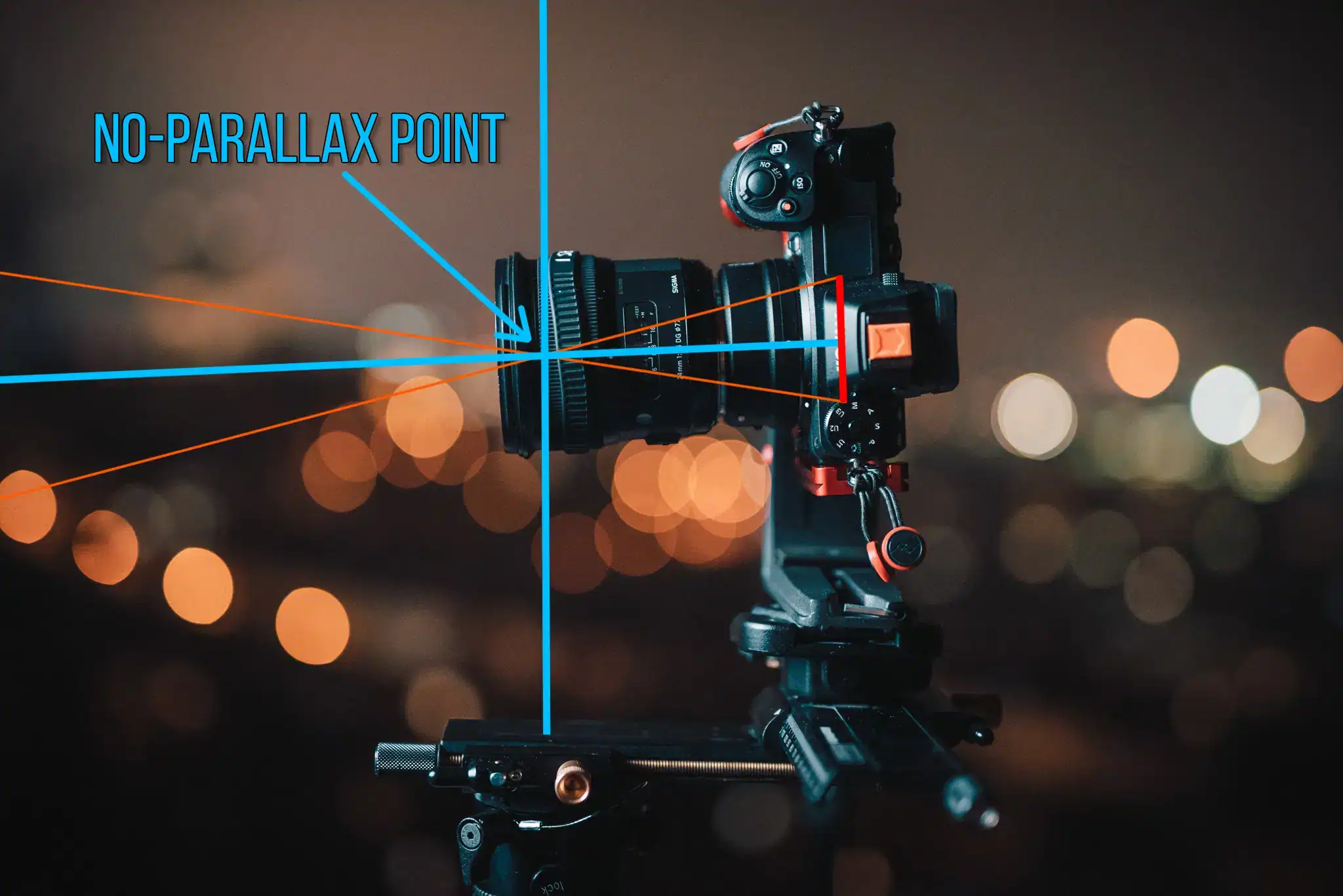
- Panoramic head: This is critical. A pano head lets you rotate around the lens’s entrance pupil (nodal point), eliminating parallax between foreground and background. That’s what enables seamless stitching.
- Stable tripod with leveling base: Level once at the base and your rotational axis stays true. A bubble level or digital level saves time.
- Remote trigger or Canon Camera Connect app: Prevents shake and keeps your hands off the camera between frames.
Optional Add-ons
- Pole or car mount: Use a safety tether and consider a vibration-damping mount. Wind loads can be severe with a pole—do not work near power lines, edges, or traffic without spotter and permits.
- Lighting aids: Small LED panels or bounced flash for interiors—keep lighting consistent across the sequence.
- Weather gear: Rain cover, lens cloths, and silica packs. Fisheye domes attract droplets; wipe carefully between frames.
Step-by-Step Shooting Guide
Standard Static Scenes
- Level and lock: Level the tripod via the leveling base. Lock all leg clamps firmly.
- Align the nodal point: On your pano head, slide the camera forward/backward until near and far objects stay aligned as you yaw left/right. Mark the rail positions for the R6 II + Samyang 12mm so you can set it up fast next time.
- Manual exposure and WB: Switch to M mode. Meter a mid-tone and set a fixed exposure for the whole sequence. Lock white balance (Daylight/Tungsten/Custom) to avoid color shifts between frames.
- Focus and aperture: Use manual focus. Magnify live view and focus about one-third into the scene or at the hyperfocal distance. For general work, f/8 is a sweet spot for sharpness and depth of field.
- Capture sequence:
- 6-around at 60° spacing, tilt 0°, then 1 zenith (+90°) and 1 nadir (−90°). Overlap 30–35% between frames.
- Rotate gently; let vibrations settle before each shot. Use a 2-second self-timer or remote.
- Nadir shot for tripod removal: Shoot an extra offset nadir by tilting the rig or moving the tripod slightly and shooting down. This helps patch out the tripod cleanly in post.
HDR / High Dynamic Range Interiors
- Bracket exposure: Use AEB for 3–5 frames at ±2 EV. For very bright windows, consider ±3 EV with 5 or 7 frames.
- Fixed color: Keep WB locked. Avoid Auto WB across brackets; it complicates blending and stitching.
- ISO control: Stick to ISO 100–200 on tripod for maximum dynamic range; let shutter speed vary.
- Consistent cadence: Shoot each view’s bracket set completely before rotating to maintain order and overlap.
Low-Light / Night Scenes
- Stability first: Use tripod, IBIS Off, and a remote. With the R6 II, EFCS or full electronic shutter can eliminate mechanical vibration.
- Exposure targets: f/4–f/5.6, ISO 200–800 for minimal noise; extend shutter to 1–8 seconds as needed. The R6 II can handle ISO 1600–3200 if you must—expose to the right and denoise later.
- Long exposures: Use the 2-sec timer or remote, and turn off any image review that might shake the rig if you touch the camera.
Crowded Events
- Two-pass strategy: First pass for coverage, second pass to capture gaps in crowds. You’ll blend the clean areas later.
- Faster capture: The 6-around approach reduces time. Keep shutter speeds at 1/125–1/250 if you want to freeze motion.
- Mind the edges: Ask nearby people to pause briefly when they’re close to the camera to reduce stitching ghosts.
Special Setups (Pole / Car / Rooftop)
- Safety and tether: Always tether the rig. On poles, avoid high winds; keep people clear below. On cars, use dedicated vibration-isolated mounts and drive slowly on smooth surfaces.
- Slower rotations: On a pole or vehicle, rotate more slowly to minimize motion blur and stitch misalignment.
- Extra overlap: Add more frames (8 around) to improve the stitch in challenging conditions.
Field Case Studies
Indoor Real Estate
Tripod at chest height, 6-around + Z + N, f/8, ISO 100, and 5-frame ±2 EV bracketing. Lock WB to “Tungsten” or set a custom WB. Close blinds slightly to tame extreme window highlights or ensure a clean bracket that captures the window view.
Outdoor Sunset
Expose for mid-tones and bracket 3–5 frames. Watch out for flare with the fisheye; use your hand or a flag to block the sun between frames if needed, keeping it out of the frame. Consider 8-around for more overlap against fast-changing sky brightness.
Event Crowds
Use 6-around at 1/200, f/5.6, ISO 400–800. Shoot a second pass to catch cleaner gaps. In post, mask and blend moving subjects to reduce ghosts.
Rooftop or Pole
Weather-check wind speeds. Tether the rig and use 8-around for extra overlap. Use faster shutter speeds (1/250–1/500) and a slightly higher ISO (400–800) to counter micro-movements.
Video tutorial: Panoramic head setup and capture basics
Recommended Settings & Pro Tips
Exposure & Focus
| Scenario | Aperture | Shutter | ISO | Notes |
|---|---|---|---|---|
| Daylight outdoor | f/8–f/11 | 1/100–1/250 | 100–200 | Lock WB (Daylight). Avoid flare with careful sun angles. |
| Low light/night | f/4–f/5.6 | 1/30–8 s | 200–800 | Tripod & remote; IBIS Off; EFCS or silent shutter to avoid shake. |
| Interior HDR | f/8 | Bracket ±2 EV | 100–400 | Balance windows and lamps; keep WB locked. |
| Action / moving subjects | f/5.6–f/8 | 1/200+ | 400–800 | Freeze motion; consider a second pass for clean plates. |
Critical Tips
- Manual focus at hyperfocal: With a 12mm on full-frame, f/8 focused near 1 m gives deep DoF to infinity. Confirm with magnified live view.
- Nodal calibration: Use two vertical objects (near and far). Rotate left/right; adjust camera position on the rail until parallax disappears. Mark the rail positions for this lens + adapter + body.
- White balance lock: Mixed lighting can shift color frame to frame. Set a custom WB or fixed Kelvin for consistency.
- RAW over JPEG: The R6 II’s 14-bit RAW preserves highlight headroom and shadow detail for HDR and noise reduction.
- IBIS Off on tripod: Prevents the sensor from “hunting” during long exposures. Also disable lens IS (if present).
- Use the Canon EF–EOS R adapter: The Samyang 12mm f/2.8 is EF-mount; the adapter maintains infinity focus and rigidity.
Stitching & Post-Processing
Software Workflow
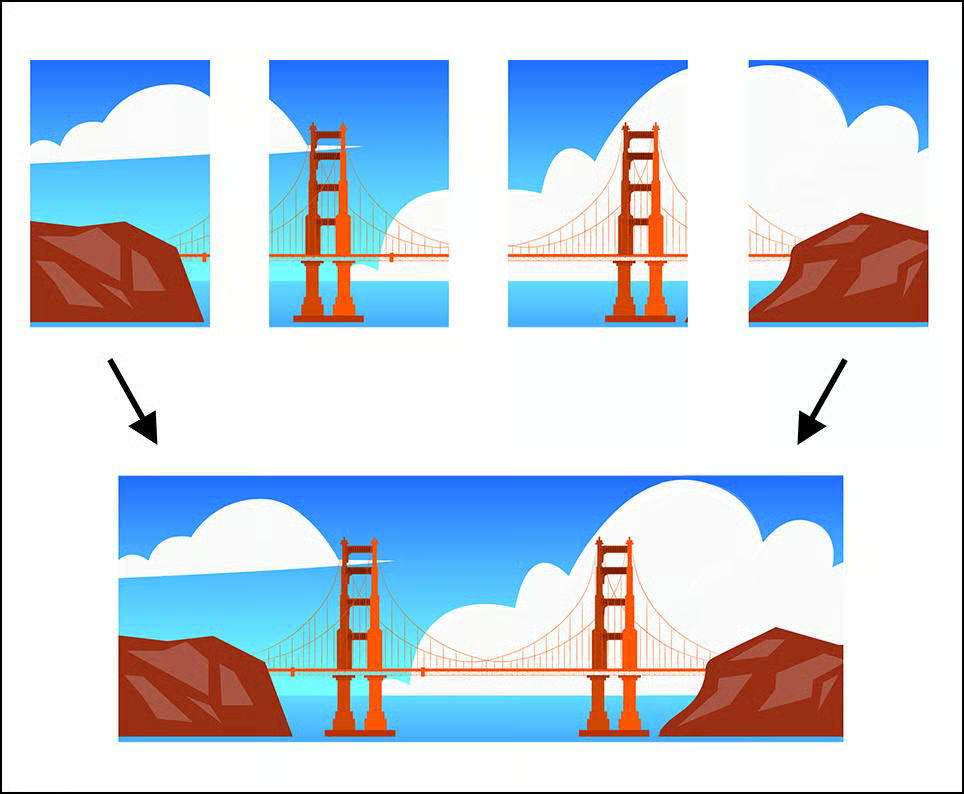
Fisheye panoramas stitch very well in dedicated panorama software. A robust workflow is: import RAWs to Lightroom (or similar), apply lens CA correction and consistent WB, export 16-bit TIFFs, and then stitch in PTGui or Hugin. With a diagonal fisheye, aim for ~30% overlap. PTGui’s fisheye lens model and control point generator will handle most scenes automatically; Hugin is an excellent open-source alternative if you prefer a free tool. For Photoshop-only methods, ensure enough overlap and manually align when needed, but dedicated tools are faster and more accurate. For an in-depth perspective on why PTGui is a top choice for pros, see this review. Fstoppers: PTGui review
Cleanup & Enhancement
- Nadir patch: Use a dedicated nadir shot or patch the tripod area with AI tools or manual cloning. Export a layered panorama and finish in Photoshop.
- Color and noise: Correct color casts from mixed light. Apply gentle noise reduction for high-ISO night scenes.
- Level horizon: In PTGui, set verticals and horizon; adjust yaw/pitch/roll to level the scene for VR viewers.
- Export for VR: Save as 16-bit TIFF master and a web-ready equirectangular JPEG (e.g., 12000 × 6000 px) for 360 platforms.
If you’re new to panoramic heads and control points, this panoramic head tutorial is a concise reference. 360 Rumors: Panoramic head tutorial
For complete 360 photo guidelines (capture to publishing), this VR creator resource is widely referenced. Oculus: Using a DSLR or mirrorless camera to shoot and stitch a 360 photo
Useful Tools & Resources
Software
- PTGui panorama stitching (fast, robust fisheye modeling)
- Hugin (open source, full control for advanced users)
- Lightroom / Photoshop for RAW prep and retouching
- AI tripod removal tools (Content-Aware Fill, Generative Fill)
Hardware
- Panoramic heads: Nodal Ninja, Leofoto, or equivalent with fore-aft and vertical rails
- Carbon fiber tripods for stiffness-to-weight advantage
- Leveling bases to speed setup and keep rotation true
- Wireless remote shutters or camera apps
- Pole extensions / car mounts with safety tethers
Disclaimer: software/hardware names provided for search reference; check official sites for details and compatibility.
Common Mistakes & How to Avoid Them
- Parallax error: Always align the nodal point; re-check after moving the tripod.
- Exposure flicker: Use Manual exposure and locked white balance for the entire sequence.
- Tripod shadows and footprints: Shoot a nadir frame or plan to patch in post.
- Ghosting from movement: Mask and blend from a cleaner second pass in post.
- Night noise and smear: Use low ISO on tripod and let shutter lengthen; disable IBIS.
- Flare on fisheye: Avoid direct light sources in-frame when possible; shade the lens between frames if needed.
Frequently Asked Questions
- Can I shoot handheld panoramas with the Canon EOS R6 Mark II?
Yes, but tripod + pano head is strongly recommended. Handheld with a fisheye can work for quick outdoor 360s (use 6–8 around), but parallax errors and tilted horizons are common. Use higher shutter speeds (1/250), lock WB, and accept more post cleanup.
- Is the Samyang 12mm f/2.8 wide enough for single-row 360°?
Yes. A single row of 6 shots around plus zenith and nadir reliably covers full 360×180. In tight interiors or when objects are very close to the lens, consider 8 around for more overlap.
- Do I need HDR for interiors with bright windows?
Often yes. Bracket ±2 EV (3–5 frames) to preserve window detail and interior shadows. The R6 II’s RAW files are flexible, but HDR brackets make stitching cleaner and reduce noise in shadow recovery.
- How do I avoid parallax issues with this setup?
Use a panoramic head and align the entrance pupil by sliding the camera along the rail until near/far objects don’t shift relative to each other as you pan. Mark your rail settings for the R6 II + adapter + Samyang 12mm to repeat quickly.
- What ISO range is safe on the EOS R6 Mark II in low light?
On tripod, favor ISO 100–400 and lengthen the shutter. If you need speed (events, wind), ISO 800–1600 remains quite clean; ISO 3200 is usable with good exposure and modern denoise tools.
Safety, Limitations, and Honest Advice
The fisheye’s 180° diagonal view captures everything—including your feet, tripod, and lighting. Plan your nadir strategy before you shoot. The Samyang 12mm is manual focus; magnify to focus precisely and re-check if temperature changes or you bump the focus ring. On rooftops, poles, or vehicle rigs, safety is paramount. Use tethers, verify clamps, and never compromise on wind conditions or local regulations. Finally, keep a redundant workflow: back up cards on-site, and shoot a second complete 360 pass if time permits. It’s the cheapest insurance you’ll ever buy.
Bonus: Visual Examples