Why This Camera & Lens Are Great for Panoramas
Looking for a practical guide on how to shoot panorama with Canon EOS R6 Mark II & Pentax DA 10-17mm f/3.5-4.5 ED Fisheye? This pairing can be a surprisingly capable 360°/VR combo when set up correctly. The Canon EOS R6 Mark II is a 24.2MP full-frame mirrorless camera (36×24mm sensor) with Dual Pixel CMOS AF II and in-body image stabilization (IBIS) rated up to 8 stops. Its pixel pitch is roughly 5.9 µm, which helps with clean shadows and low-light recovery; real-world base ISO dynamic range is in the ~13.5–14 EV class, giving you good headroom for interior HDR panoramas.
The Pentax DA 10–17mm is a diagonal fisheye zoom designed for APS-C. On APS-C (1.5–1.6× crop), it delivers up to 180° diagonal FOV at 10mm. On the R6 Mark II, you have two workable approaches:
1) use the camera’s 1.6× crop mode (recommended) to fully utilize the lens without severe vignetting; or
2) use full-frame mode and accept heavy corner darkening at shorter focal lengths, which can be masked or cropped in stitching. For consistent, professional results, crop mode is the safer path.
Fisheye lenses shine for 360 panoramas because they need fewer shots, stitch robustly, and tolerate slight subject motion better than rectilinear lenses. The trade-off is distortion and more careful nodal-point alignment. The R6 Mark II’s excellent high-ISO performance and clean RAW files make it suitable for low-light interiors and night cityscapes when paired with a stable panoramic head.
Quick Setup Overview
- Camera: Canon EOS R6 Mark II — Full-frame, 24.2MP; base ISO 100; robust DR (~13.5–14 EV at ISO 100); Dual Pixel AF II; IBIS up to 8 stops.
- Lens: Pentax DA 10–17mm f/3.5–4.5 ED Fisheye — diagonal fisheye for APS-C; ~180° diagonal FOV at 10mm on APS-C; best sharpness around f/5.6–f/8; can exhibit purple fringing/CA in high-contrast edges.
- Mounting note: Use a Pentax K to Canon RF adapter with aperture control. The DA 10–17 lacks an aperture ring; a “dumb” adapter will lock you wide-open, which is not ideal for panos.
- Estimated shots & overlap (tested):
- APS-C crop mode at 10mm: 6 around (60° spacing) + 1 zenith + 1 nadir, ~30% overlap.
- APS-C crop mode at 12–14mm: 8 around + zenith + nadir, 25–30% overlap.
- Full-frame mode (accepting vignette at 14–17mm): 8–10 around + zenith + nadir; crop/ mask edges in post.
- Difficulty: Moderate — alignment and the right adapter are the key hurdles; once set, it’s very efficient.
Planning & On-Site Preparation
Evaluate Shooting Environment
Before setting up, scan the scene for moving subjects, reflective surfaces (glass, cars, polished floors), and light sources. Strong point lights can flare with fisheyes; try to angle the camera to keep bright bulbs or the sun just outside the frame edges when possible. When shooting through glass, keep the front element close (1–3 cm) to minimize reflections; use a rubber lens hood or dark cloth if needed. For outdoor sunsets, think about the dynamic range between sky and foreground and plan for bracketing.
Match Gear to Scene Goals
The R6 Mark II offers clean results at ISO 100–800; ISO 1600 remains very usable in RAW with careful noise reduction. Indoors, especially real estate with window views, the body’s DR and clean shadows help when bracketing ±2 EV. The Pentax DA 10–17 fisheye reduces shot count—a big win in dynamic scenes or on tight schedules—while the R6 II’s crop mode ensures the lens covers the frame without heavy vignetting. Fisheye distortion is expected and handled by modern stitching software.
Pre-shoot Checklist
- Power and storage: Fully charged batteries and fast UHS-II cards; bring spares.
- Adapter: Pentax K to Canon RF with aperture control; verify you can stop to f/8.
- Optics: Clean front element; fisheyes see “everything”—dust shows.
- Tripod & head: Leveling base and calibrated panoramic head for the nodal point.
- Safety: On rooftops or poles, add a safety tether; check wind gusts and public foot traffic.
- Backup workflow: If in doubt, shoot a second full pass; take an extra nadir for patching.
Essential Gear & Setup
Core Gear
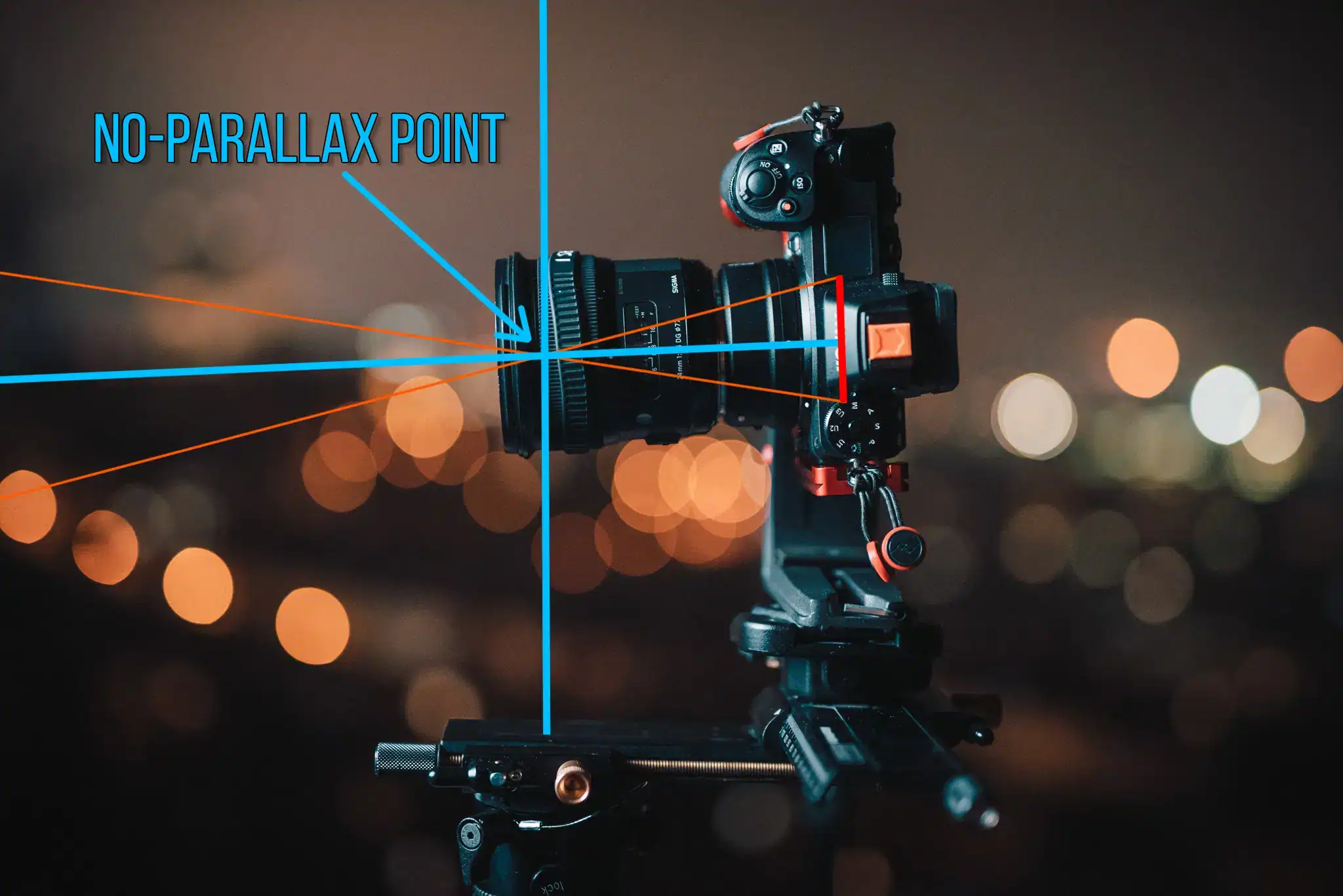
- Panoramic head: A two-axis pano head with fore-aft and lateral slide lets you place the lens’s entrance pupil (nodal point) over the rotation axis, preventing parallax between foreground and background. This is critical for clean stitches.
- Stable tripod with leveling base: Level the base first so your around-shots stay consistent; it speeds up stitching and horizon leveling later.
- Remote trigger or Canon app: Fire the shutter without touching the camera; a 2-sec self-timer also works.
Optional Add-ons
- Extension pole or car mount: Great for crowds or tight spaces; add a guy-line or tether in wind. Watch flex and vibrations; use faster shutter speeds.
- Lighting aids: LED panels for dark interiors; keep color temperature consistent to avoid WB mismatches.
- Weather protection: Rain cover and microfiber cloths; fisheyes are vulnerable to droplets and smudges.
For a deeper primer on panoramic head setup and why nodal alignment matters, see this panoramic head tutorial. Panoramic head fundamentals (360 Rumors)
Step-by-Step Shooting Guide
Standard Static Scenes
- Level and align: Level the tripod. Mount the pano head. Adjust the fore-aft slide so a foreground object and a distant line (doorframe, window edge) maintain alignment as you pan—this is your nodal point. Mark the rail positions for 10mm and 14mm so you can repeat them later.
- Camera prep: Switch the R6 Mark II to APS-C crop mode for the DA 10–17. Set RAW, Manual exposure, Manual WB (e.g., 5600K daylight or a custom reading), and Manual focus.
- Exposure: Meter the brightest area you must retain detail in (e.g., sky), then set a base exposure that protects highlights while keeping midtones workable. Typical daylight start: f/8, 1/200, ISO 100.
- Capture sequence: At 10mm, shoot 6 around at 60° yaw intervals. Add 1 zenith (tilt up ~60–90°) and 1 nadir (tilt down). Keep overlap ~25–30%.
- Nadir cleanup: After the main pass, lift the tripod, shift slightly, and shoot a clean ground patch for tripod removal. Alternatively, shoot a handheld nadir at the same nodal position if possible.
HDR / High Dynamic Range Interiors
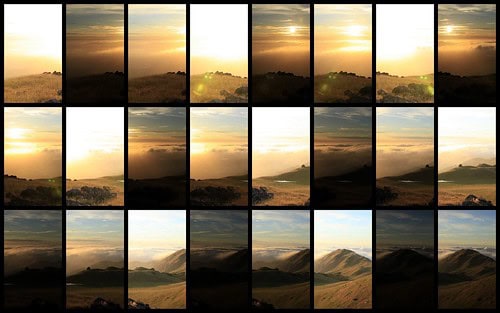
- Bracket ±2 EV (3–5 frames) to balance bright windows and dark corners. Keep the aperture and ISO fixed; only the shutter should change between brackets.
- Lock white balance: Set a Kelvin value or use a custom WB to avoid shifting color across frames and brackets.
- Order and cadence: Shoot each view as a full bracket before rotating to the next yaw angle to minimize subject movement between exposures.
Low-Light / Night Scenes
- Stability: Use a sturdy tripod; turn IBIS off on the R6 Mark II when on a tripod to prevent micro-vibrations. Enable a 2-sec timer or remote release.
- Exposure strategy: Open to f/4–f/5.6; lower shutter to 1/30–1/60 for static scenes. Keep ISO at 100–800 when possible; ISO 1600 is still very usable with RAW and noise reduction.
- Avoid flicker: Use manual exposure and manual WB; fluorescent or LED lighting can band with electronic shutter—use EFCS or mechanical if needed.
Crowded Events
- Two-pass method: Do a fast pass to lock composition and coverage, then a second, slower pass waiting for gaps in the crowd for each angle.
- Short shutter: Use 1/200+ when you need to freeze motion; if light is low, raise ISO to 800–1600. Expect some masking in post.
Special Setups (Pole / Car / Drone)
- Pole: Use a light pano head and keep the lens over the pole’s axis. In wind, stay below 3–4 m height, use guy lines, and faster shutter speeds (1/250+).
- Car mounts: Use vibration-damped suction mounts and a safety tether. Plan routes to avoid harsh bumps; shoot at stops to reduce motion blur.
- Safety: Always prioritize public safety and local regulations for elevated or vehicle-based shooting.
Video: Solid fundamentals for panorama shooting and stitching. Pair with the fisheye-specific tips above for best results.
Recommended Settings & Pro Tips
Exposure & Focus
| Scenario | Aperture | Shutter | ISO | Notes |
|---|---|---|---|---|
| Daylight outdoor | f/8–f/11 | 1/100–1/250 | 100–200 | Manual WB (daylight). Protect highlights. |
| Low light / night | f/4–f/5.6 | 1/30–1/60 | 400–800 (up to 1600) | Tripod + remote; turn IBIS off on tripod. |
| Interior HDR | f/8 | Bracket ±2 EV (3–5 shots) | 100–400 | Lock WB; keep aperture & ISO constant. |
| Events / moving subjects | f/5.6–f/8 | 1/200+ | 400–800 | Two-pass approach; mask in post. |
Critical Tips
- Manual focus: Set focus ~1 m and stop to f/8 at 10–12mm; with a fisheye, DoF will cover to infinity. Use magnified live view to confirm.
- Nodal calibration: With the camera in crop mode, find and mark rail positions for 10mm and 14mm. Use two vertical objects (one near, one far) and adjust until they don’t shift relative to each other as you pan.
- White balance lock: Avoid AWB when rotating—the color can shift, causing visible seams. Use a Kelvin value or custom white balance.
- RAW over JPEG: RAW keeps highlight and shadow detail for HDR merges and color work.
- IBIS and shutters: On tripod, turn IBIS off. Use EFCS or mechanical shutter to avoid banding under certain artificial lights.
- Adapter choice: Ensure your Pentax K→RF adapter has aperture control so you can use f/8. Test exposure consistency across the zoom range.
Stitching & Post-Processing
Software Workflow
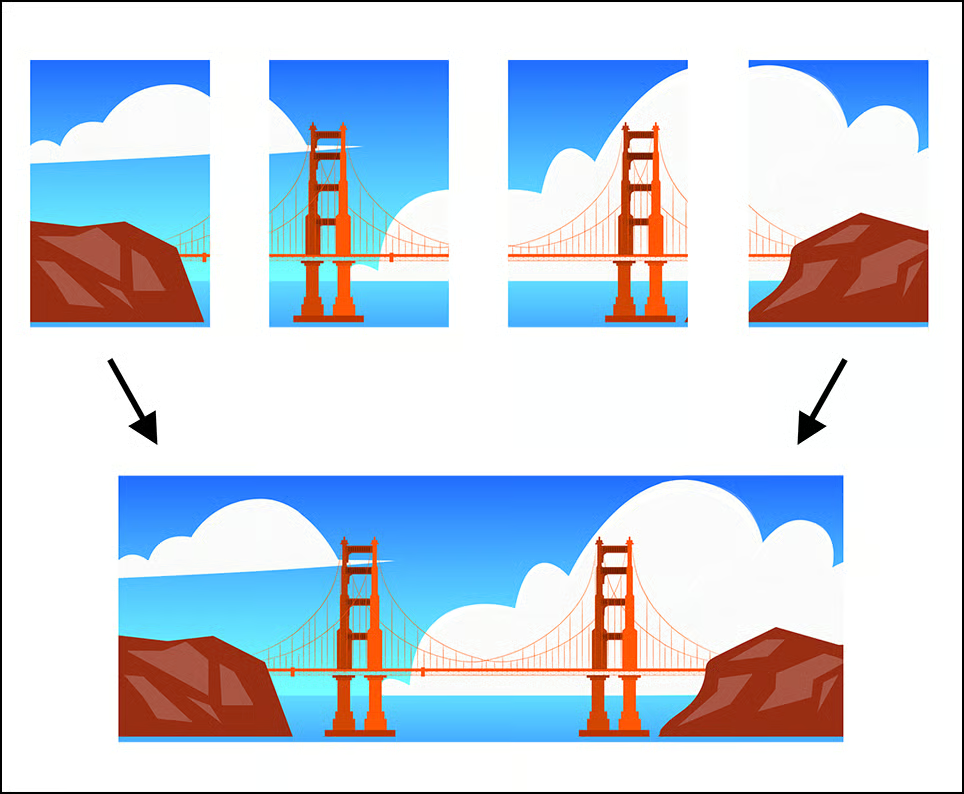
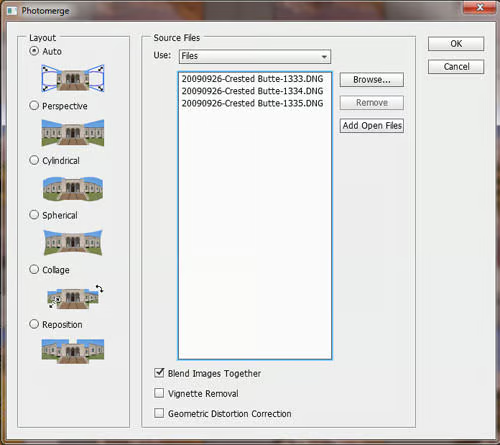
Fisheye panoramas stitch well in specialized apps. PTGui is fast and flexible with robust fisheye lens models and masking tools. Hugin is a capable open-source option. For basic cylindrical or spherical stitches, Lightroom and Photoshop can also work but offer less control for complex 360° sets. Typical overlap recommendations: ~25–30% for fisheye, ~20–25% for rectilinear. Export a 2:1 equirectangular at 8K (7680×3840) or higher for VR. Why PTGui is favored for complex panorama stitching (Fstoppers review)
Cleanup & Enhancement
- Nadir patching: Use masking in the stitcher, then clone/patch in Photoshop. Keep an extra nadir frame for the clean floor texture.
- Color consistency: Sync white balance and tone across frames before stitching. Apply gentle vignetting correction if needed.
- Noise and sharpening: For ISO 800–1600 interiors, apply luminance NR first, then subtle sharpening to avoid halos on high-contrast fisheye edges.
- Leveling: Use horizon/vertical constraints or a level grid to correct roll/yaw/pitch for a natural viewing experience.
- Export: Save an EXR or 16-bit TIFF master when doing heavy edits; deliver a JPEG equirectangular for web/VR platforms.
If you want a concise overview of DSLR/mirrorless 360 capture for VR publishing, Meta’s guide outlines best practices from acquisition to stitch. DSLR/mirrorless 360 photo guide (Meta)
Curious how many pixels you can get from different lenses and shot counts? Panotools hosts a helpful spherical resolution reference. DSLR spherical resolution (PanoTools Wiki)
Useful Tools & Resources
Software
- PTGui panorama stitching
- Hugin open source stitcher
- Lightroom / Photoshop for preprocessing and nadir patching
- AI-based tripod removal or object removal tools
Hardware
- Panoramic heads: Nodal Ninja, Leofoto, or similar two-axis heads
- Carbon fiber tripod with leveling base
- Wireless remote shutters
- Pole extensions / car suction mounts with safety tethers
Disclaimer: Names provided for research; check official sites for current specs and compatibility.
Common Mistakes & How to Avoid Them
- Parallax error: Calibrate and lock the nodal point; mark your rail for 10mm and 14mm.
- Exposure flicker: Use Manual mode and lock WB; avoid auto ISO for consistent tonality.
- Tripod shadows: Rotate to minimize tripod footprint; shoot an extra nadir patch.
- Ghosting from movement: Use faster shutter or two-pass capture; mask moving elements in post.
- Noise at night: Favor base ISO with longer exposures; turn IBIS off on tripod and use a remote.
- Adapter pitfalls: Without an aperture-control adapter, you’re stuck wide-open—expect soft corners and more CA; don’t skip the right adapter.
Field-Proven Scenarios with This Combo
Indoor Real Estate (Window Views)
Set the lens to 10mm in crop mode. Use f/8, ISO 100–200, and bracket ±2 EV (3–5 shots) per view. Aim for 6 around + zenith + nadir. Keep the camera height consistent across rooms for uniform viewer experience. Mind reflections from glossy floors; sometimes a slight tilt down reduces flare from overhead lights.
Outdoor Sunset (Golden Hour)
Meter for the sky near the sun to avoid clipping highlights. A base of f/8, ISO 100, and 1/100–1/200 sec works well. Consider a 5-shot bracket if the foreground is very dark. Flares are common with the sun inside a fisheye—place the sun near a stitch boundary and let the stitcher blend flare across frames.
Crowded Events (Festival/Parade)
Keep the focal length at 10–12mm to minimize the number of frames. Use 1/200–1/500 sec and ISO 400–800. Shoot a fast around-pass to guarantee full coverage, then a second pass waiting for gaps in traffic. Use the best frames per yaw angle during stitching and mask moving people between overlaps.
Visual Examples
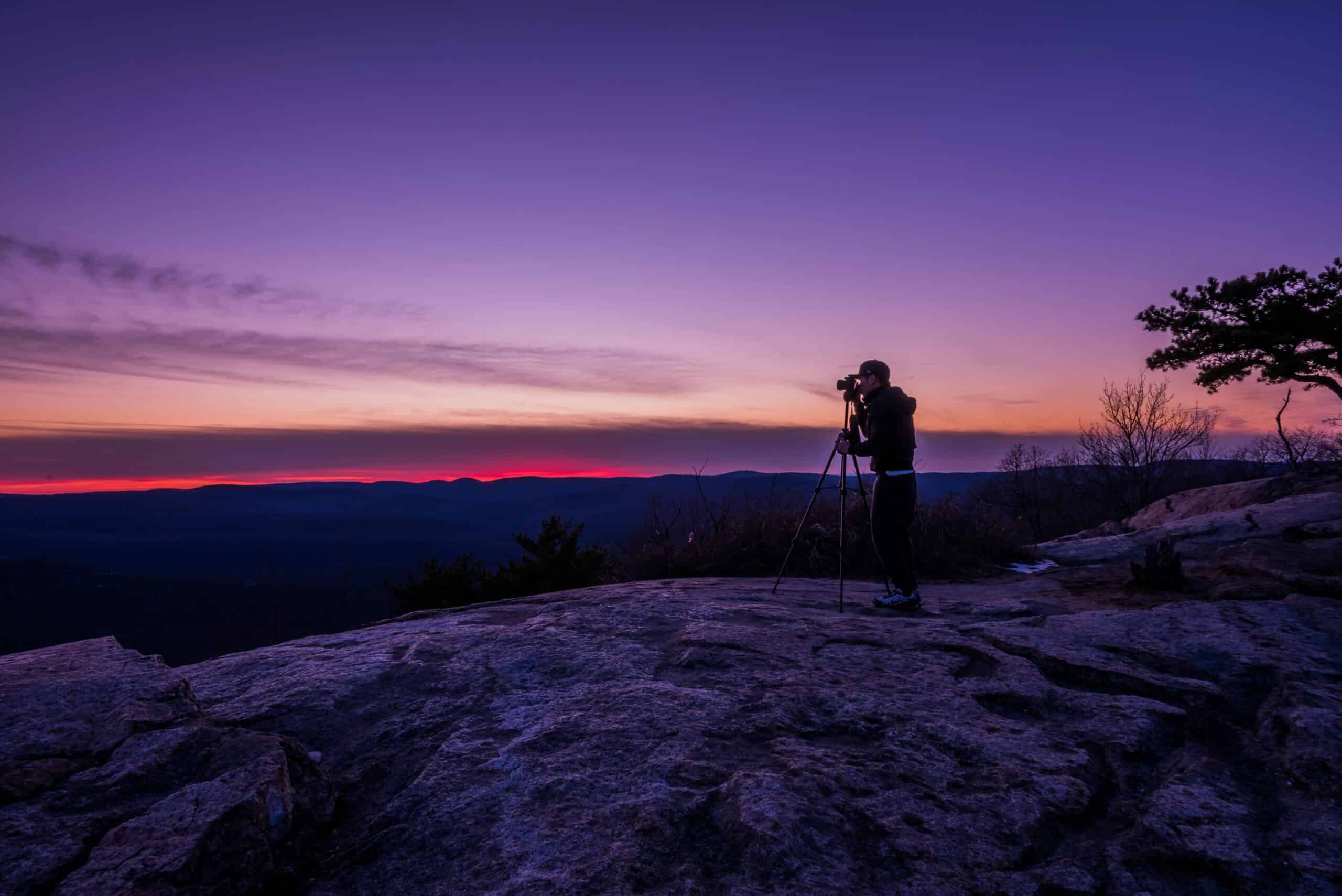
For a broader Q&A on gear choices for virtual tours, see this practical guide. DSLR virtual tour camera & lens FAQ (360 Rumors)
Frequently Asked Questions
- Can I shoot handheld panoramas with the Canon EOS R6 Mark II?
Yes, for simple single-row panos in bright light. For full 360×180 VR, a tripod and pano head are strongly recommended to avoid parallax and misalignment. Handheld works in a pinch if you keep the camera rotating around the lens, use fast shutter speeds, and accept heavier post-processing.
- Is the Pentax DA 10–17mm wide enough for a single-row 360?
In APS-C crop mode at 10mm, you can get a full sphere with 6 around plus zenith and nadir. For the cleanest zenith coverage in tight spaces, add a tilted-up row or shoot a dedicated zenith frame.
- Do I need HDR for interiors with bright windows?
Often yes. Bracketing ±2 EV (3–5 shots) preserves highlight detail outside windows and shadow detail inside, making the stitch seamless and natural-looking.
- How do I avoid parallax issues with this lens and adapter?
Use a panoramic head and align the entrance pupil: place a near object and a far vertical line in view, then adjust the fore-aft rail until they don’t shift relative to each other as you pan. Mark that position for 10mm and 14mm so you can set it quickly next time.
- What ISO range is safe on the R6 Mark II in low light?
ISO 100–800 is essentially clean; ISO 1600 remains very usable with mild noise reduction in RAW. For tripod work, favor longer shutter times over higher ISO to maximize quality.
Safety, Limitations & Honest Advice
The Pentax DA 10–17mm is an APS-C lens; plan to use the R6 Mark II’s crop mode for consistent results. Full-frame mode can work at the long end but expect heavy vignetting at shorter focal lengths. Always verify your adapter supports aperture control, or you’ll be forced to shoot wide-open with softer corners and more CA.
On rooftops, poles, and public areas, prioritize stability and safety tethers. In strong winds, reduce pole height and increase shutter speed. Keep spare batteries warm in cold weather—long HDR sequences can drain power quickly. Maintain a redundant capture workflow: if time allows, shoot a second complete pass.
For best practice on high-end head setup, this step-by-step reference is helpful at the end of your calibration session. Set up a panoramic head for high-end 360 photos (Meta)