
Why This Camera & Lens Are Great for Panoramas
If you’re researching how to shoot panorama with Canon EOS R6 Mark II & Nikon Z 14-24mm f/2.8 S, you’re already thinking like a pro: pairing a clean, modern full-frame sensor with a world-class ultra-wide rectilinear zoom is exactly what panoramic and 360 photo work demands. The Canon EOS R6 Mark II brings a 24.2MP full-frame sensor (approx. 5.94 µm pixel pitch) with excellent low-light performance, strong dynamic range at base ISO, fast live view, focus peaking, and in-body image stabilization (IBIS) that’s helpful for handheld scouting shots. The Nikon Z 14-24mm f/2.8 S is one of the sharpest ultra-wides on the market, with low lateral CA, controlled coma, and superb edge-to-edge sharpness by f/5.6–f/8—perfect traits for seamless stitching.
Important compatibility note: the Nikon Z 14-24mm f/2.8 S is a Nikon Z-mount lens and does not natively mount to the Canon RF-mount EOS R6 Mark II. There is no practical optical/mechanical adapter that preserves infinity focus. In the field, most photographers will either (a) use an optically equivalent Canon RF ultra-wide (e.g., RF 14-35mm f/4L) on the R6 Mark II, or (b) use the Nikon Z 14-24mm f/2.8 S on a Nikon Z body. In this guide, all shooting methodology, overlap, and workflow apply directly to the R6 Mark II with a rectilinear ultra-wide lens; if you’re strictly tied to the Z 14-24mm, plan to use a Nikon Z body or rent a Canon RF ultra-wide for the R6 Mark II.
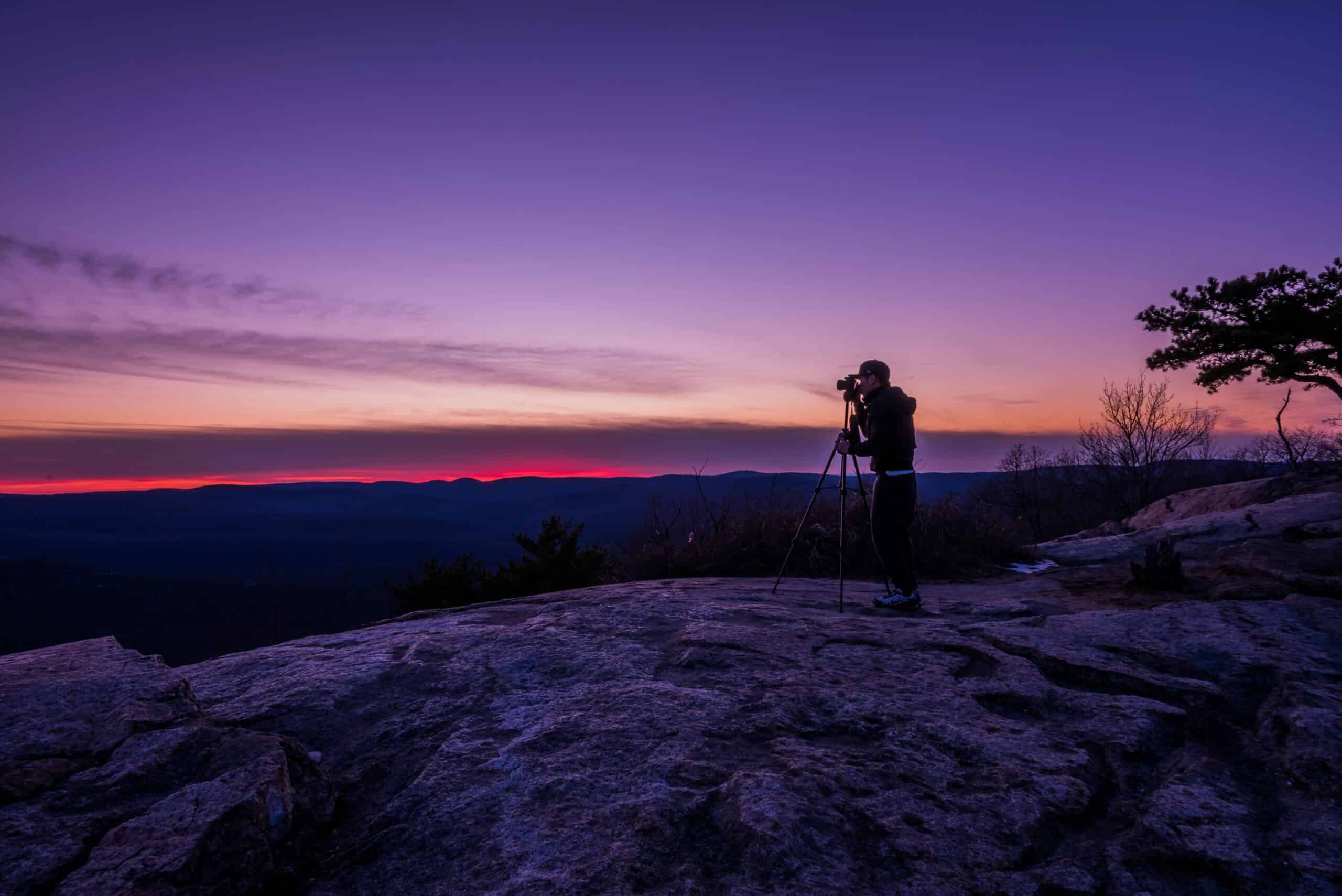
Rectilinear vs fisheye: The Nikon 14-24mm is rectilinear, so it preserves straight lines—great for architecture and real estate—but requires more frames than a fisheye to complete a full 360×180. The upside is lower distortion near the edges of your stitched panorama and better control over verticals with careful leveling.
Quick Setup Overview
- Camera: Canon EOS R6 Mark II — Full-frame 24.2MP CMOS, strong base-ISO dynamic range (~13 EV at ISO 100 class), excellent AF, focus peaking, dual UHS-II SD slots.
- Lens: Nikon Z 14-24mm f/2.8 S — Rectilinear ultra-wide zoom; razor-sharp by f/5.6–f/8; low CA; minimal coma; uses 112mm front filters with hood or rear gel slot. Note: not mount-compatible with Canon RF.
- Estimated shots & overlap (full 360×180 on full frame, rectilinear):
- At 14mm: 3 rows × 6 around (+45°, 0°, −45°) + zenith + nadir = ~20 shots (25–30% overlap).
- At 18mm: 3 rows × 8 around + zenith + nadir = ~26 shots.
- At 24mm: 4 rows × 10 around + zenith + nadir = ~42 shots
- Difficulty: Intermediate (rectilinear ultra-wide requires careful nodal alignment and multi-row capture).
Planning & On-Site Preparation
Evaluate Shooting Environment
Walk your scene and note light direction, moving subjects, reflective surfaces (glass/water), and tight spaces. For interiors with windows, expect high contrast; plan HDR bracketing. If shooting through glass, keep the front element close (1–3 cm) and shoot at a slight angle to minimize reflections; a black cloth or rubber hood helps. Watch for strong backlight that could create veiling flare—at 14mm, even small light sources can sneak into the frame.
Match Gear to Scene Goals
The EOS R6 Mark II’s 24MP full-frame sensor offers a great balance: clean base ISO 100 files with robust highlight recovery and very usable ISO 400–1600 for night scenes on a tripod. The 14–24mm rectilinear field of view reduces barrel distortion in architectural lines versus a fisheye, which means cleaner walls and ceilings—but you’ll shoot more frames. Outdoors at sunset, the R6 Mark II’s dynamic range and 14-bit RAW help tame bright skies, while the 14–24’s sharpness retains micro-detail across your stitch.
Pre-shoot Checklist
- Charge LP-E6NH batteries; carry spares. Format and test dual UHS-II SD cards (set to “Record to Multiple” for auto-backup).
- Clean lens and sensor; ultra-wide angles make dust and smudges stand out in skies and ceilings.
- Level the tripod; verify your panoramic head’s nodal alignment for the chosen focal length.
- Safety: If on a rooftop or in wind, use a weight bag and tether the tripod; never leave a pole rig unattended.
- Backup capture: When time allows, shoot a second full round as insurance against stitching or ghosting problems.
Essential Gear & Setup
Core Gear
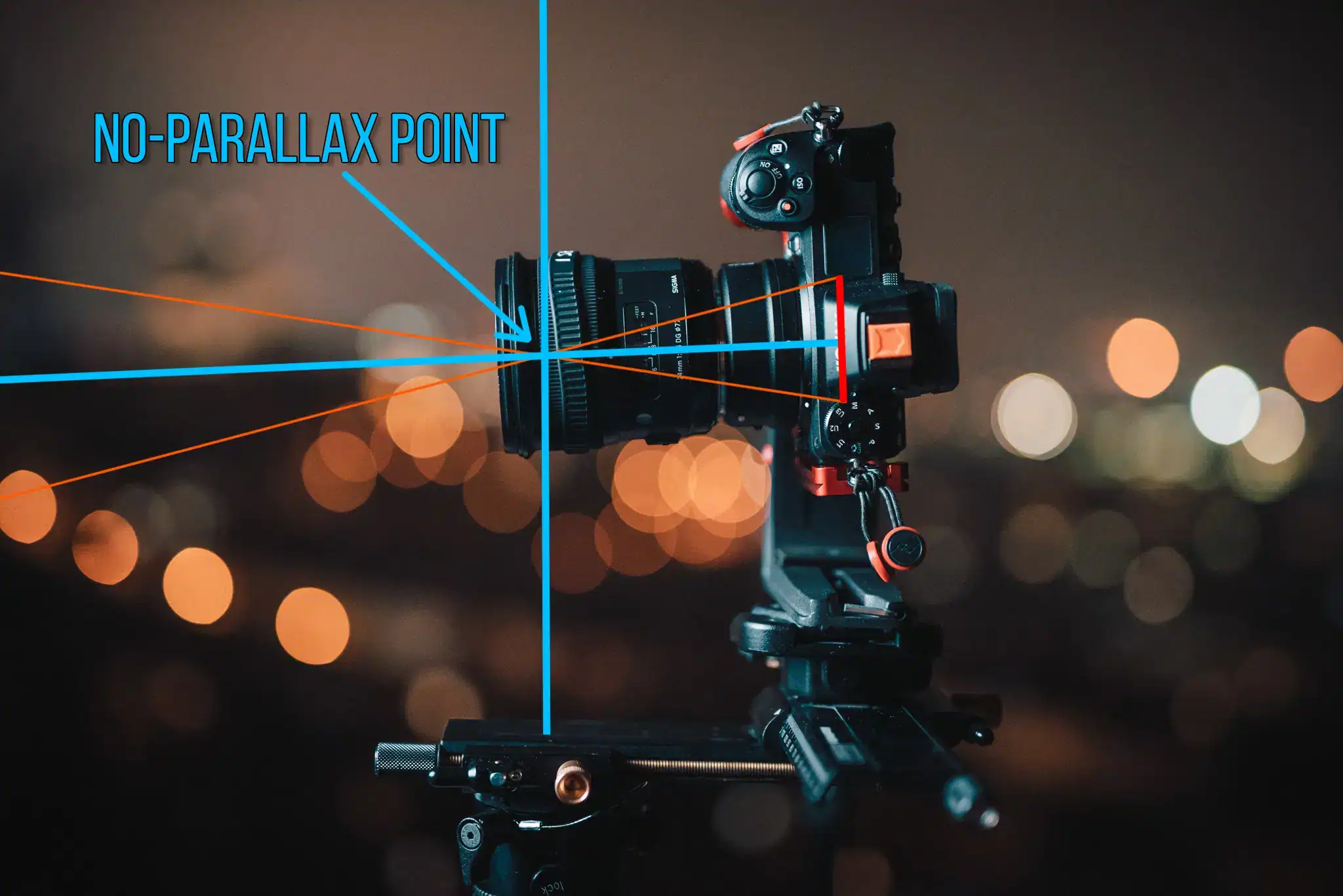
- Panoramic head with fore-aft and lateral adjustments: Aligning the entrance pupil (nodal point) over the rotation axis eliminates parallax. This is critical when nearby objects overlap between frames.
- Stable tripod with a leveling base: A half-ball or flat leveling base speeds up leveling, ensuring your rows maintain consistent pitch.
- Remote trigger or Canon Camera Connect app: Prevents vibration on long exposures and reduces handling.
Optional Add-ons
- Pole or car mount: Great for elevated viewpoints, but secure with safety tethers. Beware wind loading; keep exposures short and rotations deliberate.
- Lighting for interiors: Small LED panels bounced into ceilings can lift shadows; keep color temperature consistent across the set.
- Weather protection: Rain covers and microfiber towels for sudden drizzle; silica gel packs in your bag to reduce fogging when moving between temperatures.
Want a deep dive on dialing in a panoramic head for perfect control points? See this panoramic head setup principles guide at the end of your prep. Set up a panoramic head for high‑end 360 photos
Step-by-Step Shooting Guide
Standard Static Scenes
- Level and align the nodal point:
- Use the tripod’s leveling base and the R6 Mark II’s electronic level in the EVF/LCD.
- Place a light stand or vertical object close to the lens edge, with a distant background line behind it. Rotate the head—if the near object shifts relative to the background, adjust the rail forward/back until relative motion disappears.
- Mark the rail for 14mm, 18mm, and 24mm for repeatability. Expect the entrance pupil around the front group at 14mm; refine in the field.
- Manual exposure and white balance:
- Switch to M mode; meter for the midtones while protecting highlights. For daylight, start near f/8, ISO 100–200, and shutter 1/100–1/250.
- Lock WB (e.g., Daylight 5200–5600K) for outdoor or set a custom Kelvin for interiors to prevent color shifts across frames.
- Capture sequence with appropriate overlap:
- At 14mm: 3 rows (pitch +45°, 0°, −45°), 6 frames per row at 60° yaw steps, then one zenith and one nadir.
- At 18mm: 3 rows × 8 frames at 45° yaw steps + zenith + nadir.
- At 24mm: 4 rows × 10 frames at ~36° yaw + zenith + nadir.
- Take a dedicated nadir frame:
- Shift the rig aside or use “viewpoint correction” later. A clean nadir speeds up tripod removal during patching.
HDR / High Dynamic Range Interiors
- Bracket for windows vs. interiors: Use AEB (3–5 frames) at ±2 EV. The R6 Mark II can drive consistent brackets quickly; shoot in RAW for maximum latitude.
- Lock WB and focus so brackets match perfectly. Consider 2-pass shooting if people are moving to reduce ghosting.
Low-Light / Night Scenes
- Use a tripod, remote, and turn IBIS off on the R6 Mark II to avoid micro-vibrations on long exposures.
- Typical starting point: f/4–f/5.6, ISO 400–800, shutter 1–10s depending on ambient light. The R6 Mark II remains clean through ISO 800–1600 with careful exposure.
- Under LED/fluorescent lights, use mechanical shutter or EFCS to avoid banding; enable Anti-Flicker shooting if needed.
Crowded Events
- Shoot two full passes: one fast to secure coverage, a second where you wait for gaps.
- In post, mask people across frames for a clean composite. Keep your rotation sequence consistent to simplify masking.
Special Setups (Pole / Car / Drone)
- Secure everything: safety tethers, locked clamps, and check wind. Elevated poles amplify vibration—use faster shutters and reduce the number of shots (wider focal length, higher ISO) to shorten total capture time.
- Car rigs: Keep to safe speeds, avoid sudden stops, and use vibration-damping mounts. Plan routes to minimize traffic stops while rotating.
Recommended Settings & Pro Tips
Exposure & Focus
| Scenario | Aperture | Shutter | ISO | Notes |
|---|---|---|---|---|
| Daylight outdoor | f/8–f/11 | 1/100–1/250 | 100–200 | Lock WB (Daylight 5200–5600K); use the R6 II’s level to keep horizons true |
| Low light/night | f/4–f/5.6 | 1/30–10s | 400–800 | Tripod, remote; IBIS off; consider EFCS/mechanical |
| Interior HDR | f/8 | Bracket ±2 EV | 100–400 | Balance windows & lamps; avoid auto WB shifts |
| Action / moving subjects | f/5.6–f/8 | 1/200+ | 400–800 | Freeze motion; do two passes for masking |
Critical Tips
- Focus: At 14mm and f/8, the hyperfocal distance is roughly 0.8–1.0 m. Prefocus using AF, then switch to MF and enable focus peaking for consistency across frames.
- Nodal calibration: For each focal length, note the rail position that eliminates parallax. Label your pano head for 14, 18, and 24mm so you can switch quickly in the field.
- White balance: Lock WB or use a custom Kelvin to avoid color shifts between frames and brackets.
- RAW over JPEG: Gives maximum flexibility for highlight recovery and noise reduction, especially for HDR panoramas.
- IBIS and stabilization: Turn off IBIS and lens IS on a tripod; leave IBIS on only for handheld scouting panos.
- Card redundancy: The R6 Mark II’s dual slots are perfect for writing to both cards to protect your capture.
Stitching & Post-Processing
Software Workflow
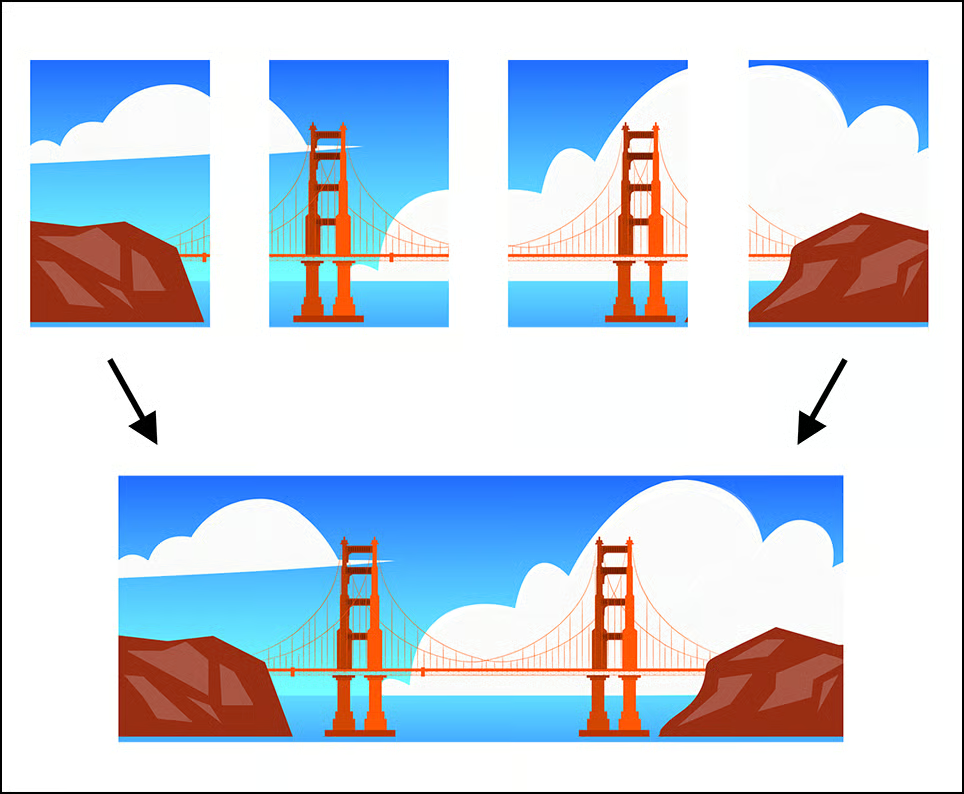
Import your RAWs into Lightroom or Capture One, apply basic lens corrections (for rectilinear UWA, avoid aggressive distortion correction before stitching), and sync exposure/WB settings. Export to PTGui or Hugin and define lens type as “rectilinear” with the correct focal length and sensor size. If EXIF is missing or misleading (e.g., using a non-native combination), set focal length manually and let the optimizer refine distortion and FOV. For rectilinear lenses, aim for 20–25% overlap; for fisheye, 25–30% is typical. After optimizing control points and aligning, output an equirectangular panorama for final editing. For a practical overview of PTGui’s strengths, this review is useful. PTGui: a powerful tool for complex panoramas
Cleanup & Enhancement
- Nadir patching: Use PTGui’s Viewpoint Correction for a dedicated nadir shot, or clone/patch in Photoshop. AI content-aware tools can speed this up.
- Color & noise: Balance WB across the set and apply gentle noise reduction (especially ISO 800+ night frames). Keep details crisp.
- Leveling: Correct horizon/roll. A minor yaw/pitch adjustment can dramatically improve immersion in VR viewers.
- Export: For VR, export equirectangular 2:1 ratios (e.g., 12000×6000 or 16384×8192 for high detail). Save a layered project for re-edits.
For a broader perspective on panoramic best practices—including lens choices, shot planning, and resolution math—these references are helpful. DSLR spherical resolution explained
Useful Tools & Resources
Software
- PTGui panorama stitching
- Hugin (open-source)
- Lightroom / Photoshop
- AI-based tripod/nadir removal tools
Hardware
- Panoramic heads (Nodal Ninja, Leofoto, Really Right Stuff)
- Carbon fiber tripods with leveling bases
- Wireless remotes or smartphone control
- Pole extensions / car suction rigs with safety tethers
Learn more foundational techniques and head setup with this concise panoramic head tutorial. Panoramic head setup principles
Disclaimer: software/hardware names provided for search reference; always check official sites for current features and compatibility.
Common Mistakes & How to Avoid Them
- Parallax error: Always align the entrance pupil for the current focal length; test with near/far objects.
- Exposure flicker: Shoot manual exposure and lock WB; avoid auto ISO or auto WB mid-sequence.
- Inconsistent rows: Level the head; use a consistent yaw step and pitch pattern.
- Ghosting: For moving people or trees, shoot multiple passes and mask in post.
- Night noise: Use a tripod and expose to the right at ISO 400–800; avoid pushing shadows too aggressively later.
- Lens/body mismatch: The Nikon Z 14-24mm f/2.8 S doesn’t mount to the R6 Mark II; use an RF ultra-wide or a Nikon Z body to leverage that lens.
Frequently Asked Questions
- Can I shoot handheld panoramas with the Canon EOS R6 Mark II?
Yes, for cylindrical or quick single-row panos. IBIS helps, but for 360×180 panoramas, a tripod and panoramic head are strongly recommended to avoid parallax and alignment errors.
- Is the Nikon Z 14-24mm f/2.8 S wide enough for single-row 360?
It’s rectilinear, so a single row won’t cover the full vertical 180°. Plan multiple rows (e.g., at 14mm: three rows × six around) plus zenith/nadir shots for a complete sphere.
- Do I need HDR for interiors with bright windows?
Usually yes. Bracket ±2 EV (3–5 frames) so you can retain window detail and interior shadows. The R6 Mark II handles bracketed sequences well; just keep WB and focus locked.
- How do I avoid parallax with this setup?
Use a panoramic head, align the entrance pupil for your chosen focal length (mark rail positions), keep the rig level, and avoid moving the tripod between frames.
- What ISO range is safe on the R6 Mark II in low light?
For tripod-based panoramas, ISO 100–800 is the sweet spot. ISO 1600 is workable with careful exposure and noise reduction, but try to prioritize longer shutter times at lower ISO whenever possible.
Field-Proven Scenarios & Settings
Indoor Real Estate
At 14–16mm and f/8, shoot 3 rows × 6–8 around with ±2 EV brackets. Use custom WB (e.g., 3500–4000K for warm LEDs) and turn off ceiling fans to prevent motion artifacts between frames. Keep verticals straight by leveling the head and avoiding extreme pitch angles in the middle row.
Outdoor Sunset
Start at ISO 100–200, f/8, and 1/100–1/250. If the sun is in-frame, shoot an extra bracket for the brightest frame to preserve highlights. Consider a second pass a few minutes later for better sky color, then blend if needed.
Event Crowds
Use 1/200–1/500 at f/5.6–f/8 and ISO 400–800. Shoot two passes and mask moving people in post for a cleaner panorama.
Rooftop / Pole Shooting
Keep the pole as vertical as possible. Use faster shutters, fewer frames (wider focal length), and a safety tether. Wind is your main enemy; plan your rotation to minimize time aloft.
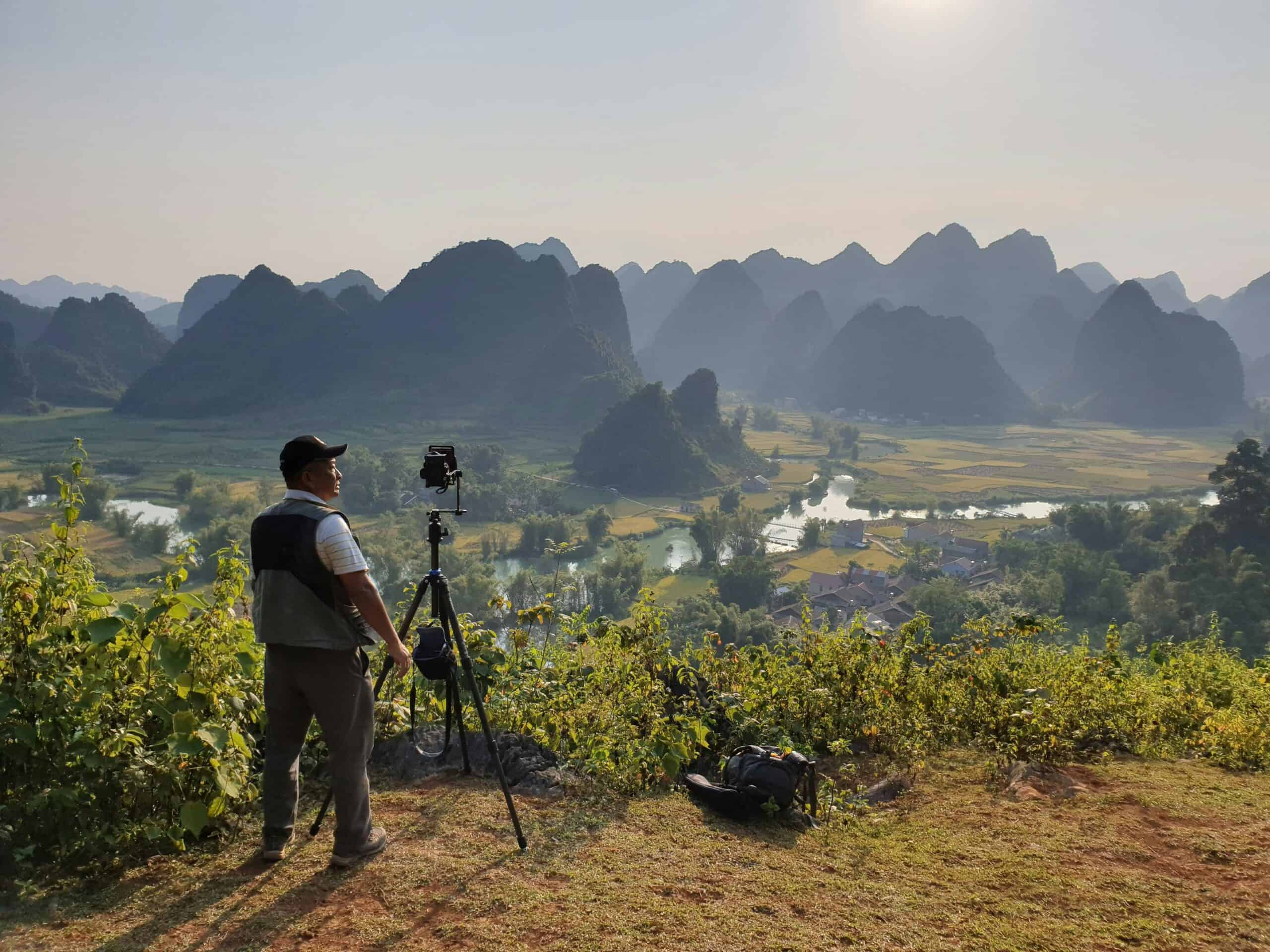
For additional technique pointers from the broader pano community, this long‑standing Q&A thread is handy. Best techniques to take 360 panoramas
Safety, Limitations & Trustworthy Workflow
- Mount incompatibility: The Nikon Z 14-24mm f/2.8 S will not mount to an EOS R6 Mark II. Use a native RF ultra-wide or a Nikon Z camera body for that lens.
- Wind and rooftop hazards: Sandbag the tripod; tether the head and camera. Never step away from a pole rig.
- Moisture and dust: Use rain covers; clean optics often—ultra-wide angles magnify smudges.
- Redundancy: Record to both SD cards; consider a second full capture round.
- Data integrity: Back up immediately on-site if possible (laptop or SSD); keep cards separate from the camera during transit.
If you’re new to panoramic heads, a compact tutorial can save hours of trial and error. Panoramic head setup principles