Why This Camera & Lens Are Great for Panoramas
If you’re learning how to shoot panorama with Canon EOS R6 Mark II & Laowa 8-15mm f/2.8 FF Zoom Fisheye, you’ve picked a powerful, efficient combo for 360° work. The R6 Mark II’s 24.2MP full-frame sensor (36×24 mm, ~6.0 µm pixel pitch) offers a strong balance of detail, dynamic range (about 13.5 EV at base ISO), and excellent high-ISO performance. It’s a modern mirrorless body with fast live view, focus peaking, and robust IBIS, which can help when you’re shooting handheld or on a pole (but turn IBIS off when on a tripod to avoid micro‑shake).
The Laowa 8–15mm f/2.8 FF Zoom Fisheye is pure manual (no electronics), but that’s ideal for panoramic work where you set and forget focus and exposure. At 8mm, it produces a circular fisheye image with an extremely wide field of view (up to 180°), which means fewer shots for a full 360×180 sphere. Zooming to 10–12–15mm converts it toward a diagonal fisheye, giving cleaner edge detail and slightly higher stitched resolution at the cost of more frames to cover the sphere. The lens is compact, sharp stopped down to f/5.6–f/8, and—like most fisheyes—exhibits low lateral CA that’s easily corrected in post.
Mount-wise, the Laowa is available in RF, and it fits the R6 Mark II natively. Because it’s manual, enable focus peaking/magnification in the camera, and use manual exposure. For consistent stitching, lock white balance, disable lens corrections, and shoot RAW.
Quick Setup Overview
- Camera: Canon EOS R6 Mark II — Full-frame 24.2MP; ~6.0 µm pixel pitch; ~13.5 EV DR at ISO 100; clean ISO 100–800, usable to 3200 with careful noise reduction.
- Lens: Laowa 8–15mm f/2.8 FF Zoom Fisheye — circular-to-diagonal fisheye; manual focus/aperture; sharpest at f/5.6–f/8; mild CA, well-controlled flare if the sun is placed near zenith or behind occlusion.
- Estimated shots & overlap (tested ranges):
- 8mm (circular): 3 around at 120° + nadir; for safety, 4 around + nadir. Optional zenith if tripod/rig intrudes.
- 10–12mm (fisheye): 4–6 around + zenith + nadir (30% overlap).
- 15mm (diagonal fisheye): 6–8 around + zenith + nadir (25–30% overlap).
- Difficulty: Easy to Moderate (fisheye keeps shot count low; careful nodal alignment still required).
Planning & On-Site Preparation
Evaluate Shooting Environment
Scan for moving objects (people, cars, trees in the wind), reflective surfaces (glass, polished floors), and the sun’s position. In interiors, note bright windows versus shadowed corners—plan to bracket HDR. If shooting through glass, keep the front element 2–5 cm off the pane to reduce reflections and use a black cloth or rubber hood. Outdoors, check wind; even a light breeze can introduce vibration on a pole or tall tripod.
Match Gear to Scene Goals
The R6 Mark II’s dynamic range and low‑noise performance pair well with the Laowa fisheye. The fisheye’s extreme FOV means fewer shots, faster capture, and fewer stitch seams—ideal for real estate interiors, fast-changing golden hour skies, or crowded events. The trade-off is fisheye distortion, which is fine for equirectangular 360s (stitchers understand fisheye projection) but less suitable for rectilinear prints without post correction. Indoors, ISO 200–800 is safe; at night, use a tripod and longer shutter instead of raising ISO.
Pre-shoot Checklist
- Battery charged, spare card; clean front element (fisheyes show everything).
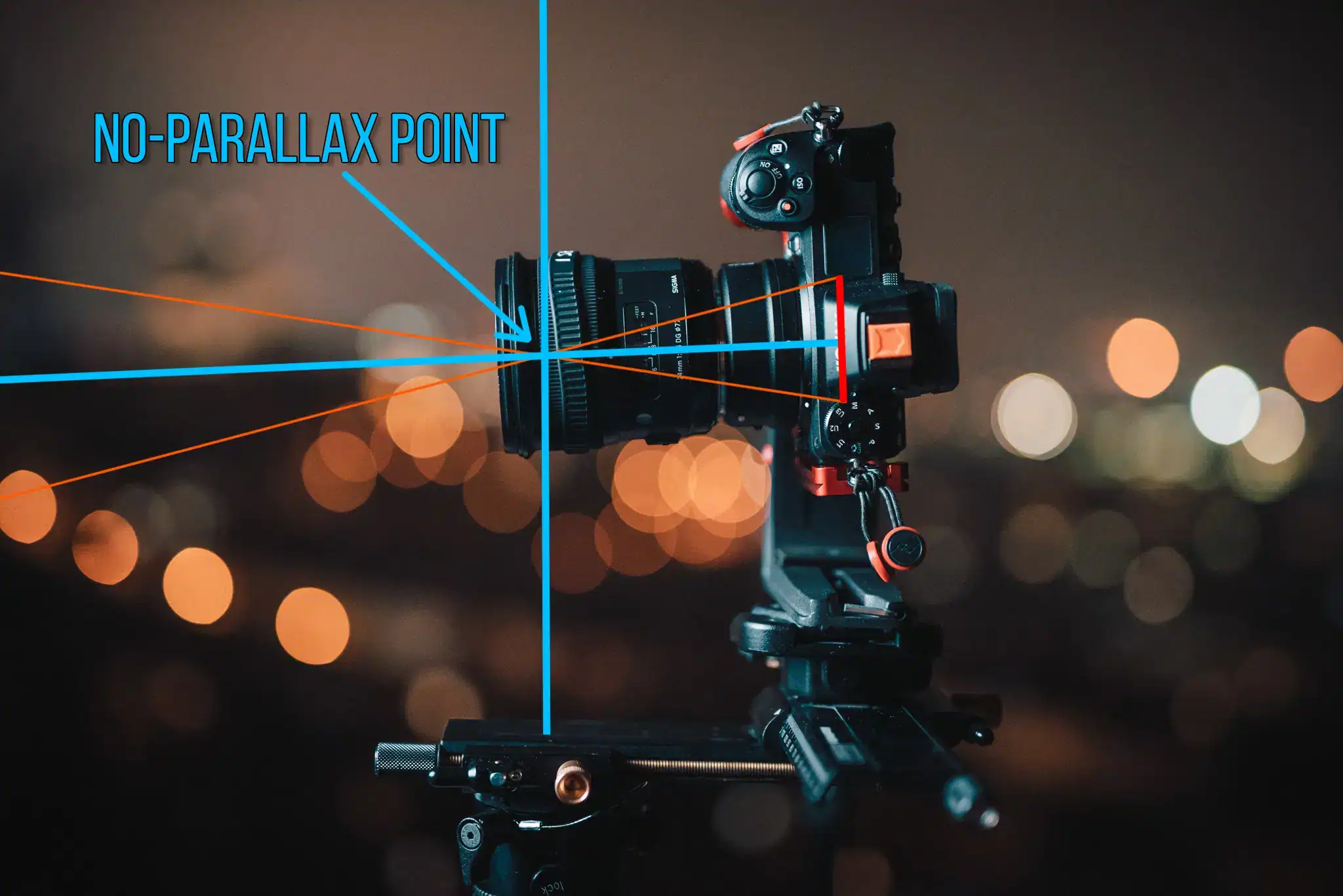
- Level tripod; calibrate panoramic head for the lens’s entrance pupil (no-parallax point).
- Safety: tether camera on rooftops/poles; avoid edges in wind; check car mounts and straps twice.
- Backup workflow: when in doubt, shoot a second round at the same position with an alternate exposure set.
Essential Gear & Setup
Core Gear
- Panoramic head with precise nodal alignment. Aligning the entrance pupil eliminates parallax so overlapping images stitch seamlessly.
- Stable tripod with a leveling base. Leveling the rotator saves time and keeps horizons straight.
- Remote trigger or Canon app. Use 2s self-timer or a release to avoid vibrations.
Optional Add-ons
- Pole or car mount — always use a safety tether; keep speeds low; watch for wind-induced oscillation.
- Lighting aids — compact LED panels for dark interiors; indirect bounce to avoid hot spots.
- Weather protection — rain cover, microfiber cloths; fisheye elements are exposed and easy to smudge.
Need a refresher on panoramic heads and nodal alignment? See this clear panoramic head tutorial and setup guide for deeper context. Panoramic head basics
Step-by-Step Shooting Guide
Standard Static Scenes
- Level the tripod and align the nodal point. With the Laowa 8–15mm, start by sliding the camera forward/back on the rail until near objects don’t shift relative to far objects as you pan. Mark this position with tape or a scribe.
- Set manual exposure and lock white balance. Example: daylight WB; RAW; f/8; ISO 100–200; shutter to taste. Disable IBIS on tripod.
- Capture around with proper overlap. At 8mm, 3 images around at 120° (or 4 at 90°) plus nadir. At 12–15mm, 6 around at 60° plus zenith and nadir. Confirm overlap of ~25–30%.
- Take a nadir shot. Tilt the camera down or move the tripod slightly aside and shoot a clean floor patch for tripod removal later.
HDR / High Dynamic Range Interiors
- Bracket ±2 EV (3 or 5 frames) to balance window highlights and interior shadows. Use the R6 Mark II’s AEB and continuous drive to minimize disturbance between frames.
- Lock white balance. Mixed lighting can cause color shifts across brackets; a fixed WB keeps tone uniform for easier stitching and blending.
- Keep the rig absolutely still. Use 2s timer or remote; disable IBIS on tripod; consider EFCS (electronic first curtain) to suppress shutter shock.
Low-Light / Night Scenes
- Prioritize low ISO (100–400). Let shutter run longer on a tripod: 1–8 seconds is common. If handheld or on a pole, push ISO to 800–1600 and use 1/60–1/125 where possible.
- Open to f/4–f/5.6 if needed, but beware coma from bright point sources; test your lens copy to find the sweet spot.
- Use a remote trigger or Canon Camera Connect app to avoid shake.
Crowded Events
- Shoot two passes. First for coverage, second when people shift to fill gaps or get cleaner overlaps. If necessary, rotate a bit slower to catch moments with fewer moving subjects.
- Later, use masks in PTGui or Photoshop to fix ghosting. Prioritize exposures where subjects are consistent across frames.
Special Setups (Pole / Car / Drone)
- Secure and tether everything. On a pole, keep the camera near the pole’s axis to minimize sway; avoid gusty days.
- Use faster shutter speeds (1/200+) and more overlap on moving platforms; consider 4–6 around even at 8–10mm for extra stitching redundancy.
Recommended Settings & Pro Tips
Exposure & Focus
| Scenario | Aperture | Shutter | ISO | Notes |
|---|---|---|---|---|
| Daylight outdoor | f/8–f/11 | 1/100–1/250 | 100–200 | Lock WB (Daylight); RAW; disable IBIS on tripod |
| Low light/night | f/4–f/5.6 | 1/30–multi-second | 100–800 | Tripod + remote; avoid pushing ISO too far |
| Interior HDR | f/8 | Bracket ±2 EV | 100–400 | Balance windows vs lamps; keep WB fixed |
| Moving subjects | f/5.6–f/8 | 1/200+ | 400–800 | Freeze motion; consider two passes |
Critical Tips
- Manual focus: set the Laowa around 0.3 m at f/8 (near the hyperfocal distance for 8–10mm). This keeps everything from ~0.15 m to infinity sharp.
- Nodal alignment: with the R6 Mark II + Laowa, expect the entrance pupil near the front element. Calibrate once and mark your rail.
- White balance: lock it. Mixed lighting can cause banding or color seams across the panorama.
- RAW always: maximize dynamic range and flexibility. The R6 Mark II’s 14-bit files grade cleanly.
- IBIS: helpful handheld; switch off on tripod to avoid micro jitter during long exposures.
- Drive mode: 2s timer or remote; EFCS for tripod work; avoid full electronic shutter under artificial light to prevent banding.
Field-Tested Shot Counts & Resolution
Expect the following effective equirectangular outputs from this combo (approximate, after overlap):
- 8mm, 3 around + nadir: ~45–60 MP equirectangular.
- 10–12mm, 4–6 around + Z/N: ~70–110 MP.
- 15mm, 6–8 around + Z/N: ~90–140 MP.
For background on spherical resolution vs lens FOV, this concise reference helps plan deliverables. Panotools: DSLR spherical resolution
Stitching & Post-Processing
Software Workflow
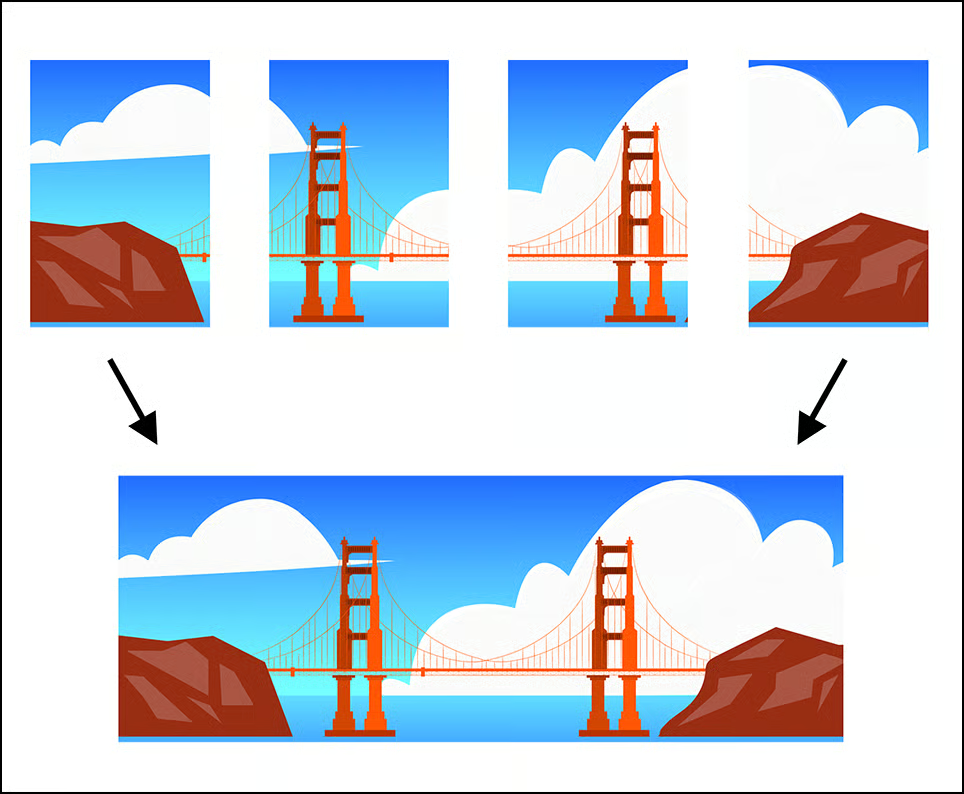
Load your RAWs into a stitcher that understands fisheye projection. PTGui is the industry workhorse, Hugin is a solid open-source alternative, and Lightroom/Photoshop can handle simpler merges. With a fisheye like the Laowa, you do not need to “defish” first—stitchers solve for lens projection directly. Aim for ~25–30% overlap with fisheye to give the control point matcher enough data. Export an equirectangular 2:1 image for 360 viewers and virtual tours. For a deep-dive on PTGui’s capabilities and when to use it, this review is a good primer. Fstoppers on PTGui for panoramas
Cleanup & Enhancement
- Nadir patch: render a nadir tile or use AI tools/clone stamp to remove tripod.
- Color: unify temperature/tint; correct mixed lighting with localized adjustments.
- Noise: apply moderate luminance NR for high-ISO frames; retain fine detail in midtones.
- Level: set horizon/verticals in the stitcher; correct roll/pitch/yaw before export.
- Export: 8-bit or 16-bit TIFF master; JPEG equirectangular for web/VR platforms.
Watch: A Practical Panorama Walkthrough
Seeing a full workflow helps connect the dots—capture, stitch, and finish:
For additional VR-specific guidelines (file formats, horizon leveling, metadata), Meta’s DSLR 360 documentation is concise and practical. Shooting and stitching a 360 photo with a DSLR/Mirrorless
Useful Tools & Resources
Software
- PTGui panorama stitching
- Hugin open source
- Lightroom / Photoshop for RAW and finishing
- AI tripod-removal tools or manual clone for nadirs
Hardware
- Panoramic heads: Nodal Ninja, Leofoto, Sunwayfoto
- Carbon fiber tripods with leveling bases
- Wireless remotes; tethering straps for safety
- Pole extensions / car suction mounts with safety cables
Disclaimer: product names are for search reference; verify specifications and compatibility on official sites.
Common Mistakes & How to Avoid Them
- Parallax error → Always align the lens’s entrance pupil to the rotator axis.
- Exposure flicker → Manual exposure and locked WB for the entire set.
- Tripod in frame → Shoot a nadir patch; plan your workflow to remove the rig.
- Ghosting from moving subjects → Time your shots, shoot a second pass, and mask in post.
- Night noise → Use tripod and longer shutter instead of cranking ISO.
If you’re new to panoramic heads, these step-by-step guides help cement best practices. Setting up a panoramic head for high-end 360s
Real-World Case Studies
Indoor Real Estate (Mixed Light)
R6 Mark II + Laowa at 10–12mm, f/8, ISO 100–200. Shoot 4–6 around + Z/N, bracket ±2 EV for windows. Lock WB around 4000–4500K if tungsten/LED mix. Use a small LED to lift dark corners, but avoid direct reflections. Expect a clean 80–100 MP equirect output.
Outdoor Sunset (Fast Light Change)
Use 8mm for speed: 3 around + nadir. Manual exposure with slight underexposure to protect highlights; RAW recovery handles shadows. Time each frame so the sun’s position and clouds remain consistent across the sweep.
Crowded Event (People Flow)
Shoot 15mm for a touch more edge definition; 6–8 around + Z/N. Use 1/200–1/500 at ISO 400–800 to freeze subjects. If someone blocks an overlap, shoot a second clean frame at that angle for later masking.
Rooftop Pole Shot (Wind Caution)
8–10mm; 4–6 around. Shutter 1/250–1/500; ISO 400–1600 depending on light. Tether the camera, wear a harness if near edges, and have an assistant stabilize the pole. Capture an extra redundancy pass in case of micro blur.
Safety, Maintenance & Backup Workflow
- Wind and height: tether everything and keep the rig low if gusts exceed 15–20 km/h.
- Lens care: fisheyes show smudges—carry blower and microfiber; shade the front element from raindrops.
- Card redundancy: if a reshoot is hard, take a second full set; back up to phone/laptop after each location.
- Firmware and settings: keep custom modes (C1/C2) for “Tripod HDR” and “Pole Fast” presets to reduce setup time.
Frequently Asked Questions
- Can I shoot handheld panoramas with the EOS R6 Mark II?
Yes for quick 360s outdoors. Use 8–10mm, 4–6 around with 30% overlap, 1/125–1/250 shutter, and ISO 400–800. Expect occasional stitching artifacts. For critical work or interiors, use a tripod and a panoramic head.
- Is the Laowa 8–15mm f/2.8 wide enough for single-row 360s?
Absolutely. At 8mm (circular), 3–4 shots around cover the horizon; add a nadir and optional zenith for full spheres. At 12–15mm, plan on 6–8 around plus Z/N for higher stitched resolution.
- Do I need HDR for interiors with bright windows?
Usually yes. Bracket ±2 EV (3–5 frames) to retain window detail and clean shadows. The R6 Mark II has good DR, but HDR saves highlights for a more natural look after stitching.
- How do I avoid parallax with this combo?
Calibrate the entrance pupil on your panoramic head: align near/far objects in live view and slide the camera on the rail until they don’t shift while panning. Mark that position for 8mm and again for 15mm; the entrance pupil moves as you zoom.
- What ISO range is safe on the R6 Mark II in low light?
On a tripod, stay at ISO 100–400 and lengthen shutter. Handheld or on a pole, ISO 800–1600 is workable; ISO 3200 can be used in a pinch with careful noise reduction.
Bonus: Behind-the-Scenes Illustrations
Wrap-Up
Now you know how to shoot panorama with Canon EOS R6 Mark II & Laowa 8-15mm f/2.8 FF Zoom Fisheye from planning to post. Keep your workflow simple: nodal alignment, manual exposure, consistent overlap, and careful stitching. With 3–4 frames around at 8mm or 6–8 around at 15mm, you’ll produce clean, high‑resolution equirectangulars ready for virtual tours, web embeds, or print derivatives. For more ideas on camera/lens choices and VR production workflows, this guide offers broader perspective. DSLR/ML camera & lens guide for virtual tours