Why This Camera & Lens Are Great for Panoramas
If you’re wondering how to shoot panorama with Canon EOS R6 Mark II & Laowa 4mm f/2.8 Circular Fisheye, this combo can be a fast, ultra-wide, and travel‑friendly way to capture full 360° scenes with very few frames. The Canon EOS R6 Mark II is a 24.2MP full‑frame mirrorless camera with excellent ergonomics, strong high‑ISO performance, and in-body image stabilization (IBIS). It offers roughly 13–14 stops of dynamic range at base ISO, a large pixel pitch of about 6.0µm (36mm sensor width / ~6000 pixels), and crisp 14-bit RAW files—great ingredients for clean, flexible panorama post-processing.
The Laowa 4mm f/2.8 Circular Fisheye is a manual, ultra‑wide circular fisheye with an approximately 210° field of view that projects a full circle within the image frame on APS‑C sensors. On the R6 Mark II, that means you’ll typically use the APS‑C (1.6×) crop mode or the APS‑C RF-mount version of the lens. Because each frame covers more than 180°, you can complete a full spherical 360° with as few as two shots (180° apart), plus an optional nadir patch for the tripod. The fisheye’s extreme coverage drastically reduces shot count and stitching effort—ideal for quick real estate shoots, crowded events, or simple travel 360 photos.
Important mount note: the Laowa 4mm f/2.8 Circular Fisheye exists in APS‑C/MFT mounts. Make sure you obtain the correct RF version for APS‑C coverage or use the R6 Mark II’s 1.6× crop mode. EF‑M lenses cannot be adapted to RF. Always verify mount compatibility before purchase or shooting.
Quick Setup Overview
- Camera: Canon EOS R6 Mark II — Full‑Frame 24.2MP sensor (~6.0µm pixel pitch), strong high‑ISO performance, ~13–14EV base dynamic range.
- Lens: Laowa 4mm f/2.8 Circular Fisheye — manual focus/aperture, circular fisheye projection, ~210° FOV, surprisingly sharp stopped to f/5.6–f/8; mild CA and flare possible near strong light sources.
- Estimated shots & overlap (APS‑C crop mode on R6 Mark II):
- 2 shots around (yaw 0°/180°) + optional nadir for tripod cleanup. ~25–35% overlap.
- 3 shots around (yaw 0°/120°/240°) for safety in busy or low‑feature scenes. ~30–40% overlap.
- Difficulty: Easy to Moderate (fisheye is forgiving, but nodal alignment and exposure discipline still matter).
Planning & On-Site Preparation
Evaluate Shooting Environment
Look for reflective surfaces (glass, glossy tiles, polished metal) that can amplify parallax or ghosting. If shooting through glass, get the front element as close as possible (1–3 cm) and shoot perpendicular to the surface to reduce reflections and flare. In interiors, watch for mixed lighting (tungsten/LED/daylight) that can produce inconsistent color between frames. Outdoors, plan your sequence so the sun isn’t split across frames—use lens shading hands or body to block stray flare if needed.
Match Gear to Scene Goals
The EOS R6 Mark II’s clean ISO 100–800 files and ~13–14 stops of DR make it suitable for both daylight and controlled interior shooting. The Laowa 4mm’s immense coverage means fewer shots, which reduces stitching time and the chance of seam issues with moving subjects. For interiors with bright windows, bracket exposures; the R6 Mark II handles ±2 EV bracketing with ease, producing smooth HDR panoramas with minimal noise. In dim scenes, ISO 400–800 is safe; ISO 1600–3200 is usable with careful noise reduction in post.
Pre-shoot Checklist
- Charge batteries and bring spares; ensure ample card space (RAW + brackets multiply file count).
- Clean lens and sensor; a dust spot on a fisheye can be very noticeable.
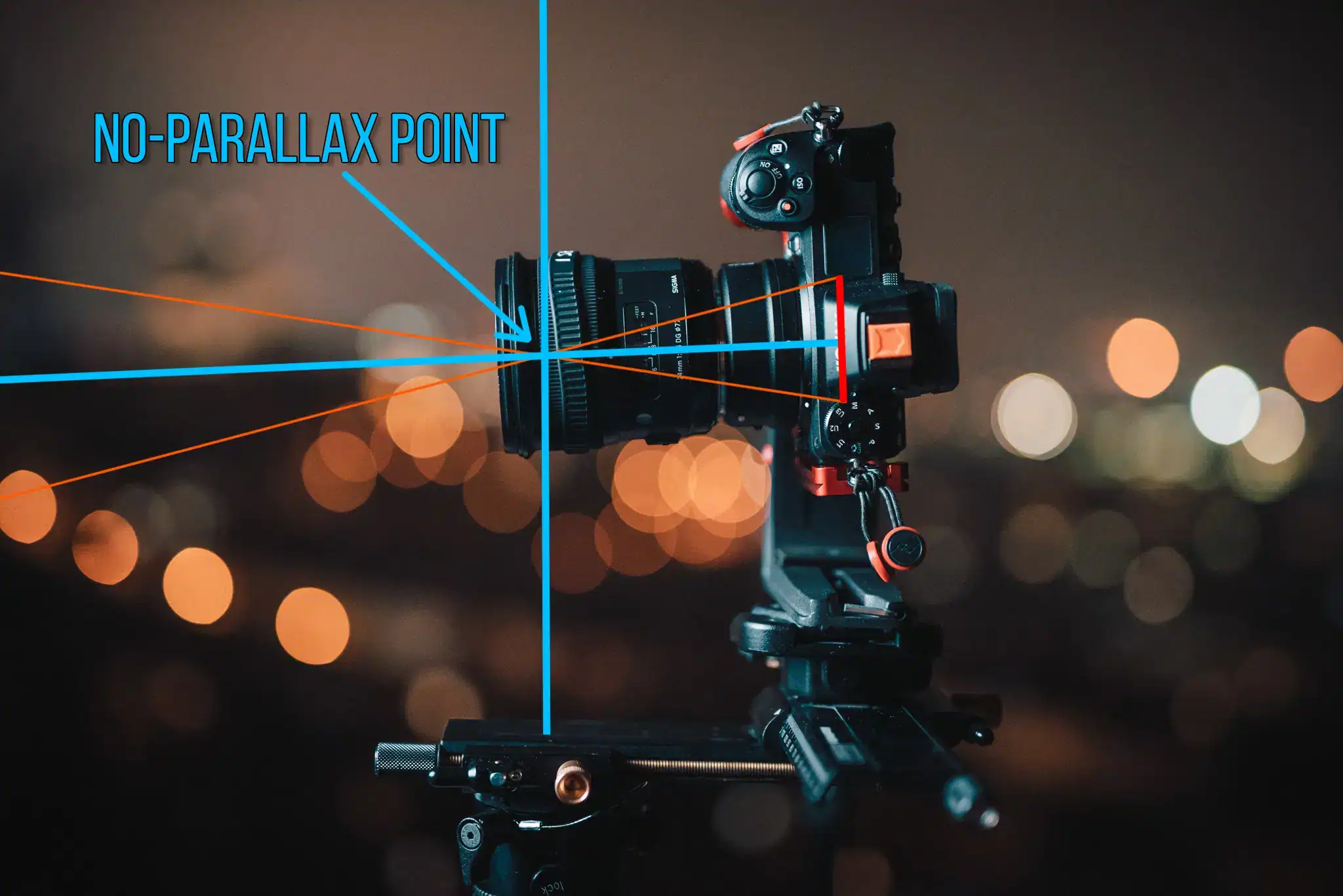
- Level tripod; calibrate your panoramic head to the lens’s no‑parallax point (NPP).
- Safety checks: weigh down tripod in wind; use a safety tether on rooftops or poles; avoid traffic hazards for car‑mounted shots.
- Backup workflow: if time permits, shoot a second safety round at the same camera position and settings.
Essential Gear & Setup
Core Gear
- Panoramic head: Allows you to rotate the camera around the lens’s NPP, reducing parallax—critical for clean stitching on near‑field subjects like furniture or railings.
- Stable tripod with leveling base: A quick‑leveling base speeds setup and keeps horizon corrections minimal later.
- Remote trigger or Canon Camera Connect app: Minimizes vibrations. Use 2s timer + EFCS (electronic first curtain shutter) when on tripod.
Optional Add-ons
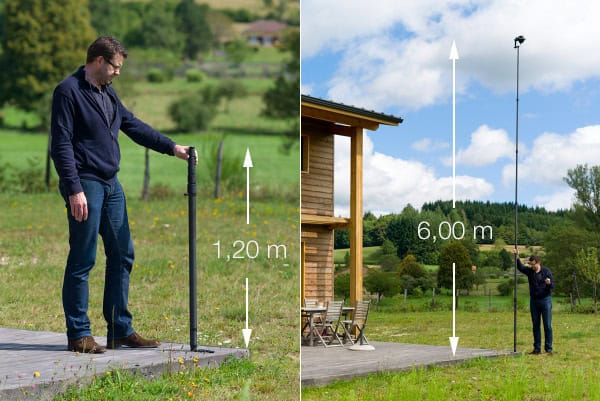
- Pole or car mount: Great for elevated or center‑of‑room shots. Safety first—use tethers, check wind gusts, and avoid overextending pole height.
- Lighting aids: Small LED panels or bounced flashes for interiors, but keep lighting consistent across frames to avoid flicker.
- Weather protection: Rain covers, silica gel, and lens hoods help protect against moisture and flare.
Step-by-Step Shooting Guide
Standard Static Scenes
- Level and Nodal Alignment: Level the tripod using a leveling base. Mount the R6 Mark II on your panoramic head and adjust fore‑aft/left‑right so the lens’s no‑parallax point sits over the rotation axis. Practical method: place two light stands (one near, one far) in the frame and rotate—adjust until their relative alignment does not shift during rotation.
- Manual Exposure & WB: Set Manual mode. Start at ISO 100–200, f/8, and a shutter that exposes highlights safely. Lock white balance (Daylight/Cloudy/Tungsten) to maintain consistency across frames.
- Focus: Switch to manual focus and use magnified live view. With the 4mm fisheye, setting focus just shy of infinity around f/8 typically keeps everything sharp (hyperfocal distance is extremely close).
- Capture Sequence: For the Laowa 4mm on APS‑C crop mode, shoot 2 frames around—yaw 0° and 180°—with the camera perfectly level. For challenging scenes (busy textures or low contrast), do 3 frames around at 120° spacing for extra overlap.
- Nadir Shot: Tilt down and capture an extra nadir frame to patch the tripod later—or shoot a handheld nadir with the tripod temporarily moved aside.
HDR / High Dynamic Range Interiors
- Bracketing: Use AEB at ±2 EV, 3 or 5 frames depending on window brightness. Keep ISO at 100–200 to preserve highlight detail.
- Consistency: Lock white balance and aperture (f/8) across the brackets. Avoid changing focus or zoom (fixed here) during the sequence.
- Workflow: Either pre‑merge brackets per angle (Lightroom/Photomatix) then stitch, or stitch each bracket set in PTGui and blend exposures inside PTGui’s HDR fusion.
Low-Light / Night Scenes
- Tripod + Remote: Use a sturdy tripod, IBIS off, EFCS, 2s timer or remote trigger.
- Exposure: Start around f/4–f/5.6, ISO 400–800, and lengthen shutter to 1–4s as needed. The R6 Mark II stays clean through ISO 1600–3200, but lower ISO delivers smoother skies.
- Glare Control: Shade the lens from streetlights and neon; consider doing a second pass for problem lights to blend later.
Crowded Events
- Two Passes: First do a quick capture for coverage. Then wait for gaps and reshoot frames with fewer people in key areas.
- Masking: In PTGui/Photoshop, mask people or moving objects between passes to reduce ghosting.
Special Setups (Pole / Car / Drone)
- Pole Work: Keep the pole vertical, use a guy line or tether, and avoid high winds. Rotate slowly to minimize wobble. Consider 3 shots around for safe overlap.
- Car-Mounted: Use vibration‑dampening mounts, secure all connections, and avoid public roads if not permitted. Shoot at stops to avoid motion blur.
- Drone: The lens is not for drones; but if you adapt concepts to drone fisheyes, ensure sufficient overlap and lock exposure.
Recommended Settings & Pro Tips
Exposure & Focus
| Scenario | Aperture | Shutter | ISO | Notes |
|---|---|---|---|---|
| Daylight outdoor | f/8–f/11 | 1/100–1/250 | 100–200 | Lock WB (Daylight), avoid splitting the sun across frames |
| Low light/night | f/4–f/5.6 | 1/30–4s | 400–800 (up to 1600–3200 if needed) | Tripod + remote, IBIS off, EFCS on |
| Interior HDR | f/8 | Bracket ±2 EV | 100–400 | Merge HDR then stitch, or use HDR in PTGui |
| Action / moving subjects | f/5.6–f/8 | 1/200+ | 400–800 | Shorter shutter, consider 3 frames around for overlap |
Critical Tips
- Manual Focus & Hyperfocal: With a 4mm fisheye at f/8, everything from very close to infinity is sharp. Magnify live view, focus slightly before infinity, then don’t touch the ring.
- Nodal Calibration: Tape a marker on your panoramic rail where the lens sits once the NPP is found. This saves time on future shoots.
- White Balance Lock: Set WB to a fixed preset or Kelvin value to avoid color shifts between frames and across brackets.
- RAW Power: Shoot RAW for maximum dynamic range and flexible color correction. The R6 Mark II’s 14‑bit RAW preserves highlights in bright windows or sunsets.
- IBIS On/Off: Turn IBIS off on a tripod to avoid sensor drift. Handheld panos can benefit from IBIS, but parallax is harder to control without a pano head.
- Shutter Mode: Use EFCS or mechanical shutter. Avoid full electronic shutter under LED lighting to prevent banding in brackets.
Stitching & Post-Processing
Software Workflow
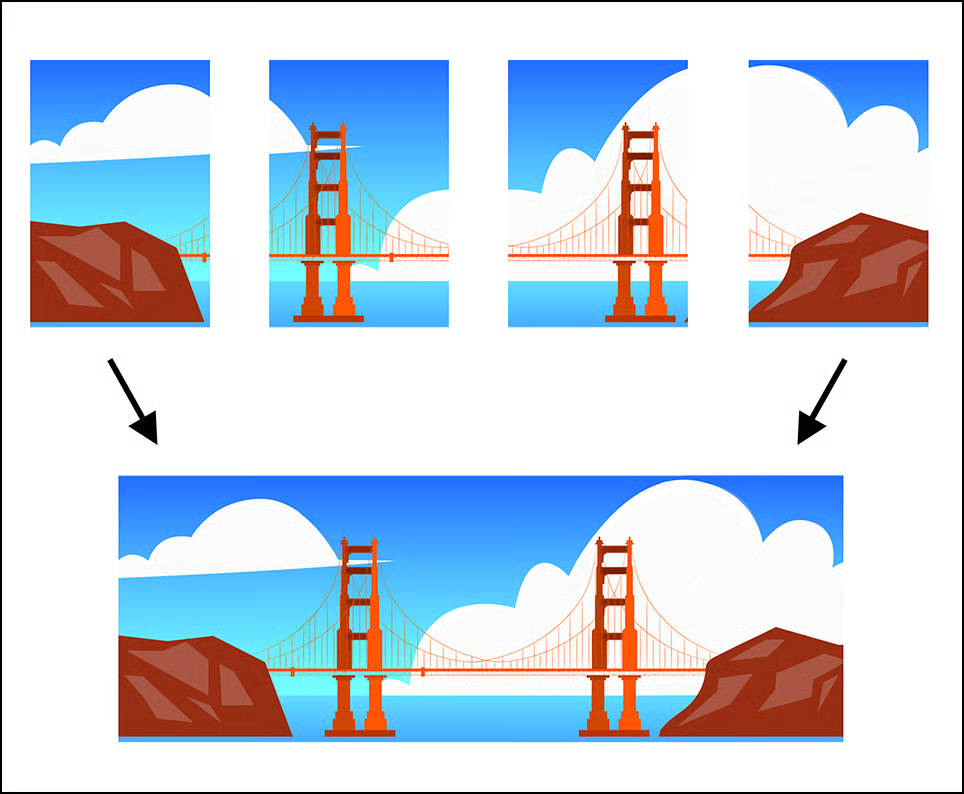
For circular fisheye sets, PTGui is exceptionally good at auto-detecting control points and handling fisheye projection. Hugin is a capable open-source alternative. Lightroom/Photoshop can stitch simple sets but are less flexible with extreme fisheye inputs and HDR stacks. With 4mm circular fisheye frames, expect to use ~25–35% overlap and a fisheye lens model during stitching. After alignment, output equirectangular at your target resolution for web or VR. Many creators land between 8K–12K wide equirects with 2–3 frame sets, depending on crop mode and overlap.
For deeper learning of pano head setup and pro capture, see this panoramic head tutorial. Panoramic head essentials—360 Rumors
Considering software options? Fstoppers’ PTGui review is helpful for understanding why it’s favored for complex fisheye/HDR workflows.
Cleanup & Enhancement
- Nadir Patch: Replace the tripod area with a clean plate or logo. PTGui includes masking and viewpoint correction; Photoshop’s clone/heal or AI retouching can finish the job.
- Color Consistency: Match contrast, saturation, and gradients across frames. Correct mixed lighting with local WB adjustments if needed.
- Noise Reduction: Apply moderate luminance NR in low‑light scenes; protect edge detail with masking.
- Level & Straighten: Use horizon and vertical lines to set the final roll/yaw/pitch so the pano feels balanced in VR.
- Export: Save a high‑quality equirectangular JPEG (quality 90–95) or 16‑bit TIFF for archival and further edits. For VR delivery, a 8K–12K equirect is common; check platform limits.
For platform-specific guidance on DSLR/mirrorless 360 production, Meta’s creator docs are clear and practical. Using a mirrorless camera to shoot and stitch a 360 photo
Video: From Pano Head to Clean 360
If you prefer to watch a walkthrough of panoramic head setup and capture discipline, this video is a great starting point:
Useful Tools & Resources
Software
- PTGui panorama stitching
- Hugin open-source panorama tool
- Lightroom / Photoshop for HDR merges and retouching
- AI tripod removal tools for faster nadir patching
Hardware
- Panoramic heads (Nodal Ninja, Leofoto)
- Carbon fiber tripods with leveling bases
- Wireless remote shutters or intervalometers
- Pole extensions / car mounts with safety tethers
Disclaimer: software/hardware names provided for search reference; verify current specs and compatibility on official sites.
Field-Proven Scenarios
Indoor Real Estate
Use two shots around at f/8, ISO 100–200, and bracket ±2 EV for bright windows. Keep the camera level so verticals remain straight after stitching. Add a single nadir patch. The circular fisheye minimizes time in busy walk‑throughs where you can’t lock down the scene for long.
Outdoor Sunset
Start at ISO 100, f/8, meter for the highlights in the brighter frame and bracket ±2 EV. You can shade the lens with your hand to reduce flare. For perfect sky gradients, consider 3 shots around for richer overlap in the transition zone near the sun.
Event Crowds
Time your two frames to when foot traffic clears around you. If the scene is constantly moving, do three frames around to ensure enough data to mask out moving subjects. Shoot a quick second pass if possible for cleaner masks.
Rooftop / Pole Shooting
Attach a safety tether, lower your pole incrementally if gusts pick up, and avoid lens pollutants (spray, dust). Take a second sequence for backup in case vibrations affect the first.
Car-Mounted Capture
Park the vehicle, turn off the engine to stop vibrations, and shoot quickly. Avoid public roads unless you have permission and the right safety equipment. For reflections on glossy paint, capture an extra frame to clone clean texture later.
Common Mistakes & How to Avoid Them
- Parallax error: Always align the no‑parallax point on a calibrated pano head.
- Exposure flicker: Manual exposure + locked WB + manual focus. Don’t auto-anything mid‑sequence.
- Tripod shadows and feet: Plan a nadir patch or shoot a clean plate.
- Ghosting from movement: Shoot a second pass and mask in post.
- High ISO noise: Keep ISO low on a tripod; use longer shutter instead.
- Flare with fisheyes: Shade the lens, avoid direct light sources across seams, and consider a second pass for problem areas.
Frequently Asked Questions
- Can I shoot handheld panoramas with the EOS R6 Mark II?
Yes, but results vary. IBIS helps stabilize, yet parallax from rotating around your body (not the lens NPP) can hurt stitching—especially with near objects. For best quality, use a pano head and tripod.
- Is the Laowa 4mm f/2.8 wide enough for single-row 360?
Yes. With ~210° FOV, you can cover a full sphere with just 2 shots around (plus optional nadir). For tough scenes or moving crowds, 3 shots at 120° spacing improves overlap and seam control.
- Do I need HDR for interiors with bright windows?
Usually, yes. Bracketing ±2 EV (3–5 frames) keeps window highlights and interior shadows clean. Merge HDR then stitch, or use PTGui’s HDR workflow for consistent results.
- How do I avoid parallax issues with this lens?
Calibrate the panoramic head for the lens’s NPP by aligning near/far objects and adjusting the rail until rotation doesn’t shift their alignment. Mark the rail position for future shoots.
- What ISO range is safe on the R6 Mark II in low light?
ISO 100–800 is ideal for top quality. ISO 1600–3200 is still usable with careful noise reduction. If you’re on a tripod, extend shutter time before raising ISO.
- Can I set Custom Shooting Modes (C1/C2) for pano?
Absolutely. Save Manual exposure, fixed WB, manual focus, EFCS on, IBIS off (tripod), and your preferred bracketing to a custom mode to set up in seconds on location.
- How do I reduce flare with a circular fisheye?
Avoid aiming directly into strong lights at seam boundaries, shade the lens with your hand or body, and take a second pass to blend out artifacts if necessary.
- What’s the best tripod head for this setup?
A compact panoramic head with fore‑aft/left‑right rails (e.g., Nodal Ninja style) is sufficient. Ensure it supports precise NPP alignment and has degree markings for repeatable 180°/120° yaw positions.
Further Reading & Authority References
Explore stitching math and expected panorama resolution by sensor/lens combos here: Panotools: DSLR spherical resolution
If you want a broader gear perspective on DSLR/mirrorless 360 capture for virtual tours, this comprehensive Q&A is handy: DSLR/VT FAQ—360 Rumors