
Why This Camera & Lens Are Great for Panoramas
The Canon EOS R6 Mark II paired with the Canon RF 14–35mm f/4L IS USM is a versatile, travel‑friendly combo that shines for high‑quality panoramas and 360 photos. The R6 Mark II’s 24.2MP full-frame sensor (approx. 36 × 24 mm) delivers about 13.5 EV of usable dynamic range at base ISO, excellent color depth, and a large pixel pitch (~6.0 µm) that keeps noise low and detail crisp. Dual Pixel CMOS AF II makes setup fast, but for panoramas you’ll usually focus once and lock focus—easy to do on this body.
The RF 14–35mm f/4L is a rectilinear ultra‑wide zoom—great for architecture and scenes where straight lines must remain straight. At 14mm you capture a huge field of view with minimal shots (vs. longer focal lengths), but you’ll still want multi‑row coverage to fully capture zenith and nadir for a complete 360°×180° sphere. Lens corrections (distortion and vignetting) are well‑controlled and predictable, and the constant f/4 aperture is plenty for tripod‑mounted low‑ISO work. IBIS + lens IS provides up to ~7 stops of stabilization when handheld; on a tripod, you’ll typically disable stabilization to avoid micro‑jitter.
Quick Setup Overview
- Camera: Canon EOS R6 Mark II — 24.2MP full-frame (36×24mm), pixel pitch ~6.0 µm, strong high‑ISO performance, Dual Pixel CMOS AF II, IBIS.
- Lens: Canon RF 14–35mm f/4L IS USM — rectilinear ultra‑wide zoom; sharp from f/5.6–f/8, mild edge CA at 14mm, distortion well corrected in software.
- Estimated shots & overlap (tested baselines on full-frame, portrait orientation):
- At 14mm for a full 360×180: 8 around × 2 rows (±45° tilt) + zenith + nadir = 18–20 images with ~30% overlap. Clean edges and easy stitch, even indoors.
- At 20mm for higher detail: 10 around × 2 rows + zenith + nadir = 22 images with ~30% overlap. Great for real estate and cityscapes.
- At 35mm for gigapixel-style detail: 14–18 around × 3 rows (+/− 45–60°) + zenith + nadir = 46–56 images with ~25–30% overlap.
- Single-row cylindrical pano at 14–24mm (not full 360×180): 8–12 images with 25–30% overlap.
- Difficulty: Moderate. Easy outdoors; more care needed indoors (parallax, reflections, mixed light).
Planning & On-Site Preparation
Evaluate Shooting Environment
Walk the scene and note the brightest highlights and deepest shadows. Check for reflective surfaces (glass, polished floors, glossy furniture) that exaggerate parallax and reveal you or your tripod. If shooting through glass, place the front element very close (1–2 cm) to reduce reflections and flare; use a rubber lens hood if available. Watch for moving subjects (crowds, vehicles, trees in wind), as they may require double passes or masking later.
Match Gear to Scene Goals
The R6 Mark II’s dynamic range and low noise help you keep ISO down while preserving highlight detail—handy for interiors with bright windows. Indoors, ISO 100–400 is ideal; ISO 800–1600 remains clean enough for most commercial work. Outdoors at sunset, bracketed HDR on tripod keeps windows and skies rich without pushing ISO. The RF 14–35mm’s rectilinear rendering avoids fisheye distortion, so straight lines stay straight—especially valuable for real estate, architecture, and interiors.
Pre-shoot Checklist
- Power & storage: Charge two batteries; carry dual cards. The R6 Mark II handles rapid bracketing; still, a spare card prevents surprise stoppages.
- Optics: Clean lens front/rear and the sensor. Smudges at 14mm are very visible on sun or lamp highlights.
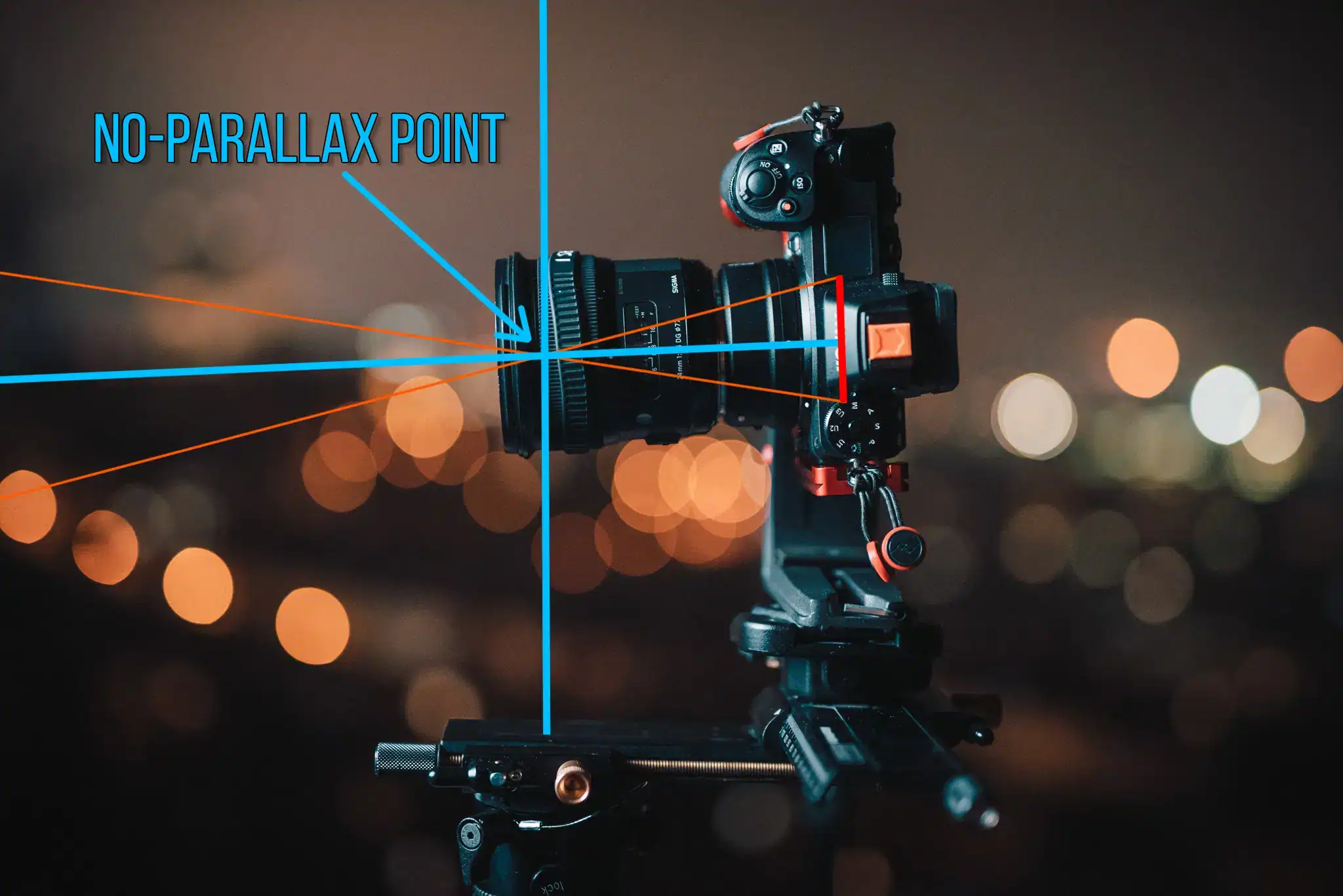
- Support: Level the tripod; ensure pano head rails and clamps are tight. Calibrate your nodal (no‑parallax) point at the focal length you’ll use.
- Safety: On rooftops or windy locations, tether your gear; use a weighted bag on the center column. For car mounts, verify suction and safety cables.
- Backup workflow: Shoot a second safety round at the main row height; redundancy saves sessions after accidental blur or passerby blocking a frame.
Essential Gear & Setup
Core Gear
- Panoramic head: Enables rotating around the lens’s entrance pupil (nodal point) to minimize parallax so overlapping frames align flawlessly. Multi‑row heads add pitch control for full spherical coverage.
- Stable tripod with leveling base: A leveling base speeds setup and keeps horizon level as you rotate. Carbon fiber helps in wind and reduces vibrations.
- Remote trigger or Canon Camera Connect app: Trigger without touching the camera to avoid micro-shake, especially during HDR bracketing.
Optional Add-ons
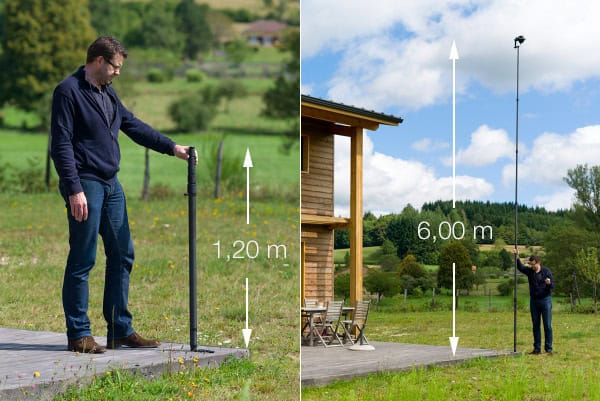
- Pole or car mount: Great for elevated or vehicle-based panoramas. Always tether the camera, check wind and vibration, and use faster shutter speeds.
- Lighting aids: Small LED panels for dark interiors to lift deep shadows where HDR alone struggles.
- Weather protection: Rain covers, lens hood, and microfiber cloths. Protects against drizzle, sea spray, or blowing dust.
For a deep explanation of panoramic head setup and why the nodal point matters, see this panoramic head tutorial at the end of this section. Panoramic head setup guide
Step-by-Step Shooting Guide
Standard Static Scenes
- Level tripod & align nodal point: Mount the R6 Mark II in portrait orientation on the panoramic head. Start with a forward rail offset of about 100–110 mm for 14mm (from the camera’s mounting screw) as a baseline, then refine using the no‑parallax test: line up a near and a far object; rotate left/right—adjust the rail until relative motion disappears.
- Manual exposure & locked white balance: Switch to M mode. Meter the mid‑tones; set a base exposure that protects highlights. Set a fixed white balance (Daylight or a custom K value). Disable Auto Lighting Optimizer and any exposure‑changing automation.
- Focus once, then lock: Use AF to focus about 2–3 m away at 14mm, then switch to MF. Alternatively, set the hyperfocal distance (f/8 gives ample depth of field at 14–20mm).
- Capture with overlap: At 14mm, shoot 8 images around at 0° tilt with 30% overlap. Add a row at +45° (8 more) and a row at −45° (8 more) for full vertical coverage, or go with 8 × 2 rows + zenith + nadir for a lighter set.
- Nadir (ground) shot: After the main rotation, tilt down and take a clean ground frame for tripod removal. If your head supports it, offset the tripod and shoot a patch plate.
HDR / High Dynamic Range Interiors
- Bracket ±2 EV (3–5 frames) to balance bright windows and interior shadows. The R6 Mark II’s bracketing and self‑timer/remote makes this quick.
- Lock WB and keep exposure increments consistent across the entire pano. Avoid AEB with auto ISO—set ISO manually.
- Use MLU or electronic first curtain shutter (EFCS) to reduce vibration. Review histograms; ensure at least one frame preserves highlights.
Low-Light / Night Scenes
- Use a stable tripod, remote trigger, and longer exposures. Prefer ISO 100–400 for best quality; ISO 800–1600 remains usable on the R6 Mark II with good noise reduction.
- Turn off lens IS and IBIS on tripod to avoid micro‑movement.
- Mind moving lights (cars, signs). If needed, shoot two passes to later mask streaks.
Crowded Events
- Shoot two passes around: one continuous for alignment, a second where you wait for gaps. This helps reduce ghosting and seams.
- Use faster shutter (1/200–1/400) and ISO 400–800 to freeze motion if light allows. Mask moving people in post to clean seams.
Special Setups (Pole / Car / Drone)
- Pole: Secure clamps, tether the camera, and keep the rig below wind thresholds. Use faster shutter (1/250+) and slightly higher ISO to fight sway.
- Car mount: Plan a very fast capture at intersections or quiet areas. Use mechanical shutter to avoid LED banding and 1/500–1/1000 if moving.
- Drone: This lens/camera combo is not drone‑friendly due to weight; use a dedicated drone camera for aerials and match vantage points from the ground if needed.
Recommended Settings & Pro Tips
Exposure & Focus
| Scenario | Aperture | Shutter | ISO | Notes |
|---|---|---|---|---|
| Daylight outdoor | f/8–f/11 | 1/100–1/250 | 100–200 | Lock WB to Daylight; disable Auto ISO |
| Low light/night | f/4–f/5.6 | 1/30–1/60 (or longer on tripod) | 100–800 (up to 1600) | Remote trigger; IS off on tripod |
| Interior HDR | f/8 | Bracket ±2 EV | 100–400 | Preserve window highlights; merge to HDR before stitching or as stacks in PTGui |
| Action/motion | f/5.6–f/8 | 1/200+ | 400–800 | Double pass for masking people/cars |
Critical Tips
- Manual focus and hyperfocal: At 14mm and f/8, focus ~1–2 m to keep near-to-far sharp. After focusing, switch to MF to prevent focus shifts.
- Nodal point calibration: Start around 100–110 mm forward rail offset for 14mm on the RF 14–35, then refine using the near/far alignment test. Mark your rail for 14, 20, and 35mm for repeatability.
- White balance lock: Mixed lighting (tungsten + daylight) causes color shifts if WB changes per frame. Set a K value (e.g., 5200K daylight or 3200–3800K for warm interiors) and keep it locked.
- RAW over JPEG: RAW gives you the dynamic range and color depth needed for seamless blending and highlight recovery.
- IS/IBIS on tripod: Switch both off to prevent micro‑vibrations and alignment drift over a long sequence.
Stitching & Post-Processing
Software Workflow
Import RAWs and apply basic corrections uniformly (lens profile, chromatic aberration, noise reduction). If you shot HDR brackets, either merge brackets first (Lightroom/Camera Raw) then stitch the merged set, or load brackets directly into PTGui and use its exposure fusion/HDR pipeline. Rectilinear lenses require more frames than fisheyes but produce cleaner edges and straight lines, ideal for interiors and architecture. Aim for ~25–30% overlap at 14–20mm; ~20–25% is workable at longer focal lengths if alignment is perfect.
PTGui is an industry standard for complex 360 photo stitching and offers robust control point editing, vertical/horizontal line constraints, and nadir patching. Hugin is a powerful open‑source alternative. Learn with a real project and gradually explore advanced features like masking, viewpoint correction, and optimizer settings. For a professional review of PTGui’s capabilities, see this overview. PTGui review and best practices
Cleanup & Enhancement
- Nadir patch: Use a dedicated nadir frame to clone out the tripod, or apply a logo patch. Some AI tools can speed this up.
- Color consistency: Sync white balance and tone curves across all frames before stitching; correct any visible seams post‑stitch.
- Noise reduction: Apply selectively to shadows after stitching; preserve texture in mid‑tones.
- Leveling: Use horizon and verticals tools in PTGui/Hugin. Correct roll/yaw/pitch for a natural viewer experience.
- Export: For VR, export an equirectangular JPEG or TIFF (2:1 aspect) at 8K–12K on the long edge for high-quality tours. Check platform guidelines.
If you are new to end‑to‑end 360 workflows with DSLRs/mirrorless, this step‑by‑step guide from Meta is a reliable primer. DSLR/Mirrorless 360 photo workflow
Useful Tools & Resources
Software
- PTGui panorama stitching
- Hugin (open-source)
- Lightroom / Photoshop for RAW prep and retouching
- AI tripod removal tools for quick nadir cleanup
Hardware
- Panoramic heads (Nodal Ninja, Leofoto, Fanotec) for precise entrance pupil alignment
- Carbon fiber tripods for stability
- Leveling bases to speed setup
- Wireless remote shutters or the Canon Camera Connect app
- Pole extensions / car mounts (with safety tethers)
For more background on camera/lens choices for virtual tours and spherical resolution math, these resources are helpful: DSLR/Mirrorless virtual tour gear guidance and DSLR spherical resolution explained.
Disclaimer: software/hardware names provided for search reference; check official sites for details.
Common Mistakes & How to Avoid Them
- Parallax error → Ensure nodal point alignment. Re‑check after changing focal length or focus distance.
- Exposure flicker → Use full manual exposure and lock white balance. Avoid auto ISO and auto WB.
- Tripod shadows and reflections → Shoot a dedicated nadir and consider a raised viewpoint. Patch in post.
- Ghosting from moving subjects → Shoot two passes; use masks in PTGui/Hugin to choose the clean frame.
- Night noise and color shifts → Keep ISO low and expose longer on tripod; apply consistent noise reduction and color correction.
- Stabilization artifacts on tripod → Turn off IBIS and lens IS to avoid alignment drift.
Field-Proven Case Studies
Indoor Real Estate (Bright Windows)
Use 14–20mm, f/8, ISO 100–200. Bracket ±2 EV (3–5 frames). Two rows (0° and +45°) plus zenith and nadir. Merge HDR first, then stitch. Result: clean lines, even tonality, and natural window retention without haloing.
Outdoor Sunset (High DR, Light Wind)
14mm, f/8, 8 around × 2 rows, ISO 100. Use a weighted tripod. Shoot the sun last or first while the brightness is consistent. Consider a second pass for the sky for exposure blending.
Event Crowd (Motion Management)
20mm, f/5.6, 1/250, ISO 400–800. Two rapid passes around. In post, mask the cleanest people positions per segment. Set the horizon using architectural lines to prevent a “tilted” feel.
Rooftop or Pole (Elevated View)
14mm on a pole, 1/250–1/500, ISO 400–800. Stabilize your stance; rotate slowly. Expect minor parallax; mask edges in post. Always use a safety tether and avoid gusty conditions.
Frequently Asked Questions
- Can I shoot handheld panoramas with the Canon EOS R6 Mark II?
Yes, for single‑row panos in good light. Use 14–20mm, f/8, 1/250+, ISO 100–400, and overlap 30–40%. For full 360×180 work, a tripod and panoramic head are strongly recommended to control parallax and ensure a perfect stitch.
- Is the RF 14–35mm f/4L wide enough for a single‑row 360?
Not for a complete sphere. At 14mm rectilinear, you’ll need at least two rows plus zenith/nadir. Single‑row is fine for cylindrical panoramas but won’t cover straight up/down.
- Do I need HDR for interiors with bright windows?
Often yes. The R6 Mark II has solid DR, but windows can be 6–10 stops brighter than interiors. Bracket ±2 EV (3–5 frames) and merge before stitching or in PTGui’s HDR pipeline to preserve both window detail and interior color.
- How do I avoid parallax issues with this lens?
Use a panoramic head and align rotation around the entrance pupil. Start with ~100–110 mm forward rail offset at 14mm (portrait orientation), then refine using a near/far alignment test. Re‑mark for 20mm and 35mm if you change focal length.
- What ISO range is safe on the R6 Mark II in low light?
ISO 100–800 is “safe” for commercial 360s. ISO 1600 is still clean with good noise reduction. Above 3200 can be used in a pinch but expect more noise and reduced micro‑contrast.
- Can I set up Custom Shooting Modes for panoramas?
Yes. Save pano settings to C1/C2 (Manual exposure, fixed WB, MF, IS off, bracketing on/off). This speeds up on‑site setup and ensures consistency across locations.
- How can I learn more about setting up a panoramic head?
Beyond this guide, see this pro tutorial on precise panoramic head setup for high‑end 360 photos. Panoramic head setup principles
- What tripod head is best for this setup?
A multi‑row panoramic head with fore‑aft and left‑right rails (e.g., Nodal Ninja or Leofoto) is ideal. Make sure it supports the R6 Mark II’s weight and allows precise entrance pupil alignment at 14–35mm.
Safety, Limitations & Trust Tips
Always stabilize and tether your gear in wind or at height. Disable stabilization on tripod. When changing focal length on the RF 14–35, recalibrate the nodal point—rectilinear ultra‑wides shift entrance pupil location across the zoom. For mission‑critical shoots, capture a backup round at the main row height. Keep a simple, consistent RAW processing baseline so frames match; then add creative grading only after stitching. Document your capture pattern and settings per job so you (or a teammate) can recreate results later.