Why This Camera & Lens Are Great for Panoramas
If you want to know how to shoot panorama with Canon EOS R6 Mark II & AstrHori 12mm f/2.8 Fisheye, you’re choosing a combo that is fast, forgiving in low light, and efficient for 360° capture. The Canon EOS R6 Mark II is a 24.2MP full-frame mirrorless body with a 36×24 mm sensor and ~6.0 µm pixel pitch, which translates to strong per-pixel signal and excellent noise characteristics. At base ISO, you can expect roughly ~14 stops of dynamic range, giving you room to hold highlights while lifting shadows—very helpful for interiors and twilight exteriors. The in-body image stabilization (IBIS) is class-leading, though for tripod-based panoramas you’ll typically switch it off to prevent micro-drift during long exposures.
The AstrHori 12mm f/2.8 Fisheye is a manual-focus, manual-aperture diagonal fisheye designed for full-frame RF mount. It delivers an ultra-wide 180° diagonal field of view, meaning you can cover a full sphere with fewer frames than a rectilinear wide-angle lens. That saves time, reduces stitching seams, and increases your success rate in dynamic scenes. As with most diagonal fisheyes, expect some lateral CA toward the edges and softer corners at f/2.8; stopping down to f/5.6–f/8 noticeably sharpens the frame and controls aberrations. The manual focus and aperture are actually advantages for panoramas—once you lock them, your sequence remains consistent, which is key for seamless stitching.
Quick Setup Overview
- Camera: Canon EOS R6 Mark II — Full-frame 24.2MP; strong high-ISO performance; ~14-stop DR at base ISO; Dual Pixel AF II; IBIS (switch off on tripod).
- Lens: AstrHori 12mm f/2.8 Fisheye — Diagonal fisheye (approx. 180° diagonal FOV), manual focus/aperture, best sharpness around f/5.6–f/8, some edge CA typical of fisheyes.
- Estimated shots & overlap (tested): 6 around at 0° yaw spacing of ~60° with 25–30% overlap + 1 zenith + 1 nadir. For safety (featureless skies/walls), consider 8 around.
- Difficulty: Easy–Moderate (simple capture count, but requires careful nodal alignment and exposure discipline).
Planning & On-Site Preparation
Evaluate Shooting Environment
Look for contrasty light (bright windows vs dim rooms), reflective surfaces (glass, polished floors), and moving subjects (people, cars, foliage). If shooting through glass, keep the front element as close as possible (1–3 cm) to reduce reflections and ghosting; use a rubber lens hood if available. Note the wind: fisheye panoramas typically require fewer frames, but even brief tripod shake can blur a frame and complicate stitching.
Match Gear to Scene Goals
The R6 Mark II’s clean files let you safely use ISO 100–400 outdoors and 400–1600 indoors without harsh noise, especially if you plan to bracket for HDR. The AstrHori 12mm fisheye minimizes the number of shots you need, reducing the chance of subject movement between frames. Distortion is part of the fisheye look but will be mapped correctly during stitching into an equirectangular image. For straight architectural lines, keep the camera perfectly leveled and use a panoramic head to control parallax.
Pre-shoot Checklist
- Charge batteries and carry spares; format fast cards; clean lens front element and, if needed, the sensor.
- Level the tripod; confirm your panoramic head is calibrated to the lens’s no-parallax (entrance pupil) point.
- Safety: on rooftops or windy viewpoints, tether the gear; avoid standing close to edges; use a weight hook on the tripod.
- Backup workflow: shoot a full extra pass (or two) for safety, especially at twilight when light shifts rapidly.
Essential Gear & Setup
Core Gear
- Panoramic head: This allows you to rotate the camera around the lens’s entrance pupil (nodal point) so foreground and background align without parallax. Once calibrated, your stitches become dramatically cleaner, even with close objects.
- Stable tripod with leveling base: A leveling base speeds up horizon leveling and minimizes roll corrections later.
- Remote trigger or Canon Camera Connect app: Triggering without touching the camera prevents micro-blur at slower shutter speeds.
Optional Add-ons
- Pole or car mount: Great for elevated or vehicle-mounted shots. Always use safety tethers, tighter clamps, and mind wind gusts and vibration.
- Portable LEDs or flashes for interiors: Use subtle fill rather than overpowering light to maintain a natural look across frames.
- Rain covers and microfiber cloths: Keep water and dust off the large fisheye front element to avoid flare and smears.
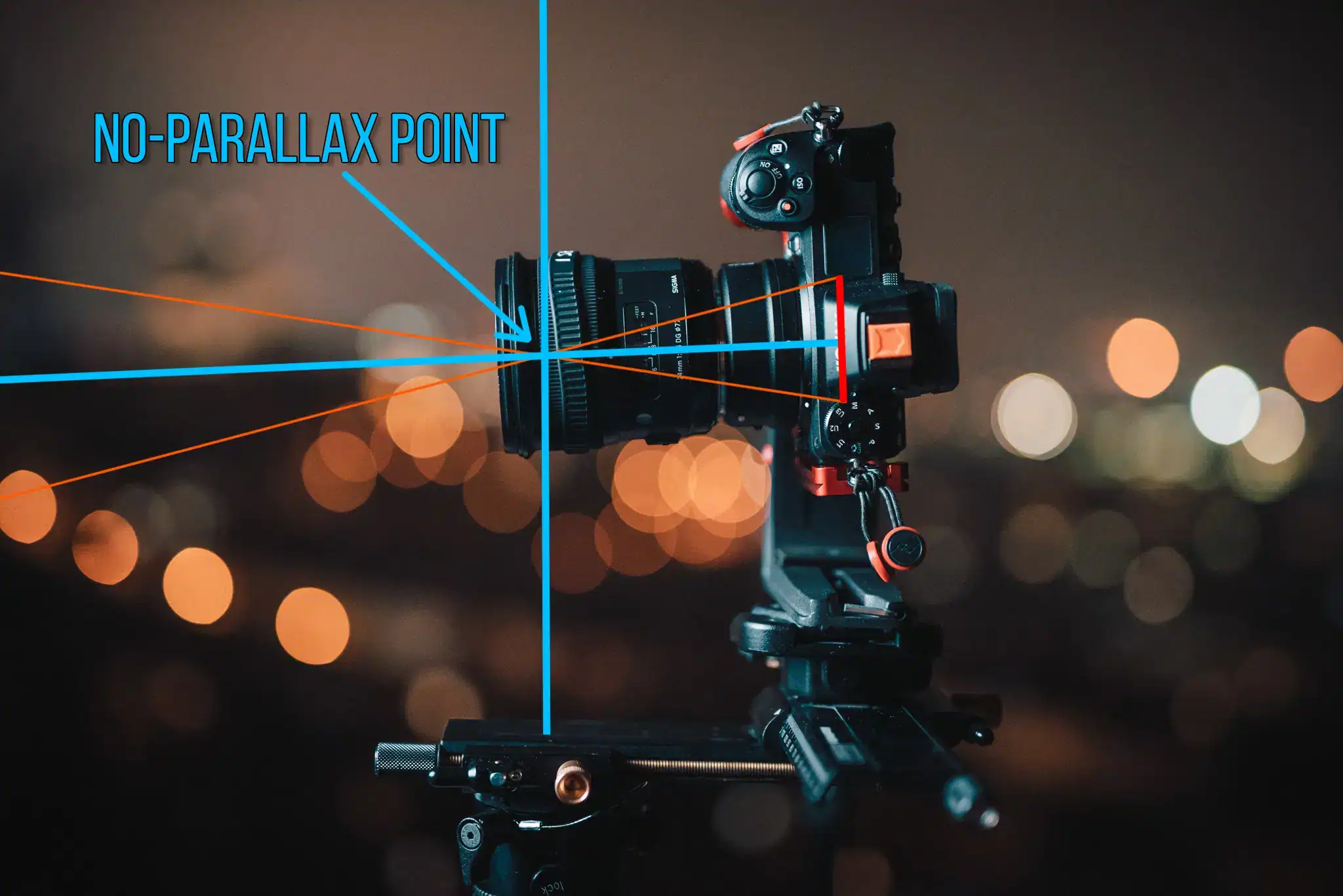
For a deeper dive into panoramic head setup theory and practice, see this panoramic head tutorial by 360Rumors at the end of this section. Comprehensive panoramic head setup guide
Step-by-Step Shooting Guide
Standard Static Scenes
- Level and align: Level your tripod using the leveling base. Mount the R6 Mark II with the AstrHori 12mm on your panoramic head. Align the rotation axis with the lens’s entrance pupil. A practical start for a 12mm diagonal fisheye on full-frame is to position the entrance pupil a few centimeters in front of the sensor plane—typically around 5–7 cm forward on your rail—then refine using a foreground/background parallax test.
- Lock exposure and color: Set Manual mode, choose a consistent exposure across the sequence, and lock white balance (Daylight or a measured Kelvin value). This prevents exposure and color shifts that cause stitching seams.
- Focus and aperture: Switch to MF, enable focus peaking in the R6 Mark II, then focus near the hyperfocal distance. With a 12mm lens at f/8 on full-frame, hyperfocal distance is roughly 0.6–0.7 m, keeping everything from ~0.3 m to infinity acceptably sharp.
- Capture sequence: Shoot 6 frames around at ~60° yaw increments with 25–30% overlap. Add 1 zenith shot (tilt up) and 1 nadir shot (tilt down). For a clean nadir, you can shoot a separate nadir patch by moving the tripod and correcting in post.
HDR / High Dynamic Range Interiors
- Bracket exposure: Use AEB to capture ±2 EV (3 or 5 frames per angle). This balances bright windows and interior shadows, improving tonality and color gradients.
- Keep WB and aperture fixed: Lock WB and use a fixed aperture (e.g., f/8) across the entire pano to ensure consistent depth of field and color.
- Shutter mode: In LED-lit interiors, mechanical shutter avoids potential banding that may appear with some flickering light sources.
Low-Light / Night Scenes
- Lower ISO first: On the R6 Mark II, ISO 100–400 is pristine; ISO 800–1600 is still very clean. Favor longer shutter times on a tripod over pushing ISO past 3200 if you can.
- Use a remote and disable IBIS on tripod: Prevent micro-vibrations and any sensor-based drift during long exposures by using a remote trigger and turning IBIS off.
- Take a safety round: Light can change quickly after sunset; shoot an extra full pass with slightly different exposure to hedge against changing streetlights and sky luminance.
Crowded Events
- Two-pass strategy: First pass for coverage, second pass where you wait for gaps in traffic. This gives you source frames to mask out moving people or objects.
- Overlap generously: In dynamic scenes, 30–35% overlap provides more control points and better masking options in post.
Special Setups (Pole / Car / Elevated)
- Secure all gear: Tighten clamps, add safety tethers, and pre-check your load. Balance the pole vertically to avoid lean.
- Short exposures: To combat vibration, prefer faster shutter speeds (1/200s+ if possible) and consider a second pass for redundancy.
Recommended Settings & Pro Tips
Exposure & Focus
| Scenario | Aperture | Shutter | ISO | Notes |
|---|---|---|---|---|
| Daylight outdoor | f/8–f/11 | 1/100–1/250 | 100–200 | Lock WB (Daylight or 5200–5600K) |
| Low light/night | f/4–f/5.6 | 1/30–1/60 (tripod) or faster if windy | 400–800 (1600 if needed) | Use remote; disable IBIS on tripod |
| Interior HDR | f/8 | Bracket ±2 EV | 100–400 | Balance windows and lamps; keep WB fixed |
| Action / moving subjects | f/5.6–f/8 | 1/200+ | 400–800 | Faster shutter to freeze motion, shoot two passes |
Critical Tips
- Manual focus near hyperfocal: At 12mm, f/8, focus around 0.6–0.7 m. Use peaking and magnification to confirm. Tape the focus ring if needed.
- Nodal calibration: Position the lens on your panoramic head so foreground and background elements do not shift relative to each other when you yaw the camera. Mark this setting on your rail for repeatability.
- White balance lock: Mixed lighting can vary by frame; a fixed Kelvin setting ensures consistent color and easier global corrections.
- RAW capture: Shoot RAW to maximize dynamic range and color depth, especially for HDR and low-light work.
- IBIS and IS: Turn IBIS off on a tripod. If you add any lens-based IS in the future, disable it for tripod panoramas to avoid drift.
- Set IBIS focal length: For manual lenses, set the focal length in the R6 Mark II’s IS settings to 12mm when you’re shooting handheld—this helps stabilization (but again switch off on tripod).
Stitching & Post-Processing
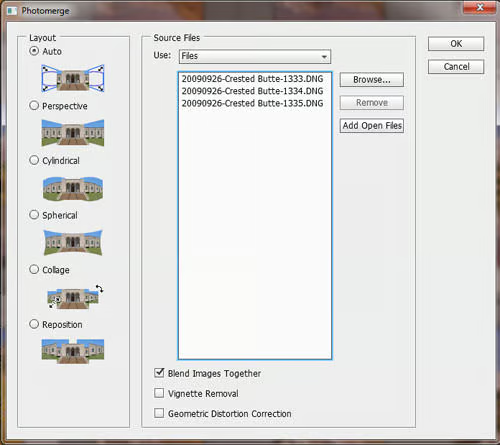
Fisheye panoramas stitch efficiently because you need fewer frames and fisheye projection maps cleanly into equirectangular. In PTGui or Hugin, set the lens type to “fisheye” and enter the focal length (12 mm). Use about 25–30% overlap for control points to distribute across frames. Rectilinear lenses generally require more shots (and often multi-row), but your fisheye keeps counts low while still delivering a high-resolution sphere.
Software Workflow
- Ingest & cull: Import RAW images, remove blurred frames, and group brackets if using HDR.
- Pre-process HDR (optional): Merge each bracket set to 32-bit or HDR DNG in Lightroom/ACR, or let PTGui handle exposure fusion.
- Stitch: In PTGui or Hugin, pick a “Spherical 360” output. Let the software detect control points; then optimize yaw, pitch, roll, and lens parameters. Check seam previews and mask moving subjects if needed.
- Level & color: Level the horizon, correct white balance and tint, and match tones between frames. Apply selective noise reduction to shadows.
- Nadir patch: Use a second nadir shot or clone/AI tools to remove the tripod. Keep textures consistent with surrounding floor materials.
- Export: Save as 16-bit TIFF for archives and as an 8-bit JPEG equirectangular (2:1 aspect ratio) for web or VR viewers.
Curious about tool choices? PTGui is a staple among professionals for speed and masking control. See this balanced review for context. Why PTGui is a go-to for advanced pano stitching
For end-to-end DSLR/mirrorless 360 workflows and VR export conventions, Meta’s Creator resources provide solid high-level guidance. Shooting and stitching a 360 photo for VR platforms
Useful Tools & Resources
Software
- PTGui (paid) — fast, robust control point generation and masking.
- Hugin (open-source) — powerful and flexible once configured properly.
- Lightroom / Photoshop — RAW processing, HDR merges, nadir patching.
- AI tripod removal tools — speed up nadir cleanup.
Hardware
- Panoramic heads (Nodal Ninja, Leofoto) — precise entrance pupil alignment.
- Carbon fiber tripods — high stiffness-to-weight ratio.
- Leveling bases — quick leveling for consistent horizons.
- Wireless remote shutters — trigger without touching the camera.
- Pole extensions / car mounts — elevated perspectives and vehicle-based capture.
Disclaimer: software/hardware names provided for search reference; check official sites for details.
For broader camera and lens selection advice in 360 pano work, this guide distills practical options and tradeoffs. Choosing cameras and lenses for virtual tour panoramas
Common Mistakes & How to Avoid Them
- Parallax error → Calibrate the entrance pupil carefully and keep the camera level during the rotation.
- Exposure flicker → Manual exposure and locked white balance prevent visible seams and color shifts.
- Tripod shadows and clutter → Shoot a dedicated nadir patch or plan your tripod placement to minimize obstructions.
- Ghosting from movement → Take a second pass and use masks in PTGui/Hugin to replace problematic areas.
- Overusing ISO at night → Favor longer shutter times (with a stable tripod) over cranking ISO past 3200.
- IBIS left on → Switch off IBIS when the camera is tripod-mounted to avoid micro-movements during long exposures.
Practical Scenarios & Field Advice
Indoor Real Estate (Bright Windows)
Use f/8, ISO 100–200, and bracket ±2 EV. Lock WB to a Kelvin value (e.g., 4200–4800K) to balance cool window light and warm interiors. Floors and countertops are reflective; watch for tripod reflections and prepare to patch the nadir. With the AstrHori 12mm, 6 around + zenith + nadir is efficient and keeps door frames and ceiling lights mapped cleanly after stitching.
Outdoor Sunset (High DR, Changing Light)
Twilight changes quickly; pre-meter and shoot a safety pass before peak color, then again at peak. Consider 8-around if clouds are fast-moving to increase overlap. Keep the sun off the front element when possible; a slight body shadow or hand flag can reduce flare.
Event Crowds (Moving People)
Use 1/200s or faster and ISO 400–800 to freeze motion. Shoot two passes: first for overall coverage, second timed to capture gaps. Mask in post to remove overlaps of moving subjects. Diagonal fisheye geometry tends to hide minor misalignments better than a rectilinear ultrawide.
Rooftop / Pole Shooting (Safety First)
Attach a safety tether and avoid strong gusts. Keep exposures short, and if necessary, raise ISO to maintain 1/200s shutter for stability. If your pole flexes, pause a moment after each rotation step to damp vibrations before firing.
Frequently Asked Questions
- Can I shoot handheld panoramas with the Canon EOS R6 Mark II?
Yes for partial panos and some 360s in open spaces, but tripod + pano head is strongly recommended. Handheld introduces roll variations and parallax, especially with nearby objects. If you must, keep shutter fast (1/200s+), use ISO 400–800, and overlap generously (35%+). Expect more post work.
- Is the AstrHori 12mm f/2.8 Fisheye wide enough for single-row 360?
Yes. On full-frame, a 12mm diagonal fisheye typically needs 6 shots around plus zenith and nadir. For minimal detail scenes, you might squeeze coverage with 6+zenith and patch the nadir, but 6+2 is the reliable baseline.
- Do I need HDR for interiors with bright windows?
Usually. The R6 Mark II has excellent dynamic range, but interiors with sunlit windows exceed even a strong sensor’s limits. Bracket ±2 EV (3–5 shots per angle) to retain window detail and clean shadows.
- How do I avoid parallax issues with this lens?
Mount the camera on a calibrated panoramic head. Start with the lens advanced ~5–7 cm forward from the sensor plane and fine-tune by aligning a close and far object; yaw the camera and adjust until there’s no relative shift. Mark the rail for repeat use with the AstrHori 12mm.
- What ISO range is safe on the R6 Mark II in low light?
For tripod-based panoramas, ISO 100–400 is ideal; ISO 800–1600 remains very clean. ISO 3200 is usable with noise reduction, but try to favor longer exposures if wind allows. On a pole/car, prioritize shutter speed even if that means ISO 1600–3200.
- Can I set up Custom Shooting Modes (C1/C2) for pano?
Yes. Save Manual exposure, fixed WB, MF with focus peaking, and disabled IBIS (for tripod work) to a Custom mode. This speeds up setup and ensures consistency. Create a second preset for HDR bracketing.
- How can I reduce flare with a fisheye?
Keep direct sun just outside the frame when possible, shield the lens with your hand or a small flag, and clean the front element meticulously. Slightly adjust yaw to move strong light sources toward overlap zones for easier masking.
- What’s the best tripod head for this setup?
A dedicated panoramic head with fore-aft and lateral rails (e.g., Nodal Ninja, Leofoto) lets you precisely place the entrance pupil over the rotation axis. A compact rotator with 60° click-stops matches the 6-around workflow nicely.
Safety, Limitations & Trustworthy Workflow
Always prioritize safety with elevated, windy, or public locations. Tether your gear, watch footing, and avoid obstructing traffic or emergency exits. The AstrHori 12mm’s bulbous front element is exposed—use caps and soft pouches when moving between spots to prevent scratches. Be transparent with clients about limits in high-contrast scenes (e.g., extreme sun flares or deep shadows) and always capture a backup pass. For a second opinion on pano fundamentals, this StackExchange thread consolidates time-tested practices. Community techniques for shooting 360 panoramas