
Why This Camera & Lens Are Great for Panoramas
If you’re wondering how to shoot panorama with Canon EOS R5 & Tamron 17-28mm f/2.8 Di III RXD, you’re looking at a high-resolution full-frame body paired with a fast, sharp ultrawide zoom. The Canon EOS R5’s 45MP full-frame sensor (approx. 36 × 24 mm, ~4.4 µm pixel pitch) captures extremely detailed source frames with solid base-ISO dynamic range (about 14+ stops at ISO 100), which is excellent for HDR panoramas and shadow recovery. Dual Pixel AF II is helpful for quick prefocusing before locking focus, and the 5-axis IBIS is handy for handheld stitches (but should be disabled on a tripod).
The Tamron 17-28mm f/2.8 Di III RXD is a rectilinear ultrawide with a constant f/2.8 aperture, low weight (~420 g), strong center sharpness, and good flare control for its class. Stopped down to f/5.6–f/8, it delivers crisp edge-to-edge performance that stitches cleanly. As a rectilinear lens, it minimizes “fisheye” curvature but requires more frames than a fisheye for full 360° coverage. Distortion at the extremes is well behaved and easily corrected in post.
Important mount note: The 17-28mm f/2.8 Di III RXD is natively made for Sony E-mount. There isn’t a practical, optically neutral adapter to mount E-mount glass on Canon RF bodies due to flange distance constraints. If you shoot an EOS R5, consider similar RF-mount ultrawides (e.g., Canon RF 15–35mm f/2.8, RF 15–30mm f/4.5–6.3, or adapted EF 16–35mm lenses). The shooting approach, overlap, and stitching workflow in this guide apply directly to any rectilinear 16–28mm ultrawide on the R5. If you do own the Tamron 17–28 but on a Sony body, apply the same frame counts and settings below; the numbers translate one-to-one.
Quick Setup Overview
- Camera: Canon EOS R5 — Full-frame, 45MP, ~14+ stops DR at base ISO, Dual Pixel AF II, 5-axis IBIS.
- Lens: Tamron 17-28mm f/2.8 Di III RXD — Rectilinear ultrawide zoom, sharp from f/4–f/8, moderate CA, good flare control. Note: native for Sony E-mount; use equivalent RF ultrawide on R5.
- Estimated shots & overlap (portrait orientation, rectilinear):
- At 17mm: 3 rows (−45°, 0°, +45°) × 6 shots around ≈ 18 + zenith + nadir = ~20 frames, 30–35% overlap.
- At 20–21mm: 3 rows × 8 around ≈ 24 + Z/N = ~26 frames.
- At 28mm: 3 rows × 10 around ≈ 30 + Z/N = ~32 frames.
- For single-row cylindrical panoramas (not full 360×180): 6–8 around at 17–20mm is often enough.
- Difficulty: Intermediate (easy outdoors; more challenging for interiors and mixed light).
Planning & On-Site Preparation
Evaluate Shooting Environment
Assess lighting, motion, and reflective surfaces. Sun position and moving clouds affect exposure consistency; wind affects stability. For interiors, watch for reflective glass, mirrors, and glossy floors—these amplify stitching errors and ghosting. If shooting through glass, get the front element as close as safely possible (1–3 cm) to reduce reflections; use a rubber lens hood to block stray light.
Match Gear to Scene Goals
The EOS R5’s wide dynamic range and clean ISO 100–800 performance let you work in varied conditions. Indoors, ISO 400–800 remains quite clean; for deep night scenes ISO 1600 is workable with careful noise reduction. A rectilinear ultrawide like the 17–28mm captures straight lines well for architecture and real estate, though it needs more frames than a fisheye for full coverage. If you need fewer shots and faster capture, a fisheye lens is faster but introduces stronger curvature and requires defishing nuances.
Pre-shoot Checklist
- Battery charged (LP-E6NH) and spare; high-speed cards (CFexpress Type B and/or SD UHS-II).
- Clean lens and sensor; pack a blower and microfiber cloth.
- Level tripod on a firm surface; confirm panoramic head calibration.
- Safety: use a weight bag on windy rooftops; tether pole rigs; avoid traffic and crowds when using car mounts.
- Backup workflow: when stakes are high, shoot an extra safety round and a second nadir view.
Essential Gear & Setup
Core Gear
- Panoramic head with fore-aft and lateral rails: Align the lens’s entrance pupil (nodal point) over the rotation axis to eliminate parallax between foreground and background. This is critical for indoor shoots with nearby objects.
- Stable tripod with a leveling base: A bowl/leveling base speeds set-up and ensures each rotation step stays level.
- Remote release or phone app (Canon Camera Connect): Prevents vibration during long exposures and HDR brackets.
Optional Add-ons
- Pole or car mount: Always use a safety tether. Avoid high winds; watch for overhead lines and pedestrian traffic. Slow your rotation and use higher overlap to counter vibrations.
- Lighting: Small LED panels for dark interiors. Keep lighting off-camera and consistent across frames.
- Weather protection: Rain cover, silica gel packs, and a dry cloth for mist and sea spray.
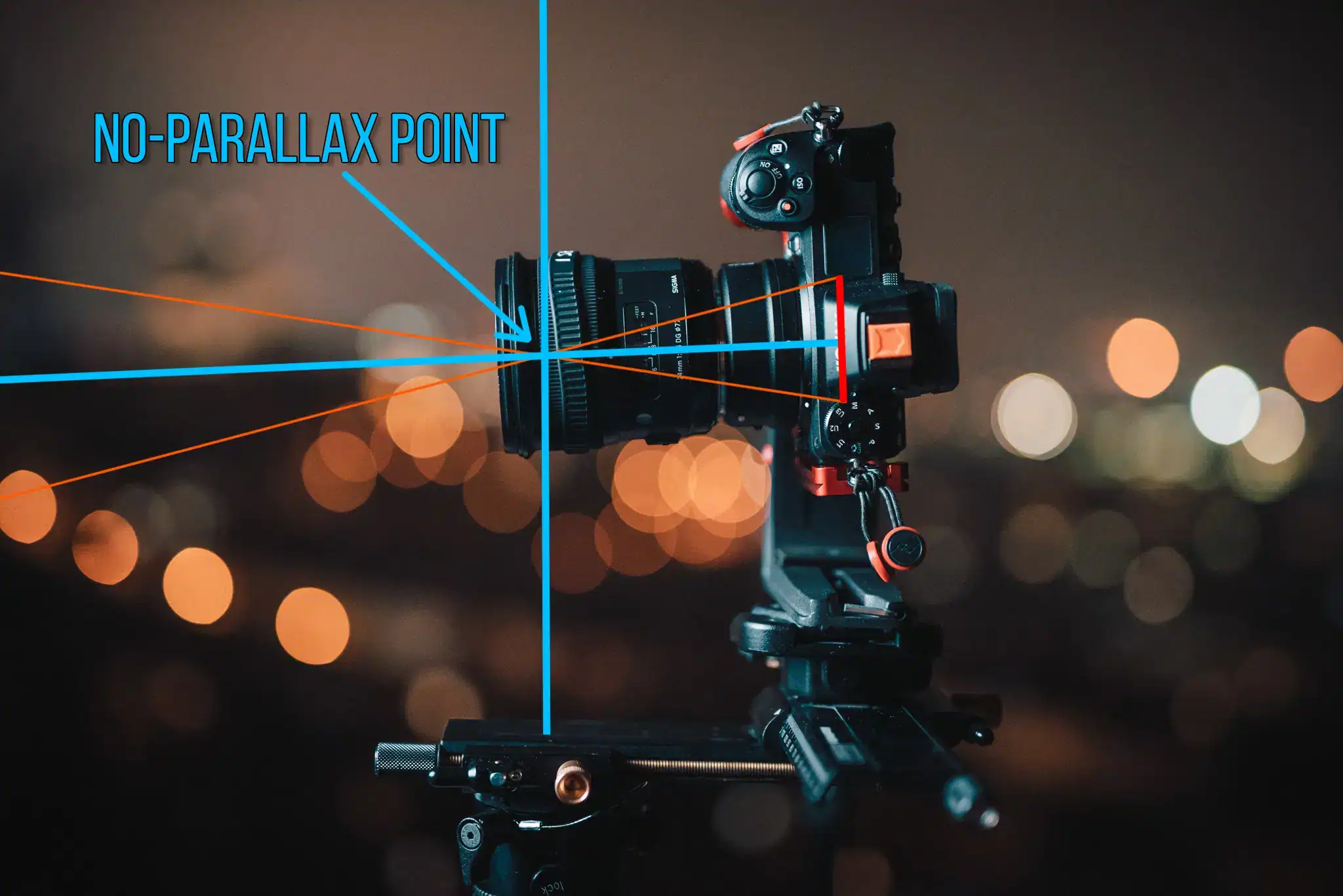
New to panoramic heads and nodal alignment? See this practical panoramic head tutorial for step-by-step visuals: How to set up a panoramic head and find the no-parallax point.
Step-by-Step Shooting Guide
Standard Static Scenes
- Level the tripod and align the nodal point. In a test setup, line up a close foreground object against a distant background object. Rotate the camera left-right. Slide the lens forward/back on the rail until the objects do not shift relative to each other.
- Set exposure manually and lock white balance. Meter a mid-tone and set Manual exposure. Choose a fixed WB (Daylight, Tungsten, or a Kelvin value) so color doesn’t drift between frames.
- Choose frame count and overlap. At 17mm (portrait orientation), shoot three rows: −45°, 0°, +45°, 6 shots each (60° yaw steps) using 30–35% overlap. Add one zenith and one nadir frame.
- Capture the nadir (ground) shot. After the main set, offset the tripod slightly or shoot a handheld nadir from directly above the pivot point for easier tripod removal in post.
HDR / High Dynamic Range Interiors
- Bracket ±2 EV. Use AEB with 3–5 frames if windows are 4–6 stops brighter than interior shadows. Keep ISO 100–200 for cleaner HDR merges.
- Lock WB and focus. This ensures consistent tone and color across all brackets, reducing stitching seams.
- Shoot a test bracket at the brightest window to ensure highlights aren’t clipped in the darkest exposure.
Low-Light / Night Scenes
- Stabilize everything. Disable IBIS on the R5 when locked on a tripod to avoid micro jitter. Use the self-timer or remote.
- Exposure targets. f/4–f/5.6, ISO 400–800, and whatever shutter you need (often 2–10 s). The R5 remains clean to ISO 800; ISO 1600 is usable with careful noise reduction.
- Watch moving lights. Cars and signs can create ghosting; capture a second clean frame for masking if needed.
Crowded Events
- Two-pass method. First pass quickly captures the composition. Second pass, wait for subject gaps in each segment to minimize overlap conflicts.
- Mask later. Use the least crowded frame per sector during post to avoid ghosting and duplicates.
Special Setups (Pole / Car / Drone)
- Secure and tether. For poles, use guy lines above 3 m, monitor wind gusts, and keep the camera’s center of mass aligned with the pole.
- Increase overlap. Use 40–50% overlap to give stitchers more leeway against small vibrations or flex.
- Short exposure times. Prefer higher ISO over blur. On the R5, ISO 800–1600 is acceptable if it prevents motion blur.
Case Study: Real Estate Interior
At 17–20mm, shoot 3 rows × 6–8 around, bracketing ±2 EV. Keep the camera at about 120–150 cm height to avoid ceiling light hotspots dominating the frame. Turn off ceiling fans; close blinds slightly if direct sun creates blown highlights.
Case Study: Sunset Landscape
Lock WB to Daylight, expose for mid-tones, and capture a bracketed set. At 17mm, 3 rows × 6 around + Z/N covers the sky’s color gradients well. Shoot an extra darker bracket for the sun’s disk if needed.
Case Study: Rooftop Pole
Keep the pole vertical with a bubble level. Use 17mm, single row of 8 around plus a tilted-up row if skyline is high. Choose faster shutter speeds (1/250–1/500) and higher ISO if wind picks up.
Case Study: Car-Mounted Capture
Park safely. Avoid traffic or pedestrians. Use 17–20mm with 40% overlap. Shoot multiple passes to mitigate vibration blur, and consider electronic shutter to reduce mechanical shock.
Recommended Settings & Pro Tips
Exposure & Focus
| Scenario | Aperture | Shutter | ISO | Notes |
|---|---|---|---|---|
| Daylight outdoor | f/8–f/11 | 1/100–1/250 | 100–200 | Lock WB to Daylight/Kelvin 5200–5600 |
| Low light/night | f/4–f/5.6 | As needed (0.5–10 s) | 400–800 (1600 if needed) | Tripod + remote, IBIS OFF on tripod |
| Interior HDR | f/8 | Bracket ±2 EV (3–5 frames) | 100–400 | Expose to protect window highlights |
| Action / moving subjects | f/5.6–f/8 | 1/200+ | 400–800 | Two-pass method to minimize ghosting |
Critical Tips
- Focus: Use manual focus at or near the hyperfocal distance. At 17mm and f/8 on full-frame, hyperfocal is roughly ~1.2 m; focus around 1.2–1.5 m for front-to-back sharpness.
- Nodal calibration: Mark the rail position for your lens once dialed in. Recheck if you change focal length; the entrance pupil shifts slightly across the zoom range.
- White balance: Set a fixed WB (Kelvin or preset) to avoid color seams. Mixed light? Consider a custom Kelvin value that balances overall warmth.
- RAW over JPEG: RAW preserves dynamic range and color depth for cleaner HDR merges and seam corrections.
- IBIS/IS: Turn off IBIS and any lens IS when on a tripod to prevent micro motion artifacts. For handheld stitches, IBIS helps.
- Custom Modes: Program C1 (single exposure pano) and C2 (HDR pano) on the R5 to speed up your workflow.
Stitching & Post-Processing
Software Workflow
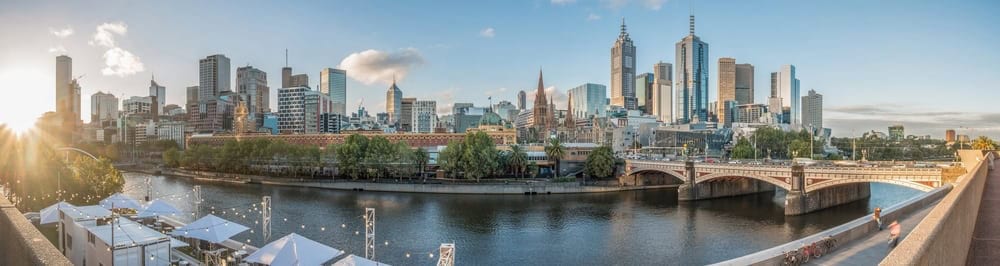
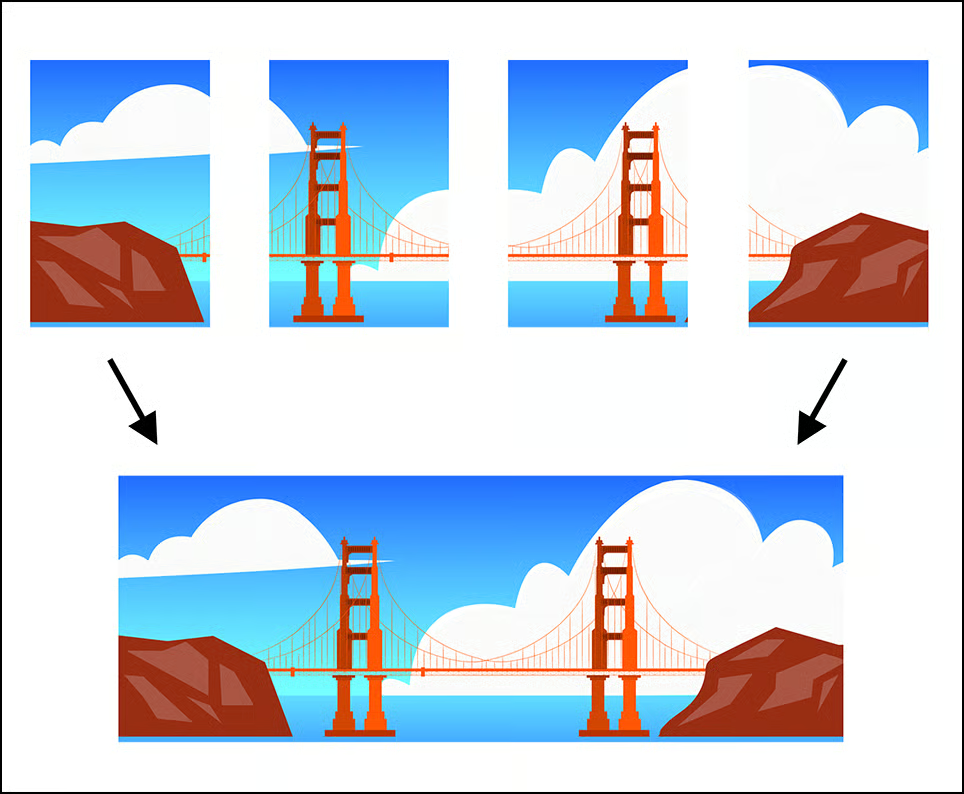
After culling, merge brackets (if any) then stitch the panorama. PTGui is an industry standard for 360×180 work, with strong control point optimization and masking tools. Hugin is a powerful open-source alternative; Lightroom/Photoshop can handle simpler panoramas. For rectilinear ultrawide sources, use ~25% overlap minimum; 30–40% gives more robust results in complex scenes. Fisheye workflows need fewer frames but require different lens models and defishing steps. For a deeper look at PTGui in practice, see this review: Fstoppers on PTGui for professional panoramas.
Cleanup & Enhancement
- Nadir patch: Shoot a clean nadir plate and patch it with masking or clone tools. Many VR editors offer AI tripod removal.
- Color and noise: Match white balance across seams, then apply noise reduction and gentle sharpening. Night panoramas benefit from selective NR in shadows.
- Leveling: Use the stitcher’s horizon/vertical tools to correct roll/yaw/pitch so the pano feels natural in VR.
- Export: For VR players and virtual tours, export an equirectangular 2:1 image (e.g., 12000×6000 or 16384×8192) in high-quality JPEG or 16-bit TIFF for further edits.
If you’re new to end-to-end 360 photo creation with mirrorless/DSLR, this platform guide is a solid primer: Using a DSLR or mirrorless camera to shoot and stitch a 360 photo.
Useful Tools & Resources
Software
- PTGui panorama stitching
- Hugin open source
- Lightroom / Photoshop for RAW, HDR, and finishing
- AI tripod removal / patch tools (various VR editors)
Hardware
- Panoramic heads (Nodal Ninja, Leofoto, Sunwayfoto)
- Carbon fiber tripods for stability-to-weight ratio
- Leveling bases and rotators with click stops
- Wireless remotes / intervalometers
- Pole extensions / car suction mounts with safety tethers
For a concise refresher on panoramic head setup and alignment, this guide is excellent: Set up a panoramic head to shoot high‑end 360 photos.
Disclaimer: Software/hardware names provided for search reference; verify current features and compatibility on official sites.
Common Mistakes & How to Avoid Them
- Parallax error → Carefully align the entrance pupil; recheck if you change focal length or camera orientation.
- Exposure flicker → Manual exposure and fixed WB. Avoid auto ISO and auto WB for critical work.
- Tripod shadows and footprints → Capture a clean nadir plate; patch later.
- Ghosting from moving subjects → Two-pass method, then mask or choose the cleanest frame for each area.
- Night noise → Prefer longer exposures on tripod over pushing ISO unnecessarily; use selective noise reduction.
- IBIS artifacts on tripod → Disable IBIS and lens IS to prevent micro blur.
Frequently Asked Questions
- Can I shoot handheld panoramas with the Canon EOS R5?
Yes for simple cylindrical or short multi-row panos. Use higher overlap (40–50%), faster shutter speeds (1/200+), and enable IBIS. For 360×180 VR panos, a tripod and panoramic head are strongly recommended for accuracy.
- Is the Tamron 17-28mm f/2.8 wide enough for a single-row 360?
For full 360×180 coverage, one row is not enough with a rectilinear 17–28mm. Plan on 2–3 rows plus zenith and nadir. A fisheye lens can do it in fewer frames, but with more curvature to manage.
- Do I need HDR for interiors with bright windows?
Usually, yes. Bracket ±2 EV (3–5 frames) to retain highlight detail in windows and clean shadows. Merge HDRs per angle, then stitch for consistent results.
- How do I avoid parallax issues indoors?
Use a panoramic head and align the entrance pupil precisely. Keep foreground objects from crossing stitch seams when possible. See a detailed tutorial on nodal alignment: Panoramic head setup and no-parallax point.
- What ISO range is safe on the EOS R5 in low light?
ISO 100–800 is very clean. ISO 1600 is usable with careful noise reduction. On a tripod, prioritize longer shutter times and keep ISO as low as the scene allows.
- Can I set up Custom Shooting Modes (C1/C2) for pano?
Yes. For example, C1: single exposure pano (Manual, WB fixed, IBIS OFF for tripod). C2: HDR pano (AEB ±2 EV, continuous bracket, delay or remote trigger). This speeds setup on location.
- Lens compatibility: can I mount the 17-28mm Di III RXD on an EOS R5?
It’s designed for Sony E-mount; there’s no practical adapter to RF with correct flange distance. Use a comparable RF/EF ultrawide on the R5; the capture strategy and frame counts are the same.
- What’s the best tripod head for this setup?
A two-rail panoramic head with a detent rotator (click stops) and a leveling base. Ensure enough fore-aft travel to position the entrance pupil at all focal lengths you use.