
Why This Camera & Lens Are Great for Panoramas
The Canon EOS R5 paired with the Sony FE 14mm f/1.8 GM is an unconventional but powerful combination for high-end panoramic work. The R5’s 45MP full-frame sensor (36×24 mm) delivers excellent detail and dynamic range for large equirectangular outputs and virtual tours. At base ISO (100), the R5 provides roughly 14+ stops of dynamic range with clean shadows and rich color depth, while its Dual Pixel AF makes prefocus fast and precise before switching to manual. The Sony 14mm f/1.8 GM is among the sharpest ultra-wide rectilinear primes available, with low coma and well-controlled lateral CA. Its 114° diagonal field of view (about 104° horizontal, ~81° vertical) minimizes the number of frames needed versus longer lenses, while keeping straight lines straight (unlike a fisheye).
Important compatibility note: the FE 14mm f/1.8 GM is a Sony E-mount lens and does not natively fit the Canon RF mount. A specialty E-to-RF electronic adapter would be required for aperture control and EXIF. Such adapters are rare; if you cannot source a reliable one, consider Canon RF alternatives (e.g., RF 14–35mm f/4L, RF 15–35mm f/2.8L) or a third-party RF 14mm prime. All shooting and stitching techniques below remain the same for a 14mm rectilinear lens on the R5.
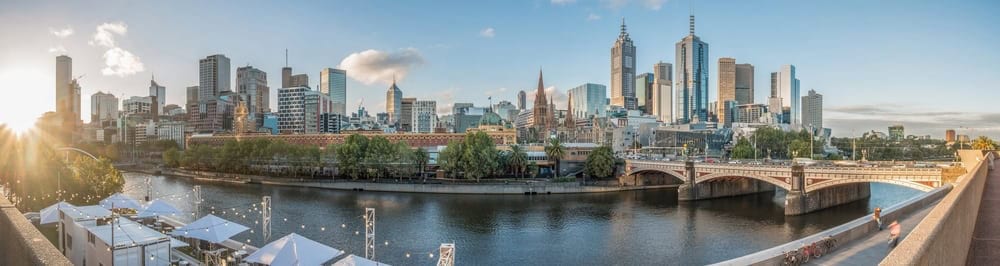
Quick Setup Overview
- Camera: Canon EOS R5 — full-frame, 45MP (approx. 8192×5464), pixel pitch ~4.4 µm, strong DR at ISO 100–200.
- Lens: Sony FE 14mm f/1.8 GM — rectilinear ultra-wide prime, very sharp from f/2.8–f/8, low coma/astigmatism, minor barrel distortion corrected in post.
- Estimated shots & overlap (14mm FF rectilinear):
- Minimal single-row: 8 around (45° steps) at 20–30% overlap + 1 zenith + 1 nadir (total ~10).
- Higher quality: 2 rows of 8 (±25–30° tilt) + zenith + nadir (total ~18–20).
- HDR interiors: same geometry with 3–5 bracketed exposures per angle.
- Difficulty: Intermediate (precise nodal alignment, careful exposure, consistent workflow).
Planning & On-Site Preparation
Evaluate Shooting Environment
Assess the light, reflective surfaces (glass/metal), and movement. Strong backlight can create flare at 14mm; adjust angle or shade the lens. When shooting near glass, keep the front element as close as possible (1–3 cm) to reduce reflections. Watch for moving elements (people, trees, traffic) that can cause ghosting between frames; plan pauses between shots to capture cleaner plates for masking.
Match Gear to Scene Goals
The EOS R5’s dynamic range and color depth excel in sunrise/sunset and interior HDR where highlight recovery matters. Indoors, ISO 400–800 remains very clean, especially when you expose to protect highlights and stack bracketed frames. The 14mm rectilinear advantage is fewer frames per 360° than a 24–35mm, while preserving straight lines in architecture (unlike fisheyes). For real estate and VR tours, this reduces shoot time and stitching complexity while maintaining a natural look.
Pre-shoot Checklist
- Charge batteries; format dual cards; clean lens and sensor.
- Level tripod; calibrate your panoramic head for this lens (nodal point alignment).
- Safety: check wind, rooftop edges, bystanders; use tethers/weights for poles or car mounts.
- Backup workflow: shoot a second pass for safety; bracket if in doubt.
Essential Gear & Setup
Core Gear
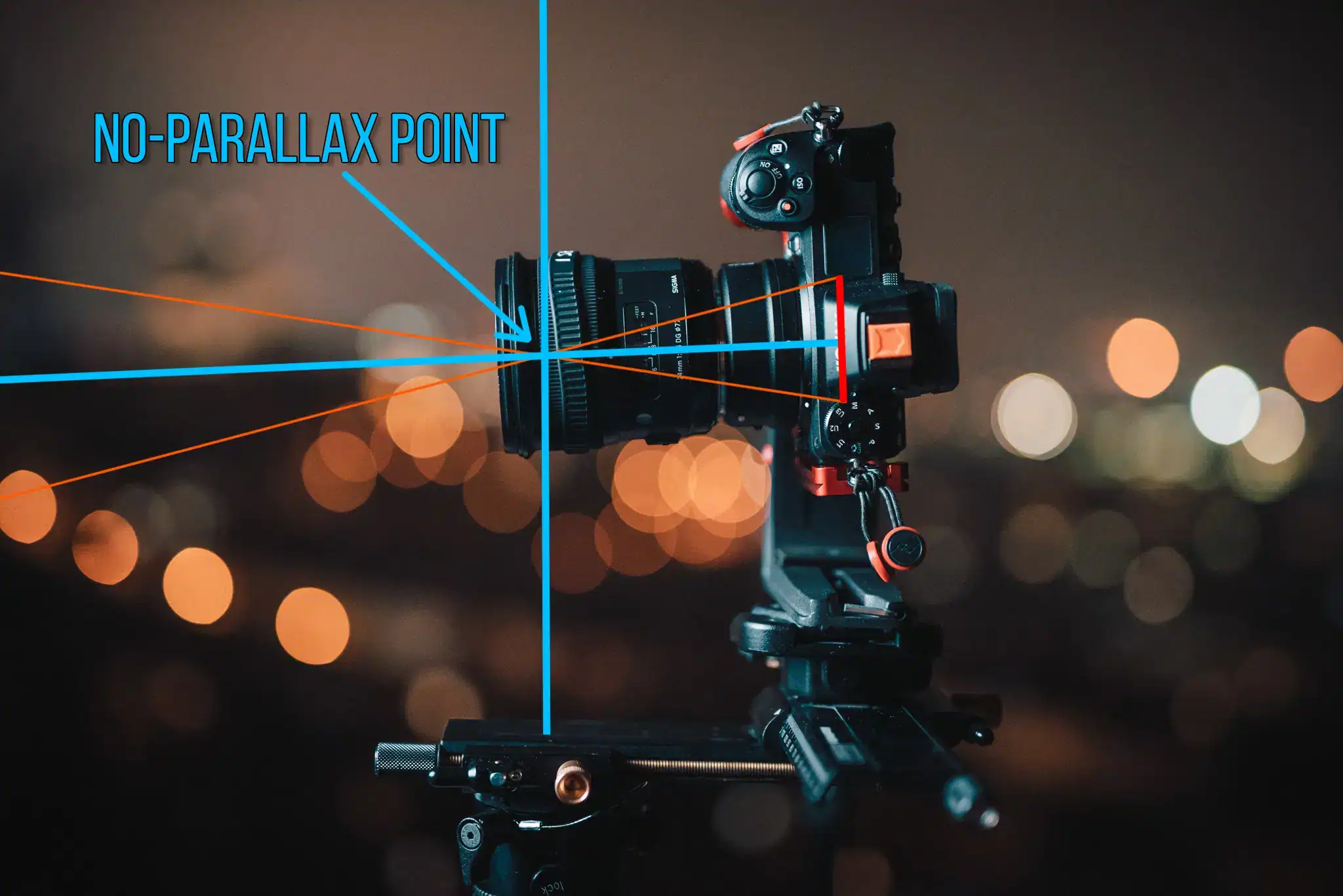
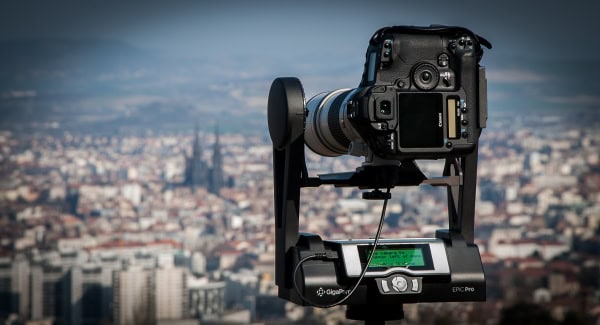
- Panoramic head: A proper multi-row head lets you align the rotation around the lens’s no-parallax point (entrance pupil), eliminating parallax errors and making stitches perfect.
- Stable tripod with leveling base: Faster setup and consistent horizons. A leveling base saves time compared to adjusting tripod legs.
- Remote trigger or app: Use a cable release or Canon Camera Connect app to avoid vibration. Enable 2s self-timer if needed.
Optional Add-ons
- Pole or car mount: Great for elevated or moving perspectives. Always use a safety tether, monitor wind gusts, and keep speed low to minimize vibration.
- Lighting aids: Small LEDs or flash for dark corners in interiors; keep lighting consistent across frames.
- Weather protection: Rain covers and lens cloths. Salt spray and dust are enemies of ultra-wide front elements.
For a deeper primer on panoramic heads and alignment, see this panoramic head tutorial. Panoramic head setup guide (360Rumors)
Step-by-Step Shooting Guide
Standard Static Scenes
- Level and align: Level the tripod via leveling base. On the pano head, align the fore-aft and lateral sliders so the rotation axis passes through the lens’s no-parallax point. Quick calibration: place two vertical objects (one close ~50–100 cm, one far) and rotate the camera; adjust until they do not shift relative to each other.
- Exposure and color consistency: Switch to Manual exposure. Meter for the brightest area you must retain (e.g., windows/sky) and set a consistent exposure for all frames. Lock white balance to “Daylight” or a Kelvin value to avoid color shifts between frames.
- Focus: Use AF once on a mid-distance subject, then switch to MF. At 14mm and f/8, setting focus around 1 m approximates hyperfocal; you’ll get near-to-infinity sharpness.
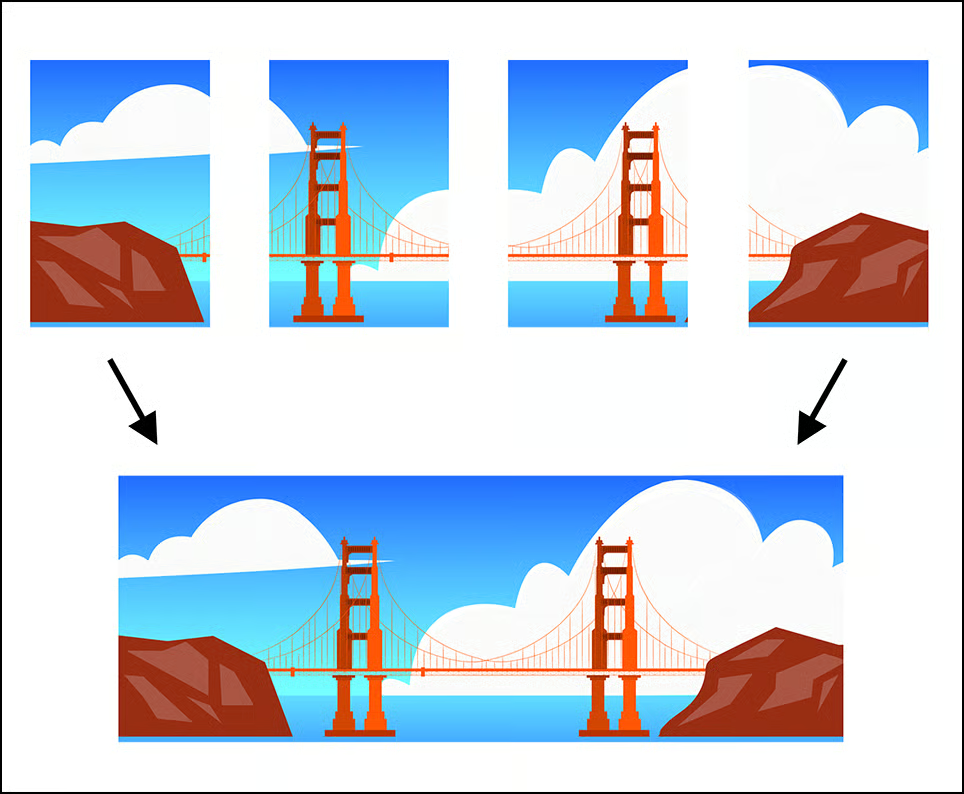
- Capture sequence: For a single-row, shoot 8 frames at 45° yaw increments with 20–30% overlap, then a zenith (point up) and a nadir (point down). For a cleaner nadir, offset the tripod slightly and shoot an extra patch frame.
HDR / High Dynamic Range Interiors
- Bracketing: Use AEB at ±2 EV (3 shots) or ±2 EV with 5 frames for extreme contrast. Keep aperture constant (e.g., f/8), vary shutter speed, and keep ISO low (100–200).
- Lock WB and picture style: Prevents bracket-to-bracket color drift. Shoot RAW for maximum latitude.
- Sequence discipline: For each pano angle, fire the full bracket before rotating to the next click-stop.
Low-Light / Night Scenes
- Stability first: Use a solid tripod and turn off IBIS when on a tripod to avoid sensor micro-movements. The R5 is very clean up to ISO 800–1600, but prefer longer exposures at ISO 100–400 for best quality.
- Aperture choices: f/4–f/5.6 to balance shutter speed and edge sharpness. The 14mm GM is excellent even wide, but stopping down improves corners.
- Trigger: Use a remote or 2s timer. Consider EFCS (electronic first-curtain) to reduce vibration; avoid full electronic shutter under artificial lights to reduce banding risk.
Crowded Events
- Two-pass strategy: First pass for framing; second pass waiting for gaps in foot traffic for key frames.
- High shutter speed: 1/200 s or faster helps freeze movement. Later, blend frames or mask moving subjects in post.
- Mind overlap: Increase overlap to ~30–35% to give your stitcher more options for control points amid motion.
Special Setups (Pole / Car / Drone)
- Pole: Keep the system as light as possible. Use guy lines in wind and a spotter. Rotate slower, and consider shooting at faster shutter speeds to mitigate sway.
- Car mounts: Only on closed sets or legal locations. Keep speeds low, stabilize the mount, and shoot at 1/500 s+ if handholding is involved.
- Drone: Not applicable with this combo, but the same principles of overlap and exposure locking apply.
Recommended Settings & Pro Tips
Exposure & Focus
| Scenario | Aperture | Shutter | ISO | Notes |
|---|---|---|---|---|
| Daylight outdoor | f/8–f/11 | 1/100–1/250 | 100–200 | Lock WB to Daylight or a Kelvin value; avoid polarizers (uneven skies at 14mm) |
| Low light/night | f/4–f/5.6 | 1/30–1/60 (or longer on tripod) | 400–800 | Tripod + remote; turn off IBIS on tripod |
| Interior HDR | f/8 | Bracket ±2 EV (3–5 frames) | 100–400 | Protect window highlights; keep WB locked |
| Action / moving subjects | f/5.6–f/8 | 1/200+ | 400–800 | Freeze motion, shoot two passes for clean plates |
Critical Tips
- Manual focus at hyperfocal: At 14mm and f/8, set focus around ~1 m to keep everything from roughly 0.6 m to infinity sharp.
- Nodal calibration: Start with the camera’s sensor-plane mark (⌀) as reference. For many rectilinear 14mm primes, the entrance pupil lies roughly 60–80 mm in front of the sensor plane—fine-tune with the near/far line-up test. Mark your rail for fast repeatability.
- White balance lock: Essential for consistent color; auto WB can shift between frames and complicate blending.
- RAW benefits: The R5’s RAW files offer ample headroom for highlight recovery and color grading—highly recommended for HDR panorama workflows.
- IBIS: Disable on tripod. If you must shoot handheld, enable IBIS and shoot faster (1/200 s+) to reduce inter-frame shifts.
- Lens corrections: For rectilinear lenses, leave in-camera corrections off for consistency; apply lens profile in PTGui/Hugin/Lightroom during stitching.
- Filters: Avoid CPLs for full 360 skies—polarization is uneven with ultra-wide FOV. ND is rarely needed unless balancing motion or light trails.
Stitching & Post-Processing
Software Workflow
Import RAWs and apply consistent lens profile and WB. For HDR, first merge brackets per angle (Lightroom, Photoshop, or HDRMerge) before stitching. Stitch in PTGui or Hugin using rectilinear lens parameters; use 20–30% overlap control points for best results. Rectilinear 14mm needs more frames than a fisheye but avoids fisheye defishing artifacts at the edges—ideal for architecture. Typical overlaps: ~25–30% for wide rectilinear. After stitch, set horizon, and export as equirectangular (2:1) for VR platforms. For a detailed look at PTGui’s capabilities, see this review. PTGui deep dive (Fstoppers)
If you want a broader background on maximizing spherical resolution from your camera and lens combination, this reference is helpful. Panotools: DSLR spherical resolution
Cleanup & Enhancement
- Nadir cleanup: Shoot a patch frame and use PTGui Viewpoint correction or clone/heal in Photoshop; AI-powered object removal can speed this up.
- Color and noise: Apply gentle noise reduction at ISO 800+; keep color balance uniform across the sphere.
- Horizon leveling: Use pitch/yaw/roll adjustments to lock a straight horizon; check verticals in architectural shots.
- Export: Common outputs include 16384×8192 JPEG (8K) or higher if the frame count supports it. For interactive tours, export tiled pyramids or 2:1 equirectangular.
Video: Head Setup and Capture Flow
Watching a concise demonstration is often the fastest way to cement the workflow:
Also see this principles-first guide to perfect panoramic head setup for consistent, high-quality 360 photos. Panoramic head setup principles (Meta/Oculus)
Useful Tools & Resources
Software
- PTGui panorama stitching
- Hugin (open-source) for stitching
- Lightroom / Photoshop for RAW and cleanup
- AI tripod removal tools (e.g., Generative Fill, Content-Aware)
Hardware
- Panoramic heads: Nodal Ninja, Leofoto, Sunwayfoto
- Carbon fiber tripods with leveling bases
- Wireless remote shutters and L-brackets
- Pole extensions and car mounts with safety tethers
Disclaimer: Product names are for reference; check manufacturers’ sites for compatibility and latest specifications.
Common Mistakes & How to Avoid Them
- Parallax error: Misaligned entrance pupil leads to stitching ghosts—calibrate your pano head carefully.
- Exposure flicker: Auto exposure or auto WB between frames causes banding and seams—lock both.
- Tripod/nadir artifacts: Always capture a nadir patch or plan to clone in post.
- Ghosting in crowds: Shoot multiple passes and mask; increase overlap for reliable control points.
- Night noise: Keep ISO modest (100–800) and extend shutter on tripod for cleaner files.
- Flare at 14mm: Use your body or a flag to shade the front element; reposition to avoid direct light sources when possible.
Field-Proven Scenarios
Indoor Real Estate (Bright Windows)
Mount the R5 on a panoramic head in the center of the room. Shoot 8 around + zenith + nadir with 3–5 shot brackets at ±2 EV. Keep ISO 100–200 and aperture at f/8. Merge HDR per angle, then stitch. Expect clean window detail with natural interior tones.
Outdoor Sunset Landscape
Expose for the sky to hold color; shoot at f/8, 1/125 s, ISO 100–200. Use 8 around + zenith (nadir optional if foreground matters). The R5’s DR recovers shadows well, but if the sun is in-frame, consider a 3-shot bracket per angle for insurance.
Rooftop on a Pole
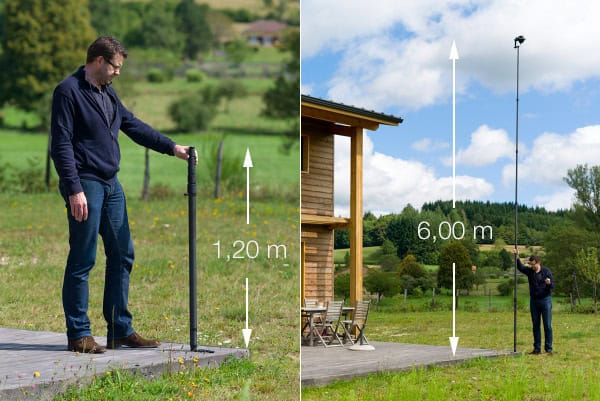
Keep the kit minimal and balanced; tether the pole. Use faster a shutter (1/250–1/500 s) at ISO 200–400, f/5.6–f/8. Rotate slowly and steadily. Shoot a second pass to ensure you have clean frames in case of sway.
Car-Mounted Capture
Only where legal and safe. Use a rigid mount, 1/500–1/1000 s shutter, and plan for stitching challenges from parallax due to motion. It’s often better to stop the car and shoot static, then move to the next location.
Adapter & Compatibility Notes
The Sony FE 14mm f/1.8 GM is a Sony E-mount lens. Canon RF bodies like the EOS R5 require an electronic E-to-RF adapter to control aperture and report EXIF. Such adapters are uncommon and may have limited support for AF/IBIS data. If using one:
- Test aperture control and confirm EXIF before critical shoots.
- If AF is unreliable, use manual focus and magnification to set hyperfocal.
- Disable IBIS on tripod to avoid micro-shifts; if the adapter doesn’t communicate focal length, IBIS may behave unpredictably.
If an adapter is not available, consider Canon RF 14–35mm f/4L or RF 15–35mm f/2.8L, or a native RF 14mm prime. The techniques in this guide apply equally to any rectilinear 14mm on full frame.
Frequently Asked Questions
- Can I shoot handheld panoramas with the Canon EOS R5?
Yes, for partial panoramas and quick 360s in bright light. Use 1/200 s or faster, IBIS on, and keep overlap generous (30–40%). For critical work, a tripod and panoramic head are far more reliable.
- Is the Sony FE 14mm f/1.8 GM wide enough for a single-row 360?
For full spherical coverage, plan 8 around plus a zenith and a nadir (about 10 frames). Two rows of 8 improves zenith/nadir coverage and edge quality, especially for architectural scenes.
- Do I need HDR for interiors with bright windows?
Usually yes. The R5 has strong DR, but windows can be 6–10 stops brighter than interiors. Use ±2 EV bracketing (3–5 frames) at each angle for clean window detail and balanced interiors.
- How do I avoid parallax issues?
Calibrate your panoramic head so the rotation axis passes through the lens’s no-parallax point. Use the near/far alignment test and mark your rail once dialed in. Increase overlap if shooting near objects.
- What ISO range is safe on the R5 in low light?
ISO 100–800 is very clean; up to 1600 is still good with mild noise reduction. On a tripod, prefer longer shutter times at ISO 100–400 for best quality.
- Can I save pano settings to Custom Modes (C1/C2)?
Yes. Store Manual exposure, MF, WB lock, EFCS, and drive mode in C1/C2 for quick recall, plus bracketing parameters for HDR in another custom slot.
- Will lens flare be a problem at 14mm?
It can be. Shade the lens, avoid direct point light sources when possible, and consider slight framing offsets to place the sun near a stitch seam where it’s easier to manage.
- Best panoramic head for this setup?
Choose a sturdy multi-row head with precise scales (e.g., Nodal Ninja, Leofoto). A leveling base speeds setup and ensures repeatability, which is crucial at 14mm where even small misalignments matter.
Safety, Data Integrity, and Workflow Confidence
Always weigh down your tripod outdoors, tether poles, and mind surroundings (traffic, rooftops, crowds). Clean the front element often—ultra-wide lenses reveal smudges. For data protection, shoot to dual cards, keep a second pass of critical scenes, and back up to a laptop or SSD on-site when possible.
For additional background and best practices, these resources reinforce industry standards and techniques: DSLR/mirrorless virtual tour guide (360Rumors) and StackExchange: techniques for 360 panoramas.