
Why This Camera & Lens Are Great for Panoramas
The Canon EOS R5 paired with an ultra‑wide rectilinear zoom like the Sony FE 12–24mm f/4 G gives you huge coverage, high resolving power, and excellent image quality for multi‑row 360° panoramas. The R5’s 45MP full‑frame sensor (36×24 mm) delivers fine detail and strong dynamic range at base ISO, while its Dual Pixel AF II makes prefocusing fast. The pixel pitch is approximately 4.4 µm, which balances acuity and noise performance; expect clean files at ISO 100–400 and very usable results through ISO 800 when exposure is solid.
Important compatibility note: the Sony FE 12–24mm f/4 G is an E‑mount lens and cannot be natively adapted to Canon RF mount while retaining infinity focus and electronic control. In practice, you’ll either shoot this lens on a Sony body, or use an equivalent ultra‑wide on the EOS R5 (such as the RF 14–35mm f/4L IS USM at 14 mm, or the EF 11–24mm f/4L via EF‑to‑RF adapter). The techniques in this guide apply directly to the R5 with any rectilinear ultra‑wide; where focal length matters, we provide tested shot counts for 12 mm and how to adjust if you’re at 14–24 mm.
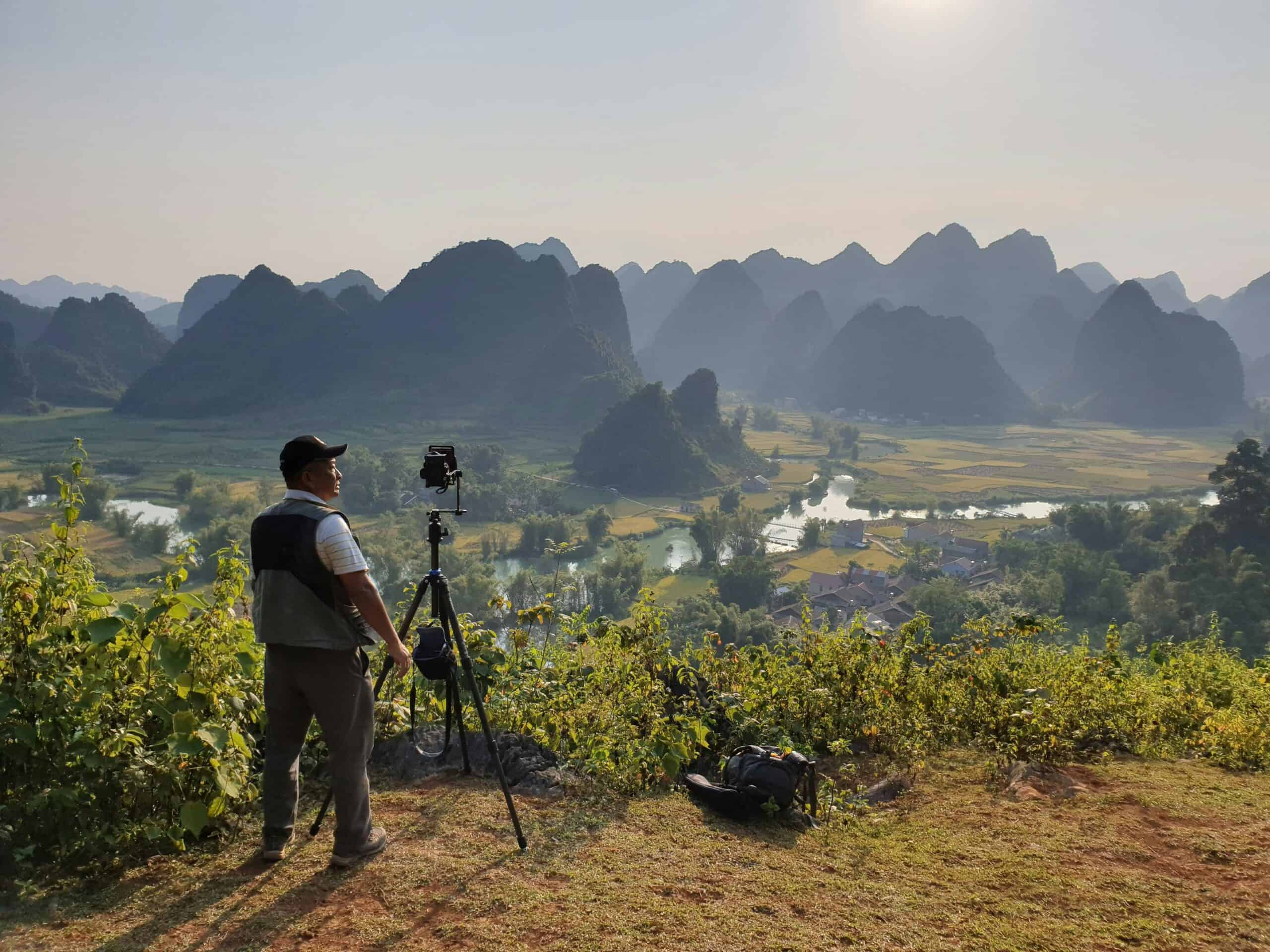
Why an ultra‑wide rectilinear? Compared to a fisheye, a rectilinear lens avoids the characteristic “bulging” distortion, which is helpful for architecture lines and real‑estate work. The trade‑off is you’ll need more frames to cover the sphere, but stitching can be cleaner at the edges and verticals remain straighter. The Sony 12–24mm f/4 G at 12 mm offers a ~112° horizontal field of view and ~90° vertical—ideal for efficient 3‑row shooting on a 45MP sensor.
Quick Setup Overview
- Camera: Canon EOS R5 — full‑frame 45MP (approx. 8192×5464), pixel pitch ~4.4 µm, base ISO DR ~13.5 EV, in‑body stabilization (IBIS), Dual Pixel AF II.
- Lens: Sony FE 12–24mm f/4 G — ultra‑wide rectilinear zoom; bulbous front element (no front filter thread), mild barrel distortion at 12 mm, best edge sharpness around f/8–f/11. Note: not natively compatible with RF mount; use an equivalent RF/EF ultra‑wide if shooting on R5.
- Estimated shots & overlap (tested):
- At 12 mm (FF rectilinear): 6 shots per row × 3 rows (−50°, 0°, +50°) + zenith + nadir = 20 frames per exposure. 25–30% overlap.
- At 14 mm: 8 shots per row × 3 rows + Z + N = 26 frames per exposure.
- At 24 mm: 10–12 per row × 3 rows + Z + N = 32–38 frames per exposure.
- Difficulty: Intermediate (easy with a calibrated panoramic head; challenging handheld).
Tip: If you need fewer frames, consider a fisheye prime (e.g., 8–10 mm) where you can often cover a sphere with 4–6 shots plus zenith/nadir. Rectilinear gives straighter lines but costs time in additional frames.
Planning & On-Site Preparation
Evaluate Shooting Environment
Start by reading the light and the motion. For interiors, note mixed lighting (tungsten, daylight through windows, LED strips). For exteriors, observe sun angle and potential flare—ultra‑wides are susceptible, especially with bulbous front elements. Check for reflective surfaces (glass, polished floors) and moving subjects (trees, people, vehicles). If shooting against glass, get the front element as close as safely possible (1–2 cm) and shade with a cloth or your hand to reduce reflections and ghosting.
Match Gear to Scene Goals
The EOS R5’s dynamic range is excellent at ISO 100–200; for interior windows vs. shadow, plan to bracket (±2 EV). The R5 handles ISO 400–800 well for static tripod work with careful exposure. At ultra‑wide rectilinear focal lengths (12–14 mm), you’ll capture more scene per frame with less distortion than at longer focal lengths. If you can’t mount the Sony 12–24/4 G on R5, the RF 14–35/4L at 14 mm is a near‑equivalent workflow—just account for a few more frames per row.
Pre-shoot Checklist
- Charge batteries; bring a spare. The R5’s high‑res sensor and IBIS can drain faster on long sessions.
- Use fast, redundant storage (dual cards). Back up to a portable SSD after the shoot.
- Clean lens and sensor; dust shows up across many frames.
- Calibrate your panoramic head for the lens’s no‑parallax (nodal) point; mark the rails for repeatability.
- Level your tripod with a leveling base; enable the R5 electronic level for quick checks.
- Safety: If on rooftops, near traffic, or on poles, tether your gear, mind wind loads, and never work near edges without approved fall protection.
- Backup workflow: Shoot a second safety round at the same settings in case of missed frames or motion ghosts.
Essential Gear & Setup
Core Gear
- Panoramic head: Allows rotation around the lens’s no‑parallax point to eliminate parallax errors when stitching. Use fore‑aft and vertical sliders to align the entrance pupil of the lens over the rotation axis.
- Stable tripod with a leveling base: A leveled platform lets you maintain constant pitch between frames and keep the horizon stable.
- Remote trigger or the Canon Camera Connect app: Prevents vibrations during long exposures and allows hands‑off shooting.

Optional Add-ons
- Pole or car mount: Use only with safety tethers. Wind loads increase dramatically with an ultra‑wide and panoramic head; rotate slowly to minimize vibration.
- Lighting aids: Small LED panels for dark interiors; avoid mixed color temperatures when possible.
- Weather protection: Rain covers and silica gel packs for humid conditions; the R5 is weather‑sealed but keep water off the lens front element.
Want a deeper dive on setting up a panoramic head? See this practical guide on entrance‑pupil alignment and head setup at the end of this paragraph. Set up a panoramic head for perfect 360 photos.
Step-by-Step Shooting Guide
Standard Static Scenes
- Level and center: Level the tripod using the leveling base; confirm with the R5’s electronic level. Ensure the rotation axis is exactly vertical.
- Align the nodal point: Slide the camera on the panoramic head rails until foreground and background objects do not shift relative to each other as you pan. Mark this position for 12 mm and any other focal lengths you use.
- Manual everything: Set the R5 to Manual exposure. Lock white balance (Daylight, Tungsten, or a custom Kelvin value) to prevent color shifts between frames. Turn off Auto Lighting Optimizer and HDR modes in‑camera.
- Focus: Use manual focus at or near the hyperfocal distance. At 12–14 mm and f/8–f/11, focusing ~1–1.5 m often keeps everything from ~0.6 m to infinity sharp. Use magnified live view or focus peaking to confirm.
- Capture sequence:
- At 12 mm: Shoot 3 rows, pitch at +50°, 0°, −50°, 6 frames per row (every 60°), then a zenith (+90°) and a nadir (−90°). 20 shots total.
- At 14 mm: Use 8 frames per row (every 45°). 26 shots total with Z/N.
- Nadir/Tripod removal: After the main set, offset the tripod slightly and shoot a clean ground patch for easier cloning later.
HDR / High Dynamic Range Interiors
- Bracketing: Use 3–5 frames at ±2 EV to handle bright windows and dark interiors. With the R5, AEB set to 5 brackets is efficient; keep shutter speed as the variable and hold aperture and ISO constant.
- WB consistency: Keep white balance locked; mixed WB across brackets is hard to unify during stitching.
- Sequence: Shoot all brackets per position before rotating to the next yaw. This keeps alignment tight and simplifies batch processing.
Low-Light / Night Scenes
- Exposure: Start at f/4–f/5.6, ISO 200–800, and adjust shutter to 1/10–1 s depending on scene. The R5 files are clean up to ISO 800 when exposed to the right.
- Stability: Turn off IBIS and any lens IS on a locked tripod to avoid sensor micro‑movement blur during long exposures. Use a 2 s self‑timer or remote.
- Sequence speed: Allow vibrations to settle after touching the camera; wait ~2 seconds before each frame.
Crowded Events
- Two passes: Do a fast pass to ensure full coverage, then a second pass waiting for cleaner gaps in traffic or people.
- Masking later: In PTGui/Hugin, use masking to choose the best frame for each region to avoid ghosting.
Special Setups (Pole / Car / Drone)
- Pole work: Use a lightweight panoramic head and keep the pole vertical. Tether the camera and rotate more slowly; consider electronic shutter to reduce vibration blur.
- Car-mounted: Use suction mounts rated for your load, tether everything, and shoot from a parked vehicle; rolling shots introduce motion parallax that is very difficult to stitch.
Recommended Settings & Pro Tips
Exposure & Focus
| Scenario | Aperture | Shutter | ISO | Notes |
|---|---|---|---|---|
| Daylight outdoor | f/8–f/11 | 1/100–1/250 | 100–200 | Lock WB to Daylight; protect highlights for cleaner skies |
| Low light/night | f/4–f/5.6 | 1/10–1 s | 200–800 | Tripod and remote; IBIS/IS off; expose to the right |
| Interior HDR | f/8 | Bracket ±2 EV | 100–400 | Balance windows and lamps; merge HDR per angle before stitching |
| Action / moving subjects | f/5.6–f/8 | 1/200+ | 400–800 | Freeze motion; double pass for clean masks |
Critical Tips
- Manual focus at hyperfocal: At 12–14 mm and f/8, ~1–1.5 m is a good starting point; verify with magnified live view.
- Nodal calibration: Place a near object (0.5–1 m) and a far object in line. Pan left/right; adjust fore‑aft on the rail until the near object stays aligned relative to the far object.
- White balance lock: Avoid AWB; use Kelvin or a preset matching the dominant light to ensure color consistency across the panorama.
- RAW capture: Shoot 14‑bit RAW for maximum dynamic range and color latitude; the R5’s files grade very well.
- Stabilization: Disable IBIS and lens IS when on a locked tripod to prevent micro‑blur during long exposures.
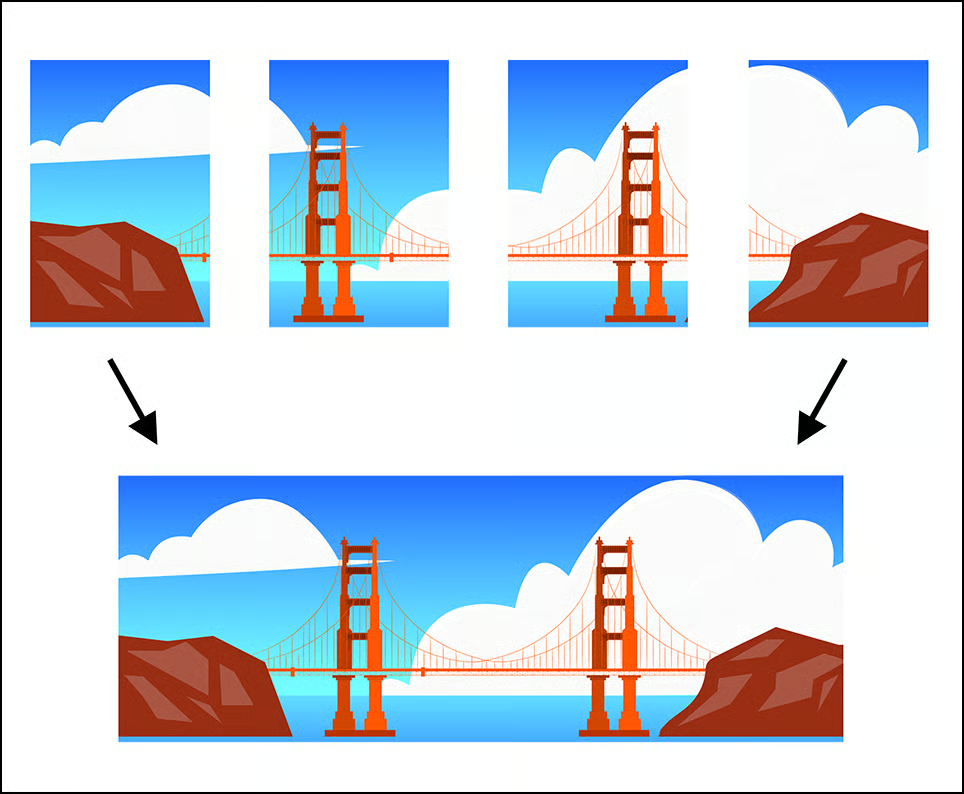
- Frame overlap: For rectilinear lenses, aim for 20–30% overlap horizontally and vertically. More overlap makes stitching easier but increases frame count.
Stitching & Post-Processing
Software Workflow
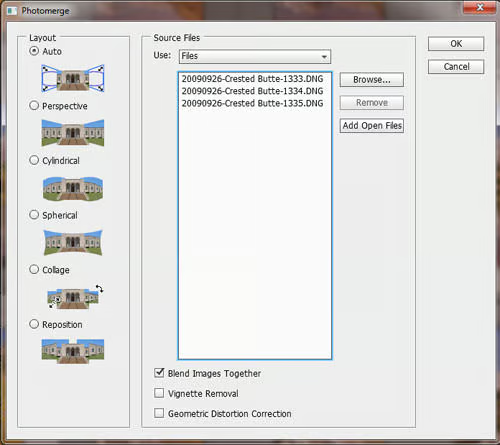
Industry‑standard tools include PTGui, Hugin, Lightroom/Photoshop, and Affinity Photo. With a rectilinear ultra‑wide, you’ll typically batch‑merge HDRs (if used) per angle, then stitch the resulting exposures. PTGui’s control point optimizer and masking tools are excellent for resolving parallax and moving objects. For reference on why PTGui is favored by many pros, see this review. PTGui: best tool for creating incredible panoramas.
Overlap guidance: Rectilinear lenses stitch well with 20–25% overlap; 25–30% is safer for complex scenes. Fisheye lenses need fewer shots but require careful defishing and have different overlap needs (typically 25–30%). For theoretical coverage vs. sensor resolution, this resource is gold. Panotools: DSLR spherical resolution.
Cleanup & Enhancement
- Nadir patch: Shoot a clean ground plate and blend it, or clone/Content‑Aware Fill the tripod footprint.
- Color and noise: Match white balance per row if needed, then apply global color correction. Use luminance noise reduction modestly at ISO 800+.
- Leveling: Use horizon tools to correct yaw/pitch/roll and ensure an accurate straight horizon in equirectangular output.
- Export: For VR, export an 8,192 px or 12,000 px wide equirectangular JPEG/TIFF depending on platform requirements. Oculus guidelines are a good reference for DSLR/ML workflows. Using a DSLR or mirrorless to shoot a 360 photo.
Disclaimer: Always consult the latest documentation for your stitching software; interface and features evolve.
Useful Tools & Resources
Software
- PTGui panorama stitching
- Hugin open source
- Lightroom / Photoshop
- AI tripod removal tools
Hardware
- Panoramic heads (Nodal Ninja, Leofoto, Really Right Stuff)
- Carbon fiber tripods with leveling bases
- Precision rail clamps and L‑brackets
- Wireless remote shutters
- Pole extensions / car mounts with safety tethers
Disclaimer: Product names are provided for search reference; verify compatibility and specifications with manufacturers.
For a hands‑on primer with gear selection and setup, this tutorial is worth bookmarking. Panoramic head tutorial and buying guide.
Common Mistakes & How to Avoid Them
- Parallax error: Caused by rotating around the wrong point. Solution: Calibrate and mark the no‑parallax (entrance pupil) position for your focal length.
- Exposure flicker: Using auto exposure or AWB. Solution: Manual exposure and locked white balance.
- Tripod shadows and footprints: Neglecting the nadir shot. Solution: Capture an offset ground plate and patch in post.
- Ghosting: Moving people, trees, or clouds across frames. Solution: Shoot quick sequences, take a second pass, and use masks in the stitcher.
- Night noise: Pushing ISO too high. Solution: Keep ISO ≤800 where possible and use longer shutter times on a solid tripod.
- Flare: Sun or strong point lights hitting the bulbous front element. Solution: Slightly adjust yaw/pitch to avoid direct hits; use your hand as a flag (outside the frame).
Frequently Asked Questions
- Can I shoot handheld panoramas with the Canon EOS R5?
Yes, for simple cylindrical panos, but for full 360×180° spheres with an ultra‑wide rectilinear, handheld is risky. You’ll get parallax and uneven pitch. Use a calibrated panoramic head for reliable, stitchable results.
- Is the Sony FE 12–24mm f/4 G wide enough for a single‑row 360?
No. At 12 mm rectilinear on full‑frame, VFOV is ~90°, so you can’t cover zenith and nadir in one row. Plan on 3 rows (−50°, 0°, +50°) plus dedicated zenith and nadir shots.
- Can I mount the Sony 12–24/4 G on my EOS R5?
Not natively. There is no mainstream adapter that preserves infinity focus and electronic control from Sony E‑mount lenses to Canon RF bodies. Use an RF‑mount ultra‑wide (e.g., RF 14–35/4L) or EF 11–24/4L via Canon’s EF‑to‑RF adapter for an equivalent workflow.
- Do I need HDR for interiors with bright windows?
Usually yes. Bracket ±2 EV (3–5 frames) to capture window highlights and dark interiors cleanly. Merge HDR per angle first, then stitch.
- What ISO range is safe on the R5 in low light?
For tripod‑based panoramas, ISO 100–400 is ideal; ISO 800 is still very clean when exposed properly. If you must go higher, prioritize ETTR and noise‑reduction in post.
- Can I set custom modes for pano on the R5?
Yes. Save Manual exposure, manual focus, WB lock, drive mode (self‑timer or remote), and IBIS off into C1/C2. You’ll be ready to shoot in seconds on location.
Field Notes & Mini Case Studies
Indoor Real Estate (Mixed Lighting)
Set WB to 4000–4500K when daylight mixes with warm interior bulbs; bracket ±2 EV at f/8, ISO 100–200, and control reflections by shading the lens near glass. At 14 mm (RF 14–35), use 8 frames per row × 3 rows, plus zenith/nadir. Keep the camera height ~1.3–1.5 m for natural perspective.
Outdoor Sunset (High Contrast)
To retain sky color, meter for the highlights (zebra warnings help) at ISO 100–200, f/8–f/11. Use 3–5 shot brackets if the foreground is dark. Watch for flare at 12–14 mm; slight yaw adjustments can save the shot.
Event Crowds (Motion Management)
Shoot a rapid base set at 1/200 s, f/5.6–f/8, ISO 400–800 to freeze people, then wait for gaps and reshoot problem sectors. Use PTGui masks to select frames with the cleanest subject positions.
Safety, Data Integrity, and Backup Workflow
Always tether gear on rooftops, poles, or over railings. In wind, lower your profile, shorten the center column, and add weight to the tripod. For cars, use redundant suction mounts and a safety line—shoot stationary for stitching sanity. After each location, back up to a portable SSD and keep the card contents until the project is delivered. Consider shooting a second full pano as a backup; it costs minutes and can save a reshoot.
Visual Examples
Further Reading
Best practices and community knowledge on 360 shooting are deep. For additional angles and gear recommendations, this overview is helpful. DSLR/mirrorless virtual tour FAQ and gear guide.
