
Why This Camera & Lens Are Great for Panoramas
The Canon EOS R5 paired with the Samyang 8mm f/3.5 UMC Fish-Eye CS II is a surprisingly capable combo for high-quality 360° panoramas when you understand how to set it up. The R5’s 45MP full-frame sensor (36×24 mm) delivers excellent detail, roughly 14 stops of dynamic range at ISO 100, and low noise up to ISO 800–1600. With a pixel pitch of about 4.39 µm and 14-bit RAW files, it holds shadows well for HDR panoramas and retains fine texture that survives stitching and sharpening.
The Samyang 8mm f/3.5 CS II is a manual-focus diagonal fisheye designed for APS-C. Adapted to the R5 via an EF–RF adapter, you have two practical ways to use it:
- Crop mode (APS-C / 1.6×): The R5 can shoot in 1.6× crop, yielding approximately 17.5MP images. In this mode, the Samyang behaves as intended (diagonal fisheye with ~180° diagonal FOV), producing clean edges and consistent coverage for stitching. This is the recommended, no-drama workflow.
- Full-frame circular technique (advanced): With the hood removed, you can capture a near-circular image on full-frame. This enables 3–4 shots around to cover a sphere, but requires careful calibration and post-processing due to heavy vignetting and edge falloff. It’s fast but less forgiving.
Why fisheye? Fisheyes massively reduce the number of frames needed for a full 360°, speeding up capture and cutting down on stitching seams. Distortion is expected and handled by pano software; your job is to ensure good overlap and zero parallax. The Samyang’s UMC coatings help with flare and chromatic aberration, and the lens is sharpest around f/5.6–f/8. Manual focus is an advantage for panoramas—set it to hyperfocal and forget it.
Quick Setup Overview
- Camera: Canon EOS R5 — Full-frame 45MP, ~14 EV DR at base ISO, Dual Pixel AF II, 5-axis IBIS (disable on tripod), 14-bit RAW.
- Lens: Samyang 8mm f/3.5 UMC Fish-Eye CS II — diagonal fisheye (APS-C design), manual focus/aperture, best sharpness at f/5.6–f/8, moderate edge CA controlled by stopping down.
- Mounting: EF–EOS R adapter required. If your lens/adapter has no electronics, enable “Release shutter w/o lens.”
- Estimated shots & overlap (tested):
- Crop mode (1.6×): 6 around at 60° yaw increments + zenith + nadir (30–35% overlap). Indoors or tight spaces: 8 around at 45° for safer seams.
- Full-frame circular method: 3–4 around at 90–120° + optional zenith + nadir (advanced; requires precise calibration).
- Difficulty: Intermediate (easy in crop mode; advanced for circular full-frame).
Planning & On-Site Preparation
Evaluate Shooting Environment
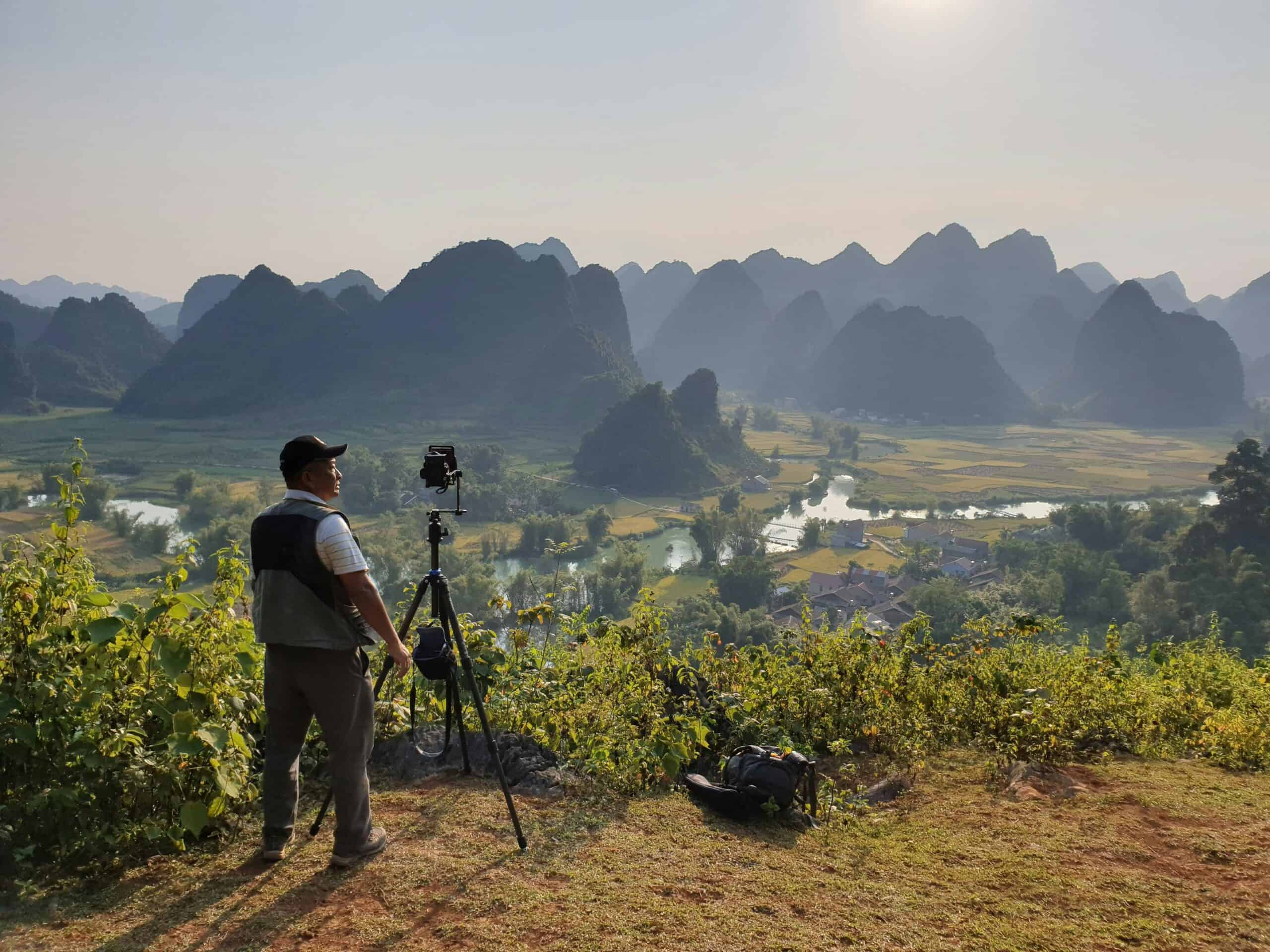
Walk the scene to anticipate challenges: reflective glass, glossy floors, moving crowds, and bright windows. If shooting near glass, get as close as safely possible (within 5–10 cm) and shoot perpendicular to minimize reflections; block stray light with your body or a flag. Watch the sun’s angle with a fisheye—backlight can cause halos and veiling flare. For outdoor sunset panoramas, plan for fast capture to keep light consistent across frames.
Match Gear to Scene Goals
The R5’s dynamic range and color depth make it excellent for HDR interior panoramas and twilight scenes. It’s safe to use ISO 100–800 for most static panoramas; ISO 1600 remains usable for darker scenes if you expose to protect shadows, while 3200 is acceptable with careful noise reduction. The Samyang 8mm fisheye reduces shot count and speeds up capture—a big win in changing light or crowds—but remember that you’re trading for strong distortion that must be corrected in software. On interiors with straight lines, precise nodal alignment and consistent exposure are key to clean stitches.
Pre-shoot Checklist
- Charge batteries and bring spares. Clear and format high-speed cards.
- Clean lens and sensor; fisheyes see everything—dust becomes a headache when cloning.
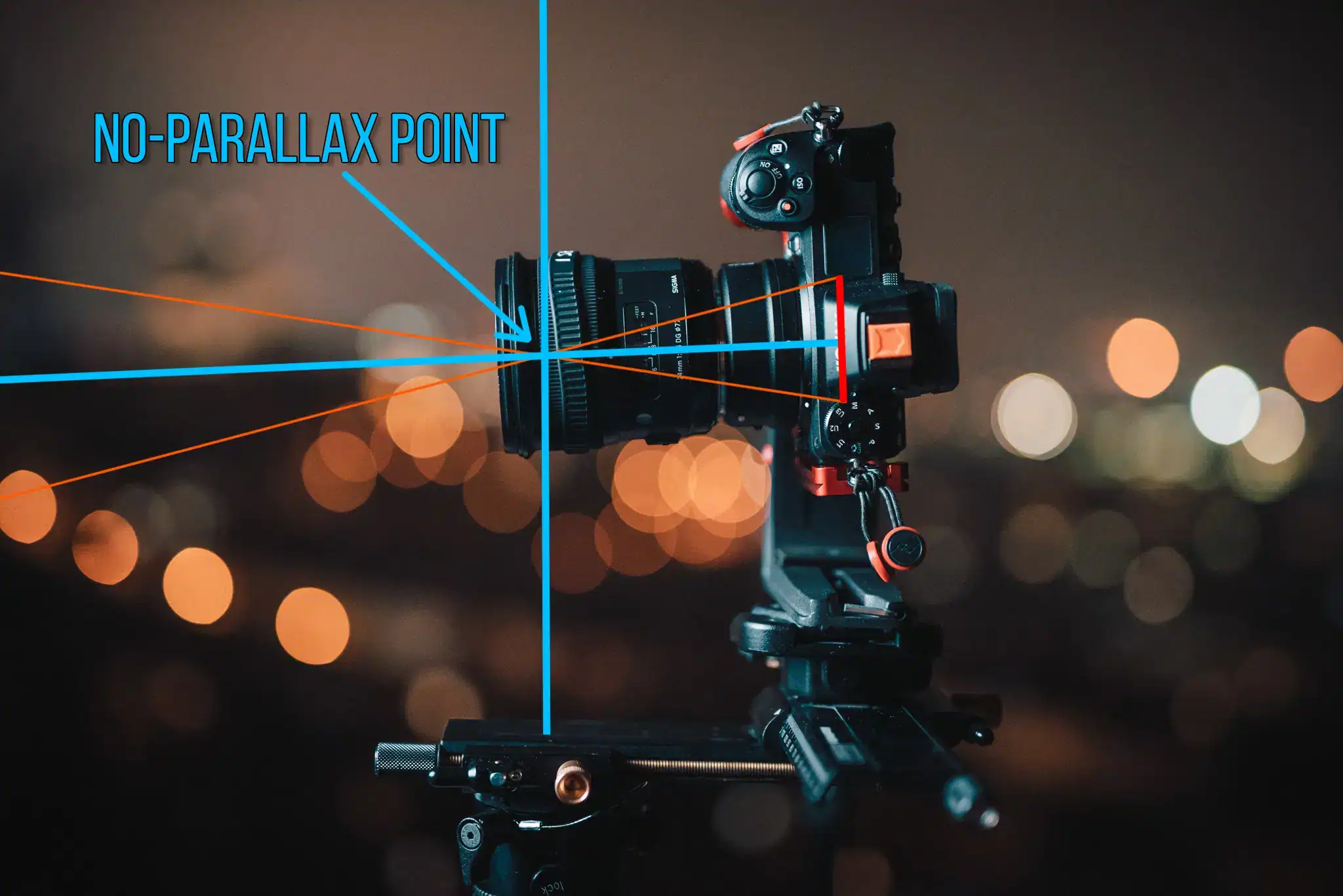
- Level your tripod; calibrate your panoramic head for the entrance pupil (no-parallax) point.
- Enable crop mode if you want the standard diagonal fisheye workflow. Otherwise, remove the hood and plan a circular workflow.
- Safety: assess wind on rooftops and poles, use a tether on car mounts, and keep weight centered over tripod legs.
- Backup workflow: shoot a second pass if time allows; it’s the cheapest insurance you can buy.
Essential Gear & Setup
Core Gear
- Panoramic head: Allows rotation around the entrance pupil to eliminate parallax, which is critical when foreground objects are near. A two-axis head with precise fore/aft and left/right adjustments is ideal.
- Stable tripod with a leveling base: Level once at the base so the head’s yaw rotation stays exactly horizontal. This reduces stitching errors and horizon tilt.
- Remote trigger or Canon Camera Connect app: Avoids vibration and lets you shoot brackets quickly. Consider EFCS (electronic first curtain shutter) to reduce shutter shock.
Optional Add-ons
- Pole or car mount: Use a safety tether. Watch vibration; use faster shutter speeds (1/250+) and consider electronic shutter only in daylight to avoid banding from LED signage.
- Lighting aids: Small LED or flash to lift dark corners in real estate; keep lighting consistent across frames.
- Weather protection: Rain cover and lens cloths; fisheyes are extra prone to raindrops and flare.
Learn more about dialing in a panoramic head setup in this concise guide from the field-tested panoramic community: Panoramic head tutorial.
Step-by-Step Shooting Guide
Standard Static Scenes
- Level the tripod and align nodal point. Slide the camera along the pano head’s rails until foreground and background features align without shifting while you pan. Mark those rail positions for this camera/lens combo. As a starting point for an 8mm fisheye, the entrance pupil is typically near the front element—expect the upper rail position to be relatively forward.
- Set manual exposure and lock white balance. Choose RAW, Disable Auto ISO, set WB to Daylight/Tungsten as appropriate, and turn off IBIS on a tripod to prevent micro-blur from sensor movement. Use EFCS to minimize vibration.
- Capture the set with the right overlap:
- Crop mode (recommended): 6 shots around at 60° yaw, tilt 0°. Then one zenith (tilt +90°) and one nadir (tilt –90° or shoot the ground patch later).
- Full-frame circular (advanced): 3 or 4 shots around at 120° or 90° yaw. Add a hand-held nadir patch after moving the tripod. Plan extra overlap due to edge falloff.
- Take a nadir shot for tripod removal. Move the tripod aside, place the camera roughly over the same point hand-held, and shoot the floor with matching exposure and WB.
HDR / High Dynamic Range Interiors
- Bracket ±2 EV (3 or 5 frames) to balance bright windows and dark corners. On the R5, keep base ISO 100–200 to maximize dynamic range.
- Lock WB and focus; do not change focus between brackets or frames. Consider using AE bracketing with a 2-second timer or remote for vibration-free sequences.
Low-Light / Night Scenes
- Use f/4–f/5.6 with longer shutters; ISO 400–800 is a safe working range on the R5. For static cityscapes on a sturdy tripod, 1–4 seconds per frame is fine; just keep exposure identical across the pano.
- Use a remote trigger. Turn off IBIS on tripod and use EFCS. If lights flicker (LED signage), avoid electronic shutter; use mechanical/EFCS.
Crowded Events
- Shoot two passes: first quickly to lock the whole scene, then a second pass waiting for gaps in motion. This gives you clean plates for masking in post.
- Use faster shutter speeds (1/200–1/500) and bump ISO to 800–1600 if needed. Consistency beats perfection—keep exposure and WB locked.
Special Setups (Pole / Car / Drone)
- Secure everything and tether your gear. Keep the pole vertical and rotate slowly between frames; wind pressure adds sway and blur.
- Car mounts love vibration. Use 1/250–1/1000 shutter and consider more overlap (e.g., 8 around) to hedge against motion blur and misalignment.
Recommended Settings & Pro Tips
Exposure & Focus
| Scenario | Aperture | Shutter | ISO | Notes |
|---|---|---|---|---|
| Daylight outdoor | f/8–f/11 | 1/100–1/250 | 100–200 | Lock WB to Daylight; IBIS off on tripod |
| Low light/night | f/4–f/5.6 | 1/30–4s (tripod) | 400–800 | Remote trigger; avoid electronic shutter under LED lights |
| Interior HDR | f/8 | Bracket ±2 EV | 100–400 | Balance windows and lamps; keep WB fixed |
| Action / moving subjects | f/5.6–f/8 | 1/200+ | 400–800 | Freeze motion; consider two-pass capture for masking |
Critical Tips
- Focus: Set manual focus slightly past 1 m and stop to f/8; at 8mm this covers near-to-infinity. Confirm with magnified live view.
- Nodal calibration: Place a near object and a distant object aligned in the frame. Pan left/right; adjust fore/aft until alignment holds with no relative shift. Mark your rail for repeatability.
- White balance: Lock it. Mixed lighting across frames is the top cause of visible seams.
- RAW over JPEG: Gives you latitude for HDR merges, exposure blending, and color correction. The R5’s 14-bit RAW files grade beautifully.
- IBIS and stabilization: Turn off on tripod. For pole/car, leave IBIS on and use faster shutter speeds.
Stitching & Post-Processing
Software Workflow
PTGui and Hugin are the gold standards for fisheye stitching. Import your frames, specify lens type as Fisheye, and set overlap to around 30%. For crop-mode shooting, you’ll typically do 6+2 (around + zenith + nadir). For circular full-frame shooting, enable circular masks and carefully crop the usable region. Industry practice is ~25–35% overlap for fisheyes and ~20–25% for rectilinear lenses. See this in-depth review of PTGui’s strengths for complex panoramas: PTGui review on Fstoppers.
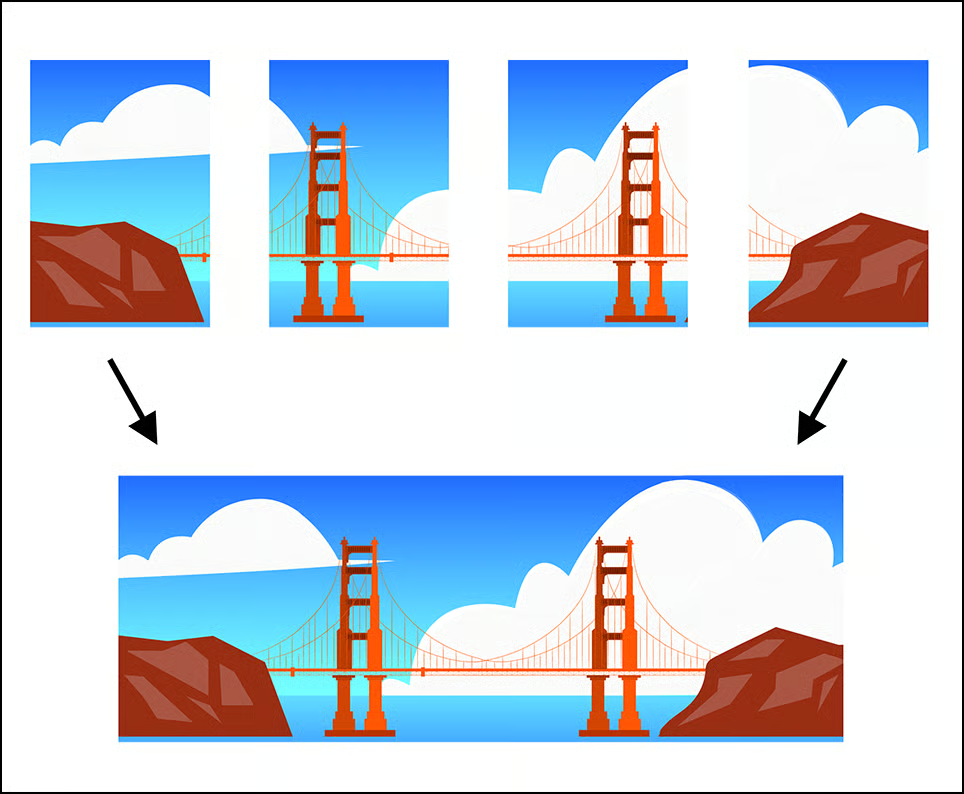
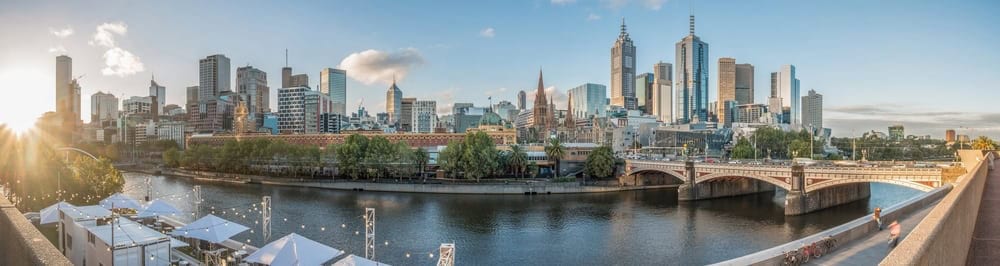
If you’re delivering to VR platforms, export an equirectangular 2:1 image (e.g., 8192×4096 or 10,000×5,000 px for higher fidelity). A 16-bit TIFF master lets you retouch before converting to an 8-bit JPEG for delivery. For more on a DSLR/mirrorless to 360 workflow, this guide is a clear primer: Using a DSLR or mirrorless to shoot and stitch a 360 photo.
Cleanup & Enhancement
- Nadir patch: Use a hand-held nadir plate, AI-based tripod removal, or manual clone/heal.
- Color consistency: Equalize white balance across blended brackets before stitching; fix any exposure drift.
- Geometry: Level the horizon, then fine-tune yaw/pitch/roll so verticals are vertical in the equirectangular output.
- Noise reduction: Apply lightly; fisheye edge detail can look smeared if overdone. Use masked NR in deep shadows only.
- Export targets: 8K–12K wide for premium tours; 6K for general web; deliver compressed JPEGs with quality 80–90.
For deeper reading on planning resolution versus coverage for spherical output, the community-maintained reference is helpful: DSLR spherical resolution (PanoTools Wiki). Always verify the latest software features in their official documentation.
Useful Tools & Resources
Software
- PTGui panorama stitching
- Hugin (open source)
- Lightroom / Photoshop
- AI tripod/nadir removal tools
Hardware
- Panoramic heads (Nodal Ninja, Leofoto, Sunwayfoto)
- Carbon fiber tripods with leveling base
- Wireless remote shutters
- Pole extensions / car suction mounts with safety tether
- EF–EOS R adapter for the Samyang
Disclaimer: product names for reference only. Check official sites for specs and compatibility.
For a wider overview of cameras and lenses for virtual tours, this FAQ is a solid starting point: Virtual tour camera & lens guide.
Common Mistakes & How to Avoid Them
- Parallax error: Always rotate around the entrance pupil and lock down your pano head adjustments.
- Exposure flicker: Manual mode only; lock WB and use identical exposure for every direction (except HDR brackets).
- Tripod shadows and the photographer in frame: Shoot a nadir patch and watch your own reflections on shiny surfaces.
- Ghosting from moving subjects: Do a second pass and mask in post, or increase shutter speed.
- High-ISO noise at night: Lower ISO and extend shutter on tripod; consider multi-shot noise reduction or exposure stacking.
- IBIS artifacts on tripod: Turn stabilization off to avoid subtle warping across frames.
Frequently Asked Questions
- Can I shoot handheld panoramas with the Canon EOS R5?
Yes, but expect more stitching errors. Handheld works outdoors with distant subjects and fast shutter speeds (1/250+). Indoors or with near foregrounds, use a tripod and pano head for zero parallax.
- Is the Samyang 8mm f/3.5 wide enough for a single-row 360?
In crop mode, yes: 6 shots around at 60° plus zenith and nadir reliably cover the sphere. In full-frame circular mode (advanced), 3–4 around may suffice, but edge quality and calibration become critical.
- Do I need HDR for interiors with bright windows?
Usually. Bracketing ±2 EV (3–5 shots) preserves both window detail and interior shadows. The R5’s dynamic range helps, but HDR keeps highlight roll-off clean and reduces banding in gradients.
- How do I avoid parallax issues with this combo?
Mount the camera on a calibrated pano head and align the entrance pupil. For the 8mm fisheye, the entrance pupil is close to the front element; slide the camera forward on the upper rail until near/far objects stay aligned while panning. Mark the rails for repeat use.
- What ISO range is safe on the EOS R5 in low light panoramas?
ISO 100–800 is ideal. ISO 1600 remains very usable with careful exposure; ISO 3200 is workable with good noise reduction. For static scenes, prefer longer shutters over very high ISO.
Field-Proven Use Cases
Indoor Real Estate
Use crop mode. Shoot f/8, ISO 100–200, bracket ±2 EV. 6 around + zenith + nadir. Keep WB consistent (Tungsten or Custom), and watch door frames for vertical alignment. Turn off ceiling fans to avoid motion artifacts across frames.
Outdoor Sunset Overlook
Work fast as light changes. Meter the brightest section you want to preserve, then lock exposure and shoot the set in a consistent rotation. Consider a second pass a minute later to blend a better sky if needed.
Event Crowds
Favor higher shutter speeds (1/200+) and ISO 800–1600. Do two passes; use the second for masking faces/ghosts. If possible, ask people nearby to hold still for a second while you rotate.
Rooftop Pole Shooting
Safety first. Use a guyline or a spotter. Shoot 8 around at 45° for more redundancy. Keep shutter 1/250+ to combat sway; IBIS on can help here.
Fast Workflow Checklist (Canon EOS R5 & Samyang 8mm f/3.5)
- Switch to 1.6× crop mode for the standard diagonal fisheye workflow.
- Manual: RAW, WB fixed, ISO 100–200 (or 400–800 in low light), IBIS off on tripod, EFCS on.
- Nodal alignment locked. Level the base.
- Capture: 6 around + zenith + nadir (bracketed if needed).
- Post: Merge HDR (if used) first, then stitch in PTGui/Hugin as fisheye. Export 8K–12K equirectangular TIFF > edit > final JPEG.
- Backup: Save RAW, PTGui project, and final masters to two locations.
Safety, Reliability, and Honest Limitations
The R5 is weather-sealed, but the Samyang’s manual aperture and focus rings aren’t. In rain, water can bead on the fisheye front element and ruin frames; keep a microfiber and a rain hood handy. On long poles or car mounts, always use a safety tether—do not rely on a single suction cup. Avoid electronic shutter under flickering LED lighting to prevent banding. Finally, remember that the Samyang is an APS-C lens: crop mode is the simplest, most reliable method; the full-frame circular approach is faster in the field but needs expert post-processing and excellent calibration to avoid stitching gaps or edge softness.
If you want a visual primer on high-end head setup for no-compromise quality, this step-by-step training is a great reference: Set up a panoramic head for perfect high-end 360 photos.