
Why This Camera & Lens Are Great for Panoramas
If you want to learn how to shoot panorama with Canon EOS R5 & Samyang 12mm f/2.8 ED AS NCS Fish-Eye, you’ve picked a powerful combo for both speed and quality. The Canon EOS R5’s 45MP full-frame sensor (36×24mm) delivers exceptional detail with approximately 4.39µm pixel pitch, strong base ISO dynamic range (around 14 stops at ISO 100), and reliable low-light performance. Pairing it with the Samyang 12mm f/2.8 fisheye (a full-frame, diagonal fisheye offering ~180° diagonal field of view) means you can cover the full sphere with fewer frames, speeding up capture and minimizing stitching errors from moving subjects. The R5’s IBIS and accurate electronic level help keep frames consistent; the Samyang’s manual-focus simplicity is perfect for locking focus at the hyperfocal distance and forgetting about it.
Because this is a diagonal fisheye, the edges will be curved—exactly what we want for efficient 360° capture. With correct nodal (entrance pupil) alignment on a panoramic head, parallax can be minimized for clean stitches indoors and out. The lens is available in Canon EF mount; adapted to the EOS R5 via EF–EOS R adapter, it performs reliably. For spherical panoramas, this setup balances speed (fewer shots) with high-resolution output suitable for VR tours, real estate, and creative 360 photos.
Quick Setup Overview
- Camera: Canon EOS R5 — Full-frame 45MP sensor (8192×5464), excellent DR at base ISO, IBIS up to ~8 stops (with compatible lenses), accurate electronic level, reliable manual exposure tools.
- Lens: Samyang 12mm f/2.8 ED AS NCS Fish-Eye — full-frame diagonal fisheye, manual focus, sharp from f/5.6–f/8, some vignetting wide open, moderate CA that corrects well in post.
- Estimated shots & overlap (field-tested):
- Fast capture: 6 around (60° yaw steps) + 1 zenith + 1 nadir.
- Higher quality: 8 around (45° steps) + zenith + 1–2 nadir frames.
- On a pole/monopod: 6 around; patch the nadir later.
- Difficulty: Intermediate — easy outdoors; careful nodal alignment needed for interiors.
Planning & On-Site Preparation
Evaluate Shooting Environment
Before setting up, scan for reflective glass, strong point lights, moving crowds, and wind exposure. Fisheyes are prone to flare; keep bright sources slightly off-axis when possible. If shooting through glass, get the front element as close as safely possible (1–3 cm) to reduce reflections and ghosting. For interiors with windows, expect extreme dynamic range—plan to bracket exposures.
Match Gear to Scene Goals
The EOS R5’s strong DR at ISO 100–200 and clean ISO up to ~800–1600 makes it versatile from daytime exteriors to darker interiors. The Samyang 12mm fisheye minimizes the number of shots—great for busy places where you need speed. The trade-off is fisheye distortion, but spherical stitching software accounts for that. Indoors, parallax sensitivity increases with near objects—precise nodal alignment is essential. Outdoors (landscape), you can get away with fewer frames and larger overlaps.
Pre-shoot Checklist
- Charge batteries and carry spares; use fast and redundant media (CFexpress + SD). Consider writing RAW to both cards for backup.
- Clean the lens and sensor; dust becomes very visible in skies and large gradients.
- Level the tripod and verify panoramic head calibration (nodal/entrance pupil alignment).
- Safety checks: weigh down the tripod in wind; use a safety tether on rooftops and poles; confirm car mounts and suction cups are rated and redundant.
- Workflow backup: When in doubt, shoot a second pass; bracketed sequences double as insurance.
Essential Gear & Setup
Core Gear
- Panoramic head: Allows rotation around the lens’s entrance pupil to eliminate parallax. For a fisheye, a compact two-axis head is often sufficient; mark your calibrated positions for repeatability.
- Stable tripod with leveling base: A leveling base makes fast, accurate leveling; even a small tilt can complicate stitching.
- Remote trigger or Canon Camera Connect app: Prevents vibrations during long exposures, especially at night or indoors.

Optional Add-ons
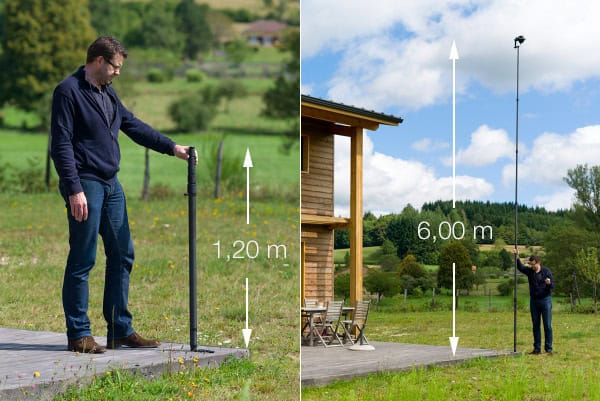
- Pole or car mount: For elevated or vehicle-based capture. Warning: wind and vibration can ruin frames; use a safety tether, drive slowly, and shoot at high shutter speeds.
- Lighting aids: LED panels or bounced flash for dim interiors if HDR is insufficient.
- Weather protection: Rain covers, lens hood, and microfiber cloths for drizzle or sea spray.
For deeper background on panoramic heads and nodal alignment, see this panoramic head setup tutorial (excellent fundamentals). Panoramic head tutorial by 360 Rumors
Step-by-Step Shooting Guide
Standard Static Scenes
- Level tripod and align the nodal point: On your pano head, slide the camera forward/back until near and far objects do not shift relative to each other as you pan. For a 12mm fisheye, the entrance pupil is typically near the front group—often around several centimeters forward of the mount—so expect the rail to be extended. Calibrate once and mark the rails for repeat use.
- Switch to manual exposure and lock white balance: Set Manual (M) mode and a fixed Kelvin WB (e.g., 5200–5600K daylight outdoors). Locking exposure and WB prevents flicker and color jumps that complicate stitching.
- Manual focus at hyperfocal: On full-frame at 12mm, the hyperfocal is roughly 0.6 m at f/8. Focus just past 0.6 m and turn off AF. Enable focus peaking if you like, but don’t refocus between shots.
- Capture with consistent overlap:
- 6 around at 60° yaw steps for speed; tilt slightly up (+5–10°) to help cover zenith, then take 1–2 dedicated zenith frames.
- Take 1–2 nadir shots by tilting down and/or offsetting the tripod for a clean ground patch.
- Record a nadir (ground) frame: If you need a clean floor, shoot a handheld nadir after moving the tripod, keeping the nodal point close to original position.
HDR / High Dynamic Range Interiors
- Bracket exposures ±2 EV (3 or 5 shots) at each pano position to balance interiors and bright windows. The R5’s base ISO files merge cleanly.
- Keep WB locked to avoid cross-frame shifts; shoot RAW for maximum latitude.
- Consider 6 around + zenith + nadir per bracket set. Use a remote to automate sequences.
Low-Light / Night Scenes
- Use a sturdy tripod and turn IBIS off for tripod work (prevents micro drift); aim for f/4–f/5.6 and ISO 400–800, lengthening shutter speed as needed (1–8s typical). The R5 remains clean through ISO 800–1600 if required.
- Use mirror lockup is irrelevant on mirrorless; instead, use the 2s timer or remote to avoid shake.
- Take an extra pass for safety in case of motion blur or wind gusts.
Crowded Events
- Shoot two passes: one fast pass to lock geometry, then a second pass patiently waiting for gaps in each tile.
- Mask moving people in post, favoring the clean frames from the second pass.
Special Setups (Pole / Car / Drone)
- Secure the gear with a safety tether. Keep rotations smooth and slower to maintain overlap. On a pole, 6 around is standard; avoid long exposures in wind.
- In car-mounted scenarios, increase shutter speed (1/250–1/1000) to counter vibration. Consider capturing at stops or very low speed.
Recommended Settings & Pro Tips
Exposure & Focus
| Scenario | Aperture | Shutter | ISO | Notes |
|---|---|---|---|---|
| Daylight outdoor | f/8–f/11 | 1/100–1/250 | 100–200 | Lock WB (daylight 5200–5600K); avoid f/16+ to limit diffraction on 45MP |
| Low light/night | f/4–f/5.6 | 1/30–8s | 400–800 | Tripod, remote; turn IBIS off; take a safety pass |
| Interior HDR | f/8 | Bracket ±2 EV | 100–400 | Merge brackets before stitching or let PTGui/Hugin handle stacks |
| Action / moving subjects | f/5.6–f/8 | 1/200+ | 400–800 | Faster shutter helps freeze people and flags |
Critical Tips
- Manual focus at hyperfocal: At 12mm, f/8 hyperfocal ≈ 0.6 m. Set once; do not refocus between frames.
- Nodal calibration: Find the entrance pupil by aligning near/far objects and panning; mark your rail settings for the R5 + adapter + Samyang 12mm combo.
- White balance lock: Mixed lighting can cause color shifts; a fixed Kelvin WB avoids headache in stitchers.
- RAW over JPEG: Recover highlights from windows and lift shadows without banding; the R5’s RAWs hold impressive detail.
- IBIS on/off: Leave IBIS on if handheld; switch it off on a tripod to avoid micro-drift during long exposures.
- Lens profile: In PTGui/Hugin, set lens type to fisheye; if unsure, calibrate or choose equisolid/equidistant model and optimize.
Real-World Case Studies
Indoor Real Estate (Bright Windows)
Mount the R5 on a leveled pano head. Use f/8, ISO 100–200, and bracket ±2 EV (3 or 5 frames). Shoot 6 around + zenith + nadir for full coverage. Merge HDR per angle, then stitch. Lock WB (e.g., 5000K) to prevent room-to-room shifts. Watch reflections in mirrors; step aside between frames to avoid being captured.
Outdoor Sunset (High Contrast)
Wind can pick up; weigh down the tripod. Use f/8, ISO 100, 6 around, and consider 3-frame brackets to preserve the sun’s highlight detail. Frame the sun at a consistent position per shot to avoid flare streaks. If you see flare in one tile, shoot an extra clean frame and swap it in during masking.
Event Crowds
Speed is everything. Use 6 around at f/5.6–f/8, ISO 400–800, and 1/200–1/500. Do a second pass to catch cleaner gaps in key tiles. During stitching, favor tiles with fewer moving subjects and mask accordingly.
Rooftop/Pole Shooting
Safety first: tether the pole, wear a harness if needed, and avoid gusty conditions. Use 6 around, 1/250–1/1000 sec, and ISO 400–800. Accept a slightly higher ISO to keep shutter fast and motion blur low. Patch the nadir afterwards.
Car-Mounted Capture
Use rated suction mounts and a secondary tether. Plan routes to avoid potholes. Shoot at 1/500–1/1000 with ISO raised as needed. Stop periodically to capture a stationary set for a cleaner base and blend moving sequences only where needed.
Stitching & Post-Processing
Software Workflow
For fisheye panoramas, PTGui and Hugin are industry standards. A diagonal fisheye simplifies alignment because each frame covers more FOV, and overlap around 25–35% is ideal. The typical workflow: import RAWs to Lightroom/Camera Raw for basic corrections (lens CA, exposure tweaks), export 16-bit TIFFs, then stitch in PTGui/Hugin. Set lens type to fisheye and let the optimizer refine. With the EOS R5’s 45MP frames and 6–8 shots around, expect final equirectangular widths in the 12k–16k px range depending on overlap and rows. For a structured primer on DSLR/mirrorless 360 workflows, see the official guide. Using a mirrorless camera to shoot and stitch a 360 photo (Meta)
Cleanup & Enhancement
- Nadir patch: Use a dedicated nadir shot or AI-based patching tools. Clone and heal in Photoshop when patterns allow.
- Color correction: Balance the sky and interiors; use graduated masks to unify tone across tiles. Apply gentle noise reduction for high-ISO tiles.
- Horizon leveling: Use the pitch/roll/yaw controls in PTGui/Hugin to level the horizon; verify in VR preview.
- Export formats: For VR platforms, export 8-bit or 16-bit equirectangular JPEG/TIFF at the platform’s recommended size. Keep a layered master for client revisions.
For a PTGui perspective and features review, this is a solid read. Fstoppers: PTGui review
If you’re curious about theoretical panorama resolution and planning frame counts, Panotools maintains a helpful reference. Panotools: DSLR spherical resolution
Video Walkthrough
Prefer to see it done? This video covers the general panorama process end-to-end and pairs well with the steps above.
Also see an in-depth nodal/rotator setup guide for high-end 360 capture. Set up a panoramic head (Meta)
Useful Tools & Resources
Software
- PTGui panorama stitching
- Hugin (open source) for fisheye and multi-row
- Lightroom / Photoshop for RAW processing and cleanup
- AI tools for tripod/nadir removal
Hardware
- Panoramic heads (e.g., Nodal Ninja, Leofoto)
- Carbon fiber tripods with leveling bases
- Wireless remotes or smartphone app triggers
- Pole extensions / car mounts with safety tethers
Disclaimer: product and brand names are for search reference. Check official sites for the latest specs and compatibility.
Common Mistakes & How to Avoid Them
- Parallax error: Always align the entrance pupil and keep the tripod level; recalibrate if you change adapters or plates.
- Exposure or color flicker: Use manual exposure and fixed Kelvin WB; avoid auto ISO and auto WB during a pano set.
- Tripod shadows and footprints: Plan nadir shots and patch later; rotate to keep your shadow behind the tripod.
- Ghosting from movement: Shoot two passes and favor the cleanest tiles; use masks in the stitcher.
- Nighttime noise: Keep ISO modest (400–800 on the R5 is very clean), rely on longer shutter and sturdy support instead of pushing ISO.
- Over-stopping down: On a 45MP sensor, diffraction softening creeps in beyond f/11; prefer f/8–f/10 for maximum sharpness.
Frequently Asked Questions
- Can I shoot handheld panoramas with the Canon EOS R5?
Yes, for quick outdoor 360s you can shoot 6 around handheld with the 12mm fisheye, but expect more stitching cleanup. Use high shutter speeds (1/200+), IBIS on, and keep a consistent rotation around your body’s center. A pano head still gives the best results, especially indoors.
- Is the Samyang 12mm f/2.8 wide enough for a single-row 360?
Yes. A diagonal fisheye at 12mm on full frame allows single-row capture (6–8 shots around) plus zenith/nadir. For speed, 6 around + Z + N works well; for maximum quality, 8 around + Z + N increases overlap and reduces edge stretching.
- Do I need HDR for interiors with bright windows?
Usually, yes. Even though the R5 has excellent dynamic range, window highlights often exceed a single exposure. Bracket ±2 EV (3 or 5 frames) at each position and merge before or during stitching to preserve both view and interior details.
- How do I avoid parallax issues with this setup?
Use a panoramic head and align the rotation axis with the lens’s entrance pupil. Calibrate by observing near/far objects while panning; adjust until there’s no relative shift. Mark your rail positions for the R5 + adapter + Samyang 12mm so you can repeat quickly.
- What ISO range is safe on the EOS R5 in low light?
ISO 100–400 is pristine; ISO 800 remains very clean. ISO 1600–3200 is still usable when needed. Prefer longer shutter on a tripod over very high ISO to maintain detail, especially for 45MP output.
- Can I set up Custom Shooting Modes (C1/C2) for pano?
Absolutely. Save manual exposure, fixed WB, single-shot drive, IBIS off (tripod), and MF to C1. Save a handheld pano profile (IBIS on, faster shutter) to C2. This speeds up field work.
- How do I reduce flare with a fisheye?
Avoid direct light sources near the frame edge; slightly recompose to keep the sun just outside the field during some tiles. Use your hand or a flag just out of frame to block stray light when necessary and shoot a clean replacement tile.
- What panoramic head works best?
A two-axis compact head with precise fore-aft and lateral adjustment is ideal (e.g., Nodal Ninja, Leofoto). Ensure it supports your camera’s weight and allows repeatable rail markings for the R5 + adapter + Samyang 12mm.
Safety, Reliability & Data Protection
In wind or on rooftops, always weigh down the tripod and use a tether. For pole and car mounting, employ redundant attachment points and check fasteners before every set. The EOS R5 is weather-sealed, but your adapted lens may not be; carry a rain cover. Back up in the field by writing RAWs to two cards; offload to a laptop or SSD between locations. A duplicate panorama pass is often the best insurance against stitching surprises.
Wrap-Up
That’s how to shoot panorama with Canon EOS R5 & Samyang 12mm f/2.8 ED AS NCS Fish-Eye for fast, high-quality 360° results. The R5’s 45MP sensor and the 12mm diagonal fisheye’s efficient coverage make an ideal pairing for virtual tours, landscapes, events, and elevated viewpoint shots. Master nodal alignment, lock exposure and WB, and keep a disciplined capture routine. With a good stitcher (PTGui/Hugin) and a clean nadir workflow, you’ll deliver professional panoramas consistently.
For additional reading on DSLR/360 best practices and lens/camera choices, this comprehensive resource is useful. DSLR/mirrorless 360 virtual tour FAQ
