
Why This Camera & Lens Are Great for Panoramas
The Canon EOS R5 and Nikon Z 14–24mm f/2.8 S are both top-tier tools for panoramic and 360° photography. The EOS R5 is a 45MP full‑frame mirrorless camera with a pixel pitch of about 4.4 μm and a base‑ISO dynamic range around 13.5–14 EV, giving you clean files, deep shadow recovery, and excellent color. Its in-body image stabilization (IBIS), sturdy build, and responsive controls make it a reliable pano workhorse. The Nikon Z 14–24mm f/2.8 S is among the sharpest rectilinear ultrawides available, with high corner sharpness, low coma and flare, and well-controlled chromatic aberration. At 14 mm on full frame, you get a diagonal field of view near 114°, which is great for single- and multi-row panos and for capturing tight interiors with fewer frames.
Important compatibility note: the Nikon Z 14–24mm f/2.8 S (Z mount) cannot be directly mounted or adapted to a Canon EOS R5 (RF mount) while preserving aperture and focus control. There is no mainstream electronic adapter that allows Z-mount lenses to function on RF bodies. To use this lens’ optical qualities for panoramas, consider two practical paths: 1) use an optically equivalent Canon RF or EF ultrawide (e.g., RF 14–35mm f/4 L IS, RF 15–35mm f/2.8 L IS, or EF 16–35mm f/4 L IS via EF–RF adapter) on your EOS R5; or 2) if you must use the Nikon Z 14–24 S specifically, capture on a Nikon Z body and follow the same stitching workflow described below. The rest of this tutorial focuses on how to shoot panorama with Canon EOS R5 & Nikon Z 14-24mm f/2.8 S in practice by applying the same field methods and shot plans you’d use with an equivalent 14–24 mm rectilinear lens on an R5.
Quick Setup Overview
- Camera: Canon EOS R5 — full-frame, 45MP, pixel pitch ~4.4 μm; excellent base-ISO DR (~13.5–14 EV), clean ISO 100–800 for pano work.
- Lens: Nikon Z 14–24mm f/2.8 S — rectilinear ultrawide zoom; sharp from f/4–f/8, very low coma, minimal CA, flare-resistant coating. On EOS R5 you’ll need an RF-mount ultrawide with similar FOV in practice.
- Estimated shots & overlap (full 360×180):
- At 14 mm rectilinear FF: 6–8 shots around (0°), + 6–8 at +45°, 1 zenith, 2–3 nadir with ~30% overlap. For speed: 6+6+Z+2N. For max quality: 8+8+Z+3N.
- At 18 mm: 8 around (0°), + 8 at +45°, 1 zenith, 2–3 nadir.
- At 24 mm: 10–12 around (0°), + 8–10 at +45°, + 6–8 at −45°, 1 zenith, 2–3 nadir.
- Difficulty: Intermediate — easy outdoors; more advanced in tight interiors due to parallax control and multi-row shooting.
Planning & On-Site Preparation
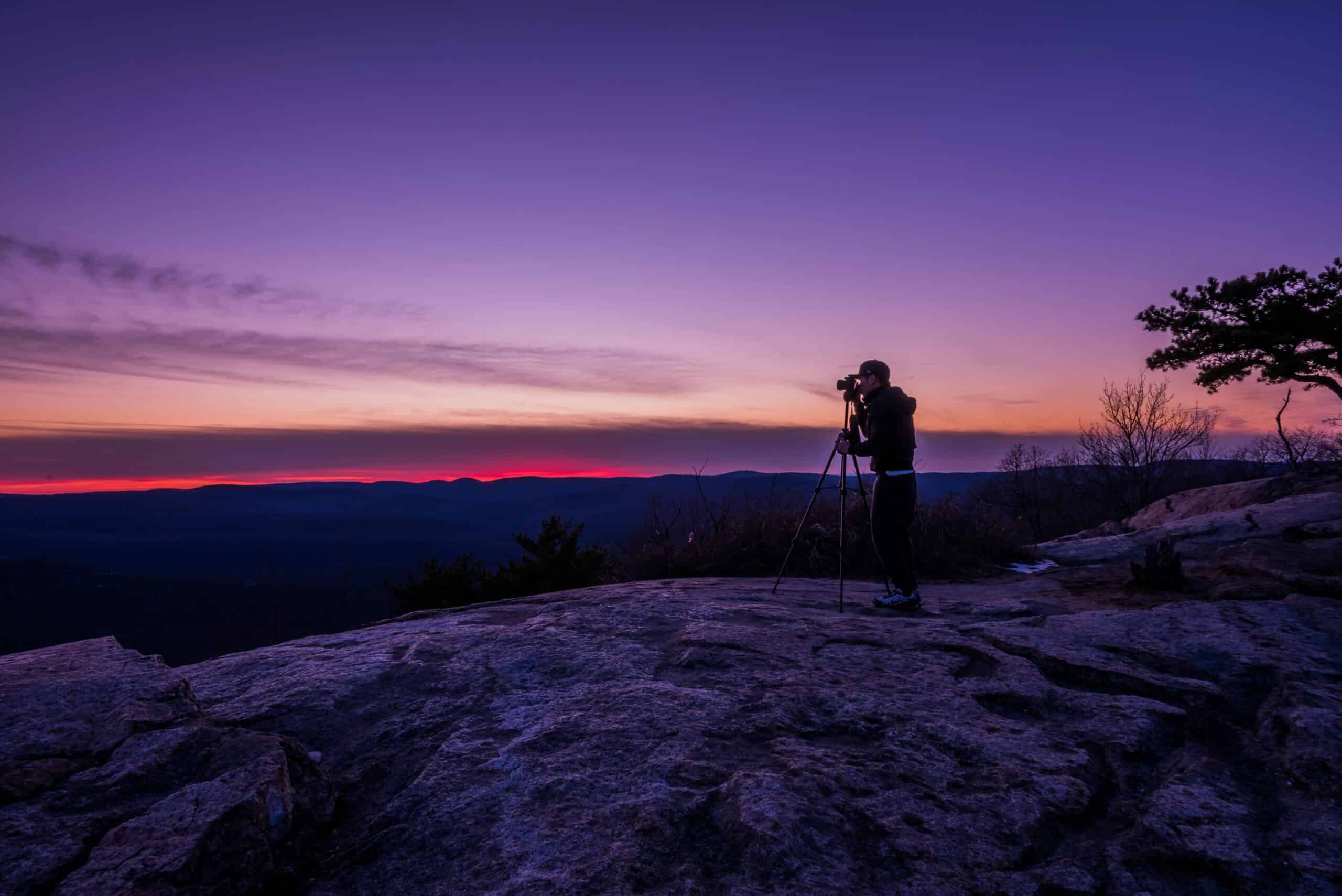
Evaluate Shooting Environment
Walk the scene before you set up. Identify primary light sources, reflective surfaces (glass, polished stone, metal), and moving elements (people, trees in wind, traffic). If you must shoot next to glass, press a rubber lens hood against the pane or stand at least 30–60 cm away to reduce reflections; flag stray light with your hand or a small black card to avoid flare. In interiors, note mixed lighting and aim to balance color temperature in post by shooting RAW with a locked white balance.
Match Gear to Scene Goals
The EOS R5’s 45MP sensor provides generous detail and headroom for perspective corrections. In low light, ISO 100–800 is the sweet spot; ISO 1600 is workable with careful noise reduction. A rectilinear 14–24 mm lens is ideal for architectural lines and natural-looking edges. At 14 mm you’ll need fewer frames than at 24 mm, but it’s still a multi-row workflow for a full sphere. If you prefer fewer shots, consider a fisheye lens instead (accepting the fisheye look and defishing in post).
If you specifically want the Nikon Z 14–24 S look, plan to use an RF ultrawide with similar FOV on the R5 (or use a Nikon Z body for the capture). The stitching math, overlap, and nodal alignment described here apply equally to any high-quality 14–24 mm rectilinear on full frame.
Pre-shoot Checklist
- Charge batteries, format cards (use dual-card backup if possible), and clean front/rear elements and the sensor.
- Calibrate your panoramic head for no-parallax point (entrance pupil) and level the tripod with a leveling base.
- Safety: check wind load, secure rooftop or balcony work with tethers, avoid traffic lanes for car-mounted shots.
- Redundancy: capture an extra full pass of the panorama as a backup and bracket critical scenes for HDR.
Essential Gear & Setup
Core Gear
- Panoramic head with fore-aft rail: Align the lens to its no-parallax point so near/far objects don’t shift as you rotate. This is essential for multi-row panos with an ultrawide rectilinear lens.
- Stable tripod with leveling base: Leveling once at the base saves time and prevents horizon drift across rows.
- Remote trigger/app or 2-sec timer: Eliminate vibrations. On the R5, EFCS (electronic first curtain shutter) + 2-sec timer is a smooth combo for tripod work.
Optional Add-ons
- Pole or car mount: Use shock-absorbing clamps and a safety tether. Wind can twist your setup—rotate slower and increase overlap.
- Lighting aids: Small LED panels or bounced flash for dim interiors (keep lighting consistent across frames).
- Weather protection: Rain sleeves and microfiber cloths; lens hoods help reduce flare and keep drizzle off your front element.
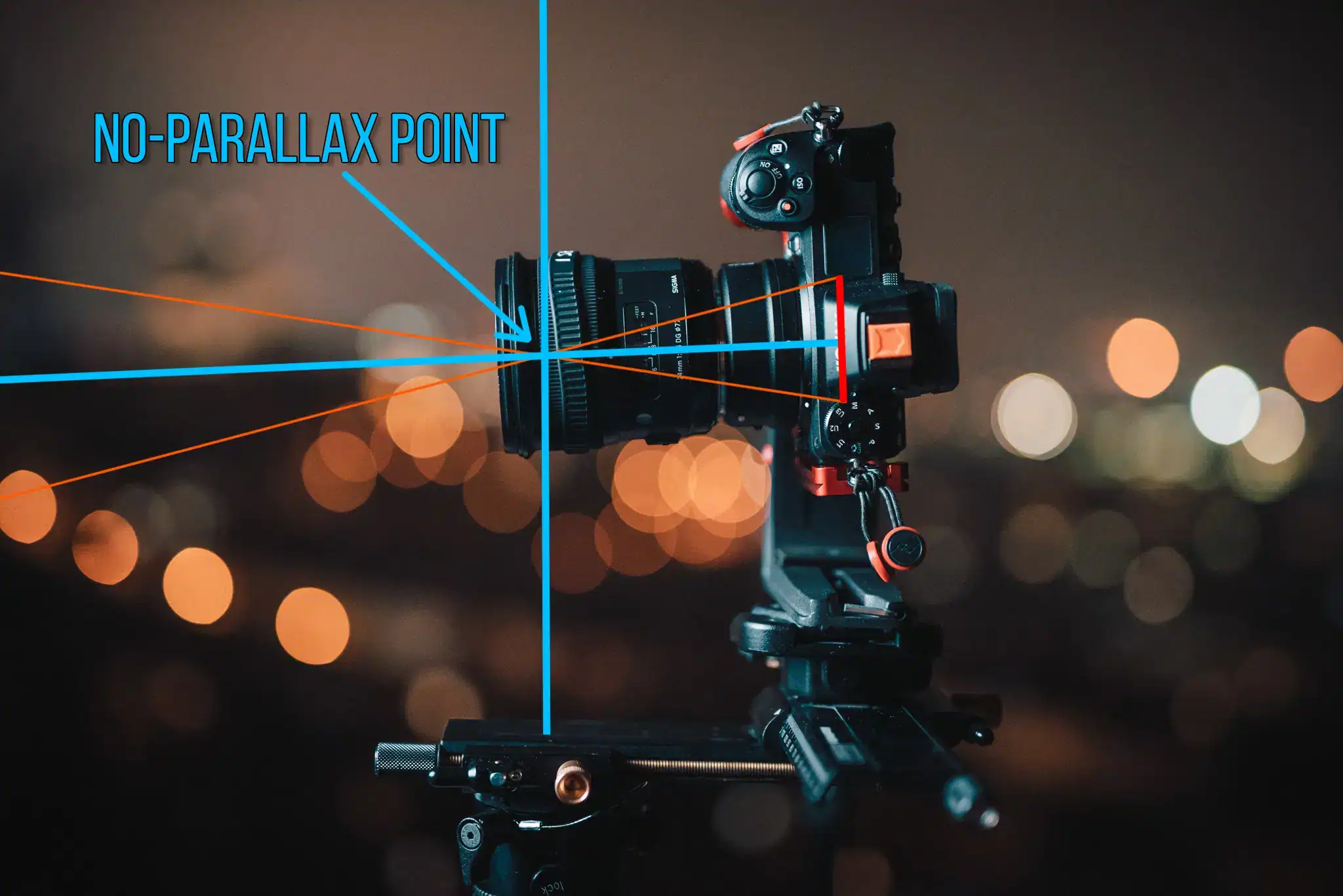
Want a deep dive into panoramic head setup? See a step-by-step guide to precision alignment at the end of this section. How to set up a panoramic head for high-end 360 photos.
Step-by-Step Shooting Guide
Standard Static Scenes
- Level and lock: Level the tripod with the base. Mount your panoramic head and ensure the rotator clicks are set at your intended intervals (e.g., 45° or 60° per click).
- Align nodal point: Calibrate fore-aft on your rail so a near foreground object aligns with a distant object as you pan. Record the rail mark for future shoots.
- Manual everything: Set Manual exposure, Manual white balance (Daylight, Tungsten, or custom), Manual focus. For 14 mm at f/8, focusing near the hyperfocal (~0.8 m for full frame) keeps everything sharp from roughly 0.4 m to infinity.
- Capture with overlap: At 14 mm, use ~30% overlap; shoot your first row at 0° pitch (6–8 shots), then a row at +45° (6–8 shots), add a zenith (straight up), and 2–3 nadir shots to patch out the tripod.
- Nadir technique: After the main capture, shift the tripod slightly or use a nadir adapter to shoot clean floor plates for patching.
HDR / High Dynamic Range Interiors
- Bracket exposure: Set AEB to ±2 EV or even ±3 EV in high-contrast interiors (bright windows). Shoot all frames per node; keep the camera rock-solid to avoid bracket misalignment.
- Lock color: Fix white balance to a preset; changing WB between brackets creates color inconsistencies in stitching and tonemapping.
- Workflow tip: Either pre-merge HDR per viewpoint (e.g., in Lightroom or PTGui’s HDR merge) then stitch, or stitch bracketed sets in PTGui/Hugin directly.
Low-Light / Night Scenes
- Exposure: Use f/4–f/5.6, slow shutter, and ISO 400–800 on the R5. Avoid going beyond ISO 1600 unless necessary; the R5 keeps detail but noise reduction will be heavier.
- Stability: Turn off IBIS on a solid tripod to avoid micro-wobble. Use remote or timer and EFCS. Watch for star trailing if you go past a few seconds—raise ISO modestly instead.
- Avoid flicker: Stay in full Manual; don’t let Auto ISO or Auto WB vary frame-to-frame.
Crowded Events
- Two-pass strategy: First pass quickly for coverage; second pass patiently when gaps appear. This gives you clean plates for masking people in post.
- Shutter speed: If you want to freeze motion, go 1/200–1/250 at f/5.6–f/8, ISO 400–800. Expect some stitching rejections; mask in post as needed.
Special Setups (Pole / Car / Drone)
- Pole: Use a lightweight head and lock your fore-aft rail. Keep rotations deliberate and increase overlap to 40%. Tether everything. Avoid windy rooftops.
- Car-mount: Safety first—use redundant straps and check local laws. Shoot at safe speeds or when stationary. Vibrations require faster shutter (1/250–1/500) and higher ISO.
Recommended Settings & Pro Tips
Exposure & Focus
| Scenario | Aperture | Shutter | ISO | Notes |
|---|---|---|---|---|
| Daylight outdoor | f/8–f/11 | 1/100–1/250 | 100–200 | Lock WB to Daylight; EFCS + 2-sec timer |
| Low light/night | f/4–f/5.6 | 1/30–1/60 (tripod) | 400–800 | IBIS off on tripod; remote trigger to prevent shake |
| Interior HDR | f/8 | Bracket ±2 EV | 100–400 | Balance windows and lamps; merge HDR before or during stitch |
| Action / moving subjects | f/5.6–f/8 | 1/200+ | 400–800 | Two-pass capture for clean plates |
Critical Tips
- Manual focus near hyperfocal: At 14 mm and f/8, focusing around 0.8 m on full-frame covers near to infinity. Use magnified Live View to confirm.
- Nodal alignment: Align the entrance pupil over the pano head’s rotation axis. Mark your rail for 14 mm and 24 mm positions so repeat setups are fast.
- White balance lock: Choose a fixed WB to avoid color shifts that complicate stitching and blending.
- RAW capture: Gives flexibility for color, highlight recovery, and noise reduction—crucial for HDR and night scenes.
- IBIS on/off: On tripod, turn IBIS off. Handheld or on a pole, IBIS can help; test for micro-wobble artifacts.
- Shutter mode: Prefer EFCS to minimize vibration and avoid LED banding seen with full electronic shutter.
Stitching & Post-Processing
Software Workflow
PTGui is the workhorse for high-end 360 stitching with excellent control point generation and HDR fusion. Hugin is a capable open-source alternative. Lightroom/Photoshop can stitch partial panos but are less reliable for full 360×180 spheres. With rectilinear ultrawides, aim for 25–30% overlap per frame; more overlap helps in complex interiors. For fisheye lenses, 30–40% is common, but you’ll take fewer frames overall. A good primer on choosing focal lengths and pano approaches can be found here: Panoramas, focal lengths, and stitching basics.
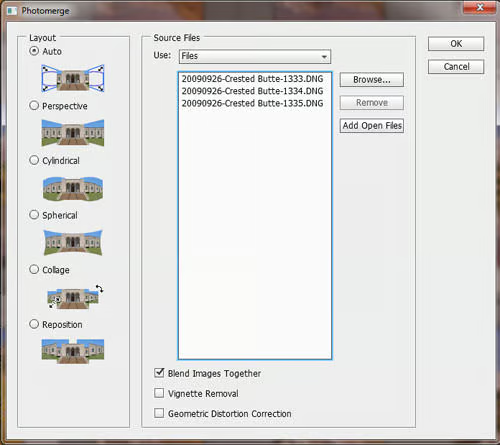
If you’re new to PTGui, this in-depth review outlines why it’s a favorite among pano pros: PTGui review and best practices. Also see spherical resolution guidance for estimating shot counts at various focal lengths: Panotools spherical resolution reference.
Cleanup & Enhancement
- Nadir patching: Use a dedicated nadir shot or clone/AI tools to remove the tripod and rail. Maintain floor texture continuity.
- Color consistency: Equalize white balance and exposure across rows; fix casts from mixed lighting with local adjustments.
- Noise reduction: Apply luminance NR lightly; mask to shadows. The EOS R5 handles ISO 400–800 gracefully.
- Leveling: Set horizon and correct roll/yaw/pitch in PTGui or your viewer. Ensure a true horizon for architectural work.
- Export: For VR, export 16-bit TIFF or high-quality JPEG equirectangular at 12K–16K on a 45MP base. For web tours, 8K–12K often balances quality vs. load time.
For a panoramic head primer, see this tutorial as well: Panoramic head tutorial.
Useful Tools & Resources
Software
- PTGui panorama stitching
- Hugin (open source)
- Lightroom / Photoshop for RAW and finishing
- AI tripod/nadir removal tools
Hardware
- Panoramic heads: Nodal Ninja, Leofoto, Fanotec
- Carbon fiber tripods with leveling bases
- Wireless remotes or app control
- Pole extensions / car mounts (with safety tethers)
Disclaimer: software/hardware names provided for search reference; check official sites for details.
Common Mistakes & How to Avoid Them
- Parallax error: Always align the entrance pupil (no-parallax point) before a critical shoot.
- Exposure flicker: Manual mode and locked WB. Avoid Auto ISO and Auto WB for 360s.
- Tripod shadows and gaps: Shoot a dedicated nadir, and consider a second pass for safety.
- Ghosting from motion: Use two-pass capture and mask in post. Increase shutter speed if needed.
- Underlap: Aim for at least 25–30% overlap; in wind or complex interiors, 35–40% is safer.
- IBIS artifacts on tripod: Turn off stabilization for long exposures on solid support.
Field-Proven Scenarios
Indoor Real Estate (Tight Rooms)
At 14 mm, use 6–8 shots per row and two rows (+45° and 0°) plus zenith/nadir. Shoot bracketed ±2 EV for bright windows. Lock WB to a Kelvin value that matches predominant lighting (e.g., 3200 K for tungsten). Keep the camera 1.2–1.5 m high for natural perspective. The EOS R5’s base ISO gives clean files; aim for ISO 100–200 and longer shutter with a remote.
Outdoor Sunset Landscape
Use f/8–f/11 at ISO 100–200. Bracket if the sun is in frame; the R5’s DR lets you recover shadows, but HDR preserves highlight gradients. For wind, take a second pass to catch foliage at different moments so you can blend clean frames.
Event Crowds
Plan a rapid first pass to capture structure, then a slower pass to fill in clean areas when people move. Mid apertures (f/5.6–f/8) and 1/200–1/250 shutter help freeze motion. If shooting from a monopod or pole, increase overlap to 40% and spin slower.
Rooftop / Pole Shooting
Use a slim panoramic head and secure gear with tethers. Wind can twist your rig; add a counterweight or guy-lines. Keep shutter at 1/125–1/250 even at base ISO 100–200 to fight micro-movement. If the city lights create extreme DR, bracket ±2 EV and use PTGui’s HDR merge.
Car-Mounted Capture
Only shoot when stationary and in safe, legal conditions. Vibrations require sturdy suction mounts, a safety strap, and faster shutter speeds. Expect more overlap and some frame rejection; you may need to mask and manually place control points in the stitcher.
Mount Compatibility & Workarounds
Directly mounting a Nikon Z 14–24mm f/2.8 S to a Canon EOS R5 is not currently feasible with full electronic control (aperture/focus). Practical workarounds for “how to shoot panorama with Canon EOS R5 & Nikon Z 14-24mm f/2.8 S” include:
- Use a Canon RF ultrawide with equivalent FOV (e.g., RF 14–35mm f/4 L, RF 15–35mm f/2.8 L). All shot counts and overlap recommendations here apply 1:1.
- If you must use the Nikon Z 14–24 S, do the capture on a Nikon Z body and follow the same panoramic head setup and stitch workflow. Files will stitch identically with proper lens parameters.
- For ultra-fast capture with fewer frames, consider a fisheye lens on the R5 (e.g., 8–12 mm). You’ll take fewer shots but must defish and manage fisheye-specific distortion in post.
This honest limitation doesn’t change the core pano process—level, nodal alignment, manual settings, overlap, and a robust stitch are universal. For background on DSLR/mirrorless choices for virtual tours, see this overview: DSLR/mirrorless virtual tour gear guide.
Frequently Asked Questions
- Can I shoot handheld panoramas with the Canon EOS R5?
Yes for partial panos and even some 360s with a fisheye, but for multi-row 14–24 mm rectilinear work, a panoramic head on a tripod is strongly recommended. Handheld introduces parallax and horizon errors that are hard to fix.
- Is the Nikon Z 14–24mm f/2.8 S wide enough for single-row 360?
For a complete 360×180 sphere, 14 mm rectilinear typically requires at least two rows plus zenith/nadir. Single-row works for partial panos. Plan for 6–8 shots per row with ~30% overlap.
- Do I need HDR for interiors with bright windows?
Usually yes. Bracket ±2 EV (sometimes ±3 EV) to preserve window detail and interior shadows. Merge HDR either before stitching or within PTGui/Hugin for best results.
- How do I avoid parallax issues?
Align the lens entrance pupil over the rotation axis of your pano head. Use a near/far object test to find the correct rail position and mark it for 14 mm and 24 mm.
- What ISO range is safe on the EOS R5 in low light?
ISO 100–400 is ideal; ISO 800 is still very clean; ISO 1600 remains usable with moderate noise reduction. For tripod work, favor lower ISO and longer exposures.
- Can I set Custom Modes on the R5 for pano?
Yes. Save a Custom mode (C1/C2) with Manual exposure, Manual WB, MF at hyperfocal, EFCS, drive to 2-sec timer, and IBIS off. This speeds up consistent setups on location.
- What’s the best tripod head choice for this setup?
A 2-axis panoramic head with a fore-aft rail and click-stop rotator (e.g., Nodal Ninja, Leofoto) is ideal for multi-row captures with ultrawides.