
Why This Camera & Lens Are Great for Panoramas
If you want to know how to shoot panorama with Canon EOS R5 & Nikon AF-S 8-15mm f/3.5-4.5E ED Fisheye, you’re already chasing one of the most efficient 360 photo workflows: a high-resolution full-frame body paired with a versatile fisheye zoom. The Canon EOS R5’s 45MP full-frame sensor (pixel pitch ~4.4 µm) delivers excellent detail and dynamic range at base ISO (roughly 14+ stops), which translates into clean skies, recoverable shadows, and crisp textural detail in brickwork, grass, and interiors. The body’s Dual Pixel AF II, clear EVF, and robust IBIS make setup easier even if you switch to manual exposure for the actual pano sequence.
The Nikon AF-S 8–15mm f/3.5–4.5E ED is a diagonal/circular fisheye hybrid: at 8mm it yields a 180° circular image on full-frame; at 12–15mm it’s a diagonal fisheye covering the frame. For 360×180 panoramas this is gold: you can finish a full sphere with fewer shots than a rectilinear lens, speeding up work in crowded or changing-light scenes. Optically, it’s known for good central sharpness and manageable chromatic aberration when stopped to around f/5.6–f/8, with the usual fisheye traits (pronounced distortion by design and susceptibility to flare if strong lights hit the front element).
Important compatibility note: this Nikon lens is an “E-type” with an electromagnetic diaphragm. As of 2025, there is no widely available electronic Nikon F-to-Canon RF adapter that fully supports aperture control for E-type lenses. Without electronic control, the lens stays wide open. You can still shoot panoramas at f/3.5–4.5, but for best sharpness and depth you’ll want f/5.6–f/8. If you cannot source a compatible smart adapter, consider borrowing or renting a Canon EF 8–15mm f/4L Fisheye with EF–RF adapter for full aperture control. Everything else in this guide still applies to field technique and stitching.
Quick Setup Overview
- Camera: Canon EOS R5 — Full-frame (36×24 mm), 45 megapixels, strong base-ISO dynamic range, excellent per-pixel detail for 12–16K equirectangular outputs.
- Lens: Nikon AF-S 8–15mm f/3.5–4.5E ED Fisheye — circular at 8mm, diagonal fisheye at 12–15mm; sharpest around f/5.6–f/8; typical fisheye CA and flare manageable with careful shooting.
- Estimated shots & overlap (tested norms on full-frame):
- 8mm: 4 around at 0° tilt (90° apart) + zenith + nadir (6 total). Advanced users may do 3 around + Z + N in tight spaces.
- 12mm: 6 around + zenith + nadir (8 total).
- 15mm: 8 around + zenith + nadir (10 total).
- Overlap guideline: 25–35% between frames for fisheye.
- Difficulty: Intermediate (basic pano-head alignment + consistent manual exposure).
Planning & On-Site Preparation
Evaluate Shooting Environment
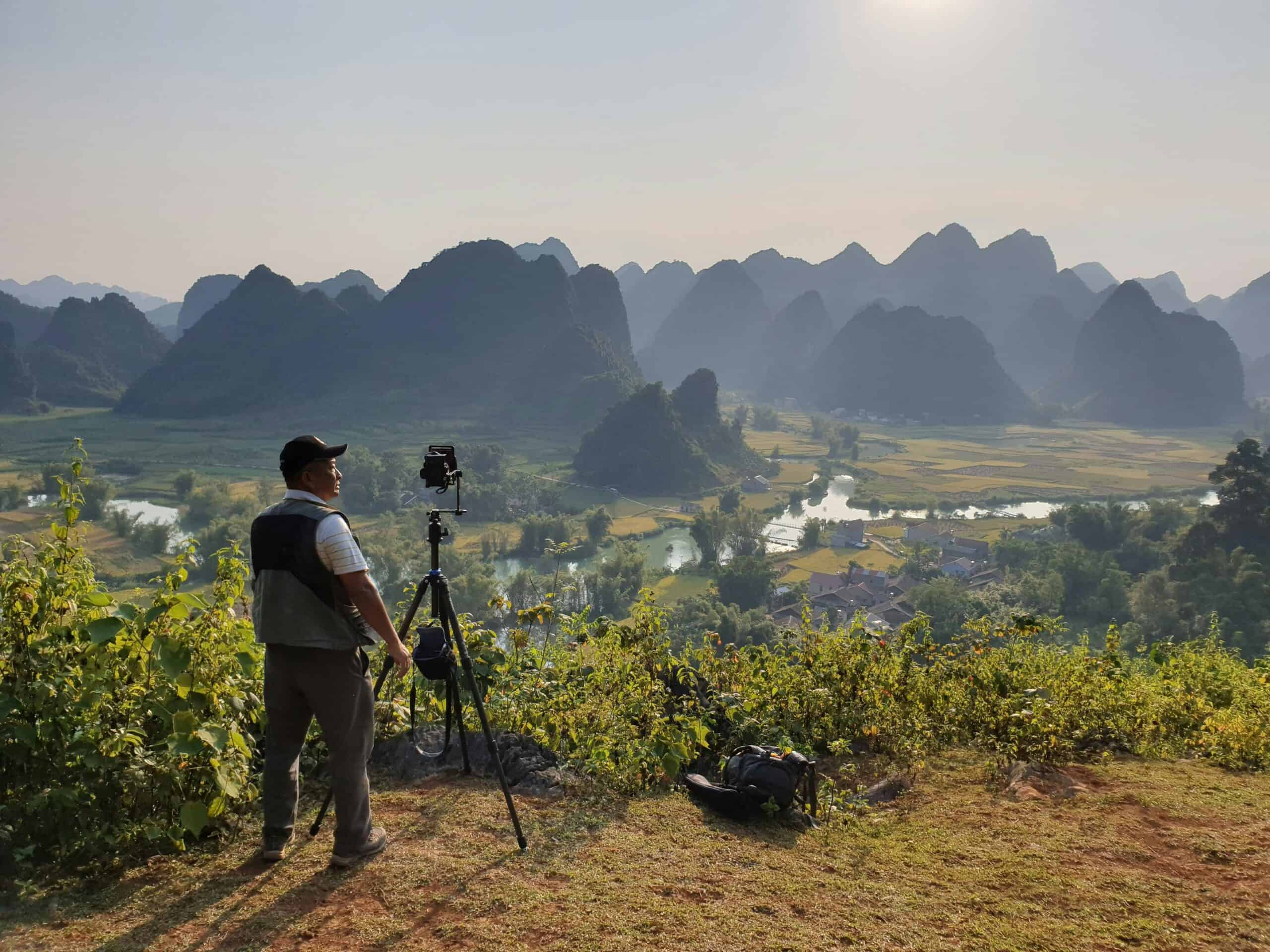
Before you set up, evaluate light direction and intensity, reflective surfaces (glass, polished floors, metals), and moving elements (people, cars, trees in wind). With fisheyes, the sun or bright lights just outside the frame can flare across half the image, so choose your orientation wisely. If shooting through glass, try to get the front element near the glass (1–3 cm) and use a black cloth around the lens to cut reflections; avoid touching the glass to prevent vibration transfer and focus issues.
Match Gear to Scene Goals
The Canon EOS R5 handles ISO 100–400 with virtually invisible noise and maintains good color depth up to ISO 800–1600 with careful exposure. That makes it suitable for indoor real estate, dusk cityscapes, and detailed VR tours. The fisheye zoom helps you minimize shot count, which is critical during sunsets (rapidly changing light) or events (people moving). Keep in mind: fewer shots means fewer seams to manage, but fisheye distortion makes straight lines curve; this is fine for spherical panos but affects single-row “flat” panos.
Pre-shoot Checklist
- Battery fully charged; at least two UHS-II cards; lens and sensor cleaned.
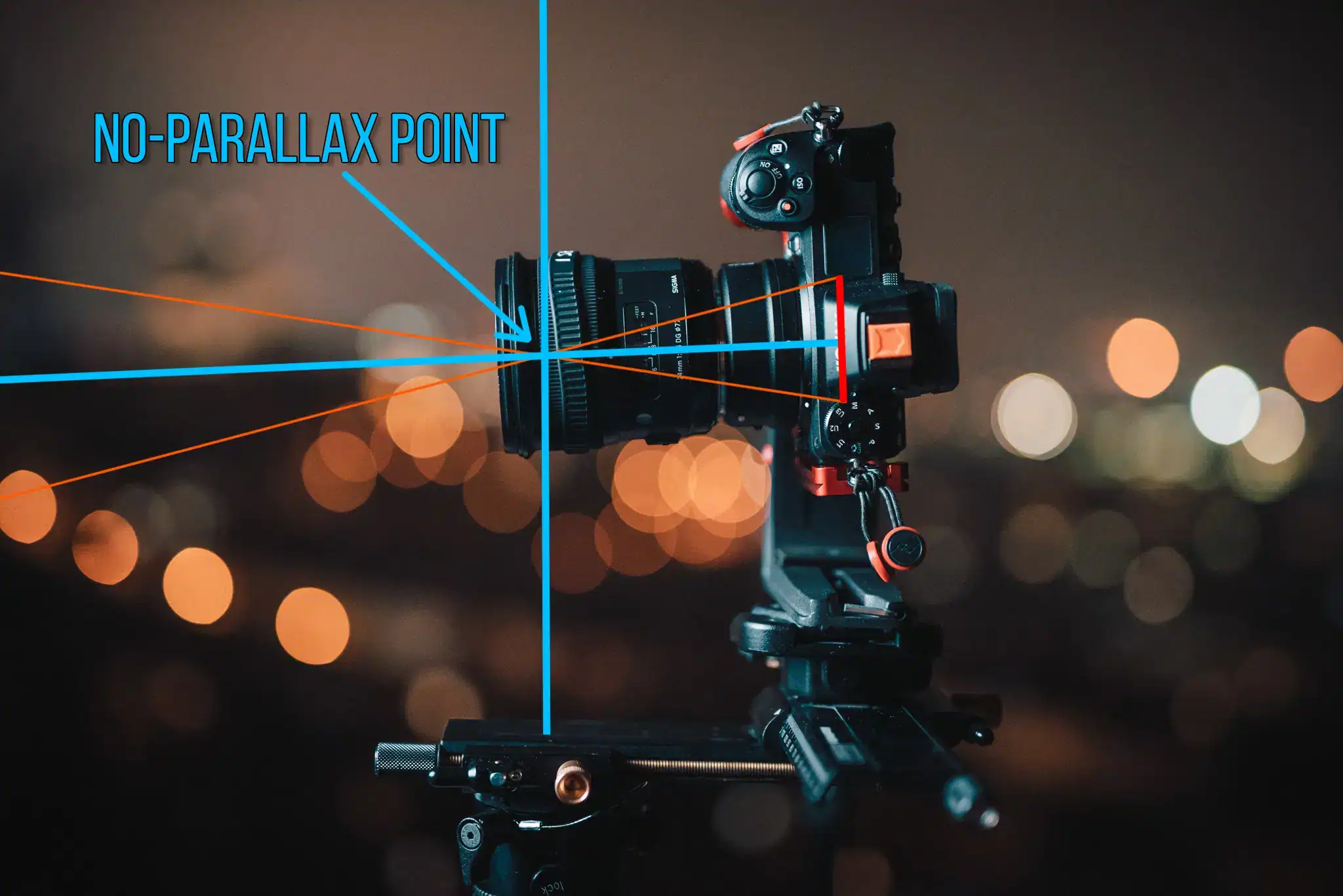
- Tripod leveled; panoramic head calibrated to the lens’s entrance pupil (no-parallax point).
- Safety: check wind loads on rooftops or when using a pole; use tethers on edges, car mounts, or elevated positions.
- Backup workflow: shoot an extra 360 pass in case a frame is soft, obstructed, or has a blinking subject.
Field Case Studies
- Indoor real estate: set WB to 4000–5000K to reduce mixed lighting shifts; bracket exposures to preserve window view; aim for f/5.6–8 for edge-to-edge clarity.
- Outdoor sunset: shoot the sun-facing frame first, then rotate quickly; consider a second pass for safety as color changes fast.
- Event crowds: do two rounds—one “primary” and one “cleanup” waiting for gaps—so you can mask out ghosts in post.
- Rooftop/pole: watch wind gusts; use shorter shutter times (1/200+) and shoot more overlap to handle micro-movements.
- Car-mounted capture: keep to very fast shutter speeds (1/1000+), shoot in bursts, and accept you’ll need aggressive masking.
Essential Gear & Setup
Core Gear
- Panoramic head: a proper pano head lets you rotate around the lens’s entrance pupil (nodal point) to eliminate parallax. This is essential for perfect stitching in tight spaces with near objects.
- Stable tripod with leveling base: leveling the base (not just the head) keeps your horizon consistent when you rotate.
- Remote trigger or Canon Camera Connect app: prevents vibration at long exposures and keeps your hands off the camera.
Optional Add-ons
- Pole or car mount: always use a safety tether; consider wind loads and vibration. Plan faster shutter speeds and extra overlap.
- Lighting aids: small LEDs or bounced flash to fill dark corners in interiors (keep lighting consistent across frames).
- Weather protection: rain cover, microfibers, and a lens hood shadowing hand to fight flare when needed.
Compatibility note: mounting Nikon 8–15mm on EOS R5
Because the lens is an E-type (electromagnetic diaphragm), you need an electronic Nikon F-to-Canon RF adapter to control aperture. As of this writing, such adapters are not widely available. If you cannot control aperture, you’ll be stuck wide open at f/3.5–4.5; increase shutter speed or use lower ISO to compensate, but accept some softness at edges compared to f/5.6–f/8. For the smoothest experience, many R5 shooters use the Canon EF 8–15mm f/4L via Canon’s EF–RF adapter for full control while following the same pano technique described here.
Video: Panoramic head basics
New to panoramic heads? This concise walkthrough of pano fundamentals will help you visualize the setup before your first field session:
Step-by-Step Shooting Guide
Standard Static Scenes
- Level and align: level the tripod base; set the pano head’s vertical and horizontal rails; align the camera so rotation happens through the entrance pupil (no-parallax point). Use two light stands or sticks (near/far) and adjust until their relative position doesn’t shift when you pan.
- Manual exposure and WB: switch the EOS R5 to Manual. Set a fixed white balance (e.g., Daylight 5200K outdoors, 4000–4500K indoors) to avoid color shifts across frames.
- Focus: use manual focus; at 8–12mm, set near hyperfocal distance around 0.8–1.2 m at f/5.6–f/8 (or as stopped as your adapter allows). Confirm via magnified live view.
- Sequence: shoot 4 around at 8mm (90° apart). Add a tilt-up (zenith) and tilt-down (nadir). At 12mm, shoot 6 around + Z + N; at 15mm, 8 around + Z + N. Aim for 25–35% overlap.
- Nadir shot: after the main ring, tilt down to capture the ground cleanly for tripod patching. Some shooters offset the camera for a “tripod removal” frame — just stay consistent.
HDR / High Dynamic Range Interiors
- Bracket ±2 EV or even ±3 EV where windows are extremely bright. Keep the same sequence for each bracket so stitching is deterministic.
- Lock white balance and turn off auto lighting optimizer. Merge brackets in a consistent way across the set (per-frame HDR first, then stitch; or stitch per exposure then exposure-fuse in PTGui).
Low-Light / Night Scenes
- Use a tripod and remote. The EOS R5 is clean at ISO 100–400; ISO 800 is still strong; ISO 1600 is workable with careful exposure and denoise. Prefer longer shutter to higher ISO when static.
- Disable IBIS when on a tripod to prevent micro-blur; use electronic first curtain shutter or mechanical shutter to avoid rolling artifacts from bright point lights.
Crowded Events
- Two-pass method: first pass quickly to capture the geometry; second pass to fill gaps when people move, or to capture clean areas for masking.
- Keep shutter at 1/200+ to freeze motion if people are close. Expect to paint masks during stitching to remove ghosts.
Special Setups (Pole / Car / Drone)
- Pole: tether everything, keep shutter fast (1/250–1/500), use 8mm or 12mm to reduce frames and rotation time, and avoid strong wind. Consider a static self-timer to reduce hand vibration.
- Car mount: only on private/controlled roads, with solid suction mounts and safety lines. Shoot at 1/1000+ and accept you’ll do robust masking in post.
Recommended Settings & Pro Tips
Exposure & Focus
| Scenario | Aperture | Shutter | ISO | Notes |
|---|---|---|---|---|
| Daylight outdoor | f/8–f/11 | 1/100–1/250 | 100–200 | Lock WB (Daylight ~5200K) |
| Low light/night | f/4–f/5.6 | 1/30–1/60 | 400–800 | Tripod + remote; disable IBIS on tripod |
| Interior HDR | f/8 | Bracket ±2 EV | 100–400 | Preserve window highlights |
| Action / moving subjects | f/5.6–f/8 | 1/200+ | 400–800 | Two-pass method for masking |
Critical Tips
- Manual focus at or near hyperfocal distance; verify with magnified live view.
- Nodal calibration: place two vertical objects (one near, one far) along a line; pan the camera and adjust the sliding rail until the objects don’t “shift” relative to each other. Mark your rail positions for 8mm, 12mm, and 15mm on tape for fast recall.
- White balance: lock WB to avoid color casts across frames. Mixed lighting? Choose a neutral preset and correct globally in post.
- RAW over JPEG: the R5’s 14-bit RAW gives maximum flexibility for exposure fusion, denoise, and color correction.
- IBIS: turn it off on a tripod; it can introduce micro-shake during long exposures.
Stitching & Post-Processing
Software Workflow
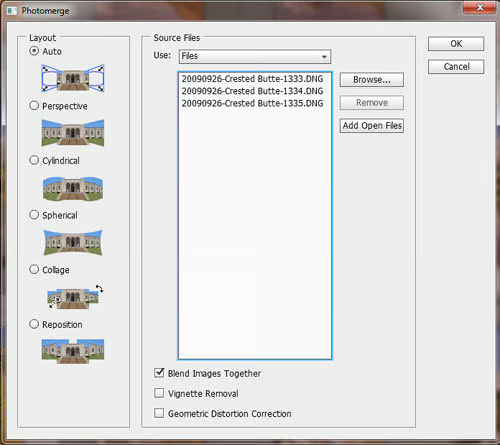
For fisheye panos, PTGui is the industry workhorse thanks to robust fisheye models, masking, HDR fusion, and exposure matching. Hugin is an open-source alternative with capable control-point tools. Lightroom/Photoshop can stitch, but they’re less predictable for full spherical work, especially with circular fisheye inputs. Typical fisheye overlap is 25–35%; rectilinear lenses often need 20–25% with more frames to avoid soft corners and distortion. After a clean stitch, target 10–16K equirectangular width on the R5 for high-quality web VR. For an overview of PTGui’s strengths in real-world workflows, see this hands-on review from Fstoppers at the end of this paragraph. PTGui review: strengths for complex panos
Cleanup & Enhancement
- Nadir patching: clone in Photoshop/Affinity or use an AI-based patch tool. Shoot a dedicated offset nadir frame to make patching easier.
- Color correction: global white balance first, then subtle HSL tweaks; watch for magenta/green shifts near strong light sources.
- Noise reduction: apply RAW denoise before stitching (consistently) or use a post-stitch denoise pass on the equirect.
- Leveling: in PTGui, set verticals via control points; adjust roll/yaw/pitch until horizons are straight and verticals true.
- Export: for VR, export 2:1 equirectangular JPEG (quality 90–100) or 16-bit TIFF for archival. Size commonly 12,000–16,000 px wide for premium tours with the R5.
Want a concise, standards-based overview of capturing and stitching DSLR/MILC 360 photos? Oculus’s creator docs provide a reliable baseline. Using a mirrorless/DSLR to shoot and stitch a 360 photo
For deeper guidance on pano-head setup and no-parallax workflows, this tutorial is a solid reference. Panoramic head setup and theory
Useful Tools & Resources
Software
- PTGui panorama stitching
- Hugin open source
- Lightroom / Photoshop
- AI tripod removal tools
Hardware
- Panoramic heads (Nodal Ninja, Leofoto, Fanotec)
- Carbon fiber tripods
- Leveling bases
- Wireless remote shutters
- Pole extensions / car mounts with safety tethers
Disclaimer: software/hardware names provided for search reference; check official sites for details and compatibility with your camera and lens.
Common Mistakes & How to Avoid Them
- Parallax error: always align to the entrance pupil; mark your rail positions and recheck when you change focal length.
- Exposure flicker: use manual exposure and locked white balance; avoid auto ISO and auto lighting optimizer.
- Tripod shadows: capture a clean nadir and be ready to patch; rotate your sequence to keep your shadow behind the camera.
- Ghosting: in crowds or trees in wind, shoot a second pass for clean plates and mask in PTGui or Photoshop.
- Noise at night: favor longer shutter and lower ISO on a sturdy tripod; denoise RAWs consistently before stitching.
- Flare with fisheye: shield the lens with a hand or flag when the sun is near the edge; adjust your rotation start point.
Frequently Asked Questions
- Can I shoot handheld panoramas with the EOS R5?
Yes, but results vary. Use 8–12mm with high overlap (40%+) and fast shutter speeds (1/200+). Handheld is fine for quick social posts, but for professional virtual tours or interiors, a leveled tripod and pano head give vastly more reliable stitches.
- Is the Nikon 8–15mm wide enough for single-row 360?
At 8mm circular fisheye: yes—4 around + zenith + nadir is typical. At 12mm diagonal fisheye, 6 around + Z + N works well. At 15mm, plan 8 around + Z + N for safe coverage.
- Do I need HDR for interiors with bright windows?
Usually. The R5 has excellent dynamic range, but windows can be 10–14 EV brighter than interior shadows. Bracket ±2 EV (sometimes ±3 EV), then exposure-fuse in PTGui or merge HDR per frame before stitching.
- How do I avoid parallax issues?
Use a pano head and calibrate the entrance pupil for your chosen focal length. Keep near and far objects aligned during a test pan. Mark your rail settings for 8, 12, and 15mm so you can swap quickly without re-calibrating every time.
- What ISO range is safe on the EOS R5 in low light?
On a tripod, ISO 100–400 is ideal; ISO 800 is still very good; ISO 1600 is workable with careful exposure and denoise. Prefer longer shutter and low ISO for best color and detail in static scenes.
Safety, Backup, and Trust Notes
Always tether your camera on rooftops, poles, or car mounts. Wind loads can topple even heavy tripods; hang weight from the center column and stay near your rig. Back up your cards as soon as possible (dual cards if you can) and consider a second full pano pass before leaving the site in case of a missed frame or soft shot. Be transparent with clients about the Nikon 8–15mm aperture control limitation on RF mount; if you can’t secure an electronic adapter, rent a compatible fisheye with working aperture control for mission-critical jobs.
For a broader perspective on DSLR/MILC pano best practices and lens choices, this overview is helpful when planning gear and shot counts. Virtual tour camera and lens guide