Why This Camera & Lens Are Great for Panoramas
If you’re figuring out how to shoot panorama with Canon EOS R5 & Fujifilm XF 10-24mm f/4 OIS WR, you’re aiming for high-fidelity, rectilinear panoramic images with excellent dynamic range and edge-to-edge sharpness. The Canon EOS R5 is a 45MP full-frame mirrorless body (36×24 mm sensor; pixel pitch ≈4.4 µm) known for superb detail, strong base-ISO dynamic range (~13.5 EV at ISO 100), rock-solid ergonomics, and reliable manual exposure tools—ideal for consistent panoramic stitching. The Fujifilm XF 10–24mm f/4 OIS WR is a stabilized ultra-wide rectilinear zoom (APS-C coverage) that is sharp centrally at f/4 and excellent across the frame at f/5.6–f/8, with well-controlled distortion and lateral CA for a UWA zoom.
Important compatibility note: Fujifilm X-mount lenses do not natively fit Canon RF bodies, and there is no mainstream electronic adapter to control the XF 10–24 on the EOS R5. Practically, you will either (a) shoot this lens on a Fujifilm X-series body using the same panorama techniques outlined here, or (b) shoot your EOS R5 with an equivalent rectilinear RF-mount ultra-wide (e.g., Canon RF 14–35mm f/4L IS USM, RF 15–35mm f/2.8L, or a manual Laowa 12–15mm). The workflow, overlap strategy, and nodal alignment are the same. Where settings are camera-dependent (e.g., IBIS behavior), we’ll call out EOS R5–specific guidance.
Quick Setup Overview
- Camera: Canon EOS R5 — Full-frame, 45MP, excellent base-ISO DR, dual card slots (CFexpress + SD), IBIS up to 8 stops with compatible lenses.
- Lens: Fujifilm XF 10–24mm f/4 OIS WR — Rectilinear ultra-wide zoom (APS-C). Sharp from f/5.6–f/8, mild barrel distortion at 10mm, OIS for handheld but turn stabilization off on tripod.
- Estimated shots & overlap (rectilinear; 25–30% overlap):
- FF 14–15mm equivalent: 8 around + 4 up + 4 down + 1 zenith + 1 nadir ≈ 18 frames.
- FF 24mm: 12 around + 6 up + 6 down + 1 zenith + 1 nadir ≈ 26 frames.
- APS-C 10mm (≈15mm FF equiv): 8 around + 4 up + 4 down + 1 zenith + 1 nadir ≈ 18 frames.
- Difficulty: Moderate (rectilinear UWA panoramas require solid nodal alignment and careful overlap; easier than telephoto gigapixel, more demanding than fisheye).
Planning & On-Site Preparation
Evaluate Shooting Environment
Scan the scene for high-contrast edges, moving elements (people, leaves, traffic), reflective glass, and strong light sources. For indoor glass or storefronts, shoot perpendicular to the glass and keep the front element as close as safely possible to reduce reflections. Outdoors at sunrise/sunset, plan your rotation to minimize the sun appearing in multiple frames.
Match Gear to Scene Goals
The EOS R5’s resolution and dynamic range make it ideal for high-end VR tours and large prints. Indoors, you can safely use ISO 100–800 without visible banding or color shifting; ISO 1600–3200 can still be excellent with proper exposure and modern denoise. The XF 10–24mm (or an RF UWA equivalent) keeps lines straight (rectilinear) and is great when you want architectural accuracy without fisheye curvature. Compared to fisheye, you’ll shoot more frames, but you get cleaner geometry and less defishing work.
Pre-shoot Checklist
- Power & storage: Fresh batteries, high-speed cards. Consider RAW-only for consistent files.
- Optics: Clean lens and sensor; carry a blower and microfiber cloth.
- Tripod & head: Leveling base, panoramic head calibrated to the nodal point for your focal length.
- Environment & safety: Assess wind loads on rooftops or poles; use tethers; avoid overhead cables.
- Workflow insurance: Shoot a second safety round (especially for paid work or if crowds move).
Essential Gear & Setup
Core Gear
- Panoramic head: A proper pano head lets you rotate around the lens’s no-parallax (entrance pupil) point to eliminate parallax between foreground and background—critical for stitching.
- Stable tripod with leveling base: A bubble or half-ball leveling base speeds setup and keeps the horizon consistent.
- Remote trigger/app: Use Canon Camera Connect or a wired remote to avoid vibration.
Optional Add-ons
- Pole or car mount: Use safety tethers and plan for wind. Slow your rotation; keep shutter times short to avoid motion blur.
- Lighting aids: For dark interiors, small LED panels to lift shadows without changing color temperature too much.
- Weather gear: Rain covers and desiccant packs; wipe down gear after sea spray.
For a deeper primer on pano heads and technique, see this panoramic head tutorial. Panoramic head setup overview
Step-by-Step Shooting Guide
Standard Static Scenes
- Level and nodal alignment:
- Level the tripod using the base, not the head.
- Calibrate the nodal point: place a close object and a far vertical edge; rotate the camera and adjust the rail until relative movement disappears.
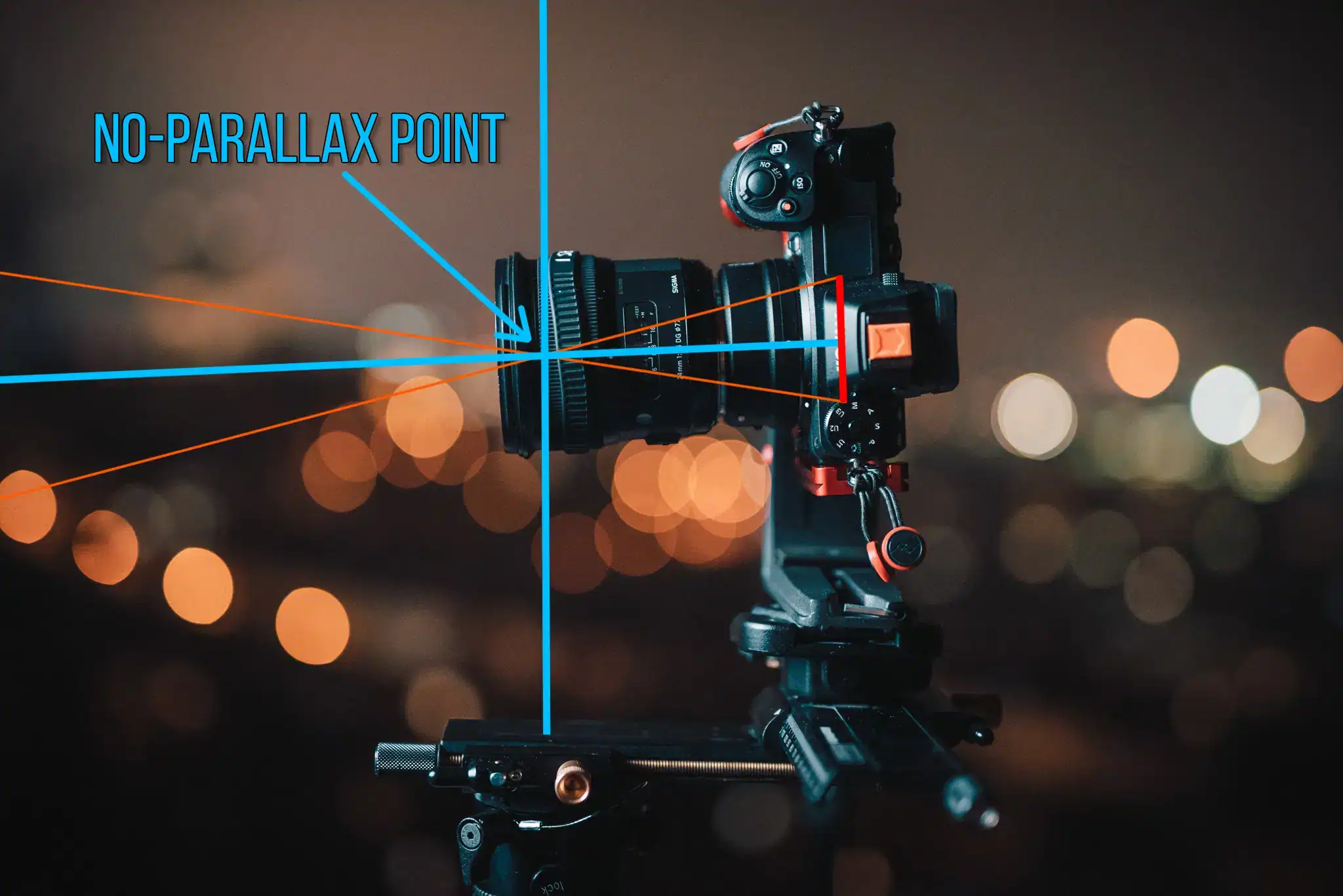
Align the lens’s entrance pupil over the rotation axis to eliminate parallax and simplify stitching. - Manual exposure and WB:
- Meter the brightest part you will include and expose to protect highlights.
- Set Manual exposure and a fixed white balance (e.g., Daylight, 5200K). Avoid Auto WB and Auto ISO for consistent color and brightness across frames.
- Focus:
- Switch to manual focus and set near the hyperfocal distance. At ~14–15mm on full-frame with f/8, focusing around 1 m keeps most of the scene sharp.
- Capture sequence:
- Use 25–30% overlap horizontally and vertically. Example at ~15mm FF equiv: 8 around at 0°, 4 up at +45–60°, 4 down at −45–60°, plus 1 zenith and 1 nadir.
- Take a dedicated nadir (ground) shot after lifting the tripod or shifting it—this helps patch out the tripod later.
HDR / High Dynamic Range Interiors
- Bracket exposures: Use ±2 EV, 3–5 frames per view. The EOS R5 supports AEB up to 7 frames; 5× ±2 EV is a robust starting point for bright windows.
- Lock WB and focus: Keep color constant across brackets; manual focus prevents focus breathing between exposures.
- Shoot all views with identical bracket settings; avoid changing aperture mid-shoot to maintain constant vignetting.
Low-Light / Night Scenes
- Shutter-first approach: Keep ISO low (100–800; up to 1600–3200 if needed) and lengthen shutter on a solid tripod. Use 2 s self-timer or remote.
- Turn off stabilization: Disable IBIS (EOS R5) and lens IS/OIS on a tripod to prevent micro-jitter.
- Watch star trailing: If including stars at 14–15mm, try 10–15 s exposures at f/4–f/5.6 and ISO 800–1600, then denoise later.
Crowded Events
- Two-pass method: First pass for coverage, second pass waiting for gaps. Keep the tripod fixed and only rotate the head.
- Mask in post: Use PTGui or Photoshop to blend the cleanest regions and remove duplicates/ghosts.
Special Setups (Pole / Car / Drone)
- Pole: Use carbon fiber, keep the camera vertical, tether everything. Limit exposure times and shoot a faster rotation to reduce sway.
- Car mount: Suction mounts must be backed with safety lines. Park in shade to reduce thermal vibration; pre-level on-site.
- Drone: If you shoot separate frames (not a one-shot 360 cam), lock exposure and WB for all directions; stitch with viewpoint correction.
Recommended Settings & Pro Tips
Exposure & Focus
| Scenario | Aperture | Shutter | ISO | Notes |
|---|---|---|---|---|
| Daylight outdoor | f/8–f/11 | 1/100–1/250 | 100–200 | Lock WB to Daylight/5200K |
| Low light/night | f/4–f/5.6 | 1/30–15 s | 400–1600 | Tripod + remote; disable IBIS/IS |
| Interior HDR | f/8 | Bracket ±2 EV | 100–400 | Keep aperture fixed for consistent vignetting |
| Action / moving subjects | f/5.6–f/8 | 1/200+ | 400–800 | Freeze motion; do double pass |
Critical Tips
- Manual focus and hyperfocal: Use magnified live view to set focus; then switch to MF to lock.
- Nodal point calibration: Mark your rail setting for each focal length you use often (e.g., 14mm and 24mm). Tape or scribe lines help repeatability.
- White balance lock: Mixed lighting? Choose a Kelvin value (e.g., 4000–4500K indoors) rather than AWB, and correct globally in post.
- RAW over JPEG: RAW gives more highlight headroom and better color matching across frames.
- Stabilization: On tripod, turn off IBIS (EOS R5) and lens IS/OIS. For handheld panos, stabilization can help, but stitching will be less reliable than tripod-based captures.
Stitching & Post-Processing
Software Workflow
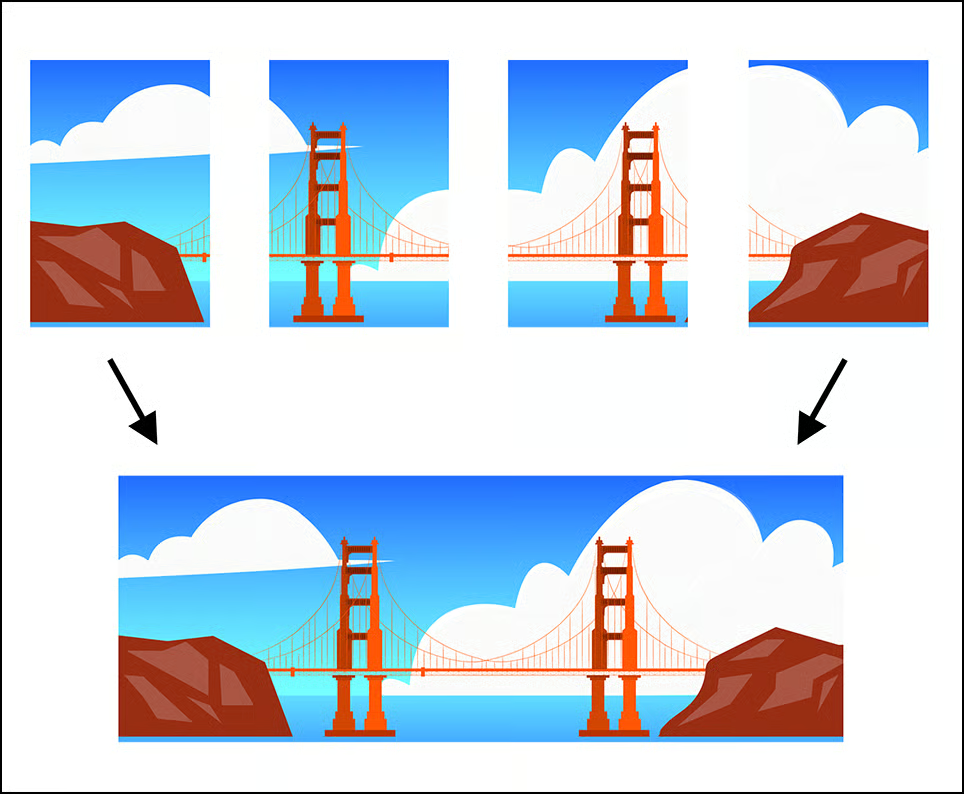
PTGui is the industry standard for professional 360 stitching; Hugin is a robust open-source alternative. Lightroom/Camera Raw handle RAW development and global color; Photoshop or Affinity Photo handle retouching and nadir patches. Rectilinear UWA shots need 20–30% overlap. Fisheye simplifies capture (fewer shots) but requires different geometry. Expect multirow stitching for clean zenith coverage at UWA rectilinear focal lengths.
Want a walkthrough from capture to export? This PTGui review is a good primer on features that matter for panoramas. Why PTGui is preferred for complex stitches
Cleanup & Enhancement
- Tripod/nadir patch: Shoot an extra nadir or use content-aware fill; AI-powered tools can speed this up.
- Color and noise: Apply consistent white balance, subtle contrast, and denoise for night frames.
- Horizon leveling: Use the panorama optimizer (pitch/roll/yaw) to straighten horizons.
- Export: For VR, export equirectangular 2:1 JPEG/PNG at 8k–12k on the long edge (or higher for premium tours). With a 45MP R5 and multirow UWA, final equirectangulars of 100–200MP are realistic.
For a structured lesson on setting up a panoramic head and shooting 360 photos for VR, this guide is clear and practical. Set up a panoramic head for high‑end 360 photos
Video: A concise panorama capture and stitching walkthrough:
Disclaimer: Always check the latest documentation for your software version; UI and features evolve.
Useful Tools & Resources
Software
- PTGui panorama stitching
- Hugin (open source)
- Lightroom / Adobe Camera Raw / Photoshop
- AI tripod/nadir removal tools
Hardware
- Panoramic heads (Nodal Ninja, Leofoto, Sunwayfoto)
- Carbon fiber tripods with leveling base
- Arca-compatible L-brackets and rails
- Wireless remote shutters
- Pole extensions / car suction mounts (with safety tethers)
For more background on DSLR/mirrorless 360 shooting and lens choice, this overview is helpful. Using a mirrorless camera to shoot and stitch a 360 photo
Common Mistakes & How to Avoid Them
- Parallax error → Calibrate and use the nodal point for your focal length; keep the camera level.
- Exposure flicker → Shoot full Manual; lock WB and ISO; keep aperture constant for all frames.
- Tripod shadows → Take a dedicated nadir; rotate the tripod slightly and patch later.
- Ghosting from motion → Use a two-pass capture and mask in PTGui/Photoshop.
- Nighttime noise → Prefer base ISO with longer shutter on tripod; denoise globally after stitching.
Field-Proven Scenarios
Indoor Real Estate
At 14–15mm FF equivalent, shoot multirow with ±2 EV bracketing (3–5 frames). Lock WB around 4000–5000K to match mixed daylight and warm interior lighting. Use a dedicated nadir for clean floors. Expect 18 frames × 3 or 5 brackets per view (54–90 exposures total).
Outdoor Sunset Vista
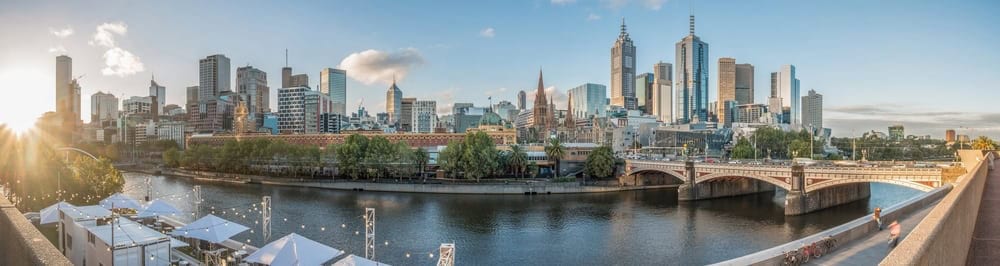
Expose for the highlights (the sun and bright clouds). Consider a graduated capture strategy: one bracketed sweep for the sky, another for the foreground (or simply bracket all frames ±2 EV). Windy conditions? Add weight to the tripod and shorten shutter times to keep foliage crisp for easier masking.
Crowded Event / Festival
Use 1/200 s or faster, ISO 400–800, and f/5.6–f/8. Do two passes: one fast for coverage, one slower to catch gaps. Mask moving subjects during stitching.
Rooftop or Pole Capture
Keep exposure times short (<1/60 s) and rotate smoothly. Use tethers and consider a safety person to stabilize the pole. The R5 is not the lightest body; keep the pole extension conservative in high winds.
For deeper reading on panorama technique and focal length effects, this reference is handy. Best techniques to take 360 panoramas
Frequently Asked Questions
- Can I physically mount the Fujifilm XF 10–24mm on the Canon EOS R5?
No. X‑mount lenses are not natively compatible with Canon RF, and there is no mainstream electronic adapter to control the Fujifilm XF 10–24 on an R5. Use the XF 10–24 on a Fuji X body, or use an RF ultra‑wide on the R5. The panorama techniques here apply to both.
- Is 14–15mm wide enough for a single‑row 360?
Not typically. With a rectilinear UWA, you’ll want multirow coverage to cleanly capture the zenith and reduce distortion at the poles. Try 8 around + 4 up + 4 down + zenith + nadir (~18 frames).
- Do I need HDR for interiors with bright windows?
Usually yes. Bracket ±2 EV (3–5 frames) to preserve both window highlights and interior shadows. Keep WB and aperture fixed across brackets to ensure clean stitching.
- What ISO range is safe on the EOS R5 for low light panos?
ISO 100–800 is essentially clean. ISO 1600–3200 is still very usable if you expose carefully and apply modern denoise. Prefer longer shutter on tripod over pushing ISO.
- How do I avoid parallax seams with a rectilinear UWA?
Use a calibrated panoramic head and rotate around the lens’s entrance pupil. Mark the rail position for each focal length you use. Maintain consistent camera height and avoid shifting the tripod mid‑sequence.
Final Checks, Safety, and Output
Before you leave the location, zoom through your frames to verify coverage, overlap, and that no frame is accidentally overexposed. Shoot a second pass if in doubt, especially for professional work.
For VR delivery, export equirectangular at 8k–12k (or higher for premium tours). If you need to calculate theoretical spherical resolution for various focal lengths and sensors, the PanoTools wiki has helpful formulas. DSLR spherical resolution reference