
Why This Camera & Lens Are Great for Panoramas
The Canon EOS R5 paired with the Canon RF 15–35mm f/2.8L IS USM is a powerful, flexible combo for 360° panoramas and high-resolution multi-row stitches. The R5’s 45MP full-frame sensor (36×24 mm) delivers excellent detail with an effective pixel pitch of about 4.4 µm, giving you clean textures and smooth gradients—especially at base ISO. Expect roughly 13.5–14 stops of dynamic range at ISO 100, with very usable files up to ISO 800–1600 for low-light interiors when needed. Dual Pixel CMOS AF II makes initial focusing easy, and once you lock focus and switch to manual, the lens stays consistent across frames.
The RF 15–35mm f/2.8L is a rectilinear ultra-wide zoom, not a fisheye. Advantages: straight lines stay straight (great for architecture and interiors), edge-to-edge sharpness improves from f/5.6–f/8, and color/contrast are classic L-series. Trade-off: because it’s rectilinear, you’ll need more shots for a full sphere than you would with a fisheye. At 15 mm, with sensible overlap, expect 2–3 rows plus zenith and nadir shots for a seamless 360 photo. The lens’s optical IS is helpful handheld, but on tripod-based panoramic work you’ll usually turn stabilization off to avoid micro-shifts across frames. Mount compatibility is native RF, and the R5’s deep integration with the lens ensures accurate EXIF for easier stitching in PTGui or Hugin.
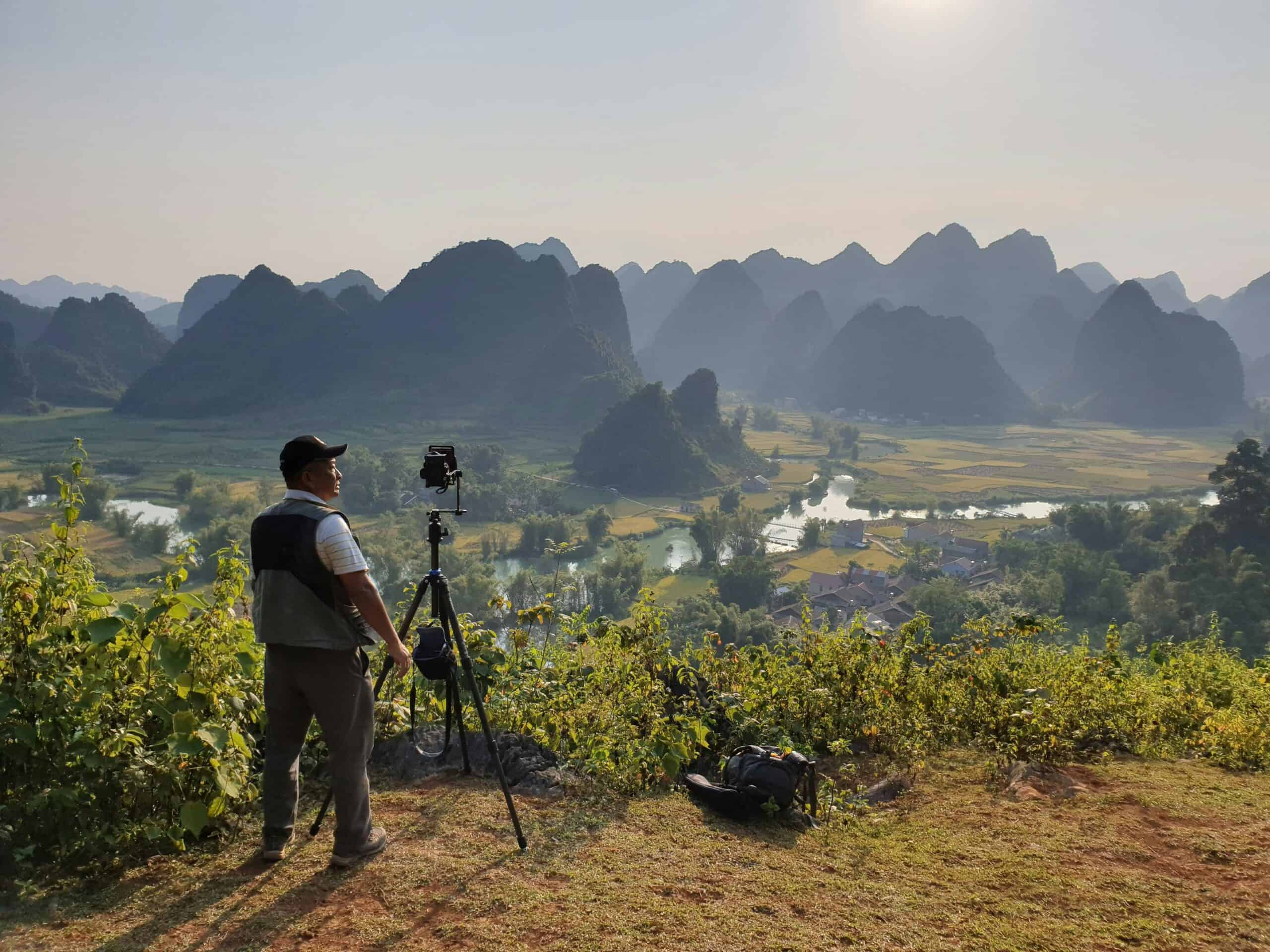
Quick Setup Overview
- Camera: Canon EOS R5 — Full-frame 45MP sensor, ~13.5–14 EV DR at ISO 100, Dual Pixel CMOS AF II, IBIS up to 8 stops with supported lenses.
- Lens: Canon RF 15–35mm f/2.8L IS USM — rectilinear ultra-wide zoom; best sharpness around f/5.6–f/8. Mild barrel distortion at 15 mm and some vignetting wide open; lateral CA is minimal and easily corrected.
- Estimated shots & overlap (tested guidance):
- At 15 mm (rectilinear): 2 rows of 8 around (+30°, −30°) + 1–2 zenith + 1 nadir = ~18–20 frames; safe 30% overlap.
- Speed pass at 15 mm: 2 rows of 6 around + Z/N = ~14–16 frames (works outdoors with simple geometry).
- At 24 mm: often 2×12 around + Z/N = ~26–28 frames for robust control points.
- At 35 mm (gigapixel intent): 3–5 rows, 8–12 around each = 36–60+ frames + Z/N.
- Difficulty: Intermediate (rectilinear UWA needs careful overlap and nodal alignment for perfect stitches).
Planning & On-Site Preparation
Evaluate Shooting Environment
Scan your scene for high-contrast light (sunlit windows versus dark interiors), reflective surfaces (glass, polished stone, glossy furniture), and moving subjects (people, trees, cars). If shooting through glass, get the lens as close as safely possible to reduce reflections and ghosting; a rubber lens hood helps. Consider sun position for outdoor panoramas: avoid placing the sun in overlap zones if possible, and plan your rotation order to minimize flare.
Match Gear to Scene Goals
The R5’s DR and clean ISO up to 800 make it excellent for indoor real estate or museums where you need to retain window detail without excessive noise. Bracketing ±2 EV is simple and rapid on the R5. The RF 15–35mm at 15 mm covers a huge field with straight lines—ideal for architecture. Compared to a fisheye, you’ll shoot more frames, but your stitch will have less distortion and better line fidelity at the edges. For twilight cityscapes, ISO 100–200 on tripod gives pristine files, and for night skylines, ISO 400–800 remains clean with careful exposure and noise reduction.
Pre-shoot Checklist
- Power and storage: Fully charge batteries; carry a spare. Use fast media (CFexpress Type B + UHS-II SD) to buffer HDR bursts.
- Optics clean: Wipe lens elements and check the sensor for dust—spotting a 360 is tedious.
- Tripod leveling: A leveling base speeds setup. Verify pano head calibration markings for this lens.
- Safety checks: Assess wind, ensure a wide stance on rooftops, use safety tethers on poles/cars. Secure loose straps.
- Backup workflow: Shoot an extra “insurance” rotation, and if feasible, a second bracket set.
Essential Gear & Setup
Core Gear
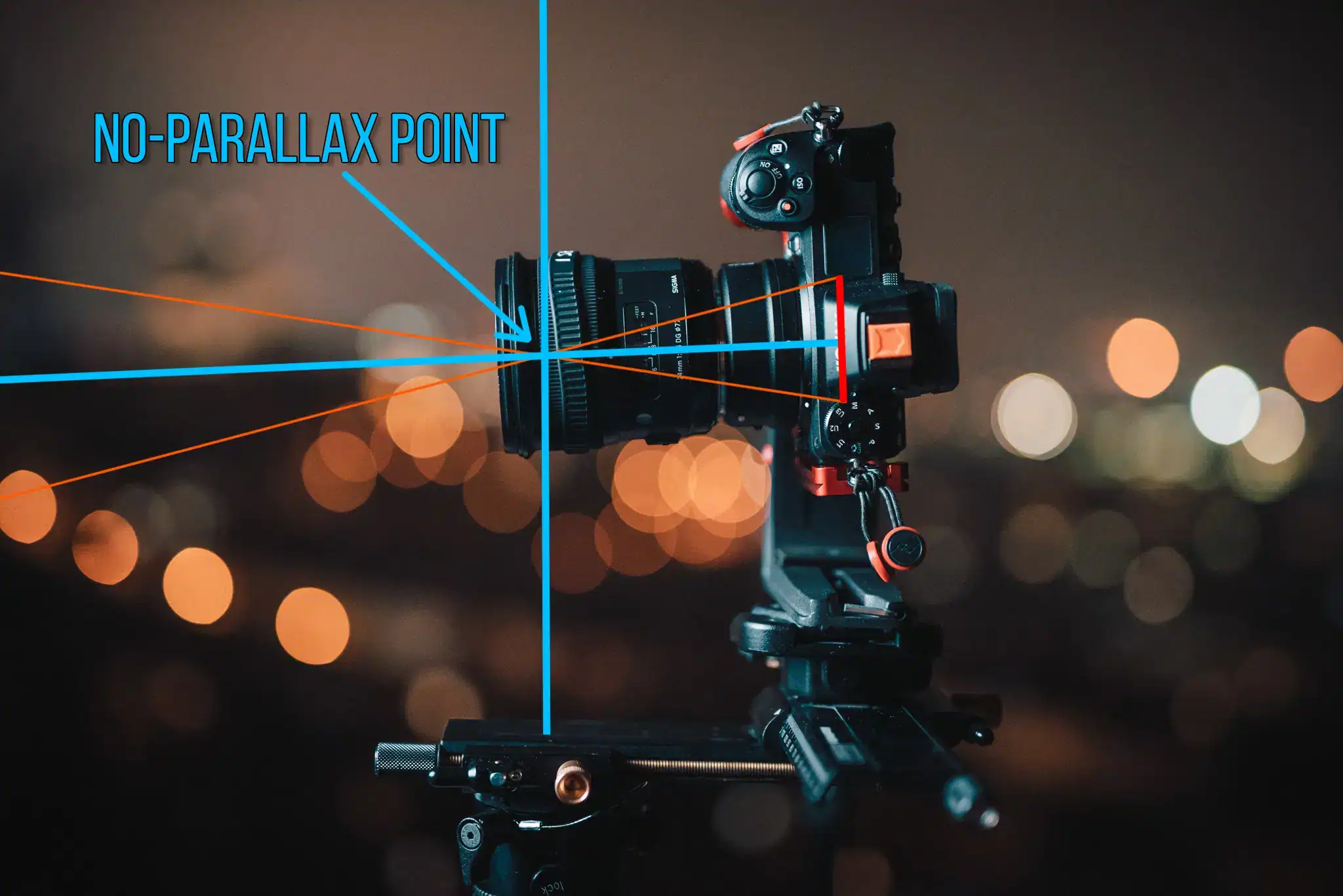
- Panoramic head: Lets you rotate around the lens’s entrance pupil (nodal point) to eliminate parallax between foreground and background. This is critical for rectilinear ultra-wides like the RF 15–35mm.
- Stable tripod with leveling base: A level platform ensures even pitch/yaw increments and avoids creeping horizon errors.
- Remote trigger or Canon Camera Connect app: Reduces vibration and speeds HDR bracketing without touching the camera.
Optional Add-ons
- Pole or car mount: Great for elevated or moving capture. Always use a safety tether and assess wind load; set faster shutters to reduce motion blur.
- Lighting aids: LED panels or bounced flash for dark interiors. Keep lighting consistent across all frames.
- Weather protection: Rain covers and silica packs keep your gear safe; avoid switching lenses outdoors in dusty or wet conditions.
For a deeper primer on panoramic heads and technique, see this panoramic head tutorial by 360 Rumors. Learn nodal workflow and head setup.
Step-by-Step Shooting Guide
Standard Static Scenes
- Level and align: Level the tripod using the leveling base. Mount your panoramic head and set the camera at 15 mm. Align the nodal point by sliding the lens along the rail until near/far objects don’t shift relative to each other when you pan. For the RF 15–35 at 15 mm, expect the entrance pupil roughly 78–82 mm forward of the sensor plane—measure and mark your exact value.
- Manual settings: Switch to M mode. Set WB to a fixed preset (Daylight/Tungsten) or a specific Kelvin value. Turn off IBIS and lens IS on a tripod to avoid sub-pixel shifts. Use EFCS (Electronic First Curtain) to minimize shutter shock.
- Exposure target: For daylight, start at ISO 100, f/8, 1/125 s. For interiors, f/8 with longer shutter at ISO 100–400. Shoot RAW for maximum dynamic range.
- Capture sequence: At 15 mm, shoot either:
- 2 rows of 8 around at +30° and −30° pitch, with ~30% overlap.
- Then add 1–2 zenith frames (tilt up 60–90°) and 1 nadir frame (tilt down 90°) for tripod removal.
- Nadir cleanup: After the main rotation, lift the camera and shoot a clean ground patch for easier tripod removal in post.
HDR / High Dynamic Range Interiors
- Bracket ±2 EV (3 or 5 frames) to balance bright windows and deep shadows. The R5 handles HDR bursts quickly with CFexpress.
- Lock WB and focus. Keep the exact same settings and composition for each bracket; only shutter speed changes.
- Consider ISO 100–200 for maximum DR. If people are moving outside the windows, use faster base shutter to reduce ghosting.
Low-Light / Night Scenes
- Start around f/4–f/5.6, 1/30–1/60 s, ISO 400–800. The R5 files remain clean here; ISO 1600 is workable with mild noise reduction.
- Use a remote trigger or 2 s self-timer. Disable IBIS/IS. If wind is strong, lower the center column and weigh down the tripod.
- Watch for star trailing at longer exposures; adjust shutter accordingly or track the sky separately if needed.
Crowded Events
- Two-pass method: First pass for full coverage, second pass to fill gaps when people move. Keep the same exposure to allow seamless masking later.
- Use faster shutters (1/200 s+) and ISO 400–800 to freeze motion, especially at 35 mm.
- Mask moving subjects in post for a clean stitch without ghosts.
Special Setups (Pole / Car / Elevated)
- Secure everything: Safety tethers on the camera, tight clamps, and check for clearance. On poles, keep the rotation smooth and slower.
- Use higher shutter speeds (1/250–1/500 s) and continuous bracketing to minimize motion blur.
- Control the camera via Canon Camera Connect; pre-focus and switch to MF before lifting the pole.
Real-World Case Notes
Indoor Real Estate
At 15 mm, f/8, ISO 100–200, bracket ±2 EV. Use two rows of 8 shots + zenith/nadir for clean corners and straight verticals. Keep the lens level for most frames and tilt only for zenith/nadir to minimize line distortions.
Outdoor Sunset
Start just before golden hour and maintain a consistent exposure sequence. Consider a graduated ND for the horizon if doing single-exposure panoramas; HDR bracketing is usually more flexible on the R5.
Rooftop or Windy Locations
Lower the tripod, add weight to the center column, and consider shooting faster shutters at ISO 200–400. Take an extra pass in case of micro-blur.
Recommended Settings & Pro Tips
Exposure & Focus
| Scenario | Aperture | Shutter | ISO | Notes |
|---|---|---|---|---|
| Daylight outdoor | f/8–f/11 | 1/100–1/250 | 100–200 | Lock WB to Daylight; disable IBIS/IS on tripod |
| Low light/night | f/4–f/5.6 | 1/30–1/60 | 400–800 | Use remote trigger; R5 tolerates ISO 1600 with NR |
| Interior HDR | f/8 | Bracket ±2 EV | 100–400 | Balance windows and lamps; keep WB fixed |
| Action / moving subjects | f/5.6–f/8 | 1/200+ | 400–800 | Two-pass method to reduce ghosts |
Critical Tips
- Manual focus at hyperfocal: At 15 mm and f/8 on full-frame, hyperfocal distance is about 0.9–1.0 m; focus there to keep everything sharp from ~0.5 m to infinity.
- Nodal calibration: Place two vertical objects (one close, one far). Pan left/right and adjust the rail until there’s no relative shift. Mark the rail for 15, 24, and 35 mm for repeatability.
- White balance lock: Use a Kelvin value (e.g., 5600K daylight) or a preset to avoid color shifts that complicate stitching.
- RAW over JPEG: Maximizes DR and color latitude for window pulls and mixed lighting.
- Stabilization: Turn off IBIS and lens IS on tripod. Handheld or pole work benefits from IS; just increase overlap.
Stitching & Post-Processing
Software Workflow
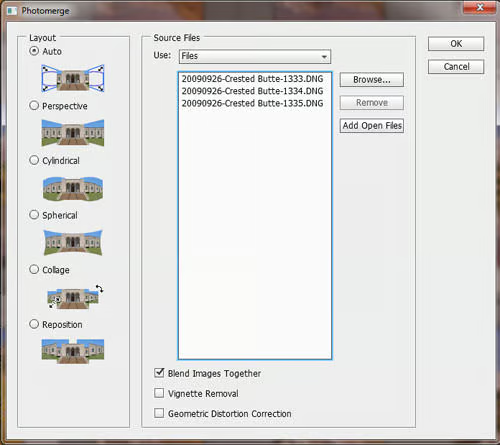
Import RAWs to Lightroom or your preferred RAW developer; set a neutral profile, synchronize exposure/WB/contrast across each bracket set, and export 16-bit TIFFs (or send directly to PTGui Pro). In PTGui or Hugin, define the lens as rectilinear at the correct focal length (15/24/35 mm). Place control points strategically across overlap areas with strong textures. Industry overlap guidance: around 25–30% for fisheye and 20–25% for rectilinear, though with ultra-wide rectilinear lenses a 30% overlap is safer for robust control points. For complex interiors, add vertical/horizontal line constraints to keep architecture straight. For tool choices and rationale, see this practical review of PTGui. Why PTGui is a top-tier panorama tool.
Cleanup & Enhancement
- Nadir patch: Use a clean ground shot or AI-based removers to patch out the tripod. Clone stamp for touch-ups.
- Color balance: Match interior lighting by neutralizing mixed color casts; fine-tune WB and HSL globally and locally.
- Noise reduction: Apply moderate NR to shadows in low-light scenes; the R5 handles ISO 800–1600 gracefully.
- Level horizon: Adjust roll/yaw/pitch in your stitcher; use vertical line constraints to straighten architecture.
- Export: For VR, output a 2:1 equirectangular (e.g., 16384×8192) JPEG/TIFF as required by your platform.
For a formal, step-by-step panoramic head and DSLR/ML workflow tailored to VR output, Meta’s creator docs are solid references. Set up a panoramic head for high-end 360 photos.
Useful Tools & Resources
Software
- PTGui (Pro) — fast, accurate, great for HDR and masking.
- Hugin — open-source panorama stitcher.
- Lightroom / Photoshop — RAW development, sky/line corrections.
- AI tripod removal tools — speed up nadir cleanup.
Hardware
- Panoramic heads: Nodal Ninja, Leofoto, and similar rail systems.
- Carbon fiber tripods — stable and light, ideal for travel and rooftops.
- Leveling bases — speed up leveling between locations.
- Wireless remotes — reduce touch-induced vibration.
- Pole extensions / car mounts — use tethers and fast shutters.
Disclaimer: names above are for search/reference; check official sites for specs and compatibility.
Recommended deep-dive video on panorama technique and stitching:
For understanding expected pano resolution from DSLR/mirrorless combos and how many frames you need, Panotools has a helpful reference. Estimate spherical resolution and frame counts.
Common Mistakes & How to Avoid Them
- Parallax error: Always rotate around the entrance pupil. Calibrate once per focal length and mark your rail.
- Exposure flicker: Use Manual exposure and fixed white balance; avoid Auto ISO for HDR panos.
- Tripod shadows and footprints: Capture a dedicated nadir frame and patch in post.
- Ghosting from movement: Use the two-pass method, faster shutters, and mask in your stitcher.
- Edge softness at f/2.8: Stop down to f/5.6–f/8 on the RF 15–35mm for best corner sharpness.
- Stabilization artifacts: Turn off IBIS/IS on a tripod to prevent micro-shifts between frames.
If you’re new to DSLRs/mirrorless 360 workflows, this overview of gear and techniques is a useful complement. DSLR/ML 360 virtual tour gear and workflow.
Frequently Asked Questions
- Can I shoot handheld panoramas with the Canon EOS R5?
Yes, but expect lower keeper rates and more stitching stress—especially with a rectilinear 15 mm. Increase overlap to 40–50%, use faster shutters (1/250 s+), enable IBIS/IS, and keep the camera rotating around roughly the same point. For professional work, use a leveled tripod and panoramic head.
- Is the Canon RF 15–35mm f/2.8L wide enough for single-row 360°?
Not reliably. As a rectilinear lens, 15 mm coverage is wide, but you’ll need at least two rows plus zenith and nadir for a clean full sphere. Single-row 360s are more practical with a fisheye.
- Do I need HDR for interiors with bright windows?
Usually yes. Bracket ±2 EV (3–5 frames) to capture the full dynamic range. The R5’s base ISO DR is strong, but windows often exceed what a single exposure can handle cleanly.
- How do I avoid parallax issues with this setup?
Use a panoramic head and align the entrance pupil. At 15 mm on the RF 15–35, start around 80 mm forward of the sensor plane, then fine-tune by checking near/far alignment while panning. Mark the rail for repeatable results.
- What ISO range is safe on the R5 in low light?
For tripod-based panoramas, ISO 100–400 is ideal; 800 remains very clean; 1600 is workable with modest noise reduction. If motion requires faster shutter speeds, don’t hesitate to push ISO slightly.
- Can I store pano settings to C1/C2 on the R5?
Yes. Create a “Pano” custom mode with Manual exposure, RAW, fixed WB, single AF then MF, IBIS/IS off (tripod), EFCS on, and your preferred bracketing. This speeds setup when you arrive on location.
- How can I reduce flare at 15 mm?
Avoid placing the sun on frame edges or in overlap areas. Use your hand or a flag just out of frame to shade the lens for each shot. Clean the front element and remove protective filters that may introduce extra flare.
- What’s the best tripod head for this combo?
A two-rail panoramic head with fore-aft and lateral adjustments is ideal. Look for engraved scales, a rotator with click-stops (e.g., 6/8/12 positions), and a stable clamp system compatible with Arca-Swiss plates.
Visual Aids and Examples
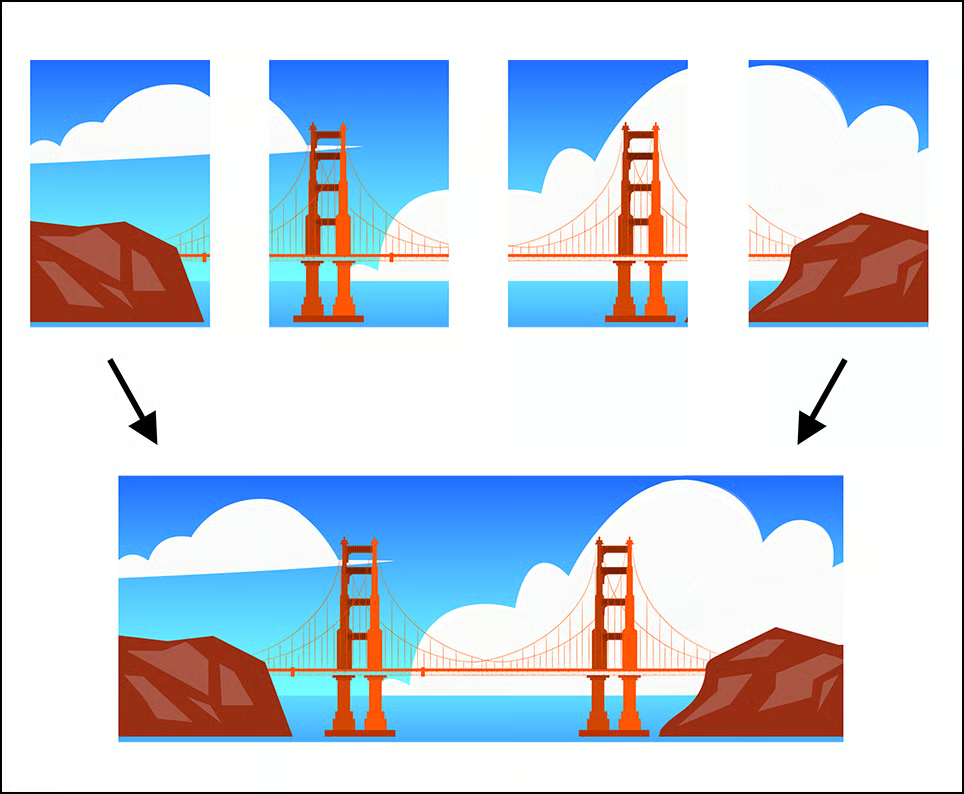
For broader technique discussion and community-tested tips, this Q&A thread is a classic reference. Best techniques to shoot 360 panoramas.
Wrap-Up: Mastering how to shoot panorama with Canon EOS R5 & Canon RF 15-35mm f/2.8L IS USM
With the EOS R5’s 45MP sensor and the RF 15–35mm’s rectilinear clarity, you can produce high-end 360 photos, architecture interiors, and even multi-row gigapixel stitches. The keys are consistent manual settings, precise nodal alignment, and disciplined overlap. For low light, stay within ISO 100–800 where possible, rely on a stable tripod, and use HDR bracketing when the scene demands it. Back up your capture with an extra pass and be conservative with safety on rooftops, poles, or car mounts. Stitch in PTGui or Hugin, clean up the nadir, and export an equirectangular master for your platform. With practice, this combo can deliver professional, reliable results in almost any environment.