
Why This Camera & Lens Are Great for Panoramas
If you want a precise, efficient workflow for how to shoot panorama with Canon EOS R5 & AstrHori 12mm f/2.8 Fisheye, this combo delivers. The Canon EOS R5’s 45MP full-frame sensor (36×24 mm) provides excellent detail and color latitude, with roughly 13–14 stops of dynamic range at base ISO and strong high-ISO performance for interiors and night scenes. Its IBIS helps when shooting handheld scouting frames, while the robust tripod tools (electronic level, focus peaking, manual exposure control) make it an ideal body for tripod-based 360 photos.
The AstrHori 12mm f/2.8 is a full-frame diagonal fisheye with a ~180° diagonal field of view. As a manual focus, manual aperture lens, it’s predictable for panorama work: you set focus once (ideally near the hyperfocal distance) and lock it. A fisheye minimizes the number of shots needed for a full 360×180° sphere, which speeds up capture and reduces stitching seams. The trade-offs are typical of fisheyes: stronger edge distortion (fine for equirectangular VR) and some lateral chromatic aberration and flare if bright lights are near the frame edge. On balance, this is a fast, reliable pairing for both indoor real estate and outdoor vistas.
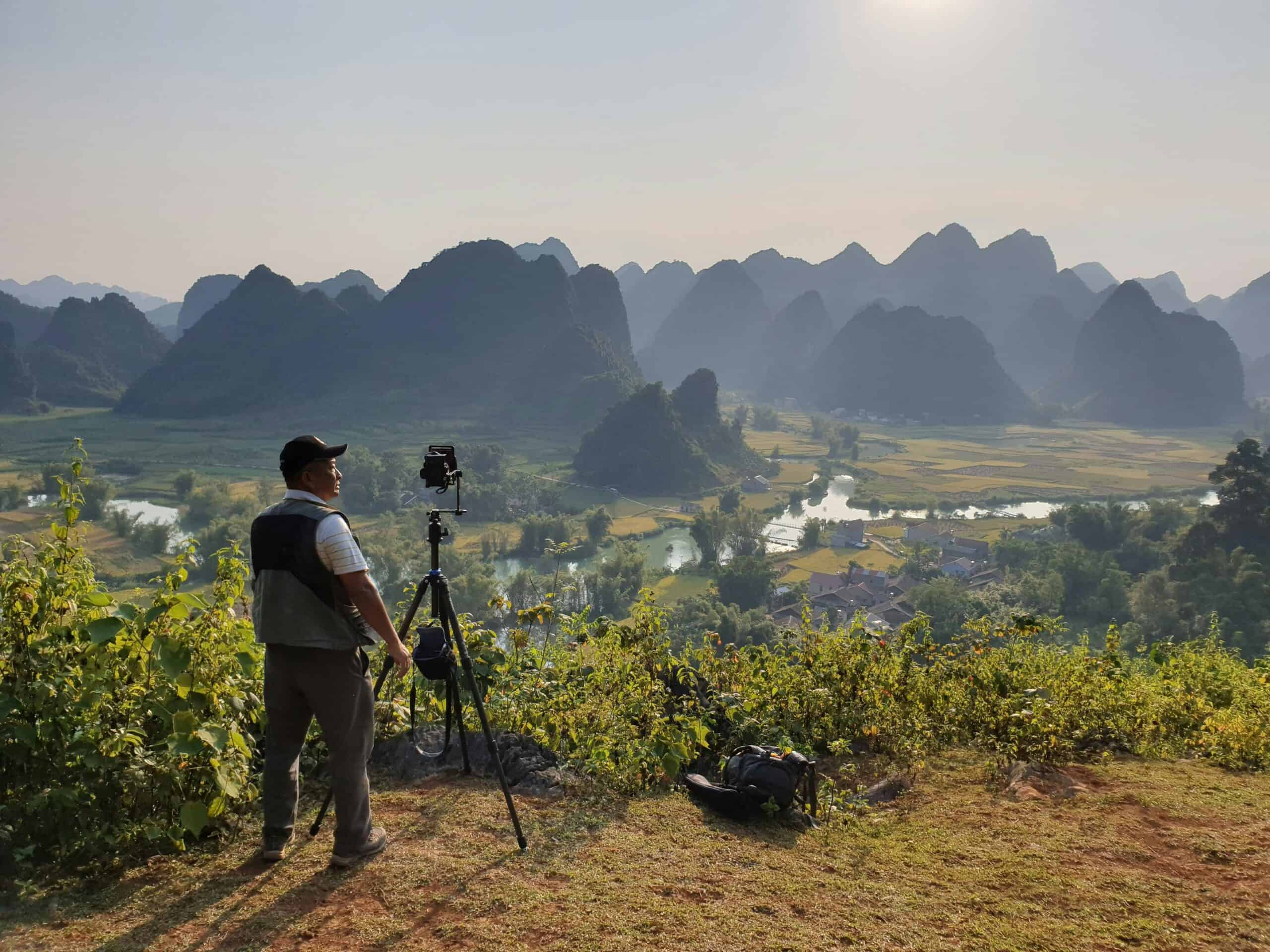
Quick Setup Overview
- Camera: Canon EOS R5 — Full-frame, 45MP; excellent DR and low-light performance; in-body stabilization; electronic level.
- Lens: AstrHori 12mm f/2.8 Fisheye — diagonal fisheye; manual focus/aperture; sharpest around f/5.6–f/8; moderate edge CA; flare control needs care around point light sources.
- Estimated shots & overlap:
– Safe standard: 6 around (60° increments) + 1 zenith + 1 nadir (25–35% overlap).
– Speed run: 4 around + zenith + nadir if subjects are distant and you’re confident in overlap.
– For tight interiors or near objects: prefer 6 around for cleaner stitching. - Difficulty: Easy–Moderate (2.5/5). Fisheye means fewer shots; nodal calibration remains essential.
Planning & On-Site Preparation
Evaluate Shooting Environment
Scan your scene for factors that complicate stitching: close foreground objects, reflective glass, moving people or foliage, and bright light sources near frame edges. For glass, get the front element as close as safely possible to reduce reflections; use a rubber lens hood or black cloth if allowed. In outdoor scenes, mind the sun angle to minimize flare and ghosting—slight camera rotation between shots can change flare, making blending harder.
Match Gear to Scene Goals
The R5’s dynamic range and color depth make it excellent for high-contrast interiors and sunset landscapes. Indoors, ISO 400–800 is typically “safe” on the R5 with clean results; outdoors or on a tripod at base ISO 100 you can capture pristine detail. The AstrHori 12mm fisheye reduces shot count, speeding up capture at events or in windy locations, but fisheye geometry can exaggerate straight lines before stitching. That’s fine for equirectangular output, just be sure to keep overlap consistent.
Pre-shoot Checklist
- Power & storage: Fully charge batteries; bring at least one spare. Use fast, large-capacity CFexpress/SD cards.
- Optics cleanliness: Clean front element and check for dust on the sensor; fisheyes show dust and fingerprints easily.
- Tripod & head: Leveling base saves time; verify your panoramic head’s nodal point calibration for this lens.
- Safety: On rooftops/poles, tether all gear; check wind gusts and obstacles; never leave the rig unattended.
- Backup workflow: When possible, shoot a second full round in case of moving people or missed overlap.
Essential Gear & Setup
Core Gear
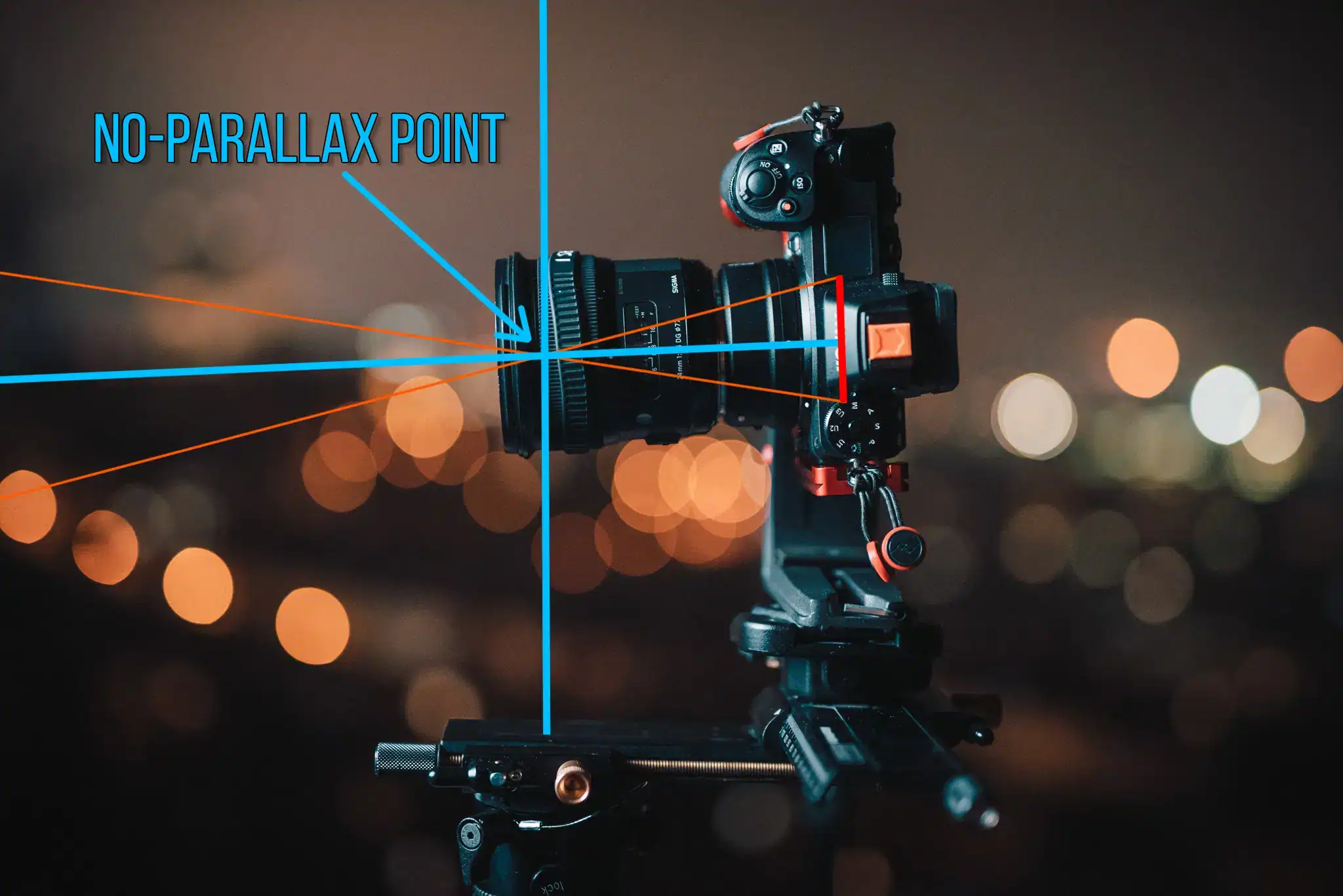
- Panoramic head: Lets you rotate around the lens’s entrance pupil (nodal point) to eliminate parallax. This is crucial when foreground objects are close; it dramatically improves stitching success.
- Stable tripod with leveling base: A leveled platform makes consistent overlaps and horizon alignment easier, reducing post-production corrections.
- Remote trigger or Canon Camera Connect app: Prevents vibration and lets you bracket HDR consistently without touching the camera.
Optional Add-ons
- Pole or car mount: Great for elevated or mobile perspectives. Use a safety tether, avoid high winds, and keep speeds low to minimize vibration. Tighten all clamps and consider a gyro/rigid pole if available.
- Lighting aids: Small LED panels or bounced flash can lift shadows in dim interiors. Keep lighting consistent across shots if you add light.
- Weather protection: Rain covers, silica gel packs, gaffer tape for wind noise on cables, and gloves for cold-weather handling.
For a deeper primer on panoramic heads and setup, this practical tutorial covers alignment and rotation strategies well. Panoramic head fundamentals
Step-by-Step Shooting Guide
Standard Static Scenes
- Level tripod and align the nodal point: Use the R5’s electronic level. On your panoramic head, move the camera forward/back until a near/far alignment test shows no relative movement while panning. With the AstrHori 12mm, expect the entrance pupil to be a few centimeters forward of the mount—fine-tune rather than rely on “universal” numbers.
- Manual exposure and white balance: Set Manual mode and lock WB (e.g., Daylight or a fixed Kelvin). This avoids exposure flicker and color shifts between frames that cause bands in the stitch.
- Focus and aperture: Switch to manual focus; set around the hyperfocal distance. At 12mm and f/8 on full frame, the hyperfocal is around 0.6 m; focusing near 0.6–0.7 m yields sharpness from roughly 0.3 m to infinity.
- Capture the round: For 6-around, rotate in 60° increments with 25–35% overlap. Add a zenith shot (tilt up) and a nadir shot (tilt down) for a full sphere.
- Nadir strategy: Take an extra “blank” shot after moving the tripod slightly or shoot a handheld nadir from above the tripod position to make patching easier.
HDR / High Dynamic Range Interiors
- Bracket ±2 EV (3–5 frames): The R5 supports up to 7 exposures in AEB; 5 frames at ±2 EV covers most window-to-interior contrasts.
- Keep WB and aperture fixed: Vary shutter speed only to preserve consistent depth of field and color.
- Use a remote: Prevent vibrations across brackets, especially at slower shutter speeds.
Low-Light / Night Scenes
- Lower ISO, longer shutter: Prefer ISO 100–400 on tripod for cleaner files; ISO 800 is still quite usable on the R5. Use longer exposures (1–10 seconds as needed).
- Disable IBIS on tripod: Turn stabilization off when locked down to avoid micro-adjustment blur.
- Use EFCS: Electronic first-curtain shutter reduces shutter shock. Avoid fully electronic shutter if street lights or movement might cause rolling artifacts.
Crowded Events
- Two passes: First for geometry, second for clean plates. Wait for gaps in traffic and reshoot frames with moving subjects.
- Mask in post: In PTGui or Photoshop, use masks to replace crowded areas with cleaner takes from your second pass.
Special Setups (Pole / Car / Drone)
- Secure everything: Safety tether the R5 and head. On poles, pre-rotate markings to minimize time aloft. For car mounts, drive slow and choose smooth roads.
- Increase overlap: Use 6–8 around shots to account for vibration-induced shifts; faster shutter speeds help on moving platforms.
Recommended Settings & Pro Tips
Exposure & Focus
| Scenario | Aperture | Shutter | ISO | Notes |
|---|---|---|---|---|
| Daylight outdoor | f/8–f/11 | 1/100–1/250 | 100–200 | Lock WB (Daylight/Kelvin); prioritize detail and overlap. |
| Low light / night | f/4–f/5.6 | 0.5–8 s | 100–400 (up to 800) | Tripod + remote; disable IBIS; consider noise reduction in post. |
| Interior HDR | f/8 | Bracket ±2 EV | 100–400 | Use 5–7 exposures if windows are very bright. |
| Action / moving subjects | f/5.6–f/8 | 1/200+ | 400–800 | Freeze motion; consider two-pass capture for clean plates. |
Critical Tips
- Manual focus at hyperfocal: For 12mm, f/8, focus ~0.6–0.7 m for near-to-infinity sharpness.
- Nodal calibration: Use a near/far alignment test. Mark your rail positions once dialed in to speed future setup.
- White balance lock: Fix WB to avoid color banding between frames; shoot RAW to refine later.
- RAW vs JPEG: Always shoot RAW for maximum DR and flexible stitching; JPEG compression can hinder control point detection.
- Stabilization: Turn IBIS off on a tripod; leave it on only for handheld scouting or emergency captures.
Stitching & Post-Processing
Software Workflow
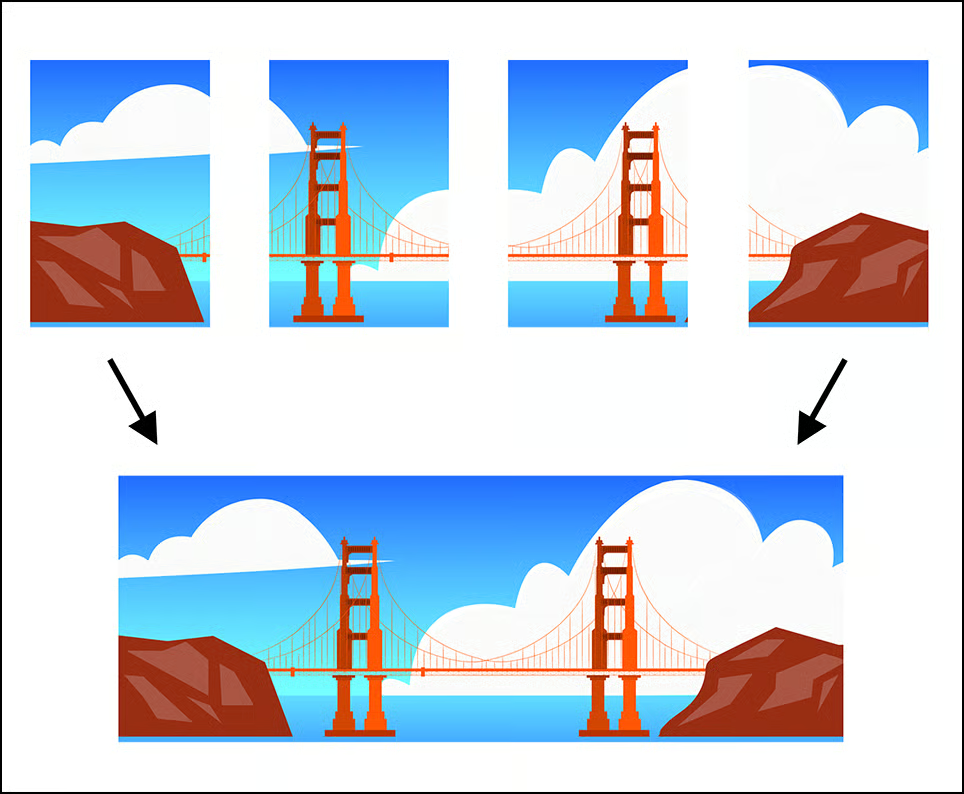
Import RAWs to your editor (Lightroom/Camera Raw). Apply consistent global adjustments: lens profile off (for fisheye, let the stitcher handle projection), fixed WB, and synchronized basic tone tweaks. Export 16-bit TIFFs or send directly to a stitcher like PTGui or Hugin. Fisheye inputs are straightforward: fewer images and robust control point matching. Recommended overlaps are ~25–35% for fisheyes and ~20–25% for rectilinear wide-angle lenses. After stitching, output an equirectangular 2:1 image (e.g., 16,384×8,192 for high-res) for VR or web viewers. For an in-depth review of PTGui’s capabilities, see this practical overview: PTGui for professional panoramas
Cleanup & Enhancement
- Nadir patching: Use PTGui Viewpoint Correction or export to Photoshop to clone/heal. AI object removal tools can speed up tripod cleanup.
- Color and noise: Equalize color across the sphere, apply selective noise reduction in shadow regions, and keep sharpening conservative to avoid seam emphasis.
- Leveling: Use horizon tools to correct roll/yaw/pitch; set your north direction to standardize embeds in virtual tours.
- Export: Save master as 16-bit TIFF; export JPEG at 8–12k width for the web. For VR platforms, follow their size and metadata guidelines.
Curious how resolution scales with focal length and sensor? This reference explains spherical resolution trade-offs: DSLR spherical resolution basics
Field-Tested Scenarios
Indoor Real Estate
Use 6 around + zenith + nadir at f/8, ISO 100–400. Bracket 5 shots at ±2 EV when windows blow out. Place the tripod away from walls to reduce near-subject parallax. Keep lights either all on or all off (avoid mixed color temps where possible). The R5’s clean files at ISO 400 make interior shadows easy to lift without banding.
Outdoor Sunset
Start at ISO 100, f/8, expose for highlights. Consider a second exposure round for shadows and blend selective sky/foreground frames in PTGui or Photoshop. Mind the sun position; shield with your hand just out of frame if flare becomes unmanageable. The AstrHori can produce ghosting if a bright sun sits on the frame edge—rotate slightly to place the sun consistently in a single frame for easier retouching.
Event Crowds
Prioritize speed and overlap consistency. Shoot a clean pass for geometry and a second pass to capture less-crowded moments in each direction. Mark your head angles and move quickly. The fisheye’s fewer shots reduce people movement mismatches.
Rooftop/Pole Shooting
Balance the pole carefully and keep the camera directly over the rotation point; use a lighter panoramic head. Increase shutter speed to 1/250–1/500 if wind is present. A safety tether is non-negotiable. Plan for 6–8 frames around to ensure coverage with inevitable sway.
Useful Tools & Resources
Software
- PTGui — fast, reliable stitching with excellent masking and viewpoint correction.
- Hugin — open-source option with powerful control point tools.
- Lightroom / Photoshop — RAW prep, color management, and finishing.
- AI tripod removal tools — speed up nadir patching and object cleanup.
Hardware
- Panoramic heads (Nodal Ninja, Leofoto, Sunwayfoto)
- Carbon fiber tripods with leveling bases
- Wireless remote shutters or app control
- Pole extensions / car suction mounts (with tethers)
For a broader planning guide on DSLR/mirrorless 360 workflows for VR output, Meta’s Creator resources are a helpful reference: Shoot and stitch a 360 photo for VR
Disclaimer: software/hardware names provided for search reference; check official sites for details.
Common Mistakes & How to Avoid Them
- Parallax error: Always align the entrance pupil on a pano head; test with near/far objects before serious work.
- Exposure flicker: Lock exposure and white balance; avoid auto ISO and auto WB.
- Tripod shadows/reflections: Take a nadir frame or plan for patching; avoid placing the rig directly under strong downlights.
- Ghosting from movement: Capture a second round for clean plates; use masks in PTGui or Photoshop.
- High-ISO noise: Prefer longer exposures on a tripod; the R5 can handle ISO 800, but base ISO gives the cleanest results.
Frequently Asked Questions
- Can I shoot handheld panoramas with the Canon EOS R5?
Yes for casual scenes, especially outdoors in good light. Use high shutter speeds (1/250+), overlap generously (40%+), and lock exposure/WB. However, for professional 360 photos—especially with near objects—use a tripod and panoramic head to avoid parallax.
- Is the AstrHori 12mm f/2.8 Fisheye wide enough for a single-row 360?
Yes. On full-frame, it supports 6-around plus zenith and nadir for a complete sphere. In open spaces, 4-around can work, but 6-around is safer for interiors and scenes with close foregrounds.
- Do I need HDR for interiors with bright windows?
Often yes. Bracket ±2 EV (5 frames is common) to preserve window detail and interior shadows. The R5’s dynamic range is strong, but windows can be 6–10 stops brighter than rooms; bracketing avoids clipped highlights.
- How do I avoid parallax issues with this combo?
Use a panoramic head and align the entrance pupil. Perform a near/far test and mark your rail positions. Recheck after any lens focus/aperture changes or if the head is bumped. A reliable alignment guide: Panoramic head setup tutorial
- What ISO range is safe on the R5 in low light?
For tripod-based panos, keep ISO at 100–400; ISO 800 is still clean for most outputs. If you need faster shutters (events/pole), 800–1600 is usable with careful noise reduction.
- Can I set up Custom Modes (C1/C2) for panoramas?
Yes. Save Manual exposure, fixed WB, manual focus, drive mode Single, AEB bracketing (if needed), EFCS on, IBIS off (tripod). Assign to C1 for standard scenes and C2 for HDR workflows to speed up setup.
Safety, Limitations & Data Integrity
Wind and height amplify risk—use tethers and don’t over-extend poles. The AstrHori 12mm can flare with strong point lights; shield or reframe to keep them in a single panel for easier cleanup. Back up cards immediately after shoots; keep two copies (onsite and offsite/cloud). If a stitch fails, check for missed overlap and parallax—reshoot the problematic segment when possible.
For more panorama background and community-vetted techniques, see this concise Q&A roundup: Best techniques to take 360 panoramas