
Why This Camera & Lens Are Great for Panoramas
The Canon EOS R3 paired with the Sigma 8mm f/3.5 EX DG Circular Fisheye is a powerhouse combo for fast, reliable 360° capture. The R3’s 24.1MP full-frame stacked CMOS sensor delivers clean, low-noise 14-bit RAWs, fast readout, excellent autofocus, and robust weather sealing—great for both interior real-estate work and outdoor adventures. With in-body image stabilization (IBIS) and superb ergonomics, the R3 makes long sessions on a tripod or pole easier and safer.
The Sigma 8mm f/3.5 EX DG is a circular fisheye, projecting a 180° field of view in all directions onto a circular image within the full-frame sensor. That huge FOV means far fewer shots are needed for a full spherical panorama compared to rectilinear lenses. At f/5.6–f/8, sharpness is excellent, and depth of field is practically “set-and-forget.” Expect some chromatic aberration on high-contrast edges (typical of fisheyes), but it’s easily handled in post.
Mount compatibility: The Sigma is an EF-mount lens, so just use Canon’s EF–EOS R adapter. Autofocus isn’t essential for panoramas; you’ll get the most consistent results using manual focus at or near the hyperfocal distance. The R3’s IBIS helps for handheld or pole work; on a tripod, turn IBIS off to avoid micro-jitters.
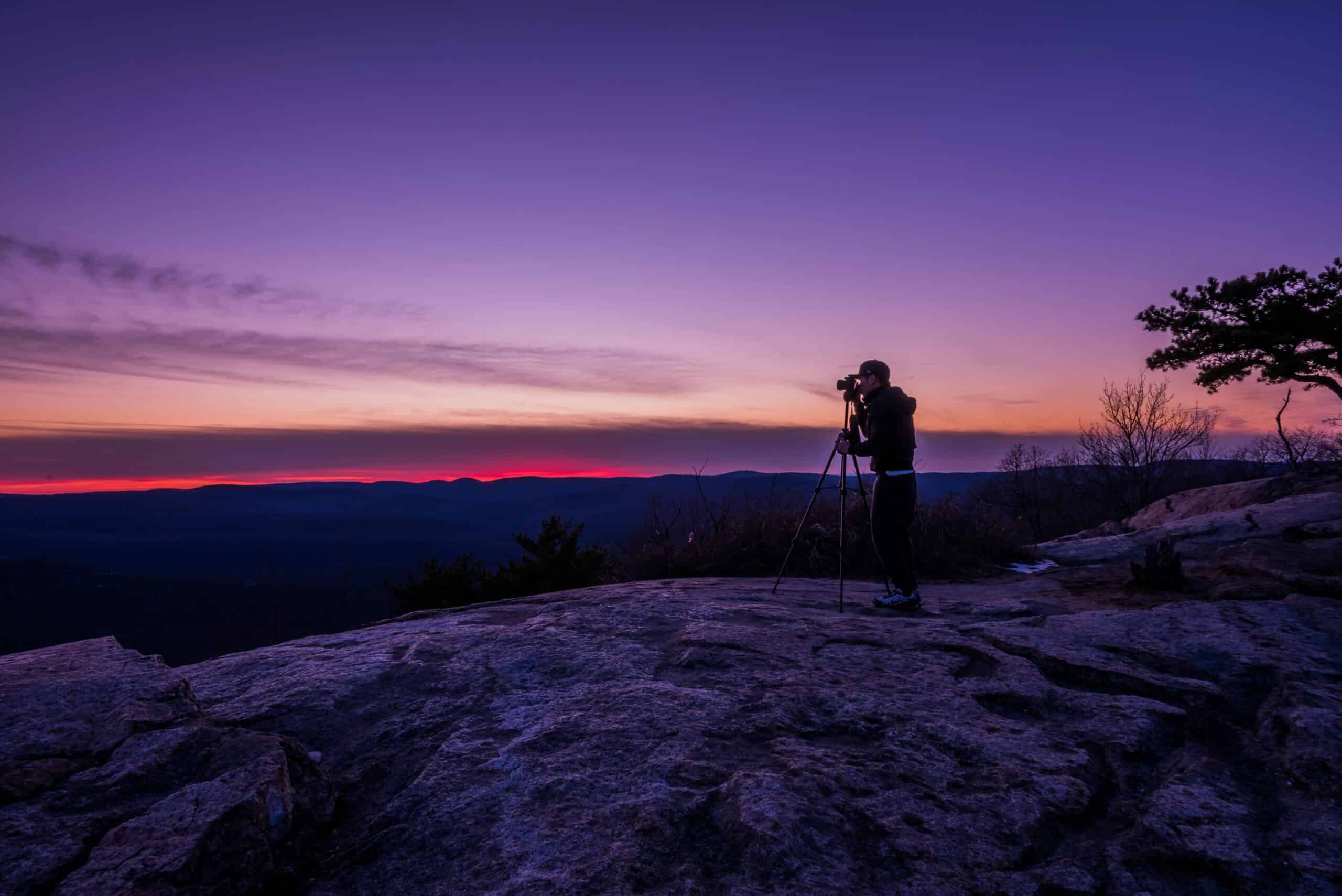
Quick Setup Overview
- Camera: Canon EOS R3 — Full-frame (36×24 mm) stacked CMOS, ~24.1MP, strong dynamic range at base ISO, excellent low-light performance and IBIS.
- Lens: Sigma 8mm f/3.5 EX DG Circular Fisheye — circular fisheye; best sharpness around f/5.6–f/8; typical fisheye CA handled well in post; front element is bulbous, handle with care.
- Estimated shots & overlap (field-tested):
- Minimal set: 3 shots around at 120° yaw, level tilt, 30–35% overlap (risk of stitching holes near nadir if tripod is large).
- Safe set: 4 shots around at 90° yaw, level tilt, ~30–40% overlap; add 1 offset nadir for clean tripod removal.
- Pole/handheld: 4–6 shots around to hedge motion/lean; add nadir patch later.
- Difficulty: Easy–Intermediate (very few frames to capture; biggest learning curve is nodal alignment and nadir cleanup).
Planning & On-Site Preparation
Evaluate Shooting Environment
Start by reading the scene: light direction, mixed lighting, reflections (glass/metal), and any moving elements. Fisheyes see everything—so watch for tripod shadows, your own reflection in windows, and the sun’s angle. For glass, keep at least a few centimeters off the surface and use a black cloth or flag to block reflections; avoid touching glass in public spaces and watch for flare/ghosting.
Match Gear to Scene Goals
The R3’s dynamic range at base ISO provides clean highlights and rich shadows—ideal for sunset skylines and interiors with bright windows. The 8mm circular fisheye’s advantage is speed: with just 3–4 frames around, you can cover a full sphere. The tradeoff is fisheye distortion, which is normal and corrected during stitching. For low light, the R3 handles ISO 400–1600 gracefully; plan to use ISO 100–400 on tripod, bump to 800–1600 if people are moving.
Pre-shoot Checklist
- Charge batteries, format fast cards; bring spares.
- Clean the Sigma’s front element carefully; it’s very exposed. Keep the cap on until ready.
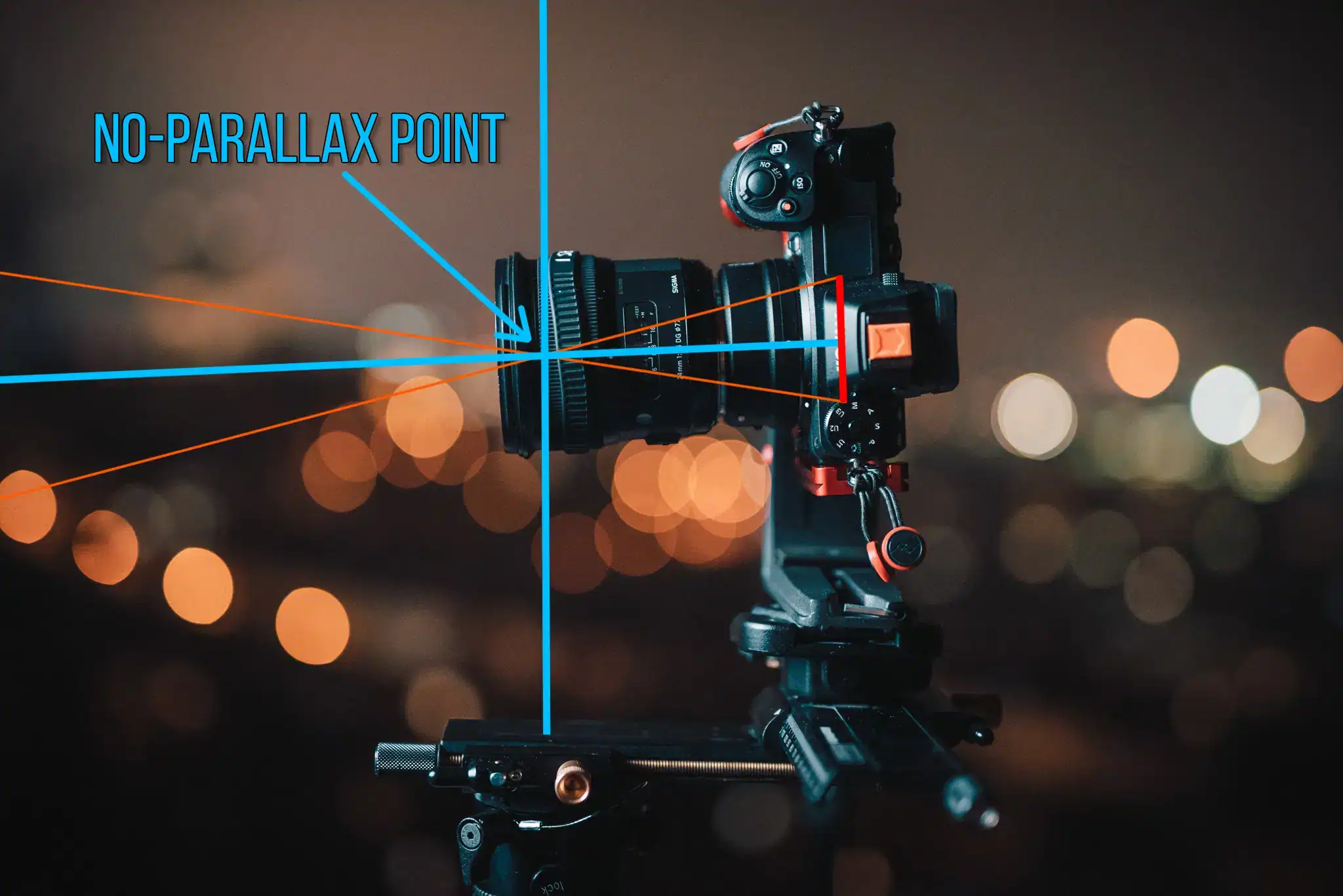
- Level the tripod; verify panoramic head calibration for the no-parallax point (entrance pupil).
- Safety: on rooftops/poles, tether your gear; mind wind. For car mounts, use redundant straps and avoid public roads without proper permits.
- Backup workflow: capture one complete “safety” round before experimenting.
Essential Gear & Setup
Core Gear
- Panoramic head: Lets you rotate precisely around the lens’s no-parallax point, preventing parallax errors with near objects and simplifying stitching.
- Stable tripod with a leveling base: A bubble or half-ball level saves time and keeps your horizon clean.
- Remote trigger or Canon Camera Connect app: Prevents camera shake and speeds up bracketed/HDR sequences.
Optional Add-ons
- Pole or car mount: Always tether; beware of wind-induced vibration and rotation. Use higher shutter speeds when off-tripod.
- Lighting aids: Small LED panels for dim interiors (bounce them to avoid hotspots).
- Weather protection: Rain cover, microfiber cloths, lens hood flag for flare control.
Video: Understanding Panoramic Heads
For a visual walkthrough on panoramic heads and alignment, this video is a helpful primer (concepts apply regardless of brand):
If you want a written reference, see this panoramic head tutorial that covers the fundamentals of no-parallax rotation. Panoramic head tutorial
Step-by-Step Shooting Guide
Standard Static Scenes
- Level and align the nodal point:
- Mount the R3 + Sigma on your panoramic head. Adjust the fore-aft rail so the rotation happens through the lens’s entrance pupil (no-parallax point). Start with a rough guess that the rotation center should be just behind the front element; fine-tune with a near object (0.5–1 m) against a far background and rotate—if the near object shifts relative to the background, adjust until it doesn’t.
- Record those rail measurements for future speed.
- Manual exposure and white balance:
- Switch to M mode; meter the brightest part you want detail in (window/sky), then open exposure until shadows are acceptable or plan to bracket.
- Lock a fixed white balance (Daylight/Tungsten/Custom) to avoid stitching color shifts.
- Capture sequence with overlap:
- Use 4 around at 90° yaw increments, level tilt, ~30–40% overlap for best results. If the scene is simple and distant, 3 around at 120° can work.
- Consider one offset nadir shot for a clean floor patch.
- Nadir (ground) shot:
- Move the tripod slightly, shoot a clean floor frame, or capture a handheld nadir looking straight down. You’ll patch this later.
HDR / High Dynamic Range Interiors
- Bracket ±2 EV (3–5 frames) to balance bright windows and darker interiors. Keep the camera steady and use a remote.
- Lock WB and focus so brackets match perfectly. In post, either fuse HDR per angle first, then stitch; or stitch brackets with HDR fusion in PTGui.
Low-Light / Night Scenes
- Use a tripod and remote; keep ISO between 100–800 for the cleanest results. The R3 remains very usable at ISO 1600–3200 if you need to freeze motion.
- Shutter speeds of 1–10 seconds are fine for static scenes. Disable IBIS on tripod to avoid micro-blur; use mechanical shutter indoors to avoid LED banding.
Crowded Events
- Shoot two passes: one normal, one “patient pass” where you wait for gaps in foot traffic at each yaw angle.
- In post, blend or mask moving people. Higher shutter (1/200–1/500) and ISO 800–1600 keeps people sharp when you want to preserve motion.
Special Setups (Pole / Car / Drone)
- Pole: Tether everything; pre-level the rotator, use 4–6 shots around to increase redundancy. Use 1/250–1/500 for wind vibration and IBIS on.
- Car: Only on private/controlled roads with secure mounts and spotters. Short exposures and higher ISO reduce motion blur.
- Drones: Generally use native 360 modes or specialized mounts; the 8mm circular fisheye is not practical on most drones.
Recommended Settings & Pro Tips
Exposure & Focus
| Scenario | Aperture | Shutter | ISO | Notes |
|---|---|---|---|---|
| Daylight outdoor | f/8–f/11 | 1/100–1/250 | 100–200 | Lock WB (Daylight). Minimal CA; easy stitch. |
| Low light/night | f/4–f/5.6 | 1/4–10s (tripod) | 100–800 | Turn IBIS off on tripod; use remote; mechanical shutter for LED interiors. |
| Interior HDR | f/8 | Bracket ±2 EV | 100–400 | Fuse HDR per angle, then stitch for clean windows/shadows. |
| Action / moving subjects | f/5.6–f/8 | 1/200+ | 400–1600 | Freeze motion; consider two-pass method. |
Critical Tips
- Manual focus near hyperfocal: At 8mm and f/8 on full-frame, hyperfocal is roughly 0.3 m—set and forget for sharpness from ~0.15 m to infinity.
- Nodal calibration: Use a near object vs. far background test. Mark your pano head rails once dialed in to speed future setups.
- White balance lock: Prevent color flicker—don’t mix Auto WB between frames or brackets.
- RAW over JPEG: Keep full dynamic range and better color for HDR and CA correction.
- IBIS off on tripod; IBIS on for handheld/pole. Avoid in-lens corrections while shooting; apply in post.
Stitching & Post-Processing
Software Workflow
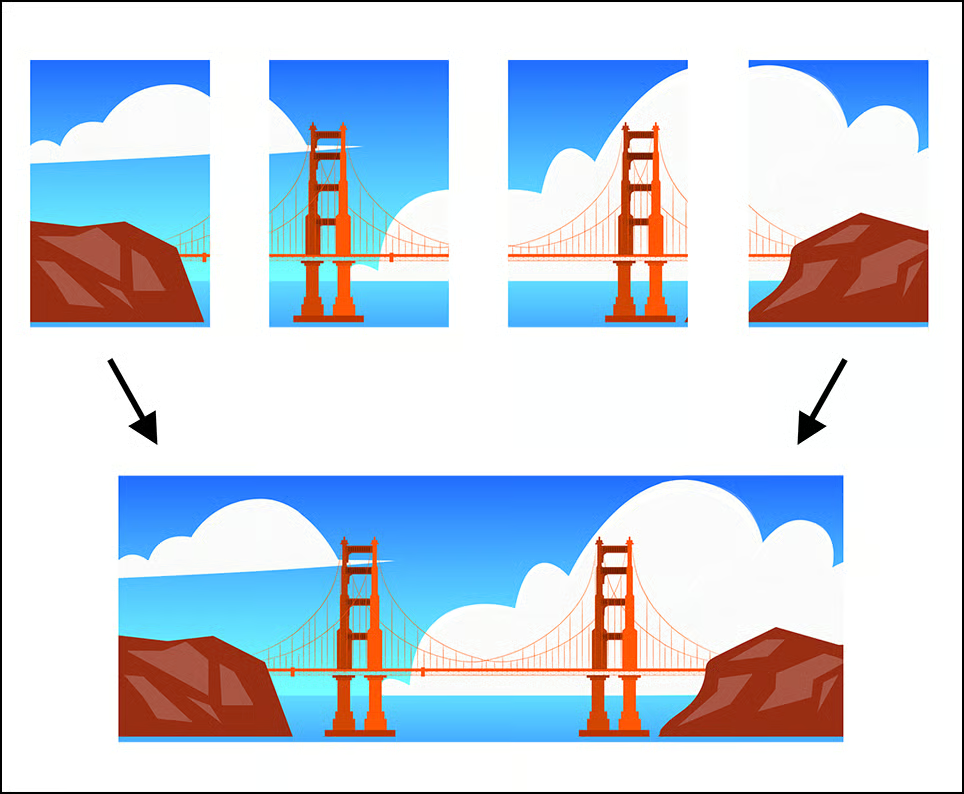
With a circular fisheye, stitching is fast and reliable. In PTGui or Hugin, set lens type to “circular fisheye” and let the optimizer detect the projection model (if unsure, try equidistant vs. equisolid and keep whichever yields lower control point errors). Industry guidance: aim for 25–30% overlap with fisheyes; rectilinear lenses typically need 20–25% overlap with more frames. Export a 2:1 equirectangular projection (e.g., 8192×4096 or 16384×8192) for VR platforms. PTGui overview and why it excels at complex pano jobs
If you want to estimate final spherical resolution with different lenses and sensors, the Panotools wiki is a great technical reference. Spherical resolution reference
Cleanup & Enhancement
- Nadir patch: Use a clean offset shot or clone/AI patch to remove tripod. Keep textures consistent with surrounding floor.
- Color consistency: Match white balance across merged brackets; use hue/sat and local adjustments to normalize mixed lighting.
- Noise reduction: Apply mild NR for ISO 1600–3200 brackets; don’t oversoften textures.
- Leveling: Correct horizon and verticals; in PTGui, use the “Horizon” tool and roll/pitch/yaw fine-tune.
- Export: Save a layered master (TIFF/PSB) and deliver optimized JPEGs for web and equirectangular uploads.
For platform-specific guidance on 360 photo publishing, this knowledge base is helpful. Using a DSLR/mirrorless to shoot and stitch a 360 photo
Useful Tools & Resources
Software
- PTGui panorama stitching
- Hugin (open source)
- Lightroom / Photoshop for RAW and cleanup
- AI-based tripod/nadir removal tools
Hardware
- Panoramic heads (Nodal Ninja, Leofoto) with fore-aft rails
- Carbon fiber tripods with leveling base
- Wireless remote shutters or interval timers
- Pole extensions / car suction mounts with safety tethers
Disclaimer: software/hardware names provided for search reference; verify specs and compatibility on official sites.
Common Mistakes & How to Avoid Them
- Parallax errors: Always align to the lens’s no-parallax point before serious shoots.
- Exposure flicker: Shoot manual exposure and fixed WB; avoid auto ISO for bracketed panos.
- Tripod shadows/glare: Watch sun angle; shoot an offset nadir; use a flag for flare control.
- Ghosting from movement: Use two-pass capture and mask in post; raise shutter speed if needed.
- Noise at night: Keep ISO as low as practical on tripod; consider HDR for dynamic scenes.
- IBIS artifacts on tripod: Turn stabilization off when mounted solidly.
Field-Proven Case Studies
Indoor Real Estate
Use 4 shots around at f/8, ISO 100–200, and bracket ±2 EV for windows. Keep the camera ~1.3–1.6 m high for natural perspective. A small LED bounced off the ceiling can lift dark corners without ugly hotspots. Expect easy stitches with minimal control point cleanup.
Outdoor Sunset Cityscape
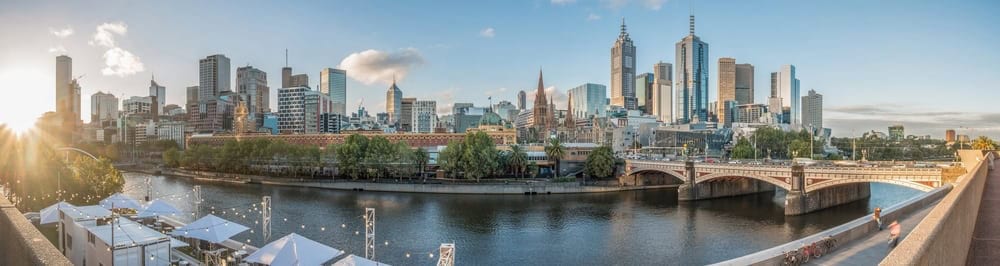
Base ISO, f/8–f/11, and 4 shots around. If the sun is in frame, shoot a second pass with your hand or a flag blocking direct flare and blend in post. The R3’s dynamic range at base ISO lets you keep highlights intact while recovering shadows.
Event Crowds
Raise shutter to 1/200–1/500 and ISO 800–1600, f/5.6–f/8. Do a quick full round, then a second pass waiting for gaps. Mask moving subjects later. The Sigma’s huge FOV reduces how many frames you need before the scene changes.
Rooftop Pole
Use a lightweight carbon pole, rotator at the top, 6 frames around for redundancy, and 1/250–1/500 shutter. Tether the gear. The R3’s IBIS helps for micro-vibrations, but avoid long exposures in wind.
Safety, Limitations & Care
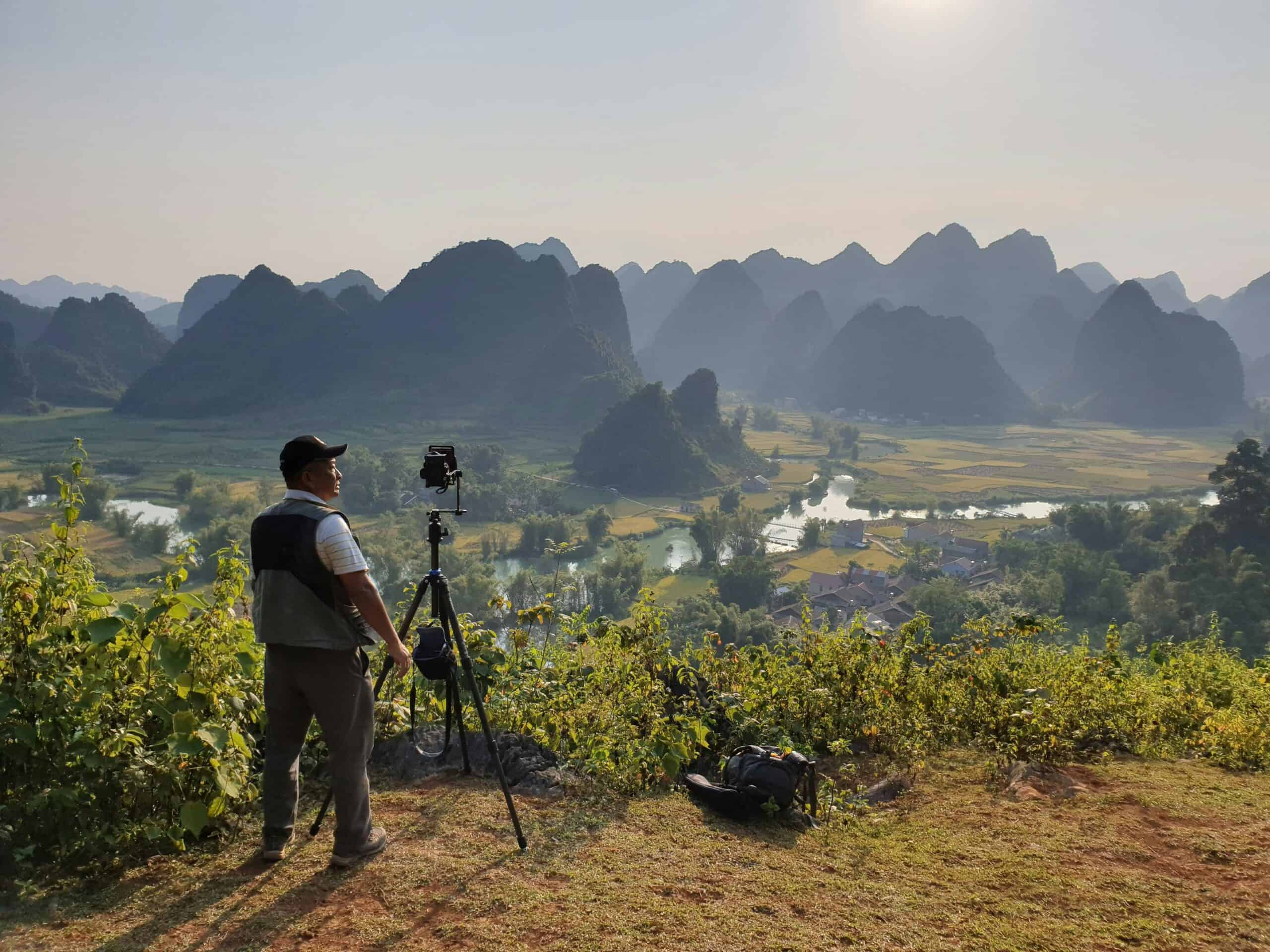
The Sigma 8mm’s front element is exposed—always cap when moving, and never place the lens face-down. Avoid wiping dust dry; blow first, then use a clean microfiber. On rooftops and poles, tether the camera, use a wrist strap, and mind bystanders. For car mounts, use redundant straps and don’t shoot on public roads without proper clearance. In crowds, secure your tripod legs to avoid tripping hazards.
Honest limitations: circular fisheye images need careful nadir cleanup; very near objects (<30 cm) can still show parallax if your nodal alignment is off; bright point lights can create flare/ghosts—change yaw or shield the lens and blend.
Backup workflow: After your first complete round, review frames at 100% for sharpness and exposure. If anything looks off, reshoot immediately while you’re still on location. For mission-critical work, store to dual cards and keep an extra battery handy.
Frequently Asked Questions
- Can I shoot handheld panoramas with the Canon EOS R3?
Yes. Use 4–6 frames around, higher shutter (1/250+), and IBIS on. Keep your body rotation smooth and consistent. Handheld is fine outdoors or when tripods are not allowed, but a tripod plus panoramic head remains the most reliable for perfect stitches.
- Is the Sigma 8mm f/3.5 wide enough for a single-row 360?
Absolutely. As a circular fisheye, it covers 180° in all directions per frame. With 3–4 shots around at level tilt, you can capture a full spherical panorama. Add a nadir shot for tripod removal.
- Do I need HDR for interiors with bright windows?
Often, yes. Bracket ±2 EV (3–5 frames) to preserve window detail and clean interior shadows. You can fuse HDR per angle before stitching, or let PTGui merge brackets. This keeps noise low and colors consistent.
- How do I avoid parallax problems with this setup?
Use a panoramic head and align rotation to the lens’s entrance pupil. Start with the fore-aft rail so the rotation axis sits just behind the front element. Test using a near object against a far background and adjust until relative movement disappears.
- What ISO range is safe on the EOS R3 in low light?
On tripod, stay at ISO 100–400 for the cleanest files. For handheld/crowds, ISO 800–1600 is still very usable; 3200 works with tasteful noise reduction. The R3’s stacked sensor handles higher ISO better than most, but base ISO remains best for dynamic range.
For additional reading on DSLR/mirrorless 360 workflows and FAQs, this guide is a solid overview. DSLR/Mirrorless 360 FAQ and gear guide
Wrap-up: A Fast, High-Quality 360° Workflow
If you want speed without sacrificing quality, few combos beat the Canon EOS R3 with the Sigma 8mm f/3.5 Circular Fisheye. With only 3–4 frames around, careful nodal alignment, and smart exposure control, you can deliver sharp, clean, and immersive 360° panoramas. Lock down your workflow—manual exposure, fixed WB, a reliable panoramic head, and PTGui/Hugin—and you’ll get repeatable, pro-grade results in any environment.