Why This Camera & Lens Are Great for Panoramas
The Canon EOS R3 is a professional full-frame, 24.1MP stacked CMOS mirrorless body with deep dynamic range, excellent low-light performance, and class-leading autofocus. Its large pixels (about 6.0 µm pitch) deliver clean files at ISO 100–800 and usable output well beyond that if you need it. Combined with a 14–24 mm ultra‑wide rectilinear zoom like the Sigma 14-24mm f/2.8 Art, you get a flexible field of view for everything from immersive 360° environments to dramatic single-row panoramas. The rectilinear rendering keeps straight lines straight—ideal for architecture and interiors—at the cost of needing more frames than a fisheye.
Important mount note: the Sigma 14-24mm f/2.8 DG DN Art is produced for Sony E and L-Mount and is not natively compatible with Canon RF. Because of flange distance differences, an E/L-to-RF adapter is not practical. For the Canon EOS R3, use the Sigma 14-24mm f/2.8 DG HSM Art (EF) with Canon’s EF‑EOS R adapter, or consider the Canon RF 15-35mm f/2.8 or RF 14-35mm f/4. The techniques and step counts below apply directly to a 14–24 mm rectilinear on full-frame, regardless of brand.
Why this combo works for panoramas: the R3’s robust files and IBIS (in-body image stabilization) help when you must go handheld or work quickly, while a 14–24 mm rectilinear zoom lets you decide between fewer shots (wider end) and higher resolution (longer end). Keep in mind that ultra‑wide rectilinears exhibit edge stretching—plan a healthy overlap and use a calibrated panoramic head to control parallax.
Quick Setup Overview
- Camera: Canon EOS R3 — Full-frame 24.1MP stacked CMOS, ~6.0 µm pixel pitch, strong DR (~14 stops at base), excellent AF; IBIS up to ~8 stops combined with IS lenses.
- Lens: Sigma 14-24mm f/2.8 Art (rectilinear) — best sharpness around f/5.6–f/8; low lateral CA; some vignetting wide open; bulbous front element (rear gel filter slot on DN, EF version uses rear drop-in via adapter).
- Estimated shots & overlap (360° spherical on full-frame):
- 14 mm: 2-row method — 10 shots around at +30°, 10 around at −30°, + zenith (1–2) + nadir (1–3) → ~22–25 frames at ~30–35% overlap.
- 18 mm: 2-row method — 12 around per row + Z/N → ~26–28 frames at ~30% overlap.
- 24 mm: 3-row method — 12–14 around × 3 rows + Z/N → ~40–48 frames at ~30% overlap.
For single-row cylindrical panos outdoors, you can use fewer frames (e.g., 6–10 around at 14 mm), but for full 360×180, plan rows.
- Difficulty: Intermediate (easy with a panoramic head; advanced if handheld or on a pole).
Planning & On-Site Preparation
Evaluate Shooting Environment
Scan for moving subjects (people, trees, traffic), bright windows or sun in frame, and reflective surfaces like glass or polished floors. Indoors, avoid standing too close to glass; step back 0.5–1 m to reduce flare and ghosting. Note any lights that flicker under electronic shutter (LEDs) and plan to use mechanical or EFCS shutter. Outdoors, plan your rotation so the sun is slightly off-axis for each frame to reduce flare; use your body or a lens shade to flag direct sun when possible.
Match Gear to Scene Goals
With the Canon EOS R3, you can confidently shoot at ISO 100–400 for base-quality pano work and push to ISO 800–1600 in low light with careful exposure. The large pixels keep noise manageable, and the stacked sensor handles mixed lighting well. A 14–24 mm rectilinear zoom lets you trade efficiency for resolution: at 14 mm you’ll need fewer shots but must manage edge stretch; at 24 mm you’ll capture finer detail at the cost of more frames and time. For interiors and real estate, rectilinear rendering is preferred over fisheye because straight lines are preserved.
Pre-shoot Checklist
- Power & media: Charge LP‑E19 batteries; carry at least one spare. Use fast CFexpress Type B (primary) and a UHS‑II SD as backup; format cards in-camera.
- Optics: Clean the front element carefully (bulbous glass is prone to flare). Pack a microfiber cloth and a rocket blower for dust.
- Tripod & head: Leveling base, panoramic head calibrated to the lens’s no‑parallax (entrance pupil) point. Verify all clamps are tight.
- Safety: In wind or on rooftops, keep a low center of gravity, hang a small weight from the hook, and always tether pole or car-mount rigs.
- Workflow insurance: Shoot one complete safety round. For HDR scenes, shoot a second bracket pass.
Essential Gear & Setup
Core Gear
- Panoramic head: A multi-row head (e.g., Nodal Ninja or Leofoto) lets you set the rotation point at the lens’s entrance pupil to eliminate parallax. This is essential for close objects (furniture, railings, cars).
- Stable tripod with leveling base: Level once at the base so your horizontal rotations are perfectly flat, reducing stitch errors.
- Remote trigger or Canon Camera Connect app: Fire without touching the camera. A short 2s timer also works if needed.
Optional Add-ons
- Pole or car mount: Use a safety tether; watch wind loads. Rotate slower and increase shutter speeds to fight vibration.
- Lighting aids: Small LED panels to fill dark corners for interiors. Turn off flickery bulbs if they cause banding.
- Weather protection: A rain cover and silica packets help keep optics clear; avoid wiping dust across bulbous glass.
For a deeper refresher on pano heads and entrance pupil concepts, see this practical panoramic head tutorial. Panoramic head basics and setup
Step-by-Step Shooting Guide
Standard Static Scenes
- Level and anchor: Level the tripod using the leveling base. Engage tripod leg locks firmly and anchor with a small weight if it’s windy.
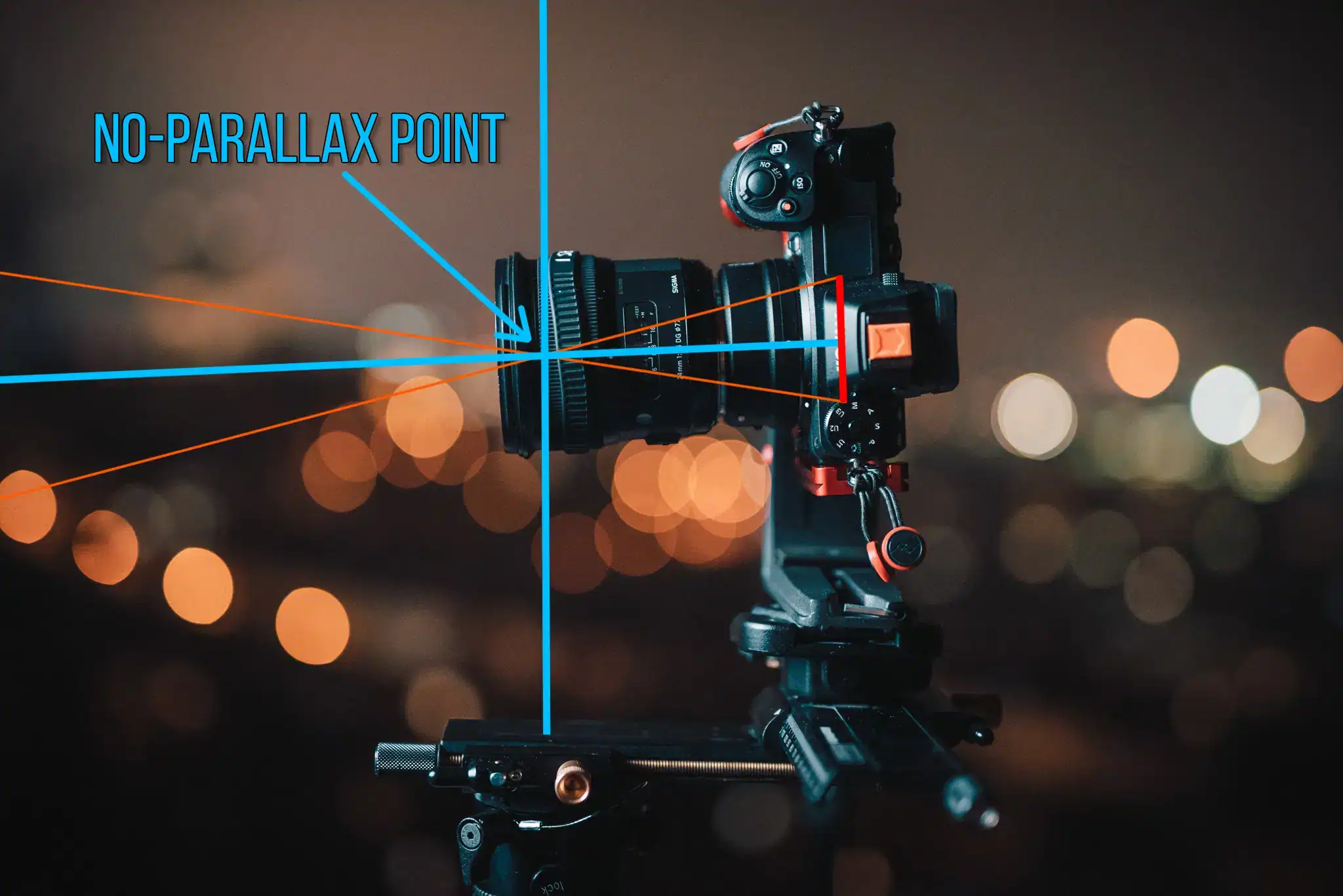
- Align the nodal point: On your panoramic head, move the camera forward/back until foreground and background objects align as you pan. As a starting point for a 14–24 rectilinear on full-frame:
- At 14 mm: the entrance pupil is typically ~80–95 mm forward of the sensor plane.
- At 24 mm: often ~70–85 mm forward.
These are starting ranges—fine‑tune with a parallax test.
- Lock exposure and color: Set Manual mode; choose a base exposure from a mid‑tone frame; lock white balance (Daylight outdoors, or a fixed Kelvin like 4000–5000K indoors). Shoot RAW.
- Focus: Switch to manual focus at the hyperfocal distance. At 14 mm, f/8, hyperfocal is ~0.83 m; at f/11 it’s ~0.61 m. Pre‑focus and tape the ring if needed.
- Capture sequence: For 360×180 at 14 mm, shoot 2 rows:
- Row 1: +30° pitch, 10 images around (36° steps).
- Row 2: −30° pitch, 10 images around (36° steps).
- Zenith: 1–2 frames near +90°.
- Nadir: 1–3 frames near −90°; offset the tripod if you plan a clean patch.
Use ~30–35% overlap. Advance in a consistent direction to simplify stitching.
- Record notes: If changing focal lengths during the shoot, voice‑note or slate the changes so you can group sets later.
HDR / High Dynamic Range Interiors
- Bracketing: Use AEB with ±2 EV (3–5 shots per position). The R3 supports up to 7 brackets; for bright windows, 5 is often ideal (−4 to +4 EV total range).
- Fixed color: Lock WB to a single preset or Kelvin value; don’t mix “Auto WB” across frames.
- Constant timing: Keep the same bracket order at every position (dark to bright). Use continuous high with remote for speed.
Low-Light / Night Scenes
- Exposure: f/4–f/5.6, shutter 1/30–1/60 (or longer on tripod), ISO 400–800 on the R3 is very clean; ISO 1600 remains usable if exposed to the right.
- Stability: Disable IBIS/lens IS on a tripod to avoid micro‑vibrations. Use EFCS or mechanical shutter to prevent banding under LEDs.
- Noise control: Slightly overexpose (without clipping highlights) for cleaner shadows; apply denoise in post.
Crowded Events
- Two passes: First pass quickly captures framing; second pass times gaps in foot traffic. Keep camera height constant between passes.
- Blend later: In PTGui or Photoshop, mask moving people. A higher frame count (more overlap) helps hide seams.
Special Setups (Pole / Car / Drone)
- Pole capture: Tether the pole; limit extension in wind. Use faster shutter (1/250–1/500) at ISO 400–800. Rotate slower; shoot extra overlap.
- Car-mounted: Use vibration-damping mounts; plan routes with lower speed and smoother pavement; avoid rolling shutter artifacts by using mechanical shutter.
- Drone: If you must, use a drone’s native panorama functions; keep horizon level and shoot more overlap to account for platform drift.
Recommended Settings & Pro Tips
Exposure & Focus
| Scenario | Aperture | Shutter | ISO | Notes |
|---|---|---|---|---|
| Daylight outdoor | f/8–f/11 | 1/100–1/250 | 100–200 | Lock WB to Daylight; EFCS or mechanical shutter |
| Low light/night | f/4–f/5.6 | 1/30–1/60 (or longer on tripod) | 400–800 | Disable IBIS/IS on tripod; remote trigger |
| Interior HDR | f/8 | Bracket ±2 EV (3–5 frames) | 100–400 | Balance windows and lamps; fixed WB |
| Action / moving subjects | f/5.6–f/8 | 1/200+ | 400–800 | Freeze motion; consider two-pass method |
Critical Tips
- Manual focus at hyperfocal: At 14 mm f/8, ~0.83 m; at f/11, ~0.61 m. Focus once and don’t touch between frames.
- Nodal calibration: Mark your rail settings for 14, 18, 24 mm on gaffer tape; re-check with a foreground object before important shoots.
- White balance lock: Mixed lighting kills stitches; pick a Kelvin value and stick to it across the set.
- RAW capture: Maximizes dynamic range and lets you synchronize tone/color before stitching.
- IBIS/IS: Off on tripod; on when handheld. The R3’s IBIS helps for quick single-row sweeps, but for multi-row on sticks, stability wins.
- Shutter mode: Mechanical or EFCS avoids LED banding. Full electronic is okay outdoors in daylight.
- Custom modes: Save pano presets to C1 (static pano) and C2 (HDR pano) on the R3 for instant recall.
Video: Visualizing the Nodal Point and Multi-Row Flow
Seeing the alignment process helps. This short explainer demonstrates pano head setup and practical rotation planning.
Stitching & Post-Processing
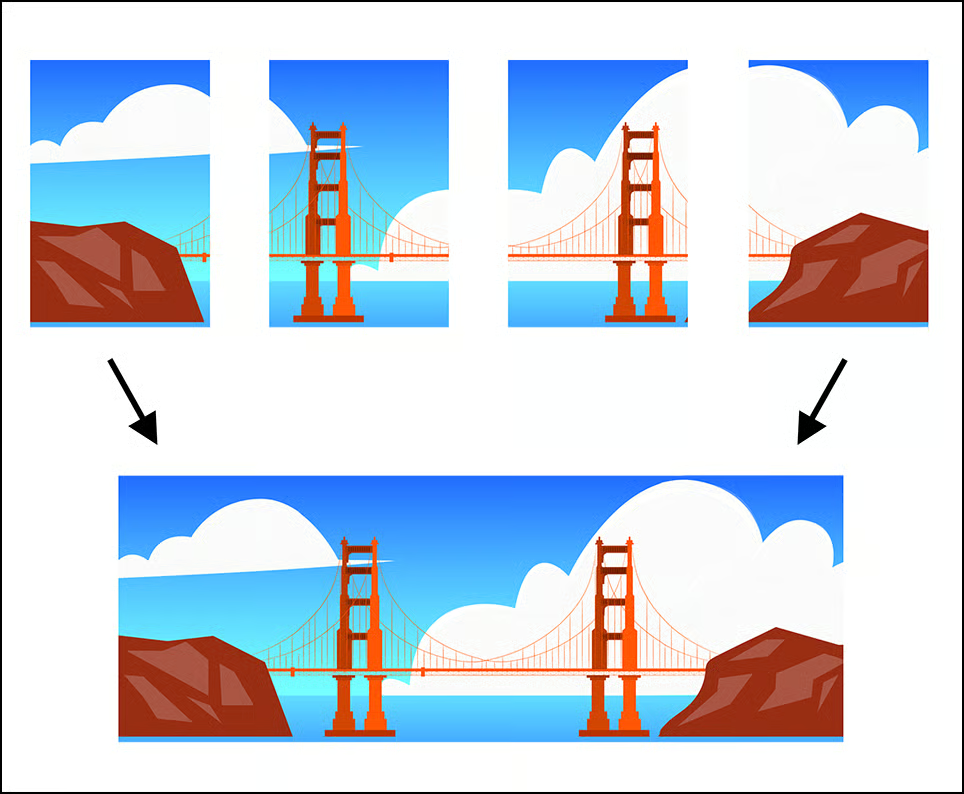
Software Workflow
Import RAWs into Lightroom or Capture One. Sync basic adjustments (WB, exposure, lens profile), then export 16‑bit TIFFs to your stitching tool. PTGui is fast and robust for complex multi-row sets; Hugin is a powerful free alternative; Photoshop and Affinity Photo can handle simpler sequences. Rectilinear ultra-wide sets often need more control points and careful horizon leveling than fisheye captures. Use ~30% overlap at ultra‑wide; rectilinear sets can stitch beautifully once nodal alignment is correct. For an overview of PTGui’s capabilities and workflow, see this review. PTGui for pro-grade panoramas
Cleanup & Enhancement
- Nadir patch: Create a clean nadir from a separate offset shot, or use AI/clone tools to remove the tripod.
- Color balance: Match color across windows and artificial lights; a custom curve for warm highlights helps interiors look natural.
- Noise control: Apply denoise before output; at ISO 800–1600 on the R3, moderate luminance denoise preserves detail well.
- Leveling: Use the stitching tool’s optimizer to lock the horizon; fine‑tune roll/yaw/pitch so the scene feels upright in VR.
- Output: Export 16‑bit TIFF intermediates for retouching; create final equirectangular JPEG (8–12K wide) for web or VR viewers.
If you are new to end‑to‑end 360 production, Meta’s creator docs outline reliable best practices and pitfalls to avoid. Mirrorless 360 shooting and stitching guide
Useful Tools & Resources
Software
- PTGui panorama stitching
- Hugin open source panorama stitcher
- Lightroom / Photoshop for RAW prep and retouch
- AI tripod removal tools for nadir cleanup
Hardware
- Panoramic heads: Nodal Ninja, Leofoto (multi-row)
- Carbon fiber tripods with leveling bases
- Wireless remotes or intervalometers
- Pole extensions and vehicle mounts with safety tethers
Disclaimer: product names are for search reference; always verify compatibility and the latest specs with the manufacturer.
Want a deeper dive into lens choices and pano head fundamentals? This overview is a solid primer. DSLR/mirrorless 360 lens and head guidance
Common Mistakes & How to Avoid Them
- Parallax error: Not aligning the entrance pupil causes broken lines; calibrate and mark your nodal rail.
- Exposure flicker: Auto exposure/WB changes across frames lead to patchy blends; lock both in manual.
- Tripod shadows and footprints: Shoot nadir frames and patch cleanly, or move position slightly for a clean plate.
- Ghosting: People/cars moving between frames cause ghosts; shoot two passes and mask in post.
- Noise and blur at night: Use stable support, lower ISO, longer shutter; remote trigger to avoid shakes.
- Lens flare: Flag the sun with a hand or card just outside the frame; choose rotation order to minimize direct light.
Frequently Asked Questions
- Can I shoot handheld panoramas with the Canon EOS R3?
Yes, for single-row cylindrical panos or fast coverage. Use IBIS on, 1/200+ shutter, and 30–40% overlap. For full 360×180 with nearby objects, a panoramic head on a tripod is strongly recommended to avoid parallax.
- Is the Sigma 14-24mm f/2.8 DG DN Art wide enough for single-row 360?
A single row at 14 mm won’t cover zenith and nadir. Plan at least two rows (+30° and −30°) plus dedicated zenith/nadir shots for complete spherical coverage. For true single-row 360s, a fisheye lens is typically used.
- Do I need HDR for interiors with bright windows?
Often yes. Bracket ±2 EV (3–5 frames) to preserve highlight detail outside and shadow detail inside. Keep WB locked and use consistent bracket order to simplify blending and stitching.
- How do I avoid parallax issues with this setup?
Mount the camera on a multi-row panoramic head and align to the lens’s entrance pupil. Start around 80–95 mm forward of the sensor plane at 14 mm, then fine‑tune using a near/far alignment test. Calibrate once and mark the rail for repeatability. A good visual primer helps if you’re new to nodal alignment. Setting up a panoramic head for perfect 360s
- What ISO range is safe on the EOS R3 for low light panoramas?
ISO 100–800 is the sweet spot for clean files; ISO 1600 remains very usable with proper exposure and denoise in post. If possible, favor tripod and longer shutter over pushing ISO.
Field-Tested Scenarios
Indoor Real Estate
At 14 mm, shoot two rows and HDR bracket ±2 EV. Lock WB (e.g., 4200–4800K). Use f/8 for corner sharpness and focus at ~0.8 m. Disable IBIS on a tripod and use EFCS to avoid banding under LEDs. A second safety pass saves the day if someone walks through a frame.
Outdoor Sunset
Meter with the sun just out of the frame, expose to protect highlights, and consider a gentle bracket (−2/0/+2) for flexibility. Rotate so that the sun position is captured in a single row quickly to minimize changing light across frames.
Event Crowds
Use 18–20 mm to reduce edge stretch of people at the frame borders. Fast shutter (≥1/200), ISO 400–800. Two-pass method for clean plates; mask in post.
Rooftop / Pole Capture
Keep the pole extension as short as possible in wind and use a guy line. Increase shutter speed to 1/500 at ISO 800 if needed. Shoot more overlap (40%) to compensate for small motions between frames.
Safety, Limitations & Data Protection
Ultra‑wide rectilinears have bulbous front elements—avoid bumps and salt spray; use a rigid hood and a soft pouch. On rooftops and near traffic, tether your rig; consider a spotter. Electronic shutter can band under LED lighting; use EFCS or mechanical indoors. The Sigma 14-24 DN is not RF-compatible; on an EOS R3, use the EF version (DG HSM) or an RF alternative. Finally, back up on-site to dual cards or a portable SSD; panoramas are time-consuming—losing a set hurts more than a single-shot miss.
Bonus: Visual Inspiration