Why This Camera & Lens Are Great for Panoramas
The Canon EOS R3 paired with the Laowa 8–15mm f/2.8 FF Zoom Fisheye is a powerhouse for spherical and ultra‑wide panoramas. The EOS R3’s 24.1 MP full‑frame stacked BSI sensor (approx. 6 µm pixel pitch) delivers excellent dynamic range (~13 stops at base ISO) and low‑noise files that stitch cleanly. Its in‑body image stabilization (IBIS), crisp EVF, focus peaking, and dependable Dual Pixel AF II make setup easy, while robust bracketing and silent operation are invaluable for interiors and events.
The Laowa 8–15mm is a constant f/2.8 full‑frame fisheye zoom that shifts from a circular 8mm fisheye (huge 180°+ coverage) to a 15mm diagonal fisheye that efficiently covers the frame with strong edge coverage. Because it’s a manual‑focus, manual‑aperture lens, it’s ideal for controlled, repeatable pano workflow: set once and lock. As a fisheye, it reduces the number of shots needed for full 360° capture, speeding up field work and minimizing stitching seams. Distortion is expected and welcomed here—pano software models fisheye projection extremely well, and you’ll defish only if needed for partial panos.
Mount compatibility: Use the version that fits your EOS R3. Laowa offers lenses in multiple mounts; many of their fisheyes are available in RF, and EF versions can be adapted seamlessly via Canon’s EF‑EOS R adapter. For panoramas, EXIF reporting isn’t critical, but remember to note focal length and aperture for consistent stitching settings.
Quick Setup Overview
- Camera: Canon EOS R3 — Full Frame, 24.1MP stacked BSI CMOS, ~13 stops DR at ISO 100, excellent high‑ISO noise control.
- Lens: Laowa 8–15mm f/2.8 FF Zoom Fisheye — fisheye zoom, manual focus/aperture, sharpest around f/5.6–f/8, typical fisheye CA controlled in post.
- Estimated shots & overlap:
- At 8mm (circular fisheye): 4 shots around (90° yaw steps) + 1 zenith + 1 nadir; 30–35% overlap.
- At 12mm (diagonal fisheye): 6 shots around (60° steps) + zenith + nadir; ~30% overlap.
- At 15mm (diagonal fisheye): 8 shots around (45° steps) + zenith + nadir; ~30% overlap.
- Difficulty: Intermediate (due to nodal alignment and manual lens workflow).
Planning & On-Site Preparation
Evaluate Shooting Environment
Before you set down the tripod, scan for moving elements (people, cars, flags, trees), reflective or glass surfaces, and strong point light sources (sun, street lamps). Reflections and specular highlights can cause stitching ghosting; place the tripod away from glass or at least 30–60 cm off glass to reduce flare and multi‑path reflections. For interiors, check mixed lighting (daylight, LEDs, tungsten) and plan to lock white balance. Outdoors, note sun position and consider a frame shielding technique during the zenith shot to reduce flare streaks.
Match Gear to Scene Goals
The Canon EOS R3’s clean files at ISO 100–800 and strong dynamic range make it excellent for detailed panoramas. Its bracketing options let you handle window‑bright interiors with ease. The Laowa 8–15mm fisheye minimizes shot count—great when you need speed (crowds, rooftops, pole work). The tradeoff is strong fisheye projection and edge stretching at 15mm, which are expected and manageable in pano software. For indoor real estate, fewer frames means fewer ghost seams around moving subjects (fans, curtains) and faster capture when people are nearby.
Pre-shoot Checklist
- Charge batteries and bring spares; format high‑speed cards; micro‑fiber and blower for lens/sensor.
- Level the tripod; verify panoramic head calibration for this body/lens combo (recorded marks help).
- Safety: On rooftops or windy locations, use a weight bag; tether pole rigs; avoid traffic lanes for car mounts.
- Backup workflow: After the main pass, shoot a second safety pass—small yaw offsets help rescue stitching.
Essential Gear & Setup
Core Gear
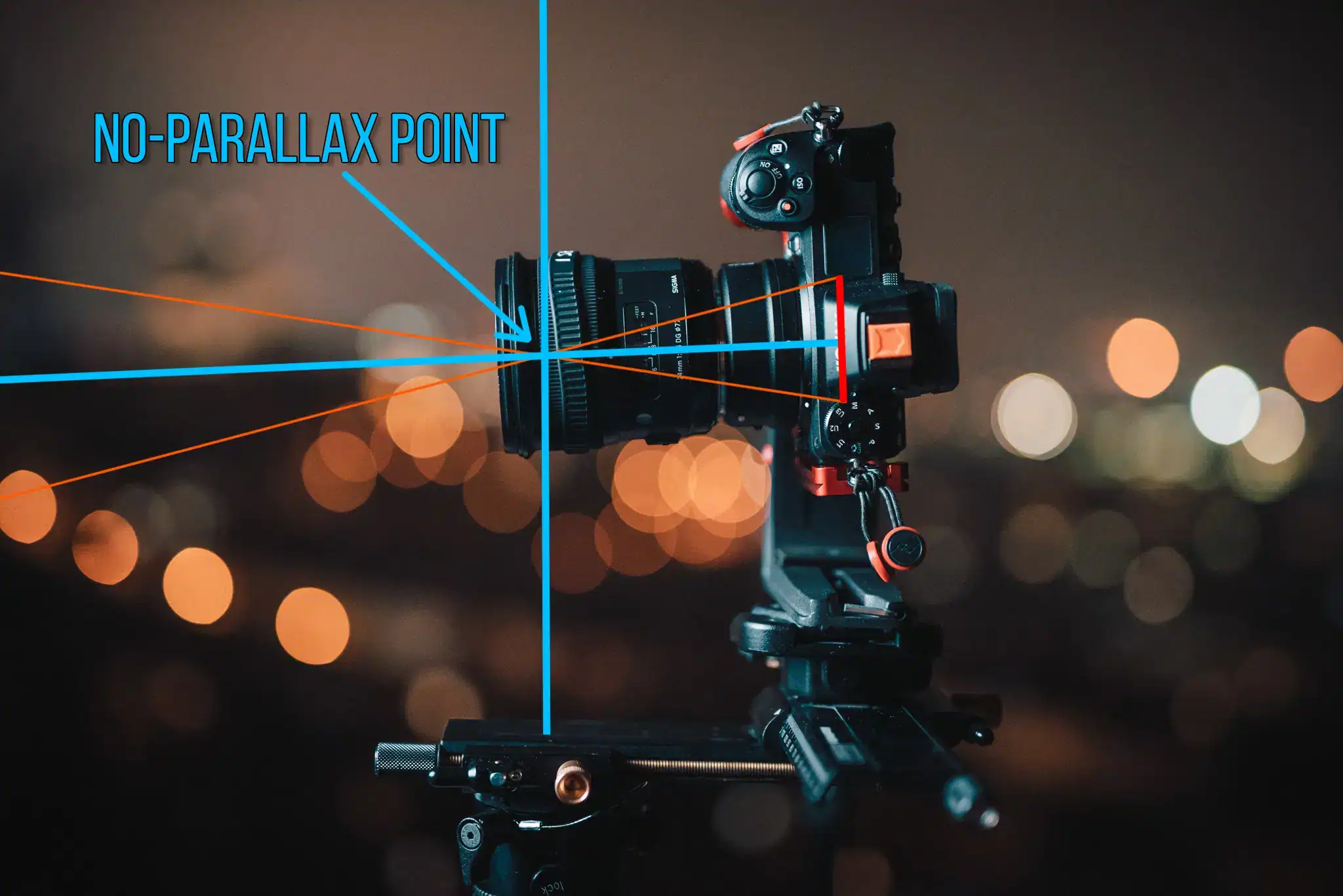
- Panoramic head: A proper pano head lets you rotate around the lens’s no‑parallax (entrance pupil) point to eliminate foreground/background shifts. This is critical for clean seams, especially with near objects.
- Stable tripod with leveling base: A bowl or leveling base makes the horizontal axis truly level so your yaw increments remain consistent.
- Remote trigger or Canon Camera Connect app: Prevents vibrations and lets you bracket without touching the camera.
Optional Add-ons
- Pole or car mount: Use a safety tether, check fasteners, and mind wind loads. The fisheye’s wide FOV amplifies visible vibration blur.
- Lighting aids: LED panels or bounced flash for interiors; keep lighting consistent across frames.
- Weather protection: Rain cover, lens hood, silica packs; wipe droplets immediately to avoid stitch artifacts.
For panoramic head theory and a step‑by‑step overview of nodal alignment, see this panoramic head tutorial resource. Panoramic head tutorial
Step-by-Step Shooting Guide
Standard Static Scenes
- Level & align: Level the tripod, then align the no‑parallax point. With the Laowa 8–15mm, start with the camera plate slid so that rotation passes roughly through the front half of the lens. Use a near object (1–2 m) and a far object (>10 m) and rotate—adjust fore/aft until their relative position doesn’t shift. Mark your rail for 8mm and 15mm positions.
- Exposure & WB: Switch to Manual exposure. Meter the brightest frame you expect (often near the sun or windows) and expose to protect highlights. Lock white balance (Daylight outdoors, Custom or Kelvin for interiors), and shoot RAW for maximum latitude.
- Capture sequence:
- 8mm: 4 around at 0° pitch in 90° yaw steps; then one zenith (~+60° to +90°) and one nadir (~−60° to −90°). 30–35% overlap.
- 12–15mm: 6–8 around at 0° pitch (60° or 45° steps), plus zenith and nadir. 30% overlap.
- Nadir shot: After the main ring, tilt down and capture a clean floor shot by offsetting the tripod or using a handheld nadir with the lens over the same no‑parallax point. This makes tripod removal easy in post.
HDR / High Dynamic Range Interiors
- Bracket strategy: Use ±2 EV brackets (3 or 5 frames). The R3 handles AEB smoothly; for severe window contrast, consider 5 frames spaced by 2 EV.
- Consistency: Keep WB locked and exposure mode in Manual. Use mechanical or electronic‑first‑curtain shutter to avoid banding under LEDs; avoid full electronic shutter under artificial light.
- Workflow: Either HDR‑merge brackets first (per angle) then stitch, or stitch bracketed sets as stacks in PTGui/Hugin. Both work; test which yields fewer ghosts for your scenes.
Low-Light / Night Scenes
- Long exposures: Use f/4–f/5.6, ISO 100–800 (ISO 1600 is still usable on the R3), and shutter speeds 1–8 s as needed. IBIS should be turned off on a tripod to prevent micro‑jitter.
- Remote triggering: Use a 2‑sec timer or remote/app to avoid touching the camera.
- Star/sky zenith: For very dark skies, consider a separate, longer zenith exposure and mask it in during post for cleaner stars.
Crowded Events
- Two passes: First pass quickly for coverage; second pass wait for gaps in traffic/people at problem seams.
- Masking later: In PTGui/Photoshop, use masks to select the cleanest figures. The fisheye’s fewer frames reduce alignment headaches.
Special Setups (Pole / Car / Drone)
- Pole: Balance the rig and tether the camera. Keep shutter speeds higher (1/200–1/500) when there’s wind. Shoot 8mm to minimize frame count and sway time.
- Car mount: Scout safe routes; avoid vibrations by using softer tires and lower speeds. Trigger with an intervalometer or app.
- Drone: If lifting the rig is not permitted/safe, don’t. Follow all regulations; pole from rooftops often substitutes safely.
Field‑Tested Case Snapshots
- Real estate interior: 12mm, f/8, ISO 200, 5‑frame ±2 EV brackets; 6 around + Z + N. Windows retain detail; minimal ghosting.
- Sunset overlook: 8mm, f/8, ISO 100, 4 around + Z + N; add a second darker pass toward the sun for highlight recovery.
- Rooftop pole: 8mm, f/4, ISO 400, 1/250 s; 4 around only (skip Z/N if ground patching is acceptable). Safety tether mandatory.
Recommended Settings & Pro Tips
Exposure & Focus
| Scenario | Aperture | Shutter | ISO | Notes |
|---|---|---|---|---|
| Daylight outdoor | f/8–f/11 | 1/100–1/250 | 100–200 | Lock WB to Daylight/Kelvin 5200–5600K |
| Low light/night | f/4–f/5.6 | 1/30–8s | 100–800 | Tripod; use mechanical/EFCS shutter; turn off IBIS |
| Interior HDR | f/8 | Bracket ±2 EV | 100–400 | Protect window highlights; merge then stitch |
| Action / moving subjects | f/5.6–f/8 | 1/200+ | 400–800 | Freeze motion; consider two‑pass capture |
Critical Tips
- Manual focus: Use focus magnification and peaking on the R3. Set hyperfocal and forget. Approx. hyperfocals on full frame:
- 8mm at f/5.6: ~0.38 m → sharp from ~0.19 m to infinity.
- 15mm at f/8: ~0.94 m → sharp from ~0.47 m to infinity.
- Nodal calibration: Mark your rail for 8mm and 15mm. Recheck if you change the zoom or add filters.
- White balance lock: Avoid Auto WB shifts across frames; set Kelvin or a custom WB from a gray card.
- RAW over JPEG: Preserve dynamic range and color fidelity for cleaner blends and better seam matching.
- IBIS and lens IS: Turn OFF on tripod to prevent sub‑pixel drift in long exposures; turn ON for handheld tests only.
- Shutter mode: Prefer mechanical or EFCS; avoid full electronic under artificial lighting to prevent banding.
- Lens profile: Because the Laowa is manual, set proper projection/focal metadata in your stitching software for best control point detection.
Stitching & Post-Processing
Software Workflow
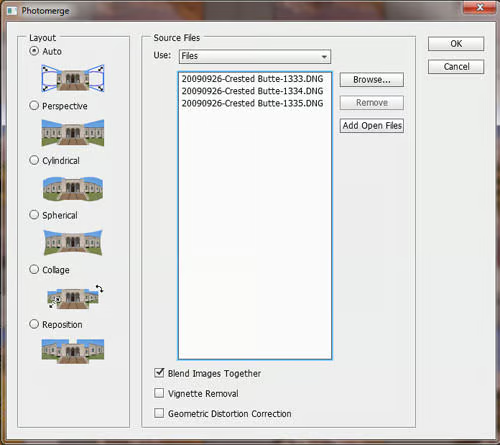
PTGui and Hugin are industry standards for 360° stitching. Fisheye frames are typically easier to stitch than rectilinear because there are fewer shots and well‑modeled projections; aim for 25–35% overlap with fisheyes and ~20–25% with rectilinear lenses. In PTGui, set lens type to “fisheye” and enter your focal length (8, 12, or 15mm) and crop. Optimize control points, then set the projection to equirectangular for 360/180 output. You can HDR‑merge inside PTGui (Exposure Fusion or HDR) or pre‑merge brackets in Lightroom before stitching. For a review of PTGui’s strengths in professional pano work, see this overview. PTGui for pro panoramas
Cleanup & Enhancement
- Nadir patch: Capture a clean nadir or patch later with content‑aware fill; specialized AI tripod removal tools can speed this up.
- Color & noise: Match color temperature across frames; apply gentle noise reduction for high‑ISO interiors or night shots.
- Leveling: Use horizon and vertical constraints to correct roll/yaw/pitch for a stable viewer experience.
- Sharpen last: Output an equirectangular at 8K–16K width depending on capture; sharpen subtly after resizing.
- Export: Save 16‑bit TIFF master and a high‑quality JPEG for web/VR platforms. Follow platform guidelines for 360 metadata.
If you’re new to DSLR/mirrorless 360 workflows, this concise guide from Meta’s creator resources explains the full capture‑to‑stitch path. DSLR/mirrorless 360 photo workflow
Resolution Expectations
With 8mm (4 around + Z + N) on a 24 MP sensor, expect an equirectangular between ~10K–13K pixels wide, depending on overlap and crop; with 12–15mm (6–8 around + Z + N), 12K–16K is typical. For a deeper dive into spherical resolution math, see the PanoTools community reference. Spherical resolution explained
Video: A Quick Panorama Workflow
Here’s a succinct video walkthrough showing a practical capture‑to‑stitch approach (similar steps apply to the EOS R3 and fisheye zoom workflow):
For more pano head setup principles and clean control point strategy, this tutorial is a solid companion to your field practice. Setting up a panoramic head
Useful Tools & Resources
Software
- PTGui panorama stitching
- Hugin (open source)
- Lightroom / Photoshop for RAW and retouching
- AI tripod removal or content‑aware fill tools
Hardware
- Panoramic heads (Nodal Ninja, Leofoto; compact “travel” heads for speed)
- Carbon fiber tripods with leveling base
- Wireless remote shutters or Canon Camera Connect
- Pole extensions / car suction mounts with safety tethers
Disclaimer: software/hardware names provided for search reference; check official sites for compatibility and current features.
Common Mistakes & How to Avoid Them
- Parallax error → Always rotate around the no‑parallax point; recalibrate when changing focal length.
- Exposure flicker → Manual exposure and locked WB; avoid Auto ISO across frames.
- Tripod shadows and footprints → Shoot a clean nadir or patch later.
- Ghosting from moving subjects → Two‑pass capture and mask in post.
- Night noise and blur → Use low ISO, longer shutter on a stable tripod; disable IBIS; use remote release.
- Banding under LEDs → Use mechanical/EFCS shutter; avoid full electronic shutter indoors.
Frequently Asked Questions
- Can I shoot handheld panoramas with the Canon EOS R3?
Yes, but expect lower stitch reliability. IBIS helps, yet parallax from rotating around your body instead of the lens’s entrance pupil can create seam errors—especially with near objects. Handheld is fine for quick outdoor scenes with distant subjects; use higher shutter speeds (1/200+) and keep overlap generous (35–40%).
- Is the Laowa 8–15mm wide enough for single‑row 360?
Absolutely. At 8mm (circular fisheye), 4 shots around plus zenith and nadir deliver a clean spherical 360. At 12–15mm (diagonal fisheye), do 6–8 around plus Z/N. Fewer shots mean faster capture and fewer moving‑subject issues.
- Do I need HDR for interiors with bright windows?
Usually yes. The EOS R3 has solid dynamic range, but window‑bright scenes exceed a single exposure. Use ±2 EV bracketing (3 or 5 frames). Merge brackets then stitch, or stack within PTGui—pick the method that yields the fewest ghosts in your workflow.
- How do I avoid parallax issues with this setup?
Calibrate the no‑parallax point for both 8mm and 15mm and mark the rail. Use a near and far object test and slide the camera until their relative position does not shift during yaw rotation. Recheck if you change zoom or add accessories.
- What ISO range is safe on the EOS R3 in low light?
For tripod‑based panoramas, ISO 100–800 is the sweet spot; ISO 1600 remains usable with careful noise reduction. Favor longer shutter speeds over pushing ISO, and disable IBIS on tripod to keep pixels perfectly aligned.
Safety, Limitations & Trustworthy Workflow
Wind and elevation multiply risk. On rooftops or poles, add a sandbag to the tripod/apex, keep the rig tethered, and never operate above crowds. The Laowa’s bulbous fisheye front element is exposed—use the hood where possible and keep a soft pouch handy. In rain or sea spray, wipe often to avoid droplets that stitch into arcs across the sky. The EOS R3’s weather sealing is robust, but always dry and inspect after harsh conditions.
For data safety, shoot a second full pass (even a quick one) and back up cards immediately. Keep a simple field log of focal length, rail mark, and any HDR decisions. This discipline pays off when you troubleshoot a seam or need to restitch months later.