
Why This Camera & Lens Are Great for Panoramas
Curious about how to shoot panorama with Canon EOS R3 & AstrHori 12mm f/2.8 Fisheye? This combo is a robust, field-proven choice for creating fast, clean 360° photos that stitch reliably. The Canon EOS R3 is a 24.1MP full-frame mirrorless body with a stacked BSI sensor, excellent dynamic range at base ISO, and superb high‑ISO behavior. Its large pixel pitch (about 6.0 µm) gives you low noise and smooth tonal transitions—ideal for sky gradients and shadow recovery. The R3 also offers in-body image stabilization (IBIS), deep buffer, silent electronic shutter, dual card slots (CFexpress Type B + SD), and pro-grade battery life—practical advantages when shooting lengthy pano sessions.
The AstrHori 12mm f/2.8 Fisheye is a manual, full‑frame diagonal fisheye that delivers approximately 180° diagonal field of view with very low focus breathing and predictable distortion. For panoramas, a fisheye lets you cover the full sphere with fewer frames, which reduces time on site and the chances of misalignment in busy scenes. Compared to rectilinear wide angles, fisheyes trade straight lines for coverage: you’ll capture fewer images and still achieve complete 360×180° coverage. Stop it down to f/5.6–f/8 for sharpness across the frame and manageable chromatic aberration. The lens is available in RF mount (or use an EF mount with adapter), and the all‑manual operation actually simplifies pano work: you lock focus and aperture, and nothing changes during the rotation.
Quick Setup Overview
- Camera: Canon EOS R3 — Full Frame, 24.1MP stacked BSI sensor; pixel pitch ≈ 6.0 µm; excellent DR at ISO 100–200 and clean ISO up to 1600 for pano use.
- Lens: AstrHori 12mm f/2.8 Fisheye — diagonal fisheye; ~180° diagonal FOV; manual focus/aperture; best stopped to f/5.6–f/8; mild purple fringing possible near edges backlit.
- Estimated shots & overlap: With a 12mm FF fisheye, plan 6 shots around at 60° yaw + 1 zenith + 1 nadir (total 8). Overlap 30–35%. For extra safety or handheld, 8 around is also reliable.
- Difficulty: Moderate — fast once the nodal point is calibrated.
Planning & On-Site Preparation
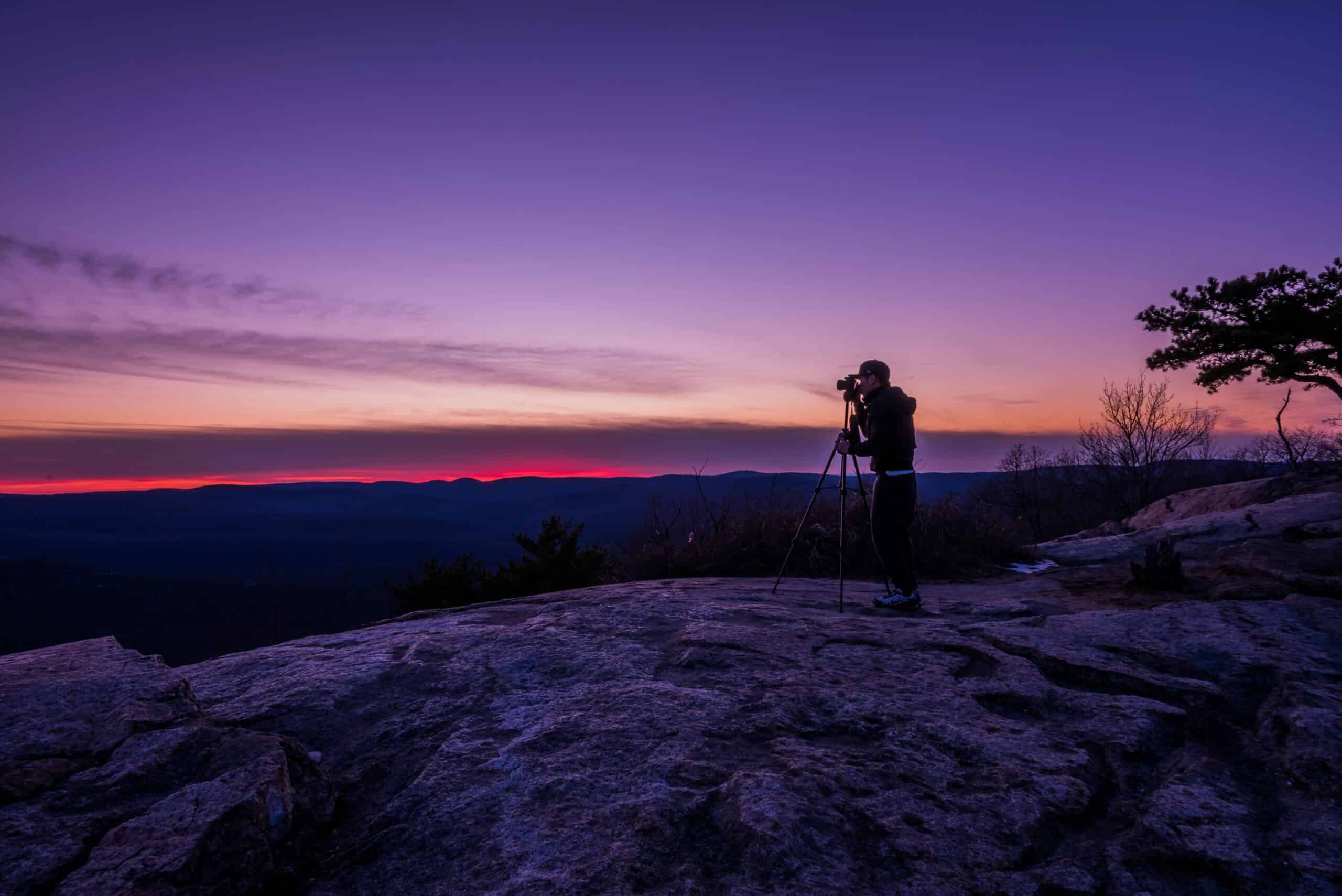
Evaluate Shooting Environment
Walk the site first. Look for moving elements (people, cars, trees in wind), reflective surfaces (glass, polished stone), and dynamic light sources (sun flicker, screens). Indoors, watch mixed lighting (tungsten + daylight) that can complicate white balance. If you must shoot through glass, get the lens as close as possible to the surface and shade it with a black cloth or your body. Even a 2–3 cm gap can reduce reflections dramatically compared to standing back 30 cm or more.
Match Gear to Scene Goals
The Canon EOS R3 delivers strong dynamic range at base ISO and clean files to ISO 800–1600, making it flexible for interiors and twilight exteriors. The AstrHori 12mm fisheye speeds up coverage: fewer shots reduce parallax consistency problems and crowd-related ghosting. The trade‑off is fisheye distortion, but modern stitching apps handle the mapping gracefully. If your priority is speed, the R3 + 12mm fisheye is ideal. If you need straight lines across the frame (e.g., architectural lines held rectilinear), you’ll fix geometry in post or consider a rectilinear lens and more frames.
Pre-shoot Checklist
- Battery fully charged (LP‑E19) and at least one spare; dual cards set to write simultaneously for redundancy.
- Clean lens front element and camera sensor; bring a blower and microfiber cloth.
- Level your tripod; check your panoramic head calibration is saved/marked for this lens.
- Safety: evaluate wind on rooftops; tether gear on poles; avoid traffic exposure if car-mounted.
- Backups: if time allows, shoot a second complete rotation for safety and later masking options.
Essential Gear & Setup
Core Gear
- Panoramic head: Enables rotation about the no-parallax point (NPP). Proper alignment eliminates foreground/background parallax misalignments during stitching.
- Stable tripod with a leveling base: Leveling simplifies even rotations and consistent horizons.
- Remote trigger or Canon Camera Connect: Fire shots without shaking the setup. Use 2 s self-timer if needed.
Optional Add-ons
- Pole or car mount: Great for elevated or center-of-room viewpoints. Always tether gear, check wind, and monitor vibrations.
- Lighting aids: Small LED panels or bounced flash for deep interior shadows (be consistent across frames).
- Weather protection: Rain covers and lens hoods reduce flare and protect from drizzle or spray.
Nodal (No-Parallax) Point Calibration
Mount the AstrHori 12mm on your panoramic head and adjust the fore‑aft slider until objects near and far stay aligned during a test rotation. Start with the lens entrance pupil roughly over the vertical axis of rotation. With a 12mm fisheye on full frame, a practical starting position is often a few centimeters ahead of the tripod’s central axis; fine-tune by watching overlap alignment of a close vertical (like a light stand) against a far background object while rotating left-right. Mark the position on your rail once set—this saves minutes on every job.
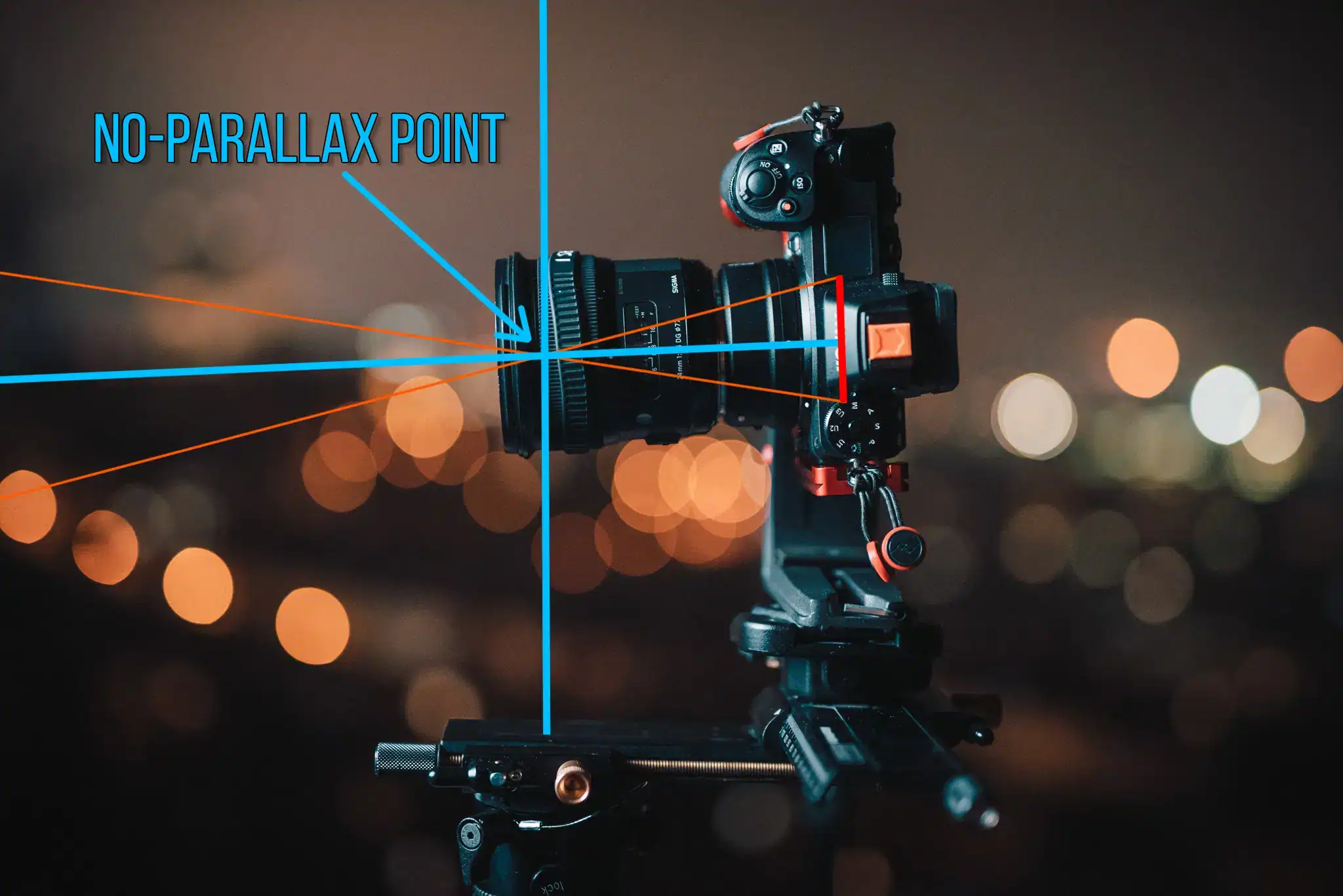
For a deeper dive into parallax control with panoramic heads, this illustrated tutorial is excellent. Panoramic head setup and NPP tutorial
Video: Panoramic Head Basics
Learn visually how nodal alignment and careful rotation create clean 360s:
Step-by-Step Shooting Guide
Standard Static Scenes
- Level the tripod and align the nodal point: Use your leveling base; double-check that nearby objects don’t shift relative to the background as you pan. Make a small test rotation and review on the R3’s screen at 100%.
- Lock down exposure and white balance: Set Manual mode, choose a fixed WB (Daylight, Tungsten, or custom Kelvin). This keeps color and brightness consistent across frames for seamless stitching.
- Shooting pattern (AstrHori 12mm): Capture 6 frames around at 60° yaw increments with 30–35% overlap. Then tilt up and take a zenith shot; for the nadir (ground), either take one extra frame with the camera tilted down or shoot a viewpoint-corrected patch later.
- Nadir capture: If your pano head has a rotator offset feature, swing the camera off-axis over the open floor and shoot the ground plate for easier tripod removal in post.
HDR / High Dynamic Range Interiors
- Bracket 3–5 frames at ±2 EV to retain window highlights and lift shadows cleanly. The R3’s bracketing is consistent; keep exposure brackets identical across the rotation.
- Lock white balance and focus: Don’t let auto controls shift across frames or brackets. Keep aperture constant (ideally f/8) to maintain uniform sharpness and vignette characteristics.
- Workflow note: You can pre-merge HDRs per angle or feed bracketed sets directly to PTGui for fusion. Keep file naming tidy for batch processing.
Low-Light / Night Scenes
- Use longer exposures on a solid tripod: Start around ISO 100–400 with shutter times 1–8 s if wind allows. If wind causes micro blur, raise ISO up to 800–1600 to keep shutter above 1/2–1 s.
- Use a remote or 2 s delay: Avoid any contact with the camera during the exposure.
- Turn IBIS off on tripod: This prevents micro-oscillations. Re-enable IBIS for handheld or pole work.
Crowded Events
- Shoot two passes: First pass quickly for coverage; second pass patiently to catch gaps or minimize subject overlap.
- Mask in post: Use PTGui’s masking to select the cleanest version of each area.
- Fisheye advantage: With only 6–8 images around, your odds of getting consistent crowd positions improve.
Special Setups (Pole / Car / Elevated)
- Secure everything: Use a safety tether on the camera and head. Check fasteners before each rotation.
- Consider vibration and wind: On a pole, use faster shutter speeds (1/125–1/250) and higher ISO (up to 800–1600 on the R3) to freeze sway.
- Car-mounted (only where legal and safe): Use multi-suction mounts and secondary tethers; shoot on private property or controlled environments when possible.
Recommended Settings & Pro Tips
Exposure & Focus
| Scenario | Aperture | Shutter | ISO | Notes |
|---|---|---|---|---|
| Daylight outdoor | f/8–f/11 | 1/100–1/250 | 100–200 | Lock WB (Daylight) |
| Low light/night | f/4–f/5.6 | 1/30–1/60 (handheld/pole) or longer on tripod | 400–1600 | Prefer tripod; raise ISO only as needed |
| Interior HDR | f/8 | Bracket ±2 EV | 100–400 | Even brackets per angle for smooth fusion |
| Action / moving subjects | f/5.6–f/8 | 1/200+ | 400–800 | Double pass and mask later |
Critical Tips
- Manual focus and hyperfocal: At 12mm and f/8 on full frame, hyperfocal distance is roughly 0.6 m. Focus around 0.6–0.8 m and you’ll keep everything from about 0.3–0.4 m to infinity acceptably sharp.
- Nodal point calibration: After initial setup, scribe a small mark on your rail. Bring a tiny ruler or note the scale index so you can repeat the position instantly.
- White balance lock: Choose a fixed WB (or custom Kelvin) to avoid color shifts that cause visible seams.
- RAW over JPEG: The R3’s 14‑bit RAW gives better highlight recovery and smoother gradients—very helpful for skies and interiors.
- Stabilization: Turn off IBIS on a tripod; enable it for handheld or pole shooting. Use electronic shutter for silent, vibration‑free captures.
- Lens quirks: The AstrHori 12mm can show edge CA and flare. Avoid strong point light sources near frame edges; shade the lens when the sun is near the horizon line.
Field-Proven Scenarios
Indoor Real Estate (Bright Windows)
Set f/8, ISO 100–200, and bracket ±2 EV (3–5 frames) per angle. Keep WB fixed to “Daylight” or a custom Kelvin (e.g., 5200K) based on your light mix. Shoot 6 around + zenith + nadir. In PTGui, either blend brackets per angle first or use the built-in exposure fusion. The R3’s clean shadows let you keep noise minimal while retaining window detail.
Outdoor Sunset
Expose for highlights to protect the sky, then consider a 3‑frame bracket for shadows if needed. Use f/8, base ISO, and 1/100–1/250 s to prevent motion blur in foliage. The AstrHori fisheye minimizes the total frames, so you can complete the pano in under a minute as light fades quickly.
Event Crowds
Keep shutter at 1/200 s or faster, ISO 400–800, and f/5.6–f/8. Do two rotations: one fast for coverage, one timed for gaps. Use PTGui’s masking tool to pick the best people positions per sector. The R3’s responsive controls and deep buffer help when shooting bursts for crowd timing.
Rooftop or Pole
On windy rooftops or elevated poles, raise shutter speed and ISO to stabilize frame-to-frame sharpness. Always tether gear and keep rotations smooth and deliberate. If the pole sways, pause at each stop to let vibrations settle before triggering the shot.
Stitching & Post-Processing
Software Workflow
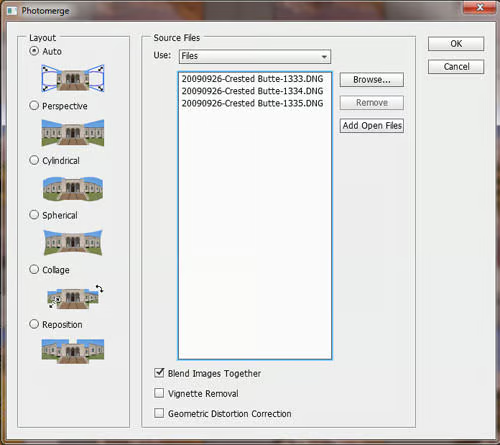
Import your images into PTGui, Hugin, or another stitching tool. For a 12mm fisheye, select “Fisheye” as the lens type. If the projection subtype is needed, try “equisolid angle” as a starting point, then let the optimizer refine parameters—fisheyes vary slightly. Use 30–35% overlap for fisheyes (industry standard is ~25–30% minimum), and verify good control points near seams. If you shot brackets, either pre-merge HDRs or let PTGui’s exposure fusion handle them. PTGui remains a favorite for precision, masking, and batch processing. PTGui: a pro‑level stitching tool review
Cleanup & Enhancement
- Nadir patch: Use a viewpoint-corrected patch from an offset nadir shot or clone/heal in Photoshop. Many AI tools can accelerate tripod removal.
- Color consistency: Balance between frames, apply a gentle contrast curve, and reduce chroma noise for low‑light areas.
- Horizon leveling: Use the stitching software’s horizon tool to correct roll and pitch, ensuring a comfortable VR experience.
- Export: For VR platforms, export an equirectangular 2:1 image (e.g., 12000×6000 or 16384×8192 if detail warrants). Keep a 16‑bit master TIFF and a high-quality JPEG for web.
If you’re new to stitching for VR delivery, Meta’s DSLR/mirrorless guide provides practical end‑to‑end context. Using a DSLR/mirrorless to shoot and stitch a 360 photo
Useful Tools & Resources
Software
- PTGui panorama stitching
- Hugin (open source)
- Lightroom / Photoshop / Affinity Photo
- AI tripod removal tools
Hardware
- Panoramic heads (Nodal Ninja, Leofoto, Sunwayfoto)
- Carbon fiber tripods + leveling bases
- Wireless remote shutters
- Pole extensions / car mounts with safety tethers
Disclaimer: software/hardware names are provided for search reference; verify current specs and compatibility on official sites.
Common Mistakes & How to Avoid Them
- Parallax error: Calibrate and mark the nodal point position for the AstrHori 12mm.
- Exposure flicker: Use manual exposure and locked white balance—don’t rely on auto.
- Tripod shadows/footprint: Capture a nadir shot or plan to patch in post with viewpoint correction.
- Ghosting from movement: Shoot a second pass and use masks to keep the cleanest subject positions.
- Noise at night: Prefer longer exposures at low ISO on a sturdy tripod; only raise ISO when necessary.
- Flare and CA: Shade the lens, avoid bright point lights on the edges, and stop down to f/5.6–f/8.
Frequently Asked Questions
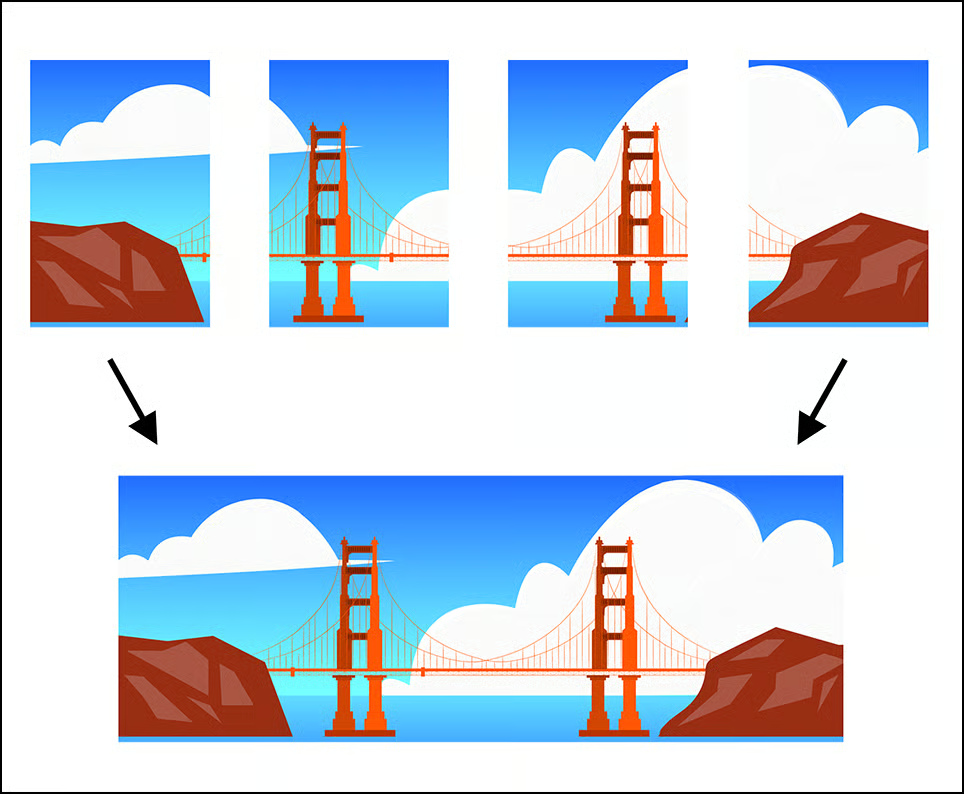
- Can I shoot handheld panoramas with the Canon EOS R3?
Yes, for quick environments. Enable IBIS, aim for 1/125–1/250 s, and keep consistent overlap. Expect slightly lower stitch reliability vs. tripod and more time masking. For critical work, use a leveled tripod and pano head.
- Is the AstrHori 12mm f/2.8 wide enough for single-row 360°?
Yes. On full frame, plan 6 shots around at 60° yaw plus a zenith and a nadir. For extra safety or when handheld, shoot 8 around for more overlap.
- Do I need HDR for interiors with bright windows?
Usually yes. Bracket 3–5 frames at ±2 EV to retain highlight detail and clean shadows. The R3’s low noise helps, but HDR ensures consistent window retention across the rotation.
- How do I avoid parallax issues with this fisheye?
Use a panoramic head and calibrate the nodal point for the 12mm. Keep the lens’s entrance pupil directly over the rotation axis. Once set, mark your rail and repeat the position every time.
- What ISO range is safe on the EOS R3 in low light?
Base ISO 100–200 for maximum DR. For interiors and night, ISO 400–800 remains very clean; ISO 1600 is still strong. Above 3200 you’ll see more grain—use when shutter speed demands.
- Can I set up Custom Modes (C1/C2) for panos?
Yes—great time saver. For example, C1: daylight pano (M, f/8, ISO 100, WB Daylight, IBIS off). C2: interior HDR (M, f/8, AEB ±2 EV, ISO 100–400, WB custom Kelvin). Double-check before shooting.
- How do I reduce flare with a fisheye?
Avoid aiming the sun or intense point lights near frame edges. Use your hand, hat, or a flag just out of frame to shade the lens. Slightly reframe and overlap more to keep options for masking flared areas.
- What’s the best tripod head for this setup?
A two-axis panoramic head with marked rails (e.g., Nodal Ninja or similar) that allows precise fore‑aft and vertical adjustments. A click‑stop rotator with 60° detents speeds up 6‑around rotations.
For a broader primer on DSLR/mirrorless 360 workflows and gear considerations, this guide is helpful. DSLR/mirrorless 360 virtual tour overview
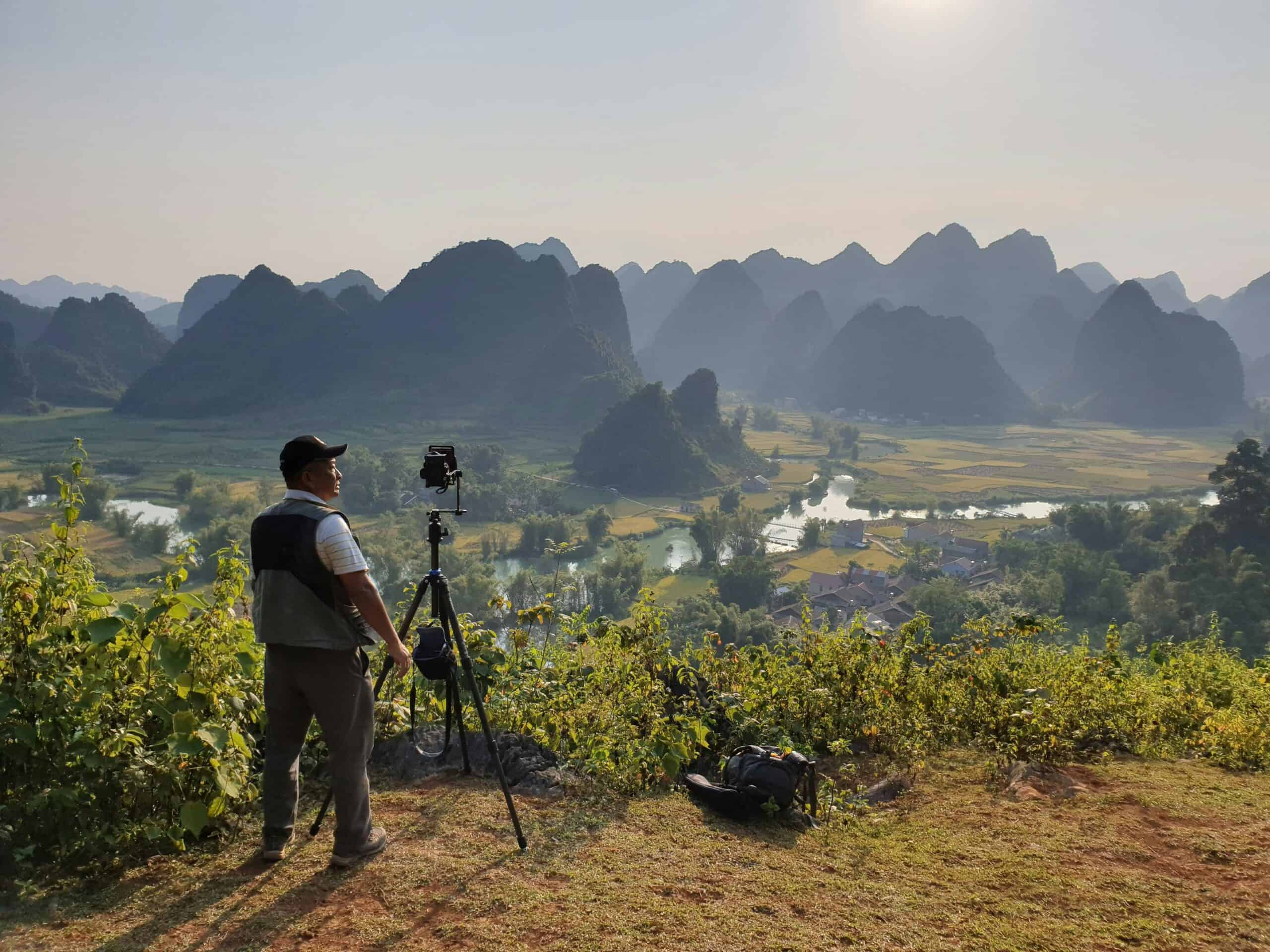
Bonus: Real-World Capture Moment
Wrap-Up
The Canon EOS R3 paired with the AstrHori 12mm f/2.8 Fisheye is a fast, reliable way to capture high-quality 360° panoramas. The R3’s low-noise sensor and robust ergonomics meet the fisheye’s efficiency—fewer shots, faster rotations, and simpler stitching. Calibrate your nodal point carefully, lock down exposure and white balance, and follow a consistent capture pattern. In post, PTGui or Hugin can handle fisheye mapping smoothly, with exposure fusion for HDR interiors. Back up to both cards in-camera, keep a 16-bit master, and export web-friendly equirectangular images for your platform of choice.
If you want to deepen your technique and workflow, these are excellent next steps: Best techniques to take 360 panoramas and Set up a panoramic head for high‑end 360 photos.