Why This Camera & Lens Are Great for Panoramas
If you want to know how to shoot panorama with Canon EOS 6D / 6D Mark II & Olympus 8mm f/1.8 PRO Fisheye, you’re eyeing a combo capable of fast capture with sweeping coverage. The Canon EOS 6D and 6D Mark II are full-frame DSLRs with strong high-ISO performance and dependable ergonomics. Pairing them with an 8mm fisheye gives you a near-360° field of view with fewer shots, speeding up field work and reducing stitch errors. Fisheyes also concentrate more resolution toward the equator of an equirectangular output, which is often where viewers look in VR.
Important mount note: the Olympus M.Zuiko 8mm f/1.8 PRO is a Micro Four Thirds lens and cannot be directly adapted to Canon EF full-frame bodies (EOS 6D/6D Mark II) due to flange distance and image circle coverage. In practice, you have two good paths:
- Use a native EF-mount fisheye with similar coverage (e.g., Canon EF 8–15mm f/4L at 8–10mm, Sigma 8mm f/3.5 circular fisheye). The technique and shot counts below apply directly.
- If you already own the Olympus 8mm, consider a Micro Four Thirds body for that lens, or a mirrorless full-frame body with the appropriate adapters. For the 6D/6D Mark II specifically, use an EF fisheye instead.
With that compatibility caveat out of the way, the guidance below is written for a full-frame Canon 6D/6D Mark II with an 8mm-class fisheye field of view, matching what the Olympus 8mm provides on its native system. You’ll get fast capture, excellent overlap, and reliable stitching for 360 photos, HDR panoramas, and virtual tours.
Quick Setup Overview
- Camera: Canon EOS 6D — Full Frame (36×24 mm), 20.2 MP (5472×3648), pixel pitch ~6.55 µm, base ISO 100, strong low-light performance. Canon EOS 6D Mark II — Full Frame, 26.2 MP (6240×4160), pixel pitch ~5.76 µm, improved AF/live view, excellent ergonomics.
- Lens: Olympus 8mm f/1.8 PRO Fisheye (Micro Four Thirds diagonal fisheye, 180° diagonal FOV). On Canon EF full-frame, use a comparable EF-mount fisheye (Canon EF 8–15mm at ~8–10mm or Sigma 8mm) to replicate coverage. Fisheyes have predictable distortion for stitching, generally good sharpness stopped to f/5.6–f/8, and manageable CA.
- Estimated shots & overlap (full-frame with 8mm circular/diagonal fisheye):
- Circular on FF (e.g., Sigma 8mm or Canon 8–15 @8mm): 4 shots around at 90° spacing + 1 zenith + 1 nadir. Advanced users can do 3 around at 120° with careful nodal alignment.
- Diagonal on FF (~10–12mm on fisheye zoom): 6 around at 60° spacing + zenith + nadir.
Target overlap: ~30–35% for fisheye.
- Difficulty: Easy–Moderate. Fisheye reduces shot count; careful nodal point setup is still required for clean stitches.
Planning & On-Site Preparation
Evaluate Shooting Environment
Survey light, moving elements, and reflective surfaces. In interiors, watch for mirrors, glass, and glossy floors that can reveal your tripod or cause flare. If shooting through glass, keep the front element close (1–2 cm) to reduce reflections and use a black cloth as a flag. Outdoors, note wind and sun position—strong backlight can produce fisheye flare and ghosting.
Match Gear to Scene Goals
Why the Canon 6D/6D Mark II is a solid base: both are full-frame with robust noise handling and gentle roll-off in highlights. The 6D’s base dynamic range is about 12 EV; the 6D Mark II sits around 11.8–12 EV—plenty for general outdoor scenes and bracketed interior work. Safe ISO ranges: ISO 100–200 for bright exteriors; ISO 400–800 for interiors; ISO 1600–3200 if handholding or in very dim situations (noise remains manageable). A fisheye dramatically reduces the number of shots, which is ideal in dynamic scenes (crowds, traffic) where fewer captures mean fewer moving-object mismatches.
Pre-shoot Checklist
- Power & storage: full batteries, spare card; long exposures and bracketing consume power and space.
- Optics clean: fisheyes see everything—fingerprints and dust near the edges will show.
- Tripod & panoramic head: level the base; confirm nodal point calibration for your fisheye.
- Safety: secure tripod in wind; tether gear on rooftops; avoid blocking pathways; for car mounts, use secondary safety straps and check fasteners before each drive.
- Backup capture: shoot a second full round. If a person walks into one frame, you’ll appreciate the redundancy.
Essential Gear & Setup
Core Gear
- Panoramic head: lets you rotate the camera around the lens’s no-parallax (nodal) point, eliminating parallax when foreground and background overlap. The result is cleaner stitches and fewer ghosts.
- Stable tripod with a leveling base: a leveling base speeds up setup and keeps yaw true, especially important with multi-row or precise increments.
- Remote trigger or Canon app: use a cable release, 2-sec timer, or the Canon Camera Connect app to prevent shake and maintain consistent cadence.
Optional Add-ons
- Pole or car mount: great for overhead or moving captures. Always tether, use vibration damping, and keep speeds modest. Wind load on a fisheye setup is non-trivial.
- Lighting aids: small LED panels or bounced flash help interiors, though be mindful of reflections with fisheyes.
- Weather protection: a simple rain cover and microfiber cloth are often the difference between success and a soaked session.
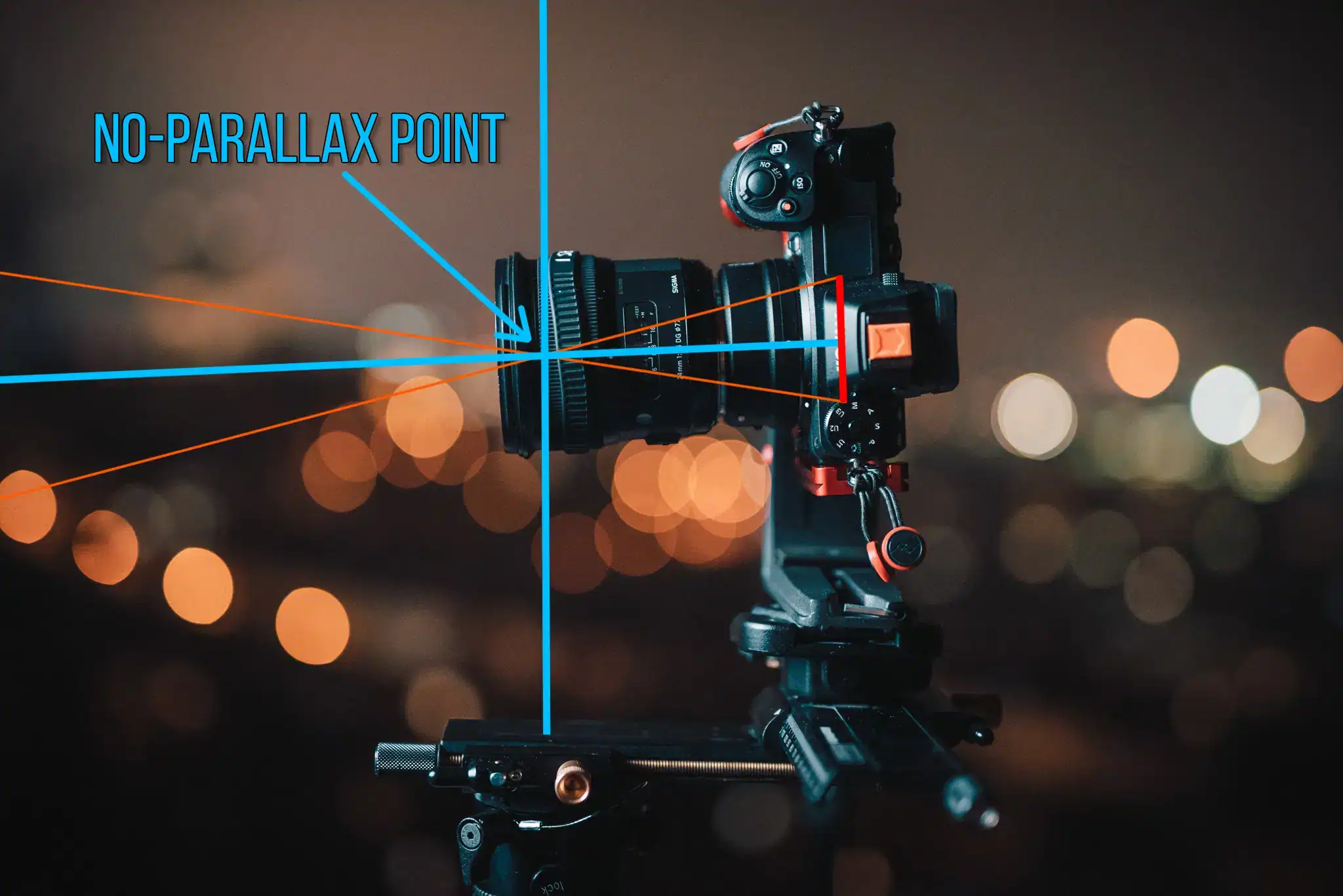
For a deeper primer on panoramic heads and nodal alignment, see this panoramic head tutorial by 360 Rumors at the end of this section. Panoramic head setup fundamentals
Step-by-Step Shooting Guide
Standard Static Scenes
- Level and calibrate: level the tripod with the bubble or electronic level. Set the panoramic head so the lens rotates around the nodal point. For a fisheye, start with the lens entrance pupil roughly over the rotation axis, then fine-tune by aligning near-far objects while panning; adjust fore-aft until parallax disappears.
- Manual exposure and white balance: set M mode. Meter the brightest part you must retain detail in, then expose to protect highlights. Set white balance to a fixed preset or Kelvin (e.g., Daylight 5200K outside, Tungsten 3200K inside). This avoids color shifts across frames.
- Focus and capture overlap: switch to manual focus and set near the hyperfocal distance (f/8 is a sweet spot on most fisheyes). Capture your round:
- 8mm circular fisheye on full frame: 4 shots around at 90° increments, then 1 zenith, 1 nadir.
- Diagonal fisheye on full frame (~10–12mm): 6 shots around at 60°, plus zenith and nadir.
Use ~30–35% overlap for robust control point generation.
- Nadir capture: tilt down to shoot the ground, or remove the camera and shoot a handheld nadir with the tripod moved. You’ll patch this area in post.
HDR / High Dynamic Range Interiors
- Brackets: use AEB or manual bracketing at ±2 EV (3–5 frames) to balance bright windows and shadowy corners. Keep aperture constant.
- WB lock: maintain a fixed white balance through the bracket sequence to avoid color flicker.
- Shoot efficiently: capture each bracketed stack at a position before rotating to the next index, to keep moving people artifacts aligned within stacks.
Low-Light / Night Scenes
- Long exposures: use f/4–f/5.6 and longer shutter times to stay at ISO 100–400 when possible. On the 6D/6D II, ISO 800–1600 remains usable if conditions demand it.
- Vibration control: enable mirror lockup and use a 2-sec timer or remote trigger. Avoid touching the setup during exposure.
- Check flare: bright street lamps can cause fisheye ghosts; shield the lens with your hand just outside the frame when possible.
Crowded Events
- Two-pass method: do a fast first pass for coverage, then wait and reshoot frames when the crowd opens. You can mask the cleaner frames in post.
- Short shutter: aim for 1/200s or faster if you want to freeze movement. You may need ISO 800–1600; the 6D/6D II handle this reasonably well.
Special Setups (Pole / Car / Rooftop)
- Pole overhead: secure clamps and add a safety line. Rotate more slowly to reduce flex-induced yaw error. Watch for pole shadow in the nadir.
- Car-mounted: avoid high speeds; soft mounts reduce vibration but increase sway. Plan routes for consistent light and minimal traffic stops.
- Rooftops and wind: bring sandbags; keep a low profile; never leave the rig unattended. Always tether.
Scenario Mini Case Studies
Indoor Real Estate
Set f/8, ISO 100–200, and bracket ±2 EV. Use 6 around + zenith + nadir for diagonal fisheye coverage to keep wall lines straighter. Turn off all ceiling fans, ask people to step out, and shoot window-facing frames quickly to reduce ghosting in tree leaves outside.
Outdoor Sunset
Meter for the sky a touch under-exposed to protect highlights, then bracket. Keep ISO 100, use a solid tripod, and expect flare near the sun—compose with the sun at an overlap boundary so you can choose the cleanest frame for blending.
Event Crowds
Use the fisheye’s speed advantage: 4 around + zenith + nadir. Shoot two full rounds; you’ll mask moving people later. Pre-focus and lock it. Shutter 1/200s+ if you can.
Rooftop/Pole Shooting
Wind is the enemy. Use a lighter head, keep the rig compact, and pause between frames to let vibrations die. Safety tethers are non-negotiable.
Car-Mounted Capture
Plan a smooth loop. Use faster shutter speeds (1/250s+) and consider single-exposure panoramas to avoid bracket misalignment from vibration.
Recommended Settings & Pro Tips
Exposure & Focus
| Scenario | Aperture | Shutter | ISO | Notes |
|---|---|---|---|---|
| Daylight outdoor | f/8–f/11 | 1/100–1/250 | 100–200 | Lock WB (daylight) |
| Low light/night | f/4–f/5.6 | 1/30–1/60 | 400–800 | Tripod & remote; avoid push ISO too far |
| Interior HDR | f/8 | Bracket ±2 EV | 100–400 | Balance windows & lamps |
| Action / moving subjects | f/5.6–f/8 | 1/200+ | 400–800 | Freeze motion, double pass |
Critical Tips
- Manual focus at or near the hyperfocal distance (e.g., f/8 on a fisheye) for wall-to-wall sharpness. Use live view magnification to confirm.
- Nodal calibration: mark the fore-aft rail position for your fisheye once, then reuse. Shoot a near object against a distant background and pan to fine-tune until parallax disappears.
- White balance lock: pick a fixed preset or Kelvin to avoid color flicker during stitching—especially critical with HDR.
- RAW over JPEG: RAW keeps maximum dynamic range and color latitude; invaluable for interior blends and shadow recovery.
- IS and stability: the 6D/6D II bodies do not have IBIS. If you use an IS-equipped EF lens, switch IS off on a tripod to avoid micro-blur. Use mirror lockup and a 2-sec timer to prevent vibrations.
- Grid your yaw: on a fisheye, stick to consistent increments (90° or 60°). Many pano heads have detents that save time and avoid missed coverage.
Stitching & Post-Processing
Software Workflow
Import RAWs and apply a consistent baseline (WB, lens profile if available, noise reduction). Stitch with PTGui or Hugin. Fisheye images are generally easier to stitch: fewer frames and strong geometric cues. For fisheyes, target 25–35% overlap; for rectilinear shots, 20–25% can suffice but you’ll need more frames overall. PTGui’s fisheye lens model and optimizer quickly locate control points, even with moving elements. For a grounding review of PTGui’s strengths, check this overview at the end of this section. Why PTGui excels for complex panoramas
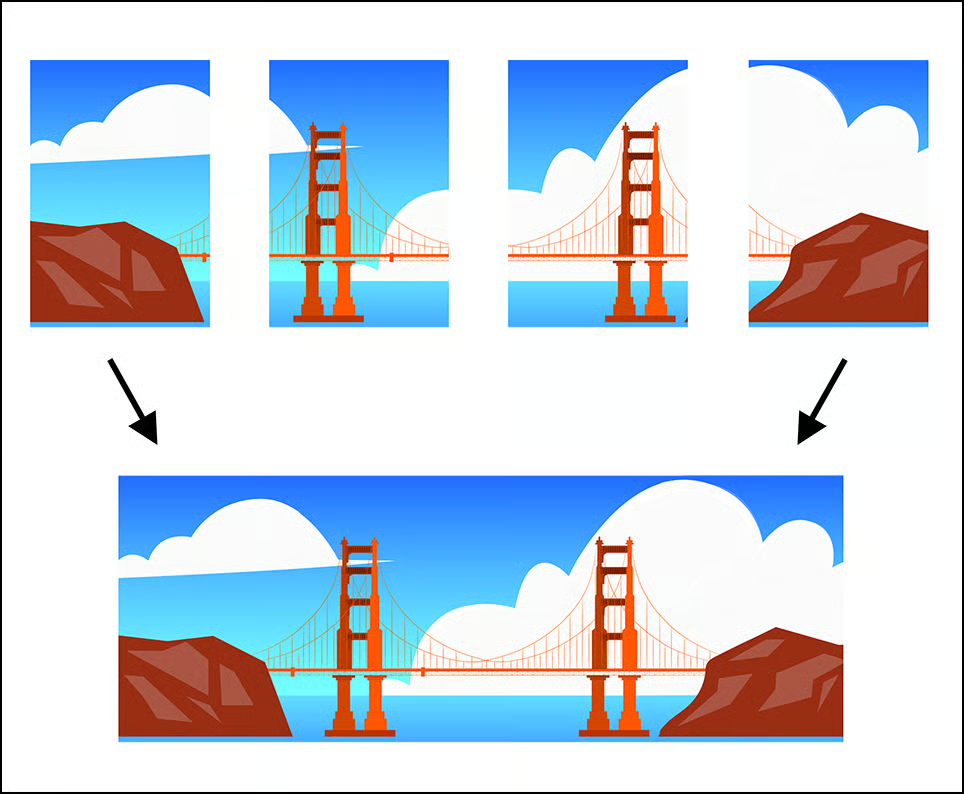
Cleanup & Enhancement
- Nadir/tripod removal: export a layered file and clone the tripod, or shoot a handheld nadir and patch it. Consider AI-based patch tools to speed up clean-up.
- Color and noise: align color across frames, apply gentle noise reduction to shadow brackets, and avoid over-sharpening the zenith where stretching is strongest.
- Leveling: ensure horizon line is level in the equirectangular. Use pitch/roll/yaw corrections in PTGui/Hugin.
- Export: save a 16-bit TIFF master and an 8-bit JPEG equirectangular at 2:1 aspect (e.g., 12000×6000) for web VR viewers and virtual tour platforms.
If you’re new to 360 DSLR workflows, the Meta (Oculus) creator guide provides a solid overview from capture to publish. DSLR 360 photo capture and stitching basics
Useful Tools & Resources
Software
- PTGui for advanced fisheye modeling and fast control point generation
- Hugin (open source) with flexible projection and optimizer
- Lightroom / Photoshop for RAW prep and retouching
- AI tools for tripod/nadir removal and reflection cleanup
Hardware
- Panoramic heads: Nodal Ninja, Leofoto, or similar with fore-aft rail
- Carbon fiber tripods for stability and reduced wind sway
- Leveling bases to speed up setup
- Wireless remote shutters or intervalometers
- Pole extensions and car mounts with tethers
Disclaimer: software/hardware names provided for search reference; verify details on official sites and documentation.
Video: A practical walkthrough of panoramic head setup and capture cadence:
For broader system choices and lens recommendations for virtual tours, this guide is helpful. DSLR virtual tour camera and lens guide
Common Mistakes & How to Avoid Them
- Parallax error: not rotating around the nodal point. Calibrate once and mark your rail.
- Exposure flicker: changing auto-exposure or AWB across frames. Use manual exposure and fixed WB.
- Tripod shadows and footprints: plan your nadir shot and patch cleanly later.
- Ghosting from moving subjects: shoot two passes and mask in post; prefer shorter shutter in busy scenes.
- Noise at night: keep ISO conservative and extend shutter; use mirror lockup and a remote release.
- Lens compatibility: the Olympus 8mm f/1.8 PRO is MFT-only; use a native EF fisheye on the 6D/6D II for best results.
Frequently Asked Questions
- Can I shoot handheld panoramas with the Canon EOS 6D or 6D Mark II?
Yes for partial panoramas and even full 360s in bright light, but expect more stitching errors. Use fast shutter speeds (1/200s+), higher ISO if needed, and keep your body rotation smooth. For critical work, a tripod and panoramic head are strongly recommended.
- Is the Olympus 8mm f/1.8 wide enough for single-row 360 capture?
On its native Micro Four Thirds bodies, yes—it’s a 180° diagonal fisheye. On full-frame Canon EF bodies, it’s not mount-compatible. Use a comparable EF-mount fisheye (e.g., Canon 8–15mm). With an 8mm circular fisheye on full frame, you can do 4 around + zenith + nadir, or even 3 around in a pinch.
- Do I need HDR for interiors with bright windows?
Usually. The 6D/6D II’s base dynamic range is solid, but window highlights often exceed it. Bracket ±2 EV (3–5 frames) per position and fuse the stacks before or during stitching to balance windows and interior shadows.
- How do I avoid parallax issues?
Mount the camera on a panoramic head and align the rotation axis to the lens’s no-parallax point. Use a near object against a far background, pan left/right, and slide the camera fore-aft until the relative position remains fixed. Mark that rail position for repeatability.
- What ISO range is safe on the 6D/6D Mark II in low light?
For tripod work, aim for ISO 100–400 and extend the shutter. Handheld or in dynamic scenes, ISO 800–1600 remains clean with modest noise reduction; ISO 3200 is usable if you expose carefully and post-process.
- Can I set up Custom Shooting Modes (C1/C2) for pano work?
Yes. Save manual exposure, fixed white balance, manual focus, mirror lockup, and 2-sec timer to a Custom Mode for instant recall on location.
- How can I reduce flare with a fisheye?
Avoid pointing directly at the sun or bright spotlights if possible. Shield the lens with your hand just outside the frame, or place the light source at an overlap boundary to pick the cleanest frame when masking.
- What panoramic head works best with this setup?
Choose a head with a fore-aft rail and detent ring for repeatable yaw increments (e.g., 60°/90°). Models from Nodal Ninja or Leofoto balance precision with portability—both are proven for fisheye-based 360 capture.
Additional Reference Images
These illustrative images match common steps in the workflow and may help you visualize key concepts.
Final Thoughts
The Canon EOS 6D/6D Mark II with an 8mm-class fisheye is a proven 360° workhorse. While the Olympus 8mm f/1.8 PRO isn’t natively compatible with Canon EF full frame, an EF-mount fisheye with similar coverage will deliver the same practical benefits: fast capture, forgiving overlap, and reliable stitching. Calibrate your nodal point, lock exposure and white balance, and plan for dynamic scenes with bracketing and double-pass techniques. If you want more guidance on principles and best practices, this fundamentals article on setting up panoramic heads is a solid read, and PTGui remains a top-tier stitcher for complex fisheye jobs. Principles for setting up a panoramic head