
Why This Camera & Lens Are Great for Panoramas
If you are researching how to shoot panorama with Canon EOS 6D / 6D Mark II & Nikon Z 20mm f/1.8 S, you’re targeting a full-frame workflow with premium image quality and a classic 20mm field of view. The Canon EOS 6D (20.2MP, ~6.55µm pixel pitch) and EOS 6D Mark II (26.2MP, ~5.76µm pixel pitch) are proven full-frame DSLRs with excellent high-ISO performance, long battery life, and simple manual controls—ideal for consistent multi-frame capture. The Nikon Z 20mm f/1.8 S is a rectilinear, ultra-sharp wide-angle prime known for minimal coma, low chromatic aberration, and high contrast across the frame from f/4–f/8—perfect traits for clean stitching and crisp edges.
Important compatibility note: Nikon Z lenses cannot be mounted natively on Canon EF DSLRs like the 6D/6D Mark II due to the much shorter Z-mount flange distance and full electronic aperture/focus control. There is no practical, fully functional adapter for this pairing. The techniques and exposure recommendations in this guide apply 1:1 to any full-frame 20mm rectilinear lens on the 6D/6D II (e.g., Canon EF 20mm f/2.8 USM, Sigma 20mm Art, or adapted RF via a different body). If you already own the Nikon Z 20mm f/1.8 S, use a Nikon Z body for capture; the pano workflow below remains the same for a 20mm rectilinear on full-frame. We’ll call out both camera models where relevant and keep field-tested numbers specific to 20mm.
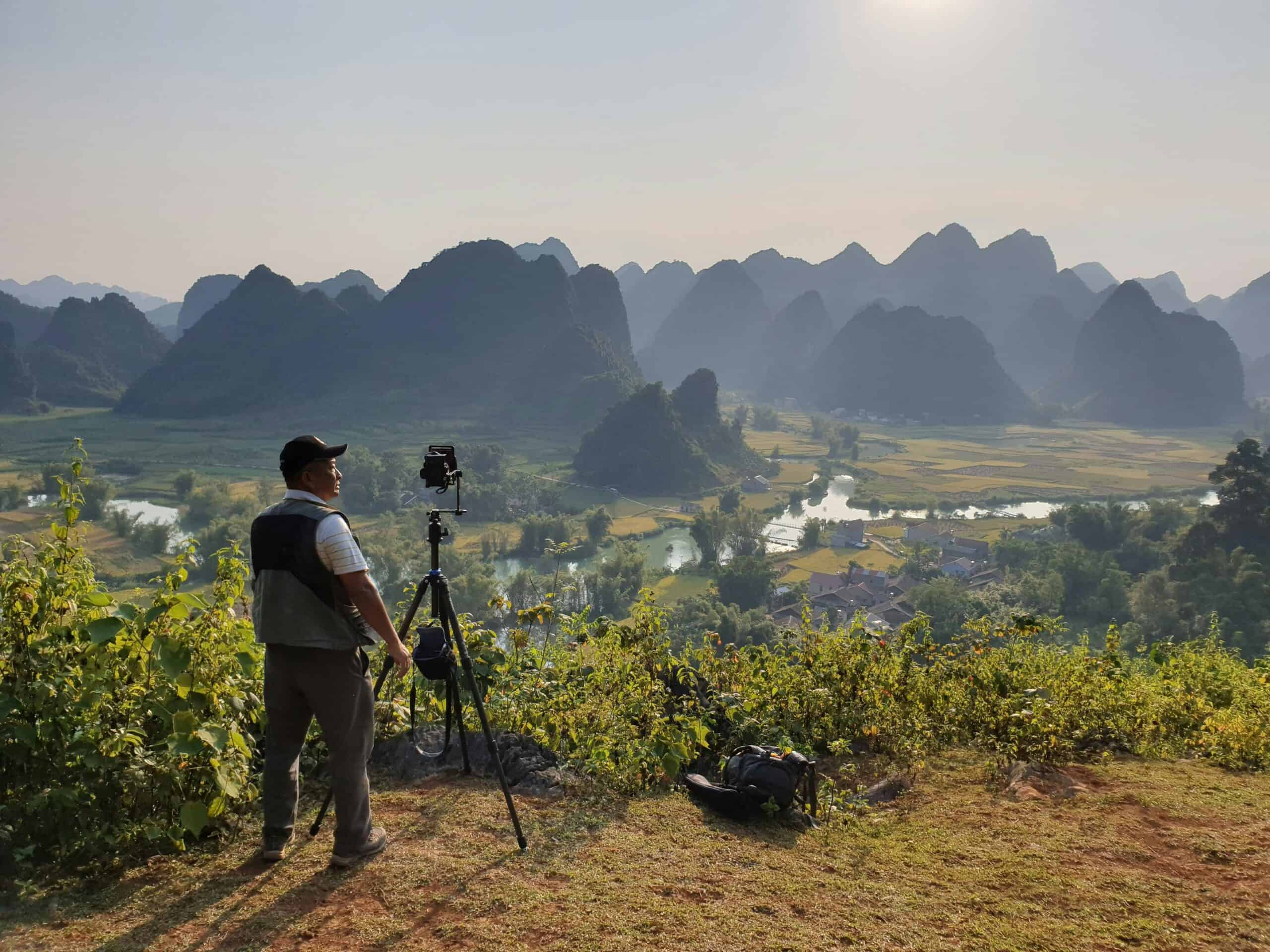
Quick Setup Overview
- Camera: Canon EOS 6D (Full Frame, 20.2MP, ~12 EV DR at ISO 100, strong ISO 800–1600) or EOS 6D Mark II (Full Frame, 26.2MP, ~11.9 EV DR at ISO 100, improved AF live view, ISO 800–1600 workable).
- Lens: Nikon Z 20mm f/1.8 S (rectilinear). Sharp from center to corners by f/5.6–f/8, low CA, excellent microcontrast. Note: not mountable on 6D/6DII; use a comparable EF 20mm for identical pano geometry.
- Estimated shots & overlap (full spherical, 360×180): safe coverage at 20mm FF is 6–8 shots per row with ~25% overlap. Typical sets:
- Minimal: 6 around at 0°, 6 at +45°, 6 at −45°, plus zenith + nadir = ~20 images.
- Safe/detail: 8 around at 0°, 8 at +45°, 8 at −45°, plus zenith + nadir = ~26 images.
- Difficulty: Moderate. Rectilinear 20mm needs careful nodal alignment and multi-row shooting, but rewards you with low distortion and high detail for pro virtual tours.
Planning & On-Site Preparation
Evaluate Shooting Environment
Walk the scene once. Note high-contrast areas (windows versus dim interiors), reflectivity (glass, glossy tiles), and moving elements (people, trees, traffic). For glass, keep the front element as close as safely possible and shoot slightly off-axis to reduce reflections and ghosting. Avoid direct light sources hitting the lens; 20mm rectilinear can flare if the sun is just outside the frame.
Match Gear to Scene Goals
The 6D/6D Mark II bodies are strong in low light and produce 14-bit RAW files with good color depth. Practically, ISO 100–400 is ideal; ISO 800 is safe; ISO 1600 can be fine with careful exposure, especially on the original 6D thanks to its larger pixel pitch. A 20mm rectilinear lens means higher shot counts than a fisheye, but you gain straighter lines—critical for architecture and real estate. Indoors, plan for HDR brackets; outdoors at sunset, meter for highlights to protect skies and blend later.
Pre-shoot Checklist
- Power: Full battery plus spare; 6D/6DII can easily do hundreds of frames but multi-row HDR can be power-hungry.
- Storage: Fast UHS-I SD cards; keep at least 64–128GB free for HDR multi-row sets.
- Clean optics: Front/rear elements and the sensor. Dust becomes repeated defects across stitches.
- Tripod level: Add a leveling base for speed; verify bubble/virtual level before every row.
- Pano head: Pre-calibrate nodal point (entrance pupil) for 20mm; bring a small ruler and your saved rail marks.
- Safety: In wind, hang a bag on the tripod hook; use a tether on rooftops or poles; never lean over edges.
- Backup plan: If time allows, shoot an extra full pass for insurance against ghosting or missed frames.
Essential Gear & Setup
Core Gear
- Panoramic head: A two-axis panoramic head (e.g., Nodal Ninja, Leofoto, or equivalent) lets you place the optical center of the lens over the rotation axes, eliminating parallax when foreground/background overlap. This is non-negotiable for flawless stitching at 20mm rectilinear.
- Stable tripod with leveling base: A leveling base speeds up row-to-row consistency; it also reduces errors in stitch optimization.
- Remote release or app: Use Canon Camera Connect via Wi‑Fi (6D/6DII) or a cable release to avoid micro-shake. Enable Live View and mirror lock-up for the 6D series to minimize vibration.
Optional Add-ons
- Pole or car mount: Great for crowds or elevated viewpoints. Always add a safety tether. Watch wind loading; rotate more slowly and consider higher shutter speeds to fight vibration.
- Lighting aids: LED panels to lift shadows in deep interiors when HDR is impractical.
- Weather protection: Rain cover and microfiber cloths to keep the front element clean between rows.

Step-by-Step Shooting Guide
Standard Static Scenes
- Level and align: Level the tripod, then align the panoramic head’s vertical post. Position the lens so its entrance pupil sits exactly over the rotation point. For many 20mm rectilinear primes, a starting guess is that the entrance pupil lies roughly near the front half of the lens; fine-tune by aligning a near object and far object in the frame and rotating—adjust fore/aft until parallax disappears.
- Manual exposure and WB: Switch to M mode. Meter for the brightest part you need to preserve detail (usually the sky/window). Set a fixed white balance (Daylight/Tungsten/Kelvin) to avoid color shifts across frames.
- Focus: Use Live View, zoom in 5–10×, and set manual focus at or slightly beyond the hyperfocal distance. For 20mm at f/8 on full frame, hyperfocal is ~1.7 m; focusing there keeps everything from ~0.85 m to infinity acceptably sharp.
- Capture the rows: At 20mm, take either the minimal set (6+6+6 around at 0/±45°) or the safe set (8+8+8). Finish with a zenith shot (tilt up ~90°) and a nadir shot (tilt down ~90°) to patch the tripod.
- Log your sequence: Keep a mental or written checklist so you don’t miss a panel. A small beep or voice note can help track rows.
HDR / High Dynamic Range Interiors
- Bracket ±2 EV: Use AEB to shoot 3–5 brackets per angle. With 6D/6DII, enable continuous drive and keep your hands off the rig using a remote/app.
- Lock WB: Mixed lighting in interiors can shift color—a fixed Kelvin (e.g., 4000–5000K) ensures consistent tonality across brackets.
- Mind movement: If curtains or plants move between brackets, shorten shutter speeds by raising ISO to 200–400; better to add a bit of noise than ghosting.
Low-Light / Night Scenes
- Long exposure strategy: Use f/4–f/5.6 and shutter speeds around 1/30–1/60 for moving crowds, or extend to several seconds for empty night streets. On 6D/6DII, ISO 400–800 is the sweet spot; avoid going past 1600 unless necessary.
- Stability: Use mirror lock-up, Live View, a remote release, and delay timer to eliminate vibration. Turn off IS if your lens has stabilization when on a tripod (most 20mm primes do not have IS).
- Avoid star trails: For astro elements, follow the 500 rule; at 20mm, keep below ~25 sec on full frame if you want points, not trails.
Crowded Events
- Two-pass method: Do one full pass quickly to capture base geometry. Then wait for gaps and reshoot frames that had heavy motion. You’ll mask/replace the busy ones in post.
- Faster shutter: Use 1/200–1/320 and ISO 400–800 to freeze people, especially on a pole where vibrations are higher.
Special Setups (Pole / Car / Drone)
- Pole safety: Use a lanyard tether and a spotter. Rotate slower and reduce bracket count to minimize sway. If wind gusts exceed safe limits, abort.
- Car-mounted: Increase shutter speed (1/250–1/500), shoot shorter brackets, and avoid flexible mounts. Park the car; do not shoot while moving.
Recommended Settings & Pro Tips
Exposure & Focus
| Scenario | Aperture | Shutter | ISO | Notes |
|---|---|---|---|---|
| Daylight outdoor | f/8–f/11 | 1/100–1/250 | 100–200 | Lock WB (Daylight) and shoot 6–8 around per row |
| Low light/night | f/4–f/5.6 | 1/30–1/60 (or longer if static) | 400–800 | Tripod + remote; mirror lock-up; keep ISO ≤1600 on 6D/6DII |
| Interior HDR | f/8 | Bracket ±2 EV (3–5 frames) | 100–400 | Protect window highlights; blend in PTGui or LR/PS |
| Action / moving subjects | f/5.6–f/8 | 1/200+ | 400–800 | Freeze motion; consider two-pass method for clean masks |
Critical Tips
- Manual focus at hyperfocal: At 20mm and f/8 on full frame, ~1.7 m is a reliable starting point. Tape the focus ring to prevent drift.
- Nodal point calibration: Mark your rail positions for this lens once and reuse. Expect the entrance pupil to sit forward of the sensor plane; verify by rotating against near/far objects until parallax disappears.
- White balance lock: Mixed-light interiors demand a fixed Kelvin value; avoid Auto WB to prevent color shifts between frames or brackets.
- RAW capture: Always shoot RAW for maximal dynamic range and flexible color grading in HDR panoramas.
- Stabilization: The 6D/6DII bodies have no IBIS. If your lens has IS, turn it off on a tripod to prevent micro-drift.
- Mirror mechanics: Use Live View and 2-second timer or a remote with mirror lock-up on the 6D series to cut vibration.
Stitching & Post-Processing
Software Workflow
Ingest and organize by row. For HDR sets, either pre-merge brackets per angle in Lightroom/Photoshop before stitching or let PTGui handle exposure fusion. Rectilinear 20mm images stitch very cleanly if parallax is controlled, but you’ll need more frames than a fisheye. Aim for ~25–30% overlap horizontally for reliability. PTGui offers robust control point generation, vertical/horizontal line constraints, and excellent masking tools for crowds. Hugin is a free alternative with similar control concepts if you’re willing to tweak more. For export to VR, generate a 2:1 equirectangular JPEG/TIFF with appropriate pixel dimensions (e.g., 12k–16k on the long edge for high-end tours). At this focal length and with 26MP frames, 16k equirects are very achievable if you use the safe multi-row set.
Cleanup & Enhancement
- Nadir patch: Shoot a handheld nadir plate or patch with content-aware fill/clone. PTGui’s Viewpoint Correction can help integrate an offset nadir.
- Color and noise: Apply consistent white balance across frames; light noise reduction for ISO 800–1600 night sets.
- Horizon leveling: Use straight-line constraints or a virtual horizon tool in your stitcher to correct roll/pitch/yaw.
- Sharpening: Moderate capture sharpening prior to downsampling; avoid over-sharpening seams.
- Export: Save an equirectangular master TIFF and a web-ready JPEG. Keep layered PSD/PSB if you masked people or patched complex areas.
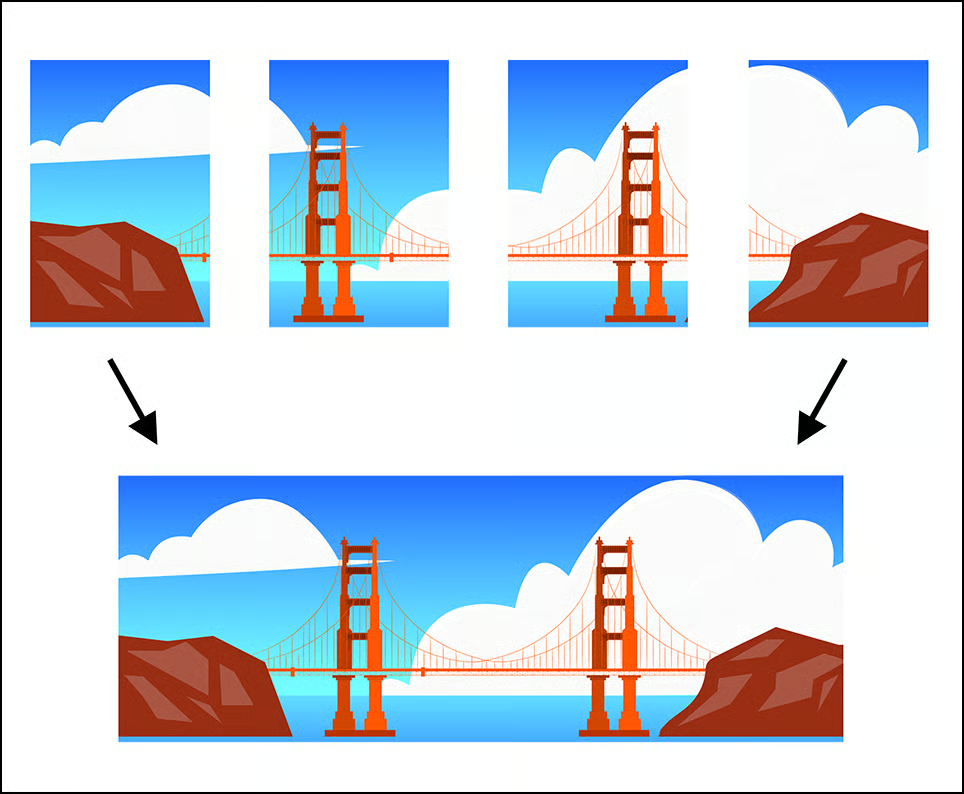
For a deeper look at pano-head setup and stitcher choices, see this panoramic head tutorial and a practical PTGui review by Fstoppers at the end of this paragraph. Panoramic head basics. PTGui review and tips.
Useful Tools & Resources
Software
- PTGui for professional stitching and HDR fusion.
- Hugin (open source) for cost-free but powerful stitching.
- Lightroom / Photoshop for RAW prep, HDR merges, and retouching.
- AI nadir removal/retouching tools for faster cleanup.
Hardware
- Panoramic heads: Nodal Ninja, Leofoto, and similar modular rigs.
- Carbon fiber tripods with a leveling base for speed and stability.
- Wireless remote shutters or Canon Camera Connect app.
- Pole extensions and car mounts with safety tethers.
Disclaimer: product names are for reference; consult official manuals and vendors for the latest specs. For additional foundational guidance on DSLR-based virtual tours, the Oculus Creator guide is a solid primer. Using a DSLR or mirrorless to shoot a 360 photo.
Common Mistakes & How to Avoid Them
- Parallax error: Don’t skip nodal alignment. Even at 20mm, nearby objects will misalign if the entrance pupil is off.
- Exposure flicker: Manual exposure and fixed WB only. Don’t use Auto ISO or Auto WB for pano sets.
- Tripod shadows and footprints: Shoot a clean nadir or be ready to patch in post.
- Ghosting from movement: Use the two-pass method and mask in your stitcher to keep or remove people selectively.
- Night noise: Keep ISO moderate (≤800 whenever possible), expose to protect highlights, and use longer shutter speeds with stable support.
- Forgetting coverage: Use a consistent pattern (e.g., −45°, 0°, +45°, then zenith/nadir) to avoid gaps.
Field-Tested Scenarios
Indoor Real Estate with Windows
Mount the 6D/6DII on the pano head, set f/8, ISO 100–200, and bracket ±2 EV across a 20–26 frame multi-row set. Lock WB around 4500–5500K. Pre-visualize the nadir plate (do not move furniture between passes). In PTGui, use exposure fusion or HDR merge; enforce verticals with line constraints so walls are straight.
Outdoor Sunset Overlook
At 20mm, shoot 8+8+8 around with 25–30% overlap. Meter for the sky highlights, ISO 100–200, f/8, 1/60–1/200 depending on light. Consider a 2–3 shot highlight bracket just for the brightest panels, and blend selectively later for immaculate skies.
Event Crowd from a Short Pole
Raise a 2–3 m pole, increase shutter to 1/250–1/320, ISO 400–800, f/5.6–f/8. Rotate slowly and avoid long brackets. Later, use masking to remove duplicated people across seams.
For a concise, community-driven list of panorama techniques and pitfalls worth revisiting, this Q&A thread remains evergreen. Best techniques for 360 panoramas.
Frequently Asked Questions
-
Can I shoot handheld panoramas with the Canon EOS 6D/6D Mark II?
Yes for simple cylindrical pans, but for 360×180 virtual tours you’ll get better results on a pano head. Handheld multi-row at 20mm is risky due to parallax and inconsistent pitch/roll; expect stitching errors indoors with close objects.
-
Is the Nikon Z 20mm f/1.8 S wide enough for a single-row 360?
No. At 20mm rectilinear on full frame, you’ll need multi-row coverage (typically 18–26 frames total). A full-frame fisheye (e.g., 8–12mm) can do single or dual row, but with more distortion.
-
Do I need HDR for interiors with bright windows?
Usually yes. Bracket ±2 EV (3–5 frames) per angle to capture both interior shadows and exterior highlights, then fuse/merge before stitching or inside PTGui.
-
How do I avoid parallax issues?
Use a panoramic head and align the entrance pupil. Place a near object and far object on a shared vertical; rotate and adjust the fore/aft rail until their relative position doesn’t shift. Save those rail marks for future shoots.
-
What ISO is safe on the 6D/6DII for low light?
ISO 100–400 is optimal. ISO 800 remains clean with proper exposure. ISO 1600 is usable if you expose well and apply modest noise reduction. Favor longer shutter speeds over pushing ISO when the scene is static.
-
Can I set Custom Shooting Modes (C1/C2) for pano?
Yes. Save manual exposure, fixed WB, RAW, single-point MF, and your preferred drive/bracketing settings to C1/C2 so you can switch quickly between daylight and HDR interior setups.
-
Will the Nikon Z 20mm f/1.8 S mount on the EOS 6D/6D Mark II?
No. Nikon Z lenses are not adaptable to Canon EF DSLRs in a practical, fully functional way. Use an EF-mount 20mm prime for identical field-of-view panorama workflows on the 6D/6DII.
-
What tripod head is best for this setup?
A two-axis panoramic head with fore/aft and lateral rails (e.g., Nodal Ninja or similar) plus a leveling base. Make sure it supports the weight of your DSLR and allows repeatable rail measurements.
Safety, Limitations & Data Protection
Wind and vibration are your main enemies—use a weight on the center column and avoid extended center columns. On rooftops, always tether your rig and keep your body behind railings. For elevated pole work, use a spotter. The 6D/6DII lack IBIS, so never rely on stabilization to compensate for sloppy support. For data safety, back up RAWs twice on-site if possible (laptop + external SSD), and keep cards separated from your gear bag when traveling.
Key Takeaways
- At 20mm rectilinear on full frame, plan on a multi-row capture (20–26 images) with ~25–30% overlap.
- Eliminate parallax with proper panoramic head alignment; mark your rails once and reuse.
- Use manual exposure, fixed white balance, and RAW for consistent stitches and flexible grading.
- HDR is often essential for interiors; keep ISO modest and prioritize stable, vibration-free captures.
- The Nikon Z 20mm f/1.8 S cannot be used on a 6D/6DII body; use an EF 20mm equivalent for the same pano geometry.
