Why This Camera & Lens Are Great for Panoramas
If you’re wondering how to shoot panorama with Canon EOS 6D / 6D Mark II & Canon RF 15-35mm f/2.8L IS USM, here’s the first truth you need: the RF 15–35mm is an RF-mount lens and cannot be directly mounted on EF-mount DSLRs like the 6D or 6D Mark II. There is no Canon adapter that lets an RF lens work on an EF body. Your best options are either to use an EOS R-series body with the RF 15–35, or to use an EF-mount ultra-wide (e.g., EF 16–35mm f/4L IS USM or EF 16–35mm f/2.8L III) on the 6D/6D Mark II. The rest of this guide focuses on technique that applies identically to either pairing, with callouts where it matters.
Why this general setup excels for panoramas: the EOS 6D (20.2MP, full-frame) and 6D Mark II (26.2MP, full-frame) deliver clean files with forgiving pixel pitch (≈6.55 μm on 6D; ≈5.76 μm on 6D II) and usable dynamic range for blended HDR. The RF 15–35mm f/2.8L IS USM (rectilinear) offers class-leading sharpness stopped down, minimal coma, and robust weather sealing—great for crisp, low-distortion stitches. On a panoramic head, rectilinear UWA glass like this ensures straight horizons and comfortable overlap when you plan the rows correctly.
Key benefits you’ll feel in the field: dependable manual control, simple live-view focusing, predictable white balance handling, and pro-level compatibility with panoramic heads. For 360 photo work, a rectilinear zoom like 15–35mm means more frames than a fisheye, but you’ll get more natural edges and fewer defishing artifacts.
Compatibility note (read first): If you must use the RF 15–35 specifically, use an EOS R/R5/R6-series body. If you only have a 6D/6D II, choose an EF ultra-wide equivalent (16–35mm) and follow the same instructions below. Technique and shot counts translate 1:1 with a 1 mm focal difference.
Quick Setup Overview
- Camera: Canon EOS 6D (Full Frame, 20.2MP) or Canon EOS 6D Mark II (Full Frame, 26.2MP). Base DR around ~12 EV; clean ISO to 1600–3200 in a pinch; best quality at ISO 100–400 for HDR work.
- Lens: Canon RF 15–35mm f/2.8L IS USM (rectilinear). Excellent sharpness by f/5.6–f/8; mild CA easily corrected; constant f/2.8 for night. On tripod, disable IS to prevent micro-vibrations.
- Estimated shots & overlap (full-frame, rectilinear, ~30% overlap):
- At 15–16mm:
- Safe/high-coverage: 6 around at -45°, 6 around at 0°, 6 around at +45°, plus zenith + nadir = ~20 shots.
- Optimized/minimal: 8 around at 0°, 4 at +60°, plus 1 zenith + 1 nadir = ~14 shots.
- At 20–24mm: ~8 around × 3 rows + zenith + nadir = ~26 shots (higher detail, cleaner corners).
- At 35mm (gigapixel intent): multi-row grid; 12–24 per row × 3–5 rows + zenith/nadir; tripod/leveling essential.
- At 15–16mm:
- Difficulty: Moderate. Rectilinear UWAs require careful nodal alignment and more frames than fisheye, but deliver natural-looking results.
Note: If you’re on EOS 6D/6D II, substitute EF 16–35mm with equivalent settings and counts.
Planning & On-Site Preparation
Evaluate Shooting Environment
Before you put the camera on the tripod, scan the scene: light direction, moving people/trees/water, reflective glass/metal, and the tightness of the space. If shooting against glass, get the front element as close as possible and angle slightly to avoid your own reflections; a 2–5 cm gap can reduce flare and ghosting. For cityscapes, note wind and vibrations (footbridges and rooftops shake). For interiors, anticipate mixed lighting and set WB manually to avoid panel-to-panel color shifts.
Match Gear to Scene Goals
The 6D/6D II sensors have forgiving high-ISO noise structure, so ISO 100–400 is perfect for HDR panoramas with crisp shadows and highlight headroom; ISO 800–1600 is clean enough for night passes if you’re careful with exposure and stacking. The RF 15–35 (or EF 16–35 on the 6D) gives you flexibility: shoot at the wider end for fewer frames, or zoom in to 20–24mm when you want better corner sharpness and lower stretching. Rectilinear glass avoids fisheye distortions but needs more shots than a fisheye; that’s a fair trade for architectural accuracy.
Pre-shoot Checklist
- Battery and memory: Start full; bring spare. Panoramas take many frames, and HDR multiplies that.
- Lens/sensor cleaning: Even tiny dust spots repeat across the 360; clean carefully.
- Tripod leveling: Use a leveling base or half-ball; it saves time per row.
- Pano head calibration: Confirm nodal (no-parallax) settings are marked for your focal lengths.
- Safety: On rooftops or poles, use a safety tether; watch wind gusts and crowds.
- Backup workflow: When possible, run a second, faster pass at the end to cover gaps or moving subjects.
Essential Gear & Setup
Core Gear
- Panoramic head: Lets you rotate around the lens’s entrance pupil (nodal point) to eliminate parallax. Align once, mark your rails for 15, 20, 24, and 35mm—then it’s repeatable.
- Stable tripod with leveling base: Level first, then everything else stays square as you rotate.
- Remote trigger or app: Use a cable release or Canon Camera Connect to avoid touching the camera. On DSLRs, enable mirror lock-up or shoot via Live View to suppress mirror shock.
Optional Add-ons
- Pole or car mount: Always add a safety tether. Wind amplifies vibration; plan shorter exposures and pause between frames for dampening.
- Lighting aids: Small LED panels for interior shadows; keep them consistent across frames or shoot pure ambient and bracket.
- Weather protection: Rain covers, gaffer tape for flapping straps, silica packets for condensation control.
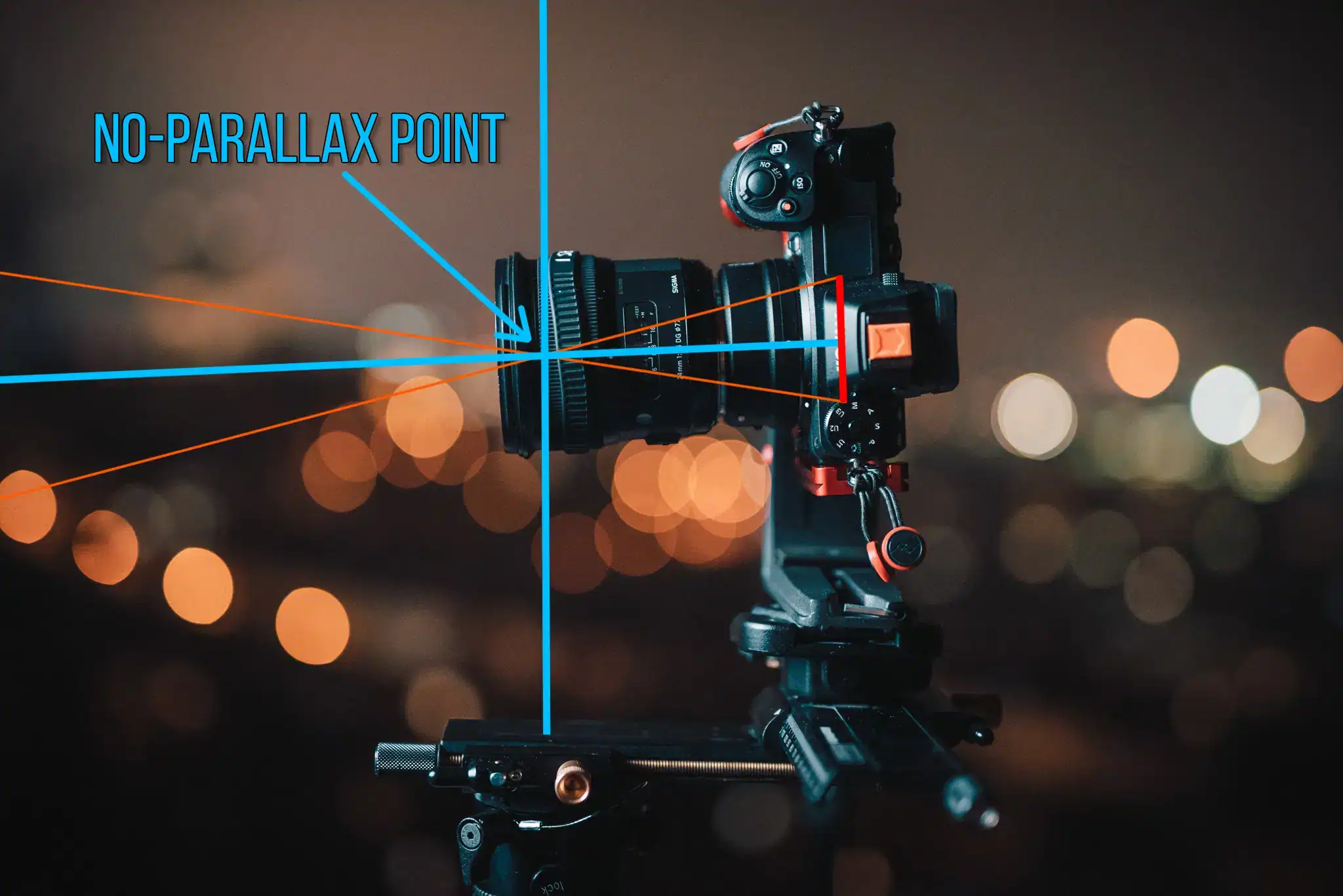
Want a deeper primer on panoramic heads and the no-parallax concept? See this panoramic head tutorial for a solid foundation. Panoramic head tutorial
Step-by-Step Shooting Guide
Standard Static Scenes
- Level and align nodal point: On your panoramic head, adjust the fore-aft rail until objects near/far don’t shift relative to each other as you pan. Mark rail scales for 15, 20, 24, 35mm.
- Manual exposure and white balance: Meter the brightest panel you’ll include (e.g., sky or windows) and expose to preserve highlights. Set WB to Daylight/Cloudy/Tungsten manually. Turn off Auto Lighting Optimizer and any flicker-y auto features.
- Focus plan: Use Live View, zoom in, and set manual focus near the hyperfocal. At 15–16mm and f/8, hyperfocal is roughly 1 m; you’ll get near-to-infinity sharpness. Tape the ring if needed.
- Capture with consistent overlap: For 15–16mm, choose either the safe 3-row method (~20 shots) or the minimal 2-row plus top/bottom (~14 shots). Rotate consistently—use the detents on your rotator if available.
- Nadir shot: After the main set, tilt down and capture a clean ground plate for tripod removal. A second off-center nadir shot helps with patching.
HDR / High Dynamic Range Interiors
- Bracket ±2 EV around a base exposure that holds window highlights. If your body limits bracket count, do multiple passes or use exposure shift between rotations.
- Keep WB locked and aperture fixed (e.g., f/8). Let shutter speed change between brackets, not ISO or aperture.
- Use a steady cadence: shoot darkest to brightest or vice versa consistently across the panorama.
Low-Light / Night Scenes
- Stability first: tripod, remote, and mirror lock-up/Live View. Use 2s self-timer if needed.
- Exposure: f/4–f/5.6 and ISO 400–800; lengthen shutter to maintain quality. On the 6D/6D II, ISO 1600 is usable but bracket or average to control noise.
- Disable lens IS on tripod to avoid micro-jitters. If handholding, keep IS on and raise ISO as needed, but expect more stitching cleanup.
Crowded Events
- Two passes: First pass for full coverage, second pass to capture empty gaps when people move. Mark your yaw start point so passes align.
- Mask moving subjects in post using PTGui or Photoshop layers. Prioritize consistent exposure across both passes.
Special Setups (Pole / Car / Drone)
- Pole: Track wind. Use a wider focal (15–16mm) and faster shutter (1/250+) to freeze sway. Shoot more overlap to hedge motion.
- Car mount: Double-check suction cups, use safety tethers, and shoot at low speeds in safe areas. Expect motion blur—raise ISO or open to f/2.8 if necessary.
- Drone: For reference panoramas only; ensure legal compliance and use automated pano modes if available.
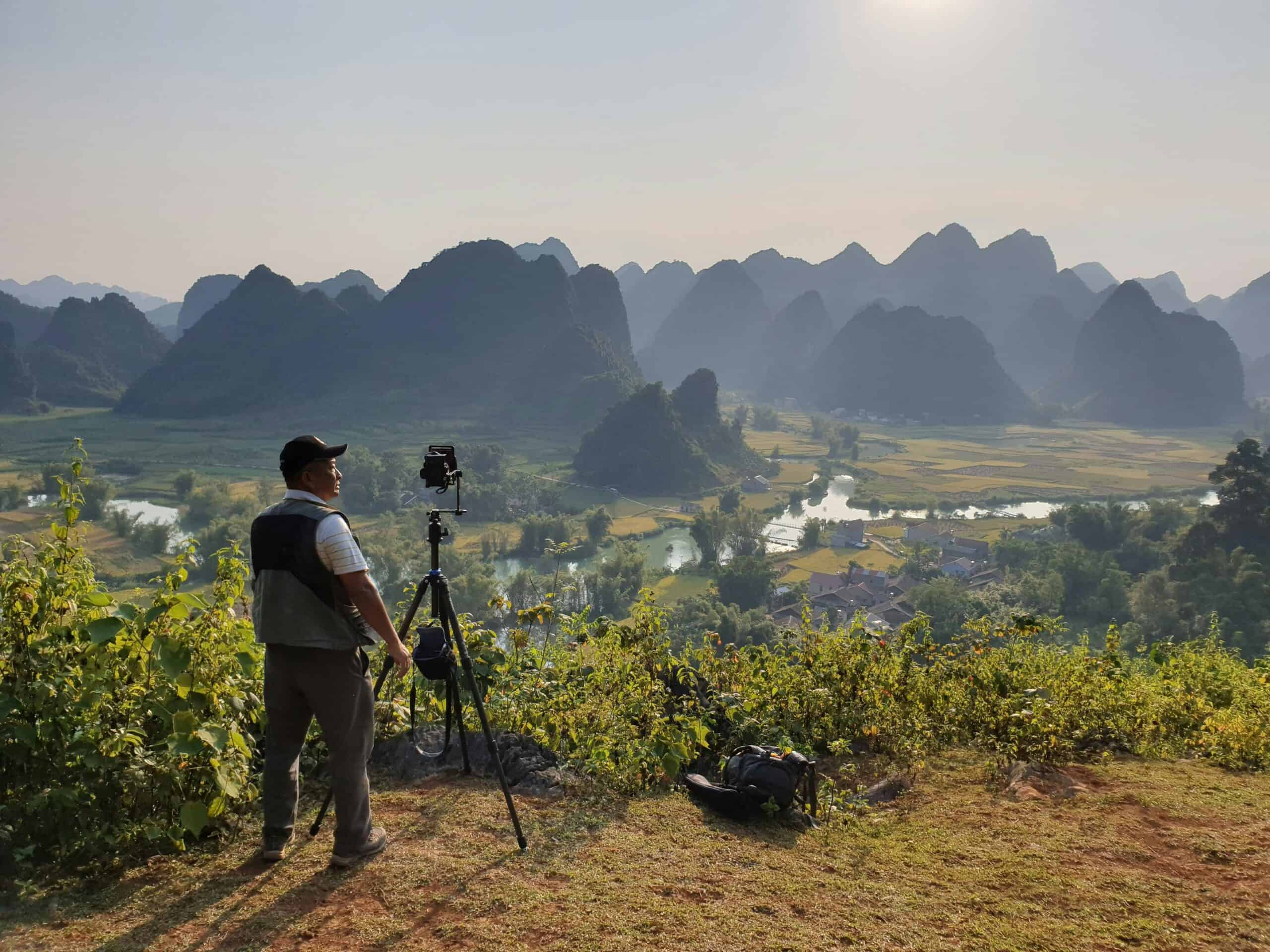
Recommended Settings & Pro Tips
Exposure & Focus
| Scenario | Aperture | Shutter | ISO | Notes |
|---|---|---|---|---|
| Daylight outdoor | f/8–f/11 | 1/100–1/250 | 100–200 | Lock WB (Daylight), manual exposure across the set |
| Low light/night | f/4–f/5.6 | 1/30–1/60 (tripod), longer if needed | 400–800 (1600 max) | Remote trigger, mirror lock, IS off on tripod |
| Interior HDR | f/8 | Bracket ±2 EV | 100–400 | Protect highlights; consistent bracket order |
| Action / moving subjects | f/5.6–f/8 | 1/200+ | 400–800 | Freeze motion; consider two-pass strategy |
Critical Tips
- Manual focus near hyperfocal: At 15–16mm and f/8, ~1 m focus gives near-to-infinity sharpness—ideal for 360 scenes.
- Nodal point calibration: Use two vertical objects (near/far). Pan 10–20°, adjust fore/aft until there’s no relative shift. Mark rail scales for repeatability.
- White balance lock: Mixed lighting kills stitches. Pick a Kelvin setting or a fixed preset and keep it for the entire capture.
- RAW capture: Always shoot RAW for panorama and HDR. You’ll want full DR and color control during blending and stitching.
- Stabilization: On the RF 15–35 or EF IS lenses, turn IS off on tripod. Handheld panos: keep IS on, raise ISO, and overshoot panels for safety.
Stitching & Post-Processing
Software Workflow
Professional-grade stitching is straightforward with PTGui (fast, reliable control points), Hugin (open-source), or Photoshop/Lightroom (good for single-row). Rectilinear UWAs need ~20–30% overlap; fisheyes can get away with ~25–30%, but require defishing and dedicated projections. Build your project as multi-row spherical, set lens type to rectilinear, and feed HDR brackets as stacks if your app supports it. PTGui’s exposure fusion and HDR merging are robust for window-heavy interiors. PTGui review: why many pros rely on it
Cleanup & Enhancement
- Nadir patch: Use a dedicated nadir shot, PTGui Viewpoint Correction, or clone/heal in Photoshop. AI-based content fill can speed up floor cleanup.
- Color/uniformity: Apply a single baseline profile. Fix panel seams with gradient masks when needed.
- Noise reduction: Apply mild NR on shadows; don’t smear textures. Address color noise first.
- Level horizon: Use the optimizer to fix pitch/roll. Set the horizon through verticals if the scene lacks a visible skyline.
- Export: For VR, export equirectangular 2:1 (e.g., 8000×4000 or higher). Keep a master TIFF and deliver a JPEG for the web.
For a concise walk-through of DSLR-to-360 workflow and best practices, this guide is worth a look. Using a DSLR/mirrorless to shoot and stitch a 360 photo
Video: Setting up a panoramic head for perfect 360 capture
Useful Tools & Resources
Software
- PTGui panorama stitching
- Hugin open source
- Lightroom / Photoshop for RAW and finishing
- AI tools for tripod/nadir removal
Hardware
- Panoramic heads (Nodal Ninja, Leofoto)
- Carbon fiber tripods with leveling bases
- Wireless remote shutters or intervalometers
- Pole extensions / car suction mounts with safety tethers
On spherical resolution and planning shot counts for 360 deliverables, see this technical reference. DSLR spherical resolution (Panotools wiki)
Disclaimer: software/hardware names provided for search reference; check official sites for details.
Common Mistakes & How to Avoid Them
- Parallax error: Always align the entrance pupil. Mark rail positions for your key focal lengths.
- Exposure flicker: Manual exposure and locked WB only. Avoid auto ISO and dynamic metering mid-pan.
- Tripod shadows and missing floor: Shoot a proper nadir and/or an off-center patch frame.
- Ghosting from moving subjects: Capture a second pass and mask in post.
- Night noise and color shifts: Prefer longer shutter over high ISO; use consistent Kelvin WB and reduce color noise first.
- Wind shake: Shorten exposures, add weight to tripod, and pause for vibrations to dampen between shots.
Frequently Asked Questions
-
Can I truly use the RF 15–35mm on the EOS 6D / 6D Mark II?
No. RF lenses do not mount on EF DSLRs. Use an EOS R-series body for RF glass, or use an EF 16–35mm on the 6D/6D II. All technique here applies equally to the EF counterpart.
-
Is 15–16mm wide enough for single-row 360?
Not for full spherical. At 15–16mm rectilinear you’ll need multiple rows (e.g., 6 around × 3 rows + zenith/nadir). For fewer shots, consider a fisheye; for architectural accuracy, stick to rectilinear and plan ~14–20 shots.
-
Do I need HDR for interiors with bright windows?
Usually yes. Bracket ±2 EV (or more if needed) to hold window highlights and interior shadows. Keep WB and aperture fixed, and let shutter vary between brackets.
-
How do I avoid parallax issues with this setup?
Use a panoramic head and align the entrance pupil for your chosen focal length. Calibrate with near/far targets and mark the rail scales so you can repeat the position every time. For a deeper primer, see this guide to setting up a pano head. Set up a panoramic head for perfect 360 photos
-
What ISO ranges are safe on the 6D/6D Mark II for low light?
For best quality, target ISO 100–400 and use longer shutter on tripod. ISO 800 is still clean; 1600 is usable with careful noise reduction. For HDR, keep ISO low and let bracketing handle dynamic range.
Field-Proven Scenarios & Tips
Indoor Real Estate
Set f/8, ISO 100–200, and bracket ±2 EV per panel. Shoot 15–20 frames at 15–20mm, keeping WB at a fixed Kelvin (e.g., 4300–4800K for mixed LED/tungsten). Marking your rotator detents helps maintain consistent yaw spacing, reducing stitching errors on white walls and straight lines.
Sunset Cityscape on Rooftop
Use f/8, ISO 100–200; expose for highlights and bracket if needed. Wind is the enemy—hang a weight from the tripod and pause for gusts to pass before each frame. Capture a fast safety pass after the sun drops for blendable city lights.
Crowded Event
Shoot one full, fast pass (shutter priority, 1/200+) and then a second pass with patience to capture emptier patches. In PTGui, use masks to select the clean panel for each seam. Overlap generously (30–40%) to give the stitcher more options around moving people.
High Vantage Pole Shot
At 15–16mm, use 1/250–1/500, f/5.6–f/8, ISO 400–800. Keep rotations minimal and deliberate; capture more frames than usual to hedge against motion. Always tether the pole and avoid crowded or windy conditions.
Compatibility & Best-Value Alternatives
If your goal is precisely how to shoot panorama with Canon EOS 6D / 6D Mark II & Canon RF 15-35mm f/2.8L IS USM, remember the hard compatibility limit. For the same results on a 6D-class DSLR, pick the EF 16–35mm f/4L IS USM (excellent stopped down, lighter) or EF 16–35mm f/2.8L III (great wide-open, superb corners by f/5.6–f/8). All the focal length guidance and shot counts above apply directly.
If you own the RF 15–35, consider an EOS R, R6, or R5 to complete the pairing. You’ll also gain on-sensor features (like focus peaking and EVF preview) that speed pano work. For general pano FAQs on DSLR setups and lens choices, this overview is helpful. DSLR virtual tour FAQ and lens guide
Safety & File Integrity
- Rooftops/poles: Use a safety tether and check weather. Never overreach; reposition instead.
- Crowds: Mind trip hazards with tripod legs. Keep a small footprint and warn passersby.
- Redundancy: If it’s paid work, duplicate the set—card failures happen. Consider dual-slot bodies for critical jobs.
- Data workflow: Back up immediately with verified checksums (e.g., copy + verify). Keep RAWs and a master stitched TIFF archived.