Why This Camera & Lens Are Great for Panoramas
If you’ve been wondering how to shoot panorama with Canon EOS 6D / 6D Mark II & Canon RF 14-35mm f/4L IS USM, here’s the first honest truth: the RF 14–35mm is an RF-mount lens designed for Canon’s mirrorless EOS R system and cannot mechanically attach to EF-mount DSLRs like the EOS 6D or 6D Mark II (there is no RF-to-EF adapter). That said, the techniques below apply perfectly to wide rectilinear glass on full-frame Canon DSLRs. If you’re staying with the 6D/6D Mark II, use an EF alternative such as the Canon EF 16–35mm f/4L IS USM, EF 14mm f/2.8L II, or a third‑party 14–15mm prime. If you do have an EOS R body available, everything here maps directly to the RF 14–35’s behavior.
Why this pairing (6D/6D Mark II + wide rectilinear zoom) still shines for panoramas: both the Canon EOS 6D (20.2 MP) and 6D Mark II (26.2 MP) are full-frame, giving you large photosites (approx. 6.55 μm on 6D; ~5.76 μm on 6D Mark II) for clean files and forgiving exposure latitude. At base ISO 100, you’ll see roughly ~12 EV of usable dynamic range on the 6D and just under that on the 6D Mark II—plenty for daylight panoramas and HDR interior work. A rectilinear ultra-wide like 14–35mm (or EF 16–35mm as a stand-in) keeps straight lines straight, which is ideal for architecture and real estate. The f/4 aperture is sharp by f/5.6–f/8, and on a tripod you don’t need more speed.
Quick Setup Overview
- Camera: Canon EOS 6D / 6D Mark II — Full Frame (36×24 mm); 6D: 20.2 MP, ~6.55 μm pixel pitch; 6D Mark II: 26.2 MP, ~5.76 μm pixel pitch. Good base ISO DR (~12 EV) and strong low-light performance up to ISO 1600–3200 with careful exposure.
- Lens: Canon RF 14–35mm f/4L IS USM (rectilinear, excellent contrast, good CA control stopped down). Note: not physically compatible with 6D/6D Mark II; use EF alternatives (e.g., EF 16–35mm f/4L IS USM) on these DSLRs. All shooting guidelines are the same.
- Estimated shots & overlap (Full-Frame rectilinear; 25–30% overlap):
- 14 mm: three rows of 6 around (−45°, 0°, +45°) = 18 shots + 1–3 zenith/nadir patches → ~20–22 total.
- 20 mm: three rows of 8 around = 24 + patches → ~26–28 total.
- 24 mm: three rows of 10 around = 30 + patches → ~32–34 total.
- 35 mm: four rows of 12 around = 48 + patches → ~50–52 total (gigapixel detail, slower).
- Difficulty: Moderate. Easier outdoors; more advanced indoors (HDR, tight spaces, parallax control).
Planning & On-Site Preparation
Evaluate Shooting Environment
Walk your scene before unpacking. Note the light direction, moving elements (people, trees, traffic), and high-contrast zones (windows vs interior shadows). Check for reflective surfaces like glass or polished floors that can cause ghosting—if you must shoot through glass, keep the front element within 2–5 cm of the pane and shade it with your hand or a rubber lens hood to reduce reflections. In tight interiors, plan for more shots and possibly a two-pass capture to handle moving subjects or flickering lights.
Match Gear to Scene Goals
The 6D/6D Mark II sensors are forgiving at base ISO and still clean at ISO 400–800. For interiors or dusk, ISO 400–800 on tripod is a safe working range; for night exteriors, ISO 800–1600 with long exposures works if you expose to the right and keep the histogram off the clipping edges. A rectilinear wide zoom like 14–35 mm (or EF 16–35 mm on 6D) delivers straight lines and minimal distortion—ideal for architecture. Fisheye options reduce shot count but introduce curvature and more complex verticals; your rectilinear choice keeps editing predictable.
Pre-shoot Checklist
- Charge two LP‑E6 batteries; bring at least 64–128 GB of fast SD/SDHC/SDXC storage.
- Clean both lens and sensor; dust shows up when stitching clear skies or white walls.
- Level the tripod, mount a panoramic head, and verify nodal alignment for the chosen focal length.
- Safety checks: weigh down tripod in wind, tether on rooftops, verify car/pole mounts, and avoid public obstruction hazards.
- Backup workflow: shoot a second full pass at the horizon row; bracket a safety set for HDR-critical scenes.
Essential Gear & Setup
Core Gear
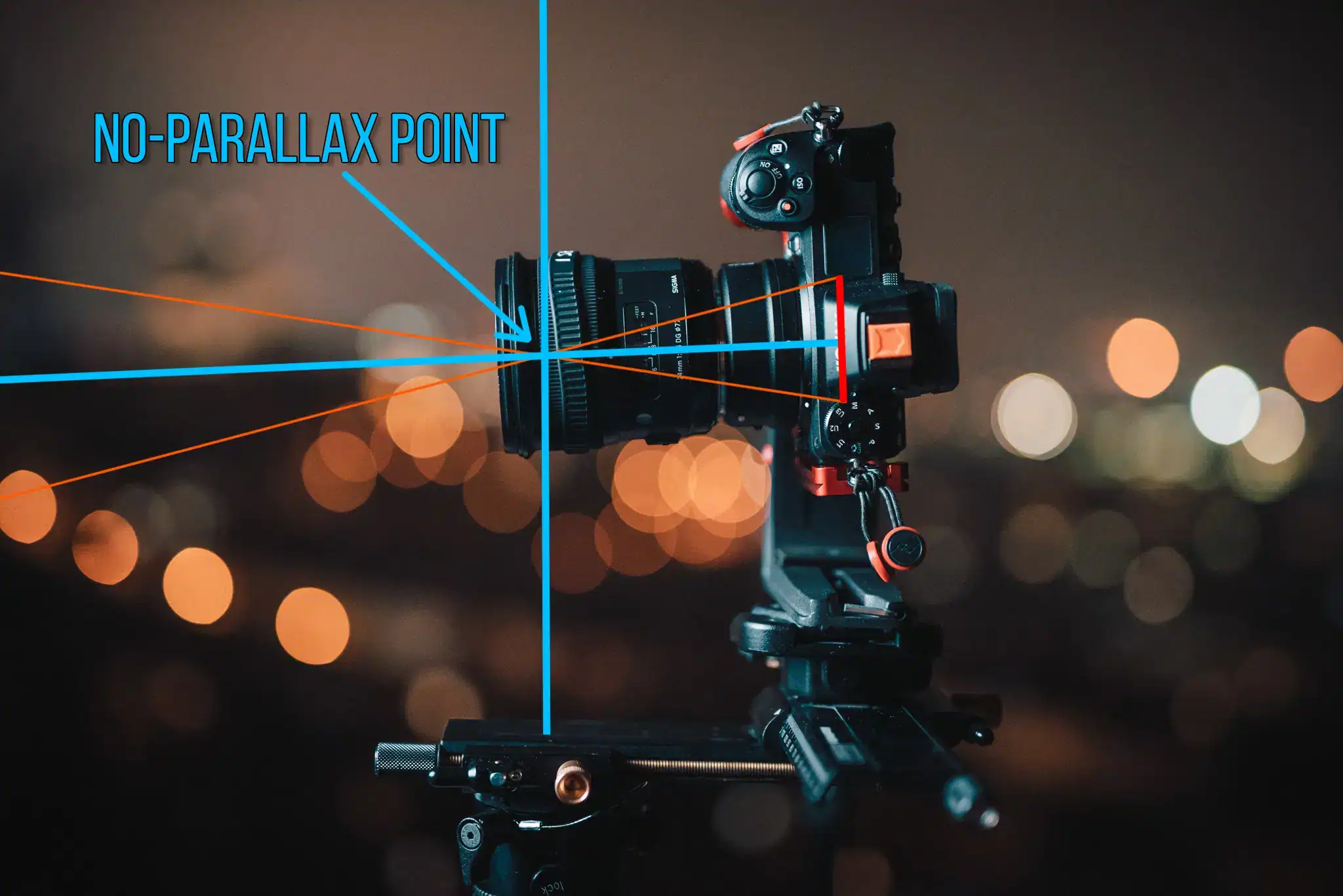
- Panoramic head: This lets you rotate around the lens’s no-parallax point (entrance pupil) to avoid foreground-background shifts. Calibrate once per focal length and mark your rails for speed later.
- Stable tripod with a leveling base: A leveled base keeps rows aligned and speeds stitching with clean horizons.
- Remote trigger or Canon Camera Connect app: Avoid vibrations; use 2-sec self-timer if you forget the remote.
Optional Add-ons
- Pole or car mount: Always use a safety tether, wind rating, and high-friction clamps. Keep speeds low and avoid sudden yaw for clean overlaps.
- Lighting aids: Portable LED panels or bounced flash for interiors; keep lighting consistent across frames.
- Weather covers: Rain shells and silica packs protect your 6D/6D Mark II; avoid using lens IS on a locked tripod to prevent micro-blur.
For a deeper dive into panoramic head setup and the no-parallax point, see this panoramic head tutorial (great visuals and best practices). Panoramic head setup guide
Video: Panoramic Head Setup (Recommended)
Seeing the nodal alignment process once makes everything easier. Watch a concise explanation here:
For a full step-by-step from capture through stitching aimed at 360 output, Oculus’ creator documentation is also excellent. Set up a panoramic head for high-end 360 photos
Step-by-Step Shooting Guide
Standard Static Scenes
- Level the tripod. Use a leveling base or bowl. On the 6D/6D Mark II, enable the electronic level in Live View to double-check.
- Align the nodal point. Place two light stands (or vertical edges) at near and far distances; rotate the camera and slide the rail until the near object doesn’t shift against the far one. Mark the rail position for each focal length (e.g., 14, 20, 24, 35 mm).
- Manual exposure and locked white balance. Set M mode, pick a consistent Kelvin (e.g., 5500K daylight outside, 3200–4000K indoors), disable Auto Lighting Optimizer and any in-camera vignetting corrections—keep frames consistent for stitching.
- Focus once and lock. Switch to Live View, magnify, focus about the hyperfocal distance:
- 14 mm at f/8 → hyperfocal ≈ 0.8–1.0 m; set MF and tape the ring if needed.
- 24 mm at f/8 → hyperfocal ≈ 2.4 m.
- Capture sequence with proper overlap. For 14 mm: 6 shots around at 0°, then tilt +45° for another 6, and −45° for another 6. Add zenith and nadir patches. Rotate smoothly; keep yaw increments even.
- Take a clean nadir. Either shoot a dedicated nadir by tilting down after moving the tripod slightly, or plan to patch later.
HDR / High Dynamic Range Interiors
- Bracket ±2 EV (3 or 5 frames) to balance bright windows and dark interiors. The 6D/6D Mark II handle bracketed series well; use 2-sec timer or remote for each node.
- Lock white balance and picture style. Exposure variability is fine; color variability is not—stitchers hate WB drift.
- Shoot all brackets at each position before rotating. This keeps moving subjects consistent and maintains alignment.
Low-Light / Night Scenes
- Use f/4–f/5.6 and slower shutter speeds (1/10–10 s) at ISO 100–800 to preserve detail. The 6D is notably clean up to ISO 1600; the 6D Mark II is good up to ~1600 with careful noise reduction.
- Disable lens IS on a tripod to avoid micro-oscillation blur. Use the remote or 2-sec timer; mirror lock-up is helpful on the 6D (enable with self-timer).
- Flag moving lights. If fountains/cars streak, capture an extra exposure for clean blend plates.
Crowded Events
- Shoot two passes on the horizon row: one continuous sequence, then a second pass waiting for gaps. This gives masking options in post.
- Favor a slightly faster shutter (1/125–1/250) at f/5.6–f/8, ISO 400–800 to freeze people without spikes in noise.
- Mask moving bodies later using the second pass as a clean plate.
Special Setups (Pole / Car / Rooftop)
- Secure everything with safety tethers and rated clamps. On poles, keep total kit weight low (6D + EF 16–35 + compact head). Avoid high winds; even small vibrations ruin overlaps.
- Use faster shutter speeds (1/250+) to counter micro-shake. Increase ISO rather than risking blur.
- Plan slower rotations and fewer shots when elevated; consider a wider focal length (14–20 mm) to minimize total frames.
Recommended Settings & Pro Tips
Exposure & Focus
| Scenario | Aperture | Shutter | ISO | Notes |
|---|---|---|---|---|
| Daylight outdoor | f/8–f/11 | 1/100–1/250 | 100–200 | Lock WB to Daylight (5200–5600K). Use CPL only if you can manage sky banding. |
| Low light/night | f/4–f/5.6 | 1/10–1 s | 100–800 | Tripod + remote; IS off on tripod; mirror lock‑up helps on 6D. |
| Interior HDR | f/8 | Bracket ±2 EV | 100–400 | Expose for mid‑tones; bracket for windows and fixtures. |
| Action / moving subjects | f/5.6–f/8 | 1/200+ | 400–800 | Do a second pass and blend to remove ghosts. |
Critical Tips
- Manual focus at hyperfocal. For 14 mm at f/8, focus ~0.8–1 m; for 24 mm at f/8, ~2.4 m. Then switch AF off.
- Nodal calibration. Calibrate and mark rail positions for 14, 20, 24, and 35 mm so you can change focal lengths mid-job without guesswork.
- White balance lock. Use Kelvin rather than Auto to avoid cross-frame color shifts that complicate stitching.
- RAW over JPEG. You’ll recover highlights/shadows better and match color across frames more easily.
- Stabilization. The 6D/6D Mark II have no IBIS; turn off lens IS when on tripod. Handheld panos benefit from IS, but use faster shutters.
Case Studies
Indoor Real Estate (Bright Windows)
Use 16–20 mm at f/8, ISO 100–200. Bracket ±2 EV (5 frames if needed) for each node. Shoot windows slightly under to retain detail; later blend HDR before stitching or use exposure fusion in PTGui.
Outdoor Sunset
Meter for the highlights and shoot a quick bracketed pass. If clouds move fast, increase overlap to ~35% to aid control points.
Event Crowds
Shoot two horizon passes; note that at 35 mm, you’ll need more frames and subject movement becomes more problematic. Prefer 20–24 mm if possible.
Rooftop / Pole Capture
Secure everything and add a safety strap. Use a wider focal length and fewer total shots to reduce time aloft. Avoid gusts and keep your body as a windbreak.
Stitching & Post-Processing
Software Workflow
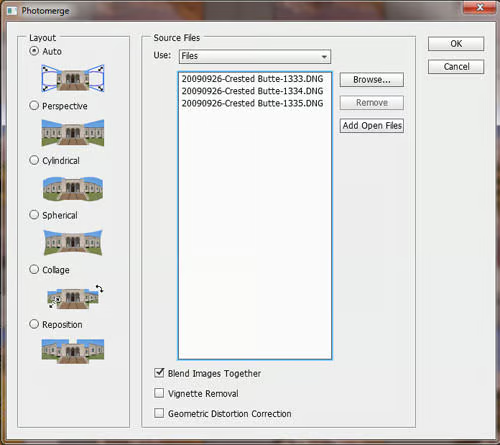
Import RAWs into Lightroom or your preferred RAW editor; apply uniform white balance, lens profile (for EF lenses), and modest noise reduction. Export 16-bit TIFFs to a stitcher like PTGui or Hugin. Rectilinear ultra-wide images are easy to align with 20–30% overlap, but multi-row sequences require good control points and leveled metadata. PTGui’s “Align to Grid” and “Viewpoint Correction” help patch tricky nadirs. Fisheye workflows involve fewer shots but more projection management; rectilinear keeps architecture straight with more frames. Why PTGui remains a top panorama tool
Cleanup & Enhancement
- Nadir patching: Export a layered panorama and clone/heal the tripod, or use a logo patch or AI-based object removal.
- Color consistency: Check neutral walls/ceilings; unify tint after stitching to avoid seams.
- Horizon leveling: Set pitch/roll/yaw in your stitcher; confirm straight verticals in architectural shots.
- Output: For VR, export 2:1 equirectangular JPEG/TIFF at the needed resolution (8k–16k typical). For web viewers and virtual tours, keep file sizes optimized.
If you’re new to full 360 capture workflows with DSLRs, this overview is a practical companion to the steps above. Using a DSLR to shoot and stitch a 360 photo
Disclaimer: Always check your software’s latest documentation for new features and updated workflows.
Useful Tools & Resources
Software
- PTGui for robust multi-row stitching and HDR fusion
- Hugin (open-source alternative)
- Lightroom / Photoshop for RAW prep and retouching
- AI tools for tripod removal and seam cleanup
Hardware
- Panoramic heads: Nodal Ninja, Leofoto, Sunwayfoto
- Carbon fiber tripods with leveling bases
- Wireless remotes (Canon RS-80N3 or intervalometers)
- Pole extensions and vehicle mounts with safety tethers
Disclaimer: Brand names are for reference; confirm specs and compatibility with your specific camera body.
Common Mistakes & How to Avoid Them
- Parallax error → Calibrate the no-parallax point for each focal length and lock it on the rails.
- Exposure flicker → Manual mode, fixed WB, uniform picture style; avoid auto ISO for panoramic sequences.
- Tripod shadows → Shoot a dedicated nadir or plan a patch; move the tripod slightly and shoot a clean plate.
- Ghosting from movement → Do a second pass and mask in post; increase shutter speed in crowds.
- Noise at night → Prioritize longer exposures at ISO 100–800; only push 1600–3200 when needed and denoise later.
Frequently Asked Questions
- Can I shoot handheld panoramas with the Canon 6D or 6D Mark II?
Yes for simple cylindrical panos. Use 24–35 mm, 30–40% overlap, and fast shutters (1/250). For full multi-row 360×180, a tripod and panoramic head are strongly recommended to avoid parallax and misalignment.
- Is the Canon RF 14–35mm f/4L IS USM wide enough for single-row 360?
For a complete 360×180 sphere, you’ll still need multiple rows even at 14 mm on full frame. Single-row works for “cylindrical” panoramas (no zenith/nadir coverage). Note: the RF lens cannot be mounted on the 6D/6D Mark II; use an EF 16–35 mm f/4 as a practical substitute on these bodies.
- Do I need HDR for interiors with bright windows?
Usually, yes. Bracket ±2 EV (3–5 frames) at each position to hold both window detail and interior shadows. Merge to HDR or use exposure fusion before stitching for best results.
- How do I avoid parallax issues?
Rotate around the no-parallax point. Calibrate your panoramic head with near/far alignment and mark the rail positions for each focal length. Keep the camera level and maintain consistent overlap between frames.
- What ISO range is safe on these cameras in low light?
For tripod work, aim for ISO 100–800 and extend the shutter. If necessary, ISO 1600–3200 on the 6D/6D Mark II is usable with careful exposure and post-process noise reduction.
- Can I set Custom Shooting Modes (C1/C2) for panoramas?
Yes. Save manual exposure, Kelvin WB, mirror lock-up, 2-sec timer, and RAW format in a custom mode. It speeds setup and ensures consistency across sessions.
- Should I keep image stabilization on?
On a tripod, turn IS off to avoid micro-movements. Handheld cylindrical panos can benefit from IS at slower shutter speeds.
- What’s the best panoramic head for this setup?
Look for a two-rail head with indexed click-stops and a leveling base. Nodal Ninja, Leofoto, or Sunwayfoto systems offer reliable alignment and repeatable positions—key for multi-row work.
Safety, Compatibility & Backup Notes
Compatibility: The Canon RF 14–35mm f/4L IS USM is not compatible with EF-mount DSLRs like the 6D/6D Mark II. There is no RF-to-EF adapter. If you need 14 mm coverage on these cameras, use EF-mount options (Canon EF 14mm f/2.8L II, EF 16–35mm f/4L IS USM, or third-party 14–15 mm primes). All panoramic shooting guidance here applies to those lenses on the 6D/6D Mark II.
Field safety: Weigh your tripod in wind, tether gear at height, and avoid obstructing public pathways. When using poles or vehicle mounts, always use a safety line and avoid high speeds.
Backup workflow: Shoot a second horizon pass; keep duplicate cards; back up immediately to two locations after the shoot. Maintain a simple folder structure (Scene › Row › Node) so stitching is painless.
For more techniques and pro tips from experienced panoramic shooters, this Q&A-style resource is a great complement to the steps above. Best techniques to take 360 panoramas