Why This Camera & Lens Are Great for Panoramas
The Canon EOS 5D Mark IV is a proven full‑frame workhorse for professional panoramas: a 30.4MP 36×24mm sensor with ~5.36μm pixel pitch delivers clean detail, robust color, and a real-world dynamic range near 13.5 EV at ISO 100. That gives you flexible exposure latitude for high-contrast scenes and rich gradations for skies and interiors. Its Dual Pixel AF makes pre-focus easy, Live View helps with leveling and mirror lock, and the body’s rugged build tolerates field work from rooftops to beaches.
The Sigma 15mm f/1.4 DG DN Diagonal Fisheye Art is a specialty ultra‑wide with a 180° diagonal field of view. As a diagonal fisheye, it covers the full sensor and captures a huge swath of the scene per shot—excellent for 360 photos because you need fewer frames to cover the sphere. Its f/1.4 aperture is outstanding for low-light scenes and astrophotography, with modern control of coma and chromatic aberration. Note an important compatibility caveat: this DG DN version is made for mirrorless mounts (Sony E / L‑mount) and does not natively fit the EOS 5D Mark IV (EF mount). For a similar diagonal fisheye experience on the 5D Mark IV, use an EF‑mount alternative like the Sigma 15mm f/2.8 EX DG diagonal fisheye or the Canon EF 8–15mm f/4L Fisheye at 15mm. The shooting workflow below remains identical for any 15mm diagonal fisheye on full frame.
Fisheye distortion isn’t a drawback for 360 work—it’s expected and handled by stitching software. With a solid panoramic head and good nodal alignment, you can produce crisp, seam‑free 360° panoramas with fewer frames and faster on-site shooting.
Quick Setup Overview
- Camera: Canon EOS 5D Mark IV — Full‑Frame (36×24mm), 30.4MP, ~13.5 EV DR at base ISO, excellent color depth.
- Lens: Sigma 15mm f/1.4 DG DN Diagonal Fisheye Art — diagonal fisheye (180° diagonal FoV), very sharp by f/5.6–f/8, modern coatings, controlled coma/CA. Compatibility note: DG DN is mirrorless‑only; on 5D Mark IV use an EF‑mount diagonal fisheye with similar 180° diagonal FoV.
- Estimated shots & overlap (Full Frame, 15mm diagonal fisheye):
- General exterior: 4 around at 0° yaw spacing + zenith + nadir (6 total) if the zenith/nadir aren’t complex.
- Interiors / complex scenes: 6 around at 0° + zenith + nadir (8 total) with ~30–40% overlap for safer stitching.
- Alternative multi-row (maximum coverage): 4 around at +30°, 4 around at −30°, plus zenith and nadir (10 total).
- Difficulty: Moderate — easy once nodal point is calibrated and exposure workflow is locked in.
Planning & On-Site Preparation
Evaluate Shooting Environment
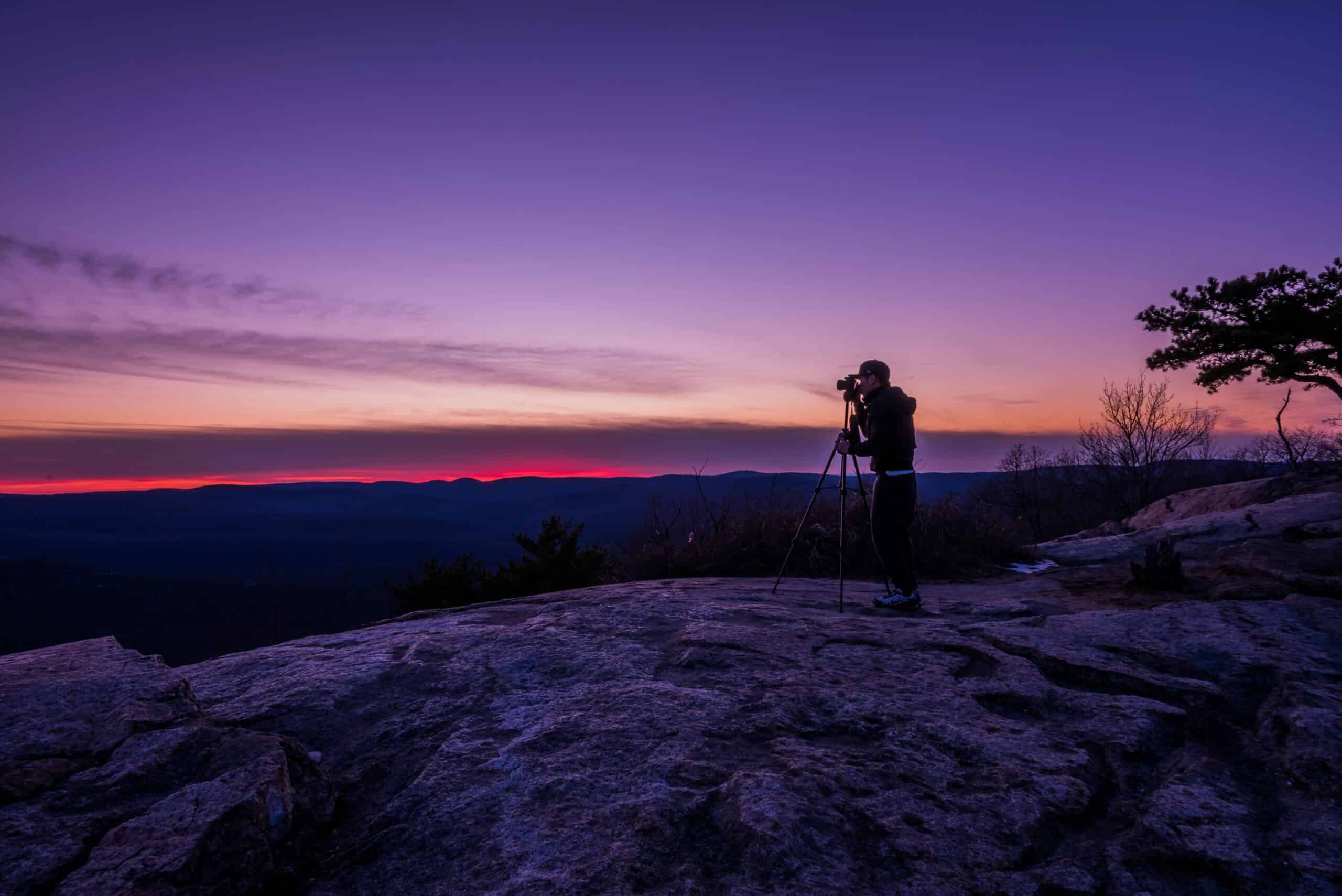
Assess light direction, sun position, and contrast. In interiors, watch for mixed lighting (tungsten + daylight) and strong window backlight; plan to bracket HDR. Identify reflective surfaces (glass, polished floors, mirrors) and keep the camera at a consistent distance; if shooting through glass, place the lens as close as possible to reduce reflections and ghosting. Outdoors, note wind speed (affects pole/car captures), moving foliage, and crowds that can cause ghosting.
Match Gear to Scene Goals
The 5D Mark IV’s DR at base ISO handles bright skies and shadow detail well; ISO 100–400 is ideal for clean results. In darker interiors or blue hour, 5D4 files remain strong up to ISO 800–1600 with noise reduction in post. A diagonal fisheye at 15mm minimizes shot count, which is perfect for time‑sensitive shoots (events, crowds) but demands careful nodal alignment to avoid parallax seams. If you’re capturing a high‑detail gigapixel façade, a rectilinear telephoto is better; but for immersive 360 photos, the 15mm fisheye is a fast, reliable choice.
Pre-shoot Checklist
- Power & storage: Fully charged batteries; fast UDMA7 CF or SD cards; bring spares.
- Clean optics: Front element, rear filter slot (if used), and sensor. Fisheyes see everything—dust shows up easily.
- Tripod & head: Leveling base, calibrated panoramic head, marked nodal setting for your camera/lens combo.
- Camera settings: Manual exposure, manual white balance, RAW capture, mirror lockup or Live View.
- Safety: For rooftops and poles, tether gear; watch wind loads; never stand under a raised pole.
- Backup workflow: When in doubt, shoot a second full round. For HDR, consider 3–5 brackets per angle.
Essential Gear & Setup
Core Gear
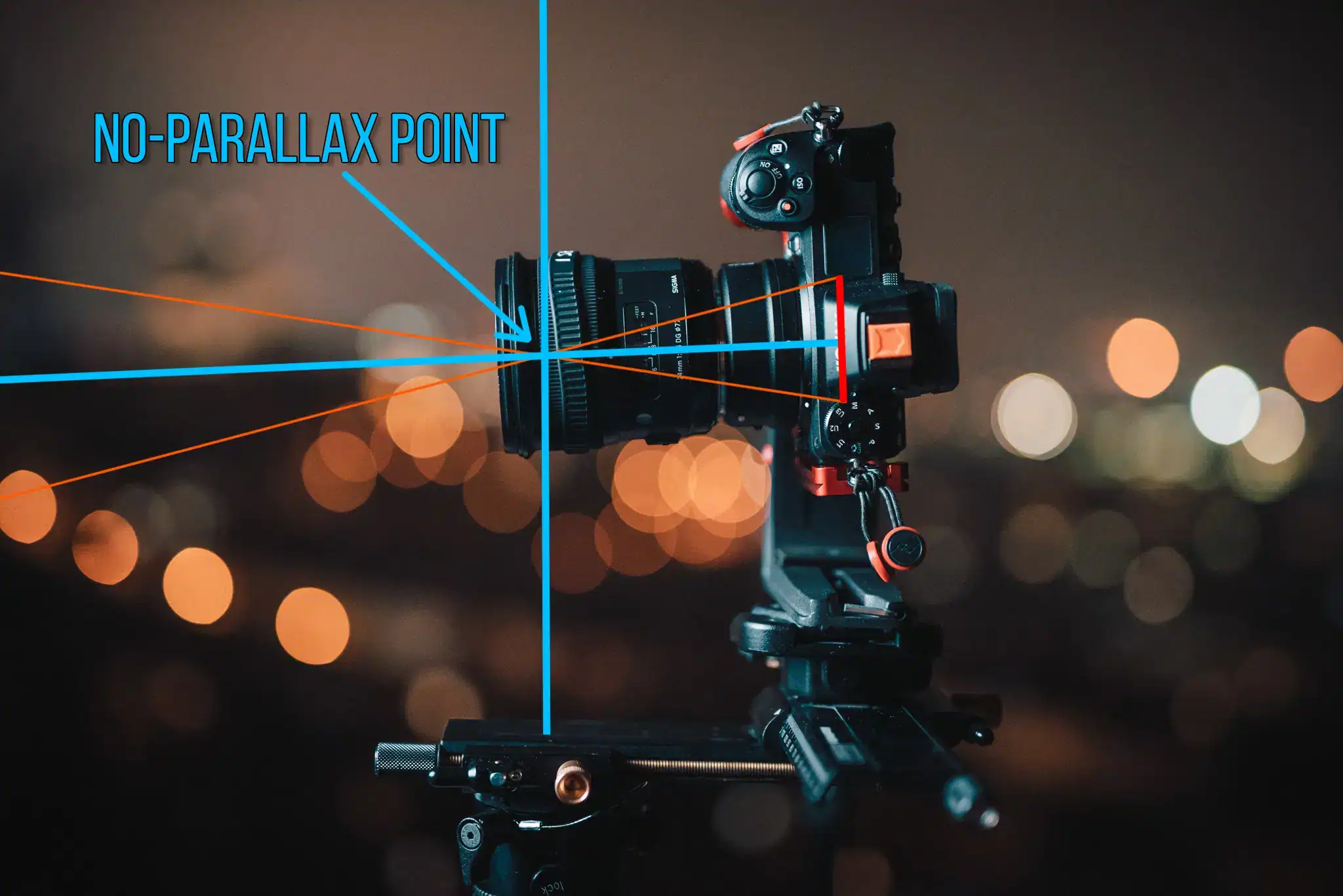
- Panoramic head: This lets you rotate the camera around the lens’s entrance pupil (nodal point) to eliminate parallax. Proper alignment is the difference between one‑click stitches and hours of masking.
- Stable tripod with leveling base: Level the platform so your yaw rotation remains true; it prevents horizon tilts and roll errors.
- Remote trigger or app: Use a cable release or self‑timer to avoid vibrations. The 5D Mark IV’s mirror lockup or Live View reduces mirror shock.
Optional Add-ons
- Pole or car mount: Great for elevated viewpoints or drive‑through coverage, but wind and vibration are real hazards—use safety lines and slower rotation, and keep shutter speeds reasonably fast (1/100–1/250) if the rig isn’t perfectly rigid.
- Lighting for interiors: Small LED panels or bounced flash can lift shadows in very dark rooms when HDR isn’t possible.
- Weather gear: Rain covers, lens hood shades, and microfiber cloths; water drops on a fisheye are highly visible.
Step-by-Step Shooting Guide
Standard Static Scenes
- Level and nodal-align: Level the tripod, then slide the camera along the pano head’s rail until foreground and background stay aligned during a small left/right pan. Mark this setting for your 5D Mark IV + diagonal fisheye combo.
- Manual exposure and white balance: Set M mode, choose a base exposure from a mid‑tone portion of the scene, and lock a fixed white balance (Daylight for sun, Tungsten for warm interiors). Shoot RAW for maximum flexibility.
- Capture sequence with overlap:
- Exterior simplicity: 4 shots around at 0° yaw spacing, then 1 zenith (+90°) and 1 nadir (−90°) for 6 total.
- Complex interior: 6 around at 60° yaw spacing + zenith + nadir for 8 total; aim for ~30–40% overlap.
- Nadir capture: Take at least one dedicated ground shot for tripod removal. Use the Viewpoint tool in stitching software or patch later.
HDR / High Dynamic Range Interiors
- Bracket exposures: 3 frames at ±2 EV often suffice; for bright windows, use 5 frames (−4, −2, 0, +2, +4 EV). Keep aperture constant; vary shutter speed.
- Lock WB and focus: Consistency across brackets is critical. Use a remote to avoid touching the camera during the bracket sequence.
- Workflow tip: Either pre-merge brackets per angle (Exposure Fusion/Tonemap) then stitch, or stitch bracketed stacks in PTGui with Exposure Fusion. Both work well.
Low-Light / Night Scenes
- Use tripod discipline: Mirror lockup or Live View, 2s timer or remote trigger, and steady ground. The 5D Mark IV has no IBIS—do not rely on stabilization.
- Exposure targets: f/4–f/5.6, 1/30–1/60s for moderately lit streets; raise ISO to 400–800 for cleaner stars and less motion blur. For very dark scenes, ISO 1600 is usable with noise reduction.
- Color control: Lock WB (e.g., 3200–3600K under sodium/LED mix) to avoid shifting colors across frames.
Crowded Events
- Two-pass method: Do one fast pass for structure, then a second pass where you wait for gaps in movement. You can mask moving people later in post.
- Shot count: Favor 6 around + Z/N for more control points and easier seam placement away from faces or signage.
Special Setups (Pole / Car / Elevated)
- Safety first: Use a safety tether, check wind loads, and keep people clear of the rig’s fall zone. On vehicles, use rated mounts and avoid public roads unless permitted.
- Vibration management: Shorten pole height if windy, increase shutter speed, and consider shooting more overlap (e.g., 8 around) to help the stitcher.
Real Field Case Studies
Indoor Real Estate
With a 15mm diagonal fisheye on the 5D4, 6 around + zenith + nadir at f/8, ISO 100–200, 3–5 bracket HDR yields clean room coverage with minimum ghosting. Place seams over static surfaces (ceilings, blank walls) rather than busy furniture lines.
Outdoor Sunset
Meter for mid-tones, then bracket ±2 EV to preserve sky color. Use 4 around + Z/N if the foreground is uncluttered. Shoot quickly to keep the sun’s position consistent across frames.
Event Crowds
Use 6 around at 1/200s, f/5.6, ISO 400–800 depending on light. Capture a second pass to fix ghosting. Place seams away from faces and moving flags.
Rooftop / Pole Shooting
Keep the pole vertical with a bubble level; avoid gusty conditions. Use faster shutter speeds (1/100–1/250) and slightly higher ISO rather than risking blur. Shoot 6–8 around for extra overlap to help the stitcher handle any flex.
Car-Mounted Capture
Only on controlled private roads with proper safety. Use a rigid suction mount rated well above your gear’s weight, shorten support arms, and shoot more frames than usual to improve stitching redundancy.
Recommended Settings & Pro Tips
Exposure & Focus
| Scenario | Aperture | Shutter | ISO | Notes |
|---|---|---|---|---|
| Daylight outdoor | f/8–f/11 | 1/100–1/250 | 100–200 | Lock WB (Daylight); avoid polarizers on fisheyes |
| Low light/night | f/4–f/5.6 | 1/30–1/60 | 400–800 | Tripod, remote, mirror lock/Live View |
| Interior HDR | f/8 | Bracket ±2 EV | 100–400 | Windows vs. shadows balanced in post |
| Action / moving subjects | f/5.6–f/8 | 1/200+ | 400–800 | Freeze motion; consider two-pass technique |
Critical Tips
- Manual focus at hyperfocal: For a 15mm on full frame at f/8, hyperfocal is roughly ~0.95 m; set focus to ~1 m to keep ~0.5 m to infinity acceptably sharp.
- Nodal calibration: Use a vertical pole in front of a distant background; pan left/right. Slide the camera along the rail until the near object stays aligned with the far object. Mark the rail for repeatable setups.
- White balance lock: Mixed lighting kills consistency; use a fixed WB or set a custom Kelvin to keep color uniform across frames.
- RAW over JPEG: You gain headroom for HDR blending, highlight recovery, and noise reduction—especially important on night scenes.
- Stabilization: The 5D Mark IV has no IBIS. If using an IS lens (not typical for fisheyes), disable IS on a tripod to avoid micro‑jitter.
Stitching & Post-Processing
Software Workflow
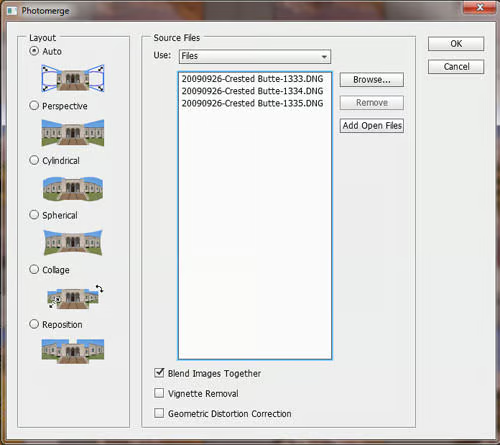
Import RAWs to Lightroom or your favorite converter, apply lens‑appropriate color corrections, then stitch in PTGui or Hugin. Fisheye images are straightforward to stitch because the overlap is generous and the projection is known; you’ll typically choose equirectangular output for 360/VR. With a 15mm diagonal fisheye on full frame, industry practice is ~25–35% overlap around; if you shot 6 around + Z/N, set control points automatically and optimize. For web, export ~12,000–16,000 px width equirectangular; for prints or high-end tours, 16,000–20,000 px is common. For a deep review of PTGui’s strengths, see the Fstoppers PTGui review at the end of this paragraph. PTGui is among the most reliable stitchers for complex panoramas.
Cleanup & Enhancement
- Tripod/nadir patch: Use a dedicated nadir shot and PTGui’s Viewpoint optimizer, or clone/patch in Photoshop. AI-based patch tools can speed this up.
- Color and noise: Harmonize WB across frames, apply subtle noise reduction at ISO 800–1600, and add lens‑appropriate sharpening (avoid halos along contrast edges).
- Horizon leveling: Use the panorama editor to set correct roll/pitch/yaw. Put the seam lines away from detailed textures.
- Export: Equirectangular JPEG (quality 90–95) for web/VR, or 16‑bit TIFF for archival and print. Keep a layered master project for revisions.
To understand resolution tradeoffs by lens and shot count, the Panotools wiki is a useful reference. See DSLR spherical resolution theory and examples.
For a step-by-step primer on DSLR 360 capture and stitching for VR delivery, Meta’s Creator resources are concise and practical. Using a DSLR or mirrorless to shoot & stitch a 360 photo.
Need a primer on pano heads and nodal alignment? This tutorial is a solid companion to the steps above. Panoramic head tutorial and nodal basics.
Useful Tools & Resources
Software
- PTGui panorama stitching
- Hugin (open-source) for stitching
- Lightroom / Photoshop for RAW and cleanup
- AI tripod removal or content-aware fill for nadir patching
Hardware
- Panoramic heads (Nodal Ninja, Leofoto, Sunwayfoto)
- Carbon fiber tripods (with leveling base)
- Cable or wireless remote shutter releases
- Pole extensions and vehicle-rated mounts (with safety tethers)
Disclaimer: software/hardware names are provided for search reference; always check official sites for current specs and best practices.
Common Mistakes & How to Avoid Them
- Parallax error → Align the nodal point correctly; don’t skip calibration.
- Exposure flicker → Manual mode, fixed WB, fixed focus across the full set.
- Tripod shadows and footprints → Capture a clean nadir or patch in post.
- Ghosting from moving subjects → Two-pass capture and blend/mask later.
- Night noise and blur → Keep ISO moderate (400–800, 1600 if needed), use mirror lock/remote, and don’t chase ultra-long exposures if wind is present.
- Lens compatibility oversight → The Sigma 15mm f/1.4 DG DN doesn’t mount on 5D Mark IV; use an EF‑mount diagonal fisheye with similar FoV to follow this guide.
Frequently Asked Questions
- Can I shoot handheld panoramas with the Canon EOS 5D Mark IV?
Yes, in a pinch—use high shutter speeds (1/200+), lock exposure and WB, and keep overlap generous (50%+). However, for 360 photos with nearby objects, a tripod and panoramic head are strongly recommended to avoid parallax seams.
- Is the Sigma 15mm f/1.4 DG DN diagonal fisheye wide enough for a single-row 360?
Yes, a 15mm diagonal fisheye on full frame is standard for single‑row coverage. Expect 4–6 around + zenith + nadir, with interiors benefiting from 6 around for safer stitching. Note: on the 5D Mark IV, use an EF‑mount diagonal fisheye with similar 180° diagonal FoV.
- Do I need HDR for interiors with bright windows?
Usually yes. Bracket ±2 EV (3 frames) for moderate contrast; use 5 frames for strong window highlights. The 5D4’s DR is good, but HDR preserves window views and interior tones without excessive noise.
- How do I avoid parallax issues with a fisheye?
Calibrate the entrance pupil on a panoramic head so the rotation axis passes through it. Use a near object aligned with a far object and adjust until they don’t shift when panning. Mark your rail for repeat use.
- What ISO range is safe on the 5D Mark IV in low light?
ISO 100–400 is pristine; 800 is typically very clean; 1600 remains usable with noise reduction. For critical work, favor longer shutter times on a solid tripod rather than pushing ISO excessively.
Compatibility & Safety Notes
Compatibility: The Sigma 15mm f/1.4 DG DN Diagonal Fisheye Art is a mirrorless lens (Sony E / L‑mount) and doesn’t mount on the Canon EOS 5D Mark IV (EF). To follow this workflow on the 5D4, use an EF‑mount diagonal fisheye such as the Sigma 15mm f/2.8 EX DG or Canon EF 8–15mm f/4L Fisheye at 15mm. The shooting steps, overlap, and post‑processing are the same.
Safety: Always tether elevated rigs, never operate poles near power lines, and avoid crowded or windy setups that could risk gear or bystanders. When car-mounting on private property, use rated mounts, secondary safety straps, and drive at low speed.