Why This Camera & Lens Are Great for Panoramas
The Canon EOS 5D Mark IV and the Samyang 12mm f/2.8 ED AS NCS Fish-Eye make a powerful, budget-friendly toolkit for 360 photos. The 5D Mark IV’s full-frame 36×24 mm sensor delivers 30.4 MP of clean, detailed 14‑bit RAW files, ~13.5 EV dynamic range at base ISO, and a pixel pitch of about 5.36 μm—excellent for shadow recovery and low-light panoramas. Its Live View with Silent Shooting (electronic first-curtain) minimizes vibration, and mirror lock options further reduce shake on a tripod. While it lacks in-body stabilization, that’s not a downside for tripod-based panoramic work.
The Samyang 12mm f/2.8 is a diagonal fisheye with a ~180° diagonal field of view. For panoramas, fisheyes are an advantage: you’ll need fewer shots for a full 360×180°, which speeds up shooting and reduces parallax risks in dynamic scenes. The Samyang is fully manual (focus and aperture), which is ideal in panoramas because you lock settings across the set. Stopped down to f/5.6–f/8 it’s sharp across most of the frame; expect some chromatic aberration and flare if you include strong light sources—both manageable in post. The EF mount pairs natively with the 5D Mark IV without adapters, keeping the rig compact and sturdy.
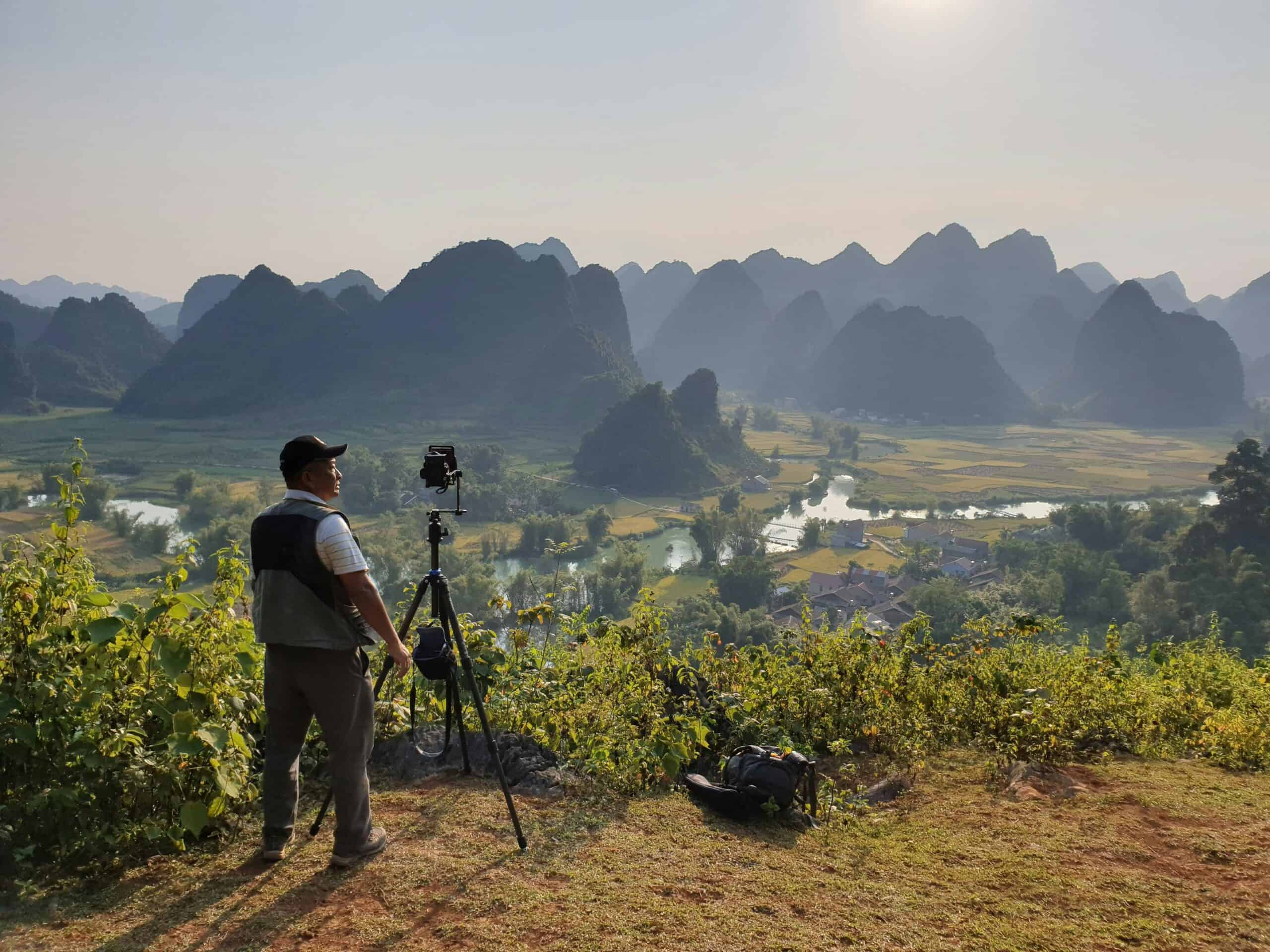
Quick Setup Overview
- Camera: Canon EOS 5D Mark IV — Full-frame (36×24 mm), 30.4 MP, ~13.5 EV DR at ISO 100, 14‑bit RAW, excellent Live View silent mode.
- Lens: Samyang 12mm f/2.8 ED AS NCS Fish-Eye — Diagonal fisheye (≈180° diagonal FOV), manual focus/aperture; best sharpness f/5.6–f/8; moderate CA and flare control needed.
- Estimated shots & overlap (tested):
- Robust single-row: 6-around (60° yaw) at 0° tilt + zenith + nadir (6+Z+N) with ~30% overlap.
- Time-critical: 4-around (90° yaw) at slight +10° tilt + nadir; add a dedicated zenith if the sky has detail (4+Z+N). Expect tighter margins.
- Difficulty: Intermediate on first setup, Easy once nodal point is calibrated.
Planning & On-Site Preparation
Evaluate Shooting Environment
Walk the scene before you deploy the tripod. Note bright highlights (sun, windows), fast-moving subjects (people, cars), reflective surfaces (glass, polished floors), and tight spaces. For glass viewpoints, press the lens close to the glass (use a black cloth around the lens hood) and shoot at a slight angle to minimize reflections and ghosting. In coastal or windy locations, anticipate vibrations; use a sturdy tripod and keep the center column down.
Match Gear to Scene Goals
The 5D Mark IV’s clean base ISO and generous dynamic range support high-contrast scenes, while the Samyang 12mm fisheye keeps shot count low—perfect for events or rooftops where time is limited. A realistic ISO tolerance on the 5D IV for professional pano quality is ISO 100–800 (very clean), 1600 (usable with light NR), 3200 (emergency; expect noise in shadows). If you’re shooting interiors with bright windows, plan HDR bracketing to extend dynamic range without pushing ISO.
Pre-shoot Checklist
- Charge LP‑E6N batteries; bring at least one spare. Format fast UHS‑I SD or CF cards.
- Clean lens front element (fisheyes are flare-prone). Sensor spots are very visible in sky areas—run a sensor cleaning cycle if needed.
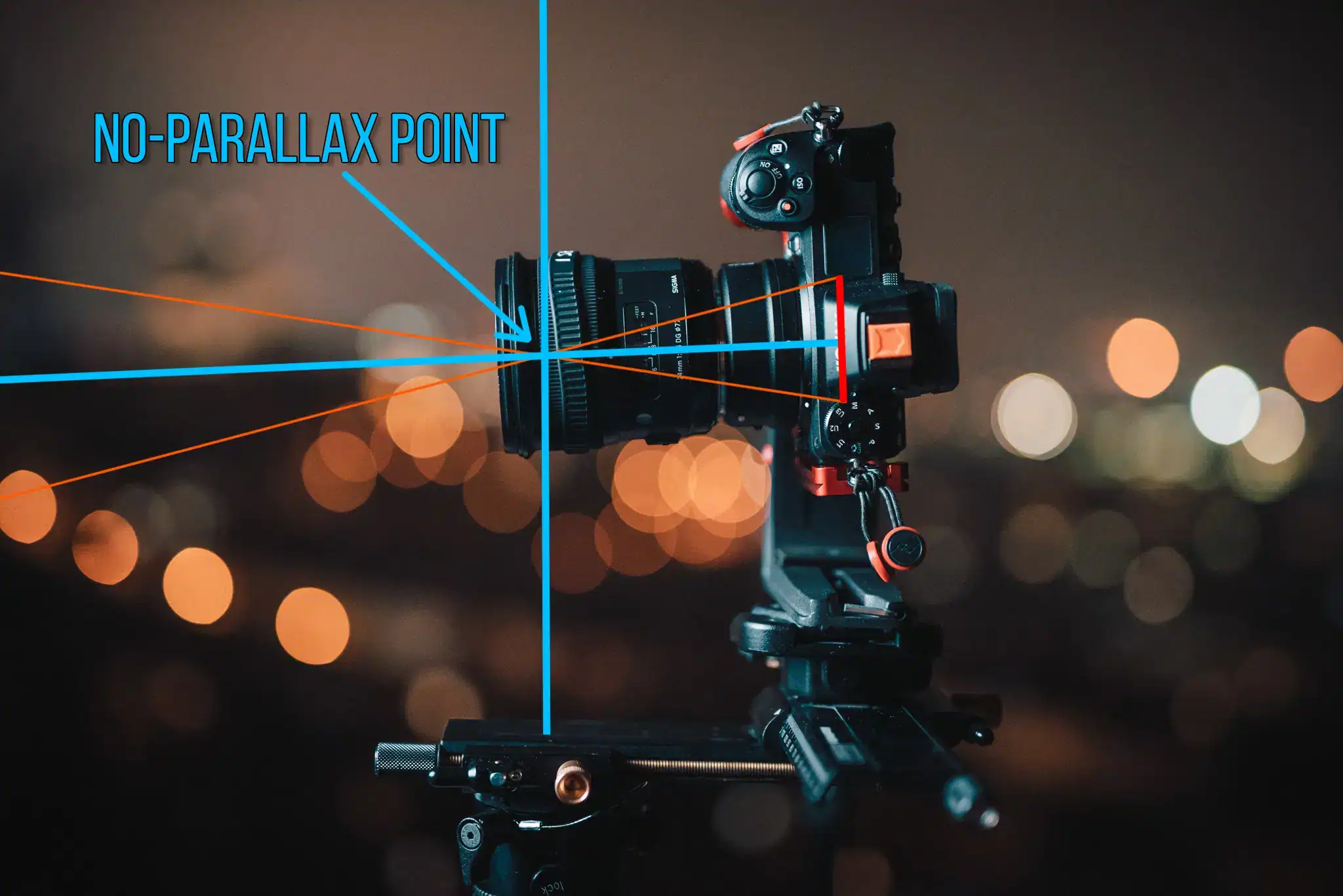
- Level the tripod; ensure your panoramic head is calibrated for the lens’s nodal point (no-parallax point).
- Safety: tether the camera on rooftops and poles; assess wind gusts; avoid overhanging pedestrians or traffic.
- Backup workflow: shoot a second pass if time allows—especially crucial for crowds or complex lighting.
Essential Gear & Setup
Core Gear
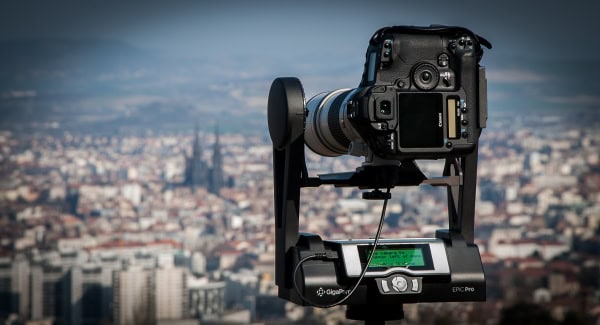
- Panoramic head: Allows rotation around the lens’s no‑parallax point to eliminate stitching errors. Calibrate fore-aft and vertical offsets for the Samyang 12mm.
- Stable tripod with a leveling base: Rapid leveling keeps rows consistent and horizons straight, essential for quick, accurate stitches.
- Remote trigger or Canon app (Camera Connect): Prevents vibrations. Use Live View Silent Shooting to reduce shutter shock.
Optional Add-ons
- Pole or car mount: Use safety tethers and avoid high winds. Increase shutter speed to counter vibration (1/250+). Rotate slower to reduce motion blur between frames.
- Lighting aids: Small LED panels or bounced flash for dark interiors. Avoid moving lights between frames.
- Weather protection: Rain cover, lens hood flagging for flare, and a microfiber cloth for sea spray or mist.
Step-by-Step Shooting Guide
Standard Static Scenes
- Level and Nodal Alignment: Set the tripod on firm ground, level via the base. Adjust the pano head so the rotation axis passes through the lens’s entrance pupil (no‑parallax point). For the Samyang 12mm on a typical compact pano head, a good starting fore‑aft offset is around 63–65 mm forward from the camera’s tripod socket; fine‑tune by observing foreground/background alignment while panning.
- Manual Exposure and White Balance: Set M mode; meter for the midtones and protect highlights. Lock white balance (e.g., Daylight or custom Kelvin) to avoid color shifts across frames.
- Focus: Use Live View magnification and manually focus slightly shy of infinity at f/8. Or set hyperfocal: at 12mm, f/8 hyperfocal is ~0.61 m; at f/5.6 it’s ~0.87 m. Switch AF off to prevent refocus.
- Capture Sequence:
- 6-around at 0° tilt with ~30% overlap. Shoot clockwise to stay consistent.
- Add a tilted up frame for zenith (+60° to +90°) and a nadir (−90°) for tripod removal.
- Metadata consistency: Keep the same exposure, WB, and focus for the entire set.
HDR / High Dynamic Range Interiors
- Bracket ±2 EV (3 or 5 frames) to balance bright windows and interior shadows. The 5D Mark IV supports up to 7‑frame bracketing, but 3–5 frames is usually enough.
- Keep WB locked, use M mode, and do not change focus between brackets.
- Use the camera’s 2s timer or remote; Live View Silent Shooting reduces vibration for longer exposures.
Low-Light / Night Scenes
- Use a tripod, Live View, and a remote release. Shoot at f/4–f/5.6 to keep star/point light definition; adapt shutter (1–8 s) at ISO 100–400 whenever possible.
- On the 5D IV, ISO 800–1600 remains usable for pano sets; 3200 only when necessary. Shoot an extra clean pass at lower ISO for the sky if you can.
Crowded Events
- Do two passes: first for coverage, second waiting for gaps in movement at overlap zones.
- Use higher shutter speeds (1/200–1/500) and consider 4-around to move faster. Mask ghosts during stitching.
Special Setups (Pole / Car / Drone)
- Pole: Keep the rig under 3 m in windy conditions. Use a guy line or hand as a stabilizer. Rotate slowly; shoot 6-around for better overlap.
- Car mount: Use high-strength suction cups, safety straps, and shoot at 1/500+ to reduce blur. Avoid public roads without permits—safety first.
- Drone: This lens is DSLR-based, so drone use is impractical; switch to a drone-native pano mode if aerials are required.
For a deeper primer on pano head setup and rotation strategy, see this panoramic head tutorial. Panoramic head setup guide
Recommended Settings & Pro Tips
Exposure & Focus
| Scenario | Aperture | Shutter | ISO | Notes |
|---|---|---|---|---|
| Daylight outdoor | f/8–f/11 | 1/100–1/250 | 100–200 | Lock WB (Daylight/5200–5600K); protect highlights |
| Low light/night | f/4–f/5.6 | 1/30–8s | 100–800 | Tripod + remote; use Live View Silent Shooting |
| Interior HDR | f/8 | Bracket ±2 EV (3–5 frames) | 100–400 | Balance windows & lamps, fix WB |
| Moving crowds | f/5.6–f/8 | 1/200+ | 400–800 | Double pass; mask in post |
Critical Tips
- Manual focus at hyperfocal: At 12mm, f/8 ≈ 0.61 m; f/5.6 ≈ 0.87 m. Mark your lens ring for repeatability.
- Nodal point calibration: Start ~63–65 mm forward from the camera’s tripod socket on many compact pano heads; fine‑tune by aligning near/far verticals while panning.
- White balance lock: Prevent color shifts—especially under mixed lighting. Consider a custom Kelvin value measured off a gray card.
- RAW over JPEG: 14‑bit RAW from the 5D Mark IV preserves highlight headroom and shadow detail, crucial for HDR blends.
- Stabilization: The Samyang has no IS and the 5D IV has no IBIS—perfect for tripod work. If you ever use an IS lens for panos, disable IS on a tripod.
- Mirror/shutter control: Use Live View Silent (EFCS) or mirror lockup + 2s timer to minimize vibration.
Stitching & Post-Processing
Software Workflow
Import your RAWs into Lightroom or similar, apply uniform white balance and lens corrections except defishing. Export 16‑bit TIFFs for stitching. In PTGui (or Hugin), set lens type to fisheye and let the optimizer determine field of view; fisheyes usually need ~25–35% overlap. With the 12mm FE, 6-around + zenith + nadir stitches very reliably, and the software will account for fisheye projection without manually defishing. Rectilinear lenses require more frames; fisheyes trade distortion for speed, which modern stitchers handle well. Why PTGui excels for complex panoramas
Cleanup & Enhancement
- Nadir patch: Export to Photoshop for tripod removal via clone/heal or use an AI patcher. Capture a dedicated nadir shot by lifting the rig or shifting tripod legs to make patching easier.
- Color and noise: Balance across the pano; apply luminance NR sparingly (fisheye corners can show color noise at higher ISOs).
- Level the horizon: Use the pitch/roll/yaw controls in PTGui/Hugin to level; set the verticals with control points if interiors appear tilted.
- Export: Save as 8‑bit or 16‑bit equirectangular TIFF/JPEG at 2:1 aspect for VR viewers (e.g., 12000×6000 px from a 30 MP set is typical). For virtual tour platforms, keep file size under their limits.
For best practices on end-to-end DSLR pano pipelines for VR, this guide is concise and practical. DSLR to 360 workflow for VR platforms
Watch: From Capture to Stitch
The following video walks through practical steps to shoot and stitch high-quality panoramas. It’s a useful refresher even if you’re already comfortable with pano heads and HDR.
For a deep dive into pano math and final resolution expectations from fisheye vs rectilinear, this reference is gold. DSLR spherical resolution (PanoTools)
Disclaimer: Software UIs evolve. Verify the latest workflow in each application’s documentation.
Useful Tools & Resources
Software
- PTGui (fast, robust control points and masking)
- Hugin (open-source alternative)
- Lightroom / Photoshop (RAW prep, nadir patching)
- AI tripod removal tools (content-aware fill or dedicated apps)
Hardware
- Panoramic heads: Nodal Ninja/Fanotec, Leofoto, Sunwayfoto
- Carbon fiber tripods with leveling bases
- Wireless remote shutters or intervalometers
- Pole extensions and vehicle mounts with safety tethers
Disclaimer: Product names are for search reference; consult official sites for current specs.
Common Mistakes & How to Avoid Them
- Parallax error: Not rotating around the no‑parallax point. Solution: Calibrate fore‑aft and vertical offsets and lock them.
- Exposure flicker: Auto exposure or auto WB between frames. Solution: Manual mode and locked WB.
- Tripod shadows and footprints: Shoot a nadir frame and patch in post.
- Ghosting from moving subjects: Capture two passes; use masking in PTGui/Hugin.
- Night noise: Push ISO too high. Use lower ISO and longer shutter times with remote release and Live View Silent mode.
- Flare arcs with the sun in frame: Shade the lens briefly and capture an extra frame to blend; avoid aiming directly into intense light when possible.
Field-Proven Scenarios
Indoor Real Estate
Set f/8, ISO 100–200, bracket ±2 EV (3–5 frames), 6-around + zenith + nadir. Lock WB to a custom Kelvin (e.g., 4000–4500K for mixed indoor lighting). The 5D Mark IV’s DR helps keep window highlights under control; if necessary, capture an extra highlight‑protected window frame for manual blend.
Outdoor Sunset
Expose for the sky highlights (ETTR cautiously), f/8, ISO 100, 6-around to preserve overlap in darker shadows. Consider a second pass a few minutes later for better-lit foregrounds and blend selectively.
Event Crowds
Use 4-around to shoot faster, 1/250 at f/5.6, ISO 400–800. Shoot two passes, anticipate gaps in movement at overlap seams, and use PTGui’s masking to pick the cleanest subjects per sector.
Rooftop / Pole Shooting
Keep the center column retracted, tether the camera, and avoid gusts. On a pole, use 6-around and rotate slower; increase shutter speed to 1/250–1/500. The fisheye’s wide FOV reduces the number of frames and the time aloft.
Car-Mounted Capture
Only in controlled environments. Use suction mounts rated for >15 kg, a safety strap, and short exposure times (1/500+). Expect rolling reflections on shiny surfaces—mask strategically in post.
For an excellent gear planning overview focused on DSLR panos and virtual tour work, see this practical guide. DSLR pano and virtual tour FAQs
Frequently Asked Questions
- Can I shoot handheld panoramas with the Canon EOS 5D Mark IV?
Yes for casual panos, but not recommended for 360×180 with foreground objects. Handheld introduces parallax and alignment errors. If you must, keep the pivot near the lens, use high shutter speeds, and stick to 4-around with generous overlap. For professional results, use a panoramic head.
- Is the Samyang 12mm f/2.8 fisheye wide enough for a single-row 360?
Yes. A reliable recipe is 6-around at 0° tilt plus zenith and nadir. In simple skies you can try 4-around + zenith + nadir, but coverage at the poles will be tighter and stitching margins smaller.
- Do I need HDR for interiors with bright windows?
Often yes. Bracket ±2 EV (3–5 frames) to recover both window highlights and deep shadows. The 5D Mark IV handles mild contrast without HDR, but windows typically need at least a 3‑frame bracket.
- How do I avoid parallax issues with this combo?
Use a pano head and calibrate the no‑parallax point. Start around a 63–65 mm fore‑aft offset from the camera’s tripod socket for the 12mm and fine‑tune by checking a near object against a far vertical while panning. Lock that position for future shoots.
- What ISO range is safe on the 5D Mark IV in low light?
ISO 100–800 is clean; 1600 is usable with light noise reduction; 3200 is emergency. Prefer longer exposures at low ISO on a tripod using Live View Silent Shooting.
- Can I set Custom Shooting Modes for faster pano setup?
Yes. Save pano settings to C1/C2/C3 (Manual exposure, fixed WB, RAW, mirror lock/Live View Silent, drive: single, bracketing on/off as needed). This greatly speeds field work.
- How do I reduce flare with this fisheye?
Avoid strong backlight when possible; shade the lens with your hand just outside the frame and capture an extra frame to clone in later. Keep the front element spotless—fisheyes amplify micro-smudges into big streaks.
- What’s the best tripod head for this setup?
A compact multi-row panoramic head with precise fore‑aft and vertical adjustments (e.g., Fanotec/Nodal Ninja or Leofoto). Ensure it supports the 5D IV’s weight and allows zenith/nadir access.
Safety, Reliability & Backup Workflow
Use a tether on rooftops, keep the center column down, and weigh the tripod in wind. For poles and cars, always add secondary safety straps. In rain, cover the camera and wipe the fisheye frequently. Back up in the field: after each location, copy the card to a second medium (laptop/SSD) and do a quick visual check to ensure you have complete coverage (no missing azimuths, no gross exposure errors). When time permits, shoot a second pass—this single habit saves more panos than any other.