Why This Camera & Lens Are Great for Panoramas
This guide walks you through how to shoot panorama with Canon EOS 5D Mark IV & Fujifilm XF 10-24mm f/4 OIS WR. First, an honest note: the Fujifilm XF 10–24mm f/4 OIS WR is a Fujifilm X‑mount APS‑C lens and cannot be mounted natively on the Canon EOS 5D Mark IV (EF mount, full frame). There is no practical adapter that preserves infinity focus and aperture control for this combination. That said, the shooting method, exposure strategy, nodal-point alignment, and stitching workflow for a rectilinear ultra-wide zoom are the same. So, if you’re using the 5D Mark IV, choose an equivalent EF-mount rectilinear ultra-wide lens (e.g., Canon EF 16–35mm f/4L IS, EF 16–35mm f/2.8L, or EF 17–40mm f/4L). If you are on Fujifilm X cameras with the XF 10–24mm, apply the same steps and shot counts based on its effective field of view (15–36mm full-frame equivalent).
Why the 5D Mark IV? It’s a 30.4MP full-frame DSLR (36×24 mm) with ~5.36 µm pixel pitch and roughly 13.5 stops of dynamic range at ISO 100, delivering clean detail and color latitude for complex scenes and HDR panoramas. Dual Pixel AF helps with precise focus before you switch to manual. The body is robust, weather-sealed, and has excellent battery life—ideal for long sessions or remote locations. With a rectilinear ultra-wide lens in the 15–24mm full-frame range, you get minimal fisheye distortion and straight architectural lines, which is perfect for real estate and cityscapes. Just note that rectilinear lenses require more frames than fisheyes for a full 360×180 capture.
Quick Setup Overview
- Camera: Canon EOS 5D Mark IV — Full Frame (36×24 mm), 30.4MP, ~13.5 EV DR at ISO 100, excellent color depth.
- Lens: Fujifilm XF 10–24mm f/4 OIS WR (rectilinear zoom, sharp from f/5.6–f/8, well-controlled CA) — note: physically incompatible with 5D Mark IV; use an EF-mount ultra-wide at 16–24mm to match FOV and approach.
- Estimated shots & overlap (rectilinear UWA on full frame):
- At ~16mm FF: 3 rows × 6 around (≈18) + zenith + nadir ≈ 20–22 frames at 30–35% overlap.
- At ~20mm FF: 3 rows × 8 around (≈24) + zenith + nadir ≈ 26–28 frames.
- At ~24mm FF: 4 rows × 7 around (≈28) + zenith + nadir ≈ 30–32 frames.
- Difficulty: Intermediate (precise nodal alignment + multi-row capture).
Planning & On-Site Preparation
Evaluate Shooting Environment
Survey the scene before deploying the tripod. Look for changing light (moving clouds, sunset transitions), moving subjects (crowds, traffic), and reflective surfaces (windows, polished floors) that can cause ghosting. If shooting through glass, keep the front element close (2–5 cm) to reduce reflections and flare. For interiors, note mixed lighting (tungsten + daylight) and plan to lock white balance to avoid stitching seams.
Match Gear to Scene Goals
The EOS 5D Mark IV’s dynamic range and clean ISO performance help in both HDR interiors and twilight cityscapes. It’s safe to shoot ISO 100–400 for best quality; ISO 800–1600 remains very usable, and ISO 3200 can work with careful noise reduction. A rectilinear ultra-wide (like 16–24mm FF) keeps lines straight—ideal for architecture and real estate—but requires multi-row shooting for full 360×180 coverage. If you need fewer frames at the cost of distortion, consider a fisheye (e.g., Canon EF 8–15mm f/4L) as an alternative.
Pre-shoot Checklist
- Charge batteries; carry spares. Format high-speed SD/CF cards.
- Clean lens and sensor; bring a blower and microfiber cloth.
- Calibrate and mark nodal (entrance pupil) settings for your chosen focal lengths.
- Level the tripod; use a leveling base or half-ball to save time.
- Safety: secure on rooftops, watch wind loads, tether pole rigs, and keep clear of traffic for car mounts.
- Backup: shoot an extra full pass if time allows; it saves reshoots when a frame is soft or obstructed.
Essential Gear & Setup
Core Gear
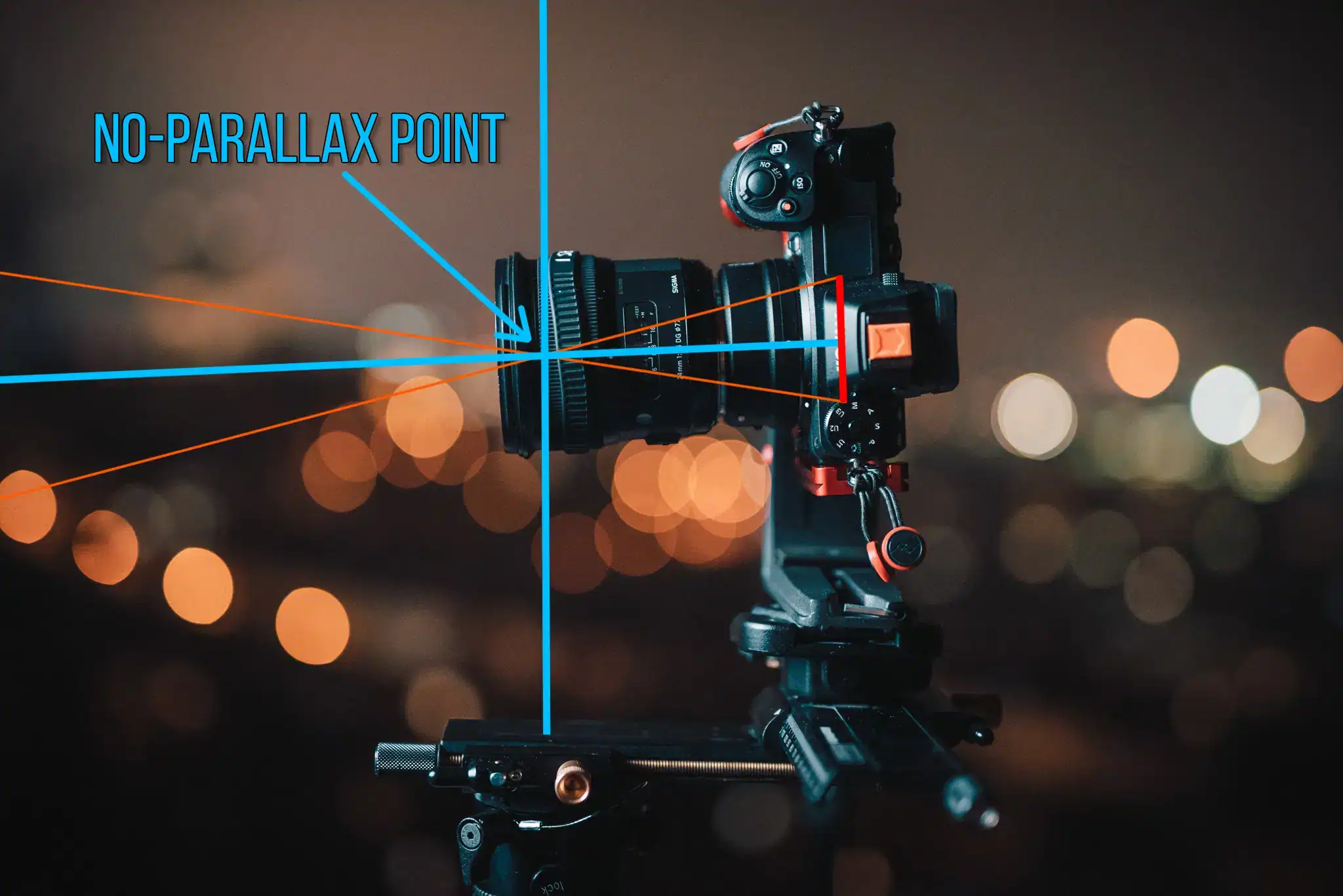
- Panoramic head with fore/aft rail: Align the lens’s entrance pupil over the rotation axis to eliminate parallax, which is critical for close objects (indoor furniture, railings).
- Stable tripod with a leveling base: Speed up leveling and keep the horizon true.
- Remote trigger or app: Use a cable release or Canon app; enable mirror lockup or shoot Live View to reduce vibration.
Optional Add-ons
- Pole or car mount: Use safety tethers, check wind gusts, avoid overhanging power lines, and verify local regulations. Vibrations demand higher shutter speeds.
- Lighting aids: Small LED panels for dark corners; avoid mixing color temperatures unless you’re comfortable color-matching later.
- Weather protection: Rain covers, gaffer tape for ports, silica gel in bag for humidity.
Step-by-Step Shooting Guide
Standard Static Scenes
- Level and align: Level the tripod, then align the panoramic head so the lens’s entrance pupil sits over the rotation axis. To calibrate, place two vertical objects (one near, one far) and rotate the camera; adjust the rail until relative motion disappears.
- Manual exposure and WB: Switch to Manual (M) mode. Meter the brightest part you need detail in, then expose to protect highlights. Lock white balance (e.g., Daylight = ~5200K outdoors, Tungsten = ~3200K indoors). Disable Auto Lighting Optimizer and any exposure variance features.
- Focus: Use Live View to focus about one-third into the scene or set the hyperfocal distance. Then switch to manual focus to prevent hunting between frames.
- Capture sequence: For ~16mm FF, shoot 3 rows (e.g., +50°, 0°, −50°) with 6 shots per row (60° increments) plus a dedicated zenith and nadir. Keep overlap ~30–35% horizontally and ~25–30% vertically.
- Nadir shot: Tilt up for zenith first to avoid your tripod shading. Then capture a separate handheld nadir by lifting the camera just over the tripod and rotating about the same point to make patching easier.
HDR / High Dynamic Range Interiors
- Bracket exposures: Use AEB at ±2 EV (3 or 5 frames) at each view to balance window highlights and interior shadows. Keep aperture constant (e.g., f/8).
- WB and consistency: Lock white balance and keep shutter speed the variable. ISO should remain fixed (100–400) to minimize noise variation across brackets.
- Sequence: Shoot all brackets at each position before rotating to the next. This reduces ghosting from moving objects.
Low-Light / Night Scenes
- Stability first: Use a sturdy tripod, remote release, and enable mirror lockup or Live View to cut vibration.
- Exposure: Start around f/5.6–f/8, ISO 100–400 if possible, and extend shutter time. When wind or vibration is an issue, raise ISO to 800–1600 and keep shutter near 1/4–1/30 s.
- Noise control: The 5D Mark IV is clean up to ISO 1600–3200 with careful processing, but aim lower ISO for premium-quality virtual tours.
Crowded Events
- Two-pass method: First pass for coverage, second pass waiting for gaps to capture clean plates.
- Post blend: Use masks during stitching or in Photoshop to minimize ghosting by favoring frames with fewer people.
Special Setups (Pole / Car / Drone)
- Pole: Balance and tether. Keep shutter speeds faster (1/125–1/250 s) to fight sway. Avoid long exposures; consider slightly higher ISO to secure sharpness.
- Car mount: Use vibration-damping mounts, plan for short bursts, and pick smooth roads. Stop the car safely for best quality.
- Drone: For the 5D Mark IV this is specialized and heavy; if you need aerial panoramas, consider a lighter mirrorless or a drone with spherical mode.
Watch: Panoramic Head Setup Basics
For a visual demo of panoramic head setup and technique, this video is a helpful primer.
Recommended Settings & Pro Tips
Exposure & Focus
| Scenario | Aperture | Shutter | ISO | Notes |
|---|---|---|---|---|
| Daylight outdoor | f/8–f/11 | 1/100–1/250 | 100–200 | Lock WB (Daylight ~5200K). Use Live View to reduce mirror shock. |
| Low light/night | f/4–f/5.6 | 1/4–1/60 | 400–1600 | Tripod and remote; prioritize sharpness, then reduce noise in post. |
| Interior HDR | f/8 | Bracket ±2 EV | 100–400 | Balance windows and lamps; keep ISO fixed for consistent noise. |
| Action / moving subjects | f/5.6–f/8 | 1/200+ | 400–800 | Freeze motion; capture a second clean pass for masking. |
Critical Tips
- Manual focus and hyperfocal: At 16mm FF and f/8, focusing ~1–1.2 m keeps most of the scene sharp. Always switch to MF after focusing.
- Nodal point calibration: For a 16–24mm rectilinear, the entrance pupil typically sits near the front element. Start with the rail set so the rotation axis is roughly beneath the front element (common values ≈60–80 mm from the tripod screw for many heads), then refine with near/far alignment tests.
- White balance lock: Avoid Auto WB; fix a Kelvin value or use a preset matching your dominant light to prevent stitching seams.
- RAW over JPEG: RAW preserves highlight detail and color flexibility—essential for HDR panoramas and mixed lighting.
- Stabilization: On a tripod, turn off lens IS/OIS to prevent micro-blur. The 5D Mark IV has no IBIS, so use a remote and mirror lockup/Live View.
Stitching & Post-Processing
Software Workflow
Import RAWs into Lightroom or your preferred RAW editor, apply consistent lens profile, WB, and basic exposure tweaks. Export 16-bit TIFFs (or send directly) to a stitcher like PTGui or Hugin. For rectilinear ultra-wide lenses, aim for 30–35% overlap horizontally and 25–30% vertically to give the optimizer enough control points and reduce edge stretching issues. After stitching to an equirectangular output (2:1 ratio), round-trip to Photoshop for cleanup, then export JPEGs for web or TIFFs for archival/print. PTGui remains a top choice for speed and control point robustness, especially for multi-row 360s. See an overview of PTGui’s strengths at the end of this paragraph. PTGui review and why it’s favored for complex panoramas.
Cleanup & Enhancement
- Tripod/nadir patch: Use PTGui’s Viewpoint correction or clone/heal in Photoshop. You can also drop in a branded patch.
- Color correction: Match saturation and temperature across the pano; fix any mixed-light color casts with local adjustments.
- Noise reduction: Apply spatial NR to shadows for night scenes; avoid over-smoothing detail areas.
- Level the horizon: Use the optimizer’s verticals or PTGui’s horizon tool to align roll/pitch/yaw.
- Export: For VR and web players, export 8–12K equirectangular JPEGs (quality ~85–90%). Keep layered masters in 16-bit TIFF.
New to nodal heads and control points? This tutorial is a good fundamentals refresher. Panoramic head tutorial: entrance pupil and setup
For publishing 360 photos and virtual tours, Meta’s creator documentation outlines file formats and practical tips. DSLR/mirrorless 360 photo workflow for VR platforms
Useful Tools & Resources
Software
- PTGui panorama stitching
- Hugin (open-source stitcher)
- Lightroom / Photoshop for RAW processing and cleanup
- AI tools for tripod/nadir removal
Hardware
- Panoramic heads (e.g., Nodal Ninja, Leofoto)
- Carbon fiber tripods with leveling bases
- Wireless remote shutter releases
- Pole extensions and car mounts with safety tethers
Disclaimer: software/hardware names are provided for search/reference; confirm specs and compatibility on official sites.
Common Mistakes & How to Avoid Them
- Parallax error: Always align the entrance pupil before shooting, especially for interiors and close objects.
- Exposure flicker: Shoot in full Manual, lock WB, disable exposure-changing features.
- Tripod intrusion: Capture a handheld nadir or use viewpoint correction and patch in post.
- Motion ghosting: Use the two-pass method and mask moving elements during editing.
- High ISO noise: Favor longer shutter on a stable tripod instead of pushing ISO too high.
- Wind shake on poles: Increase shutter speed and reduce row count or frame spacing to finish faster.
Real-World Case Studies
Indoor Real Estate (Bright Windows)
On a 5D Mark IV with a 16–35mm at 16mm, set f/8, ISO 100–200, and bracket ±2 EV (3–5 frames). Shoot three rows around plus a zenith, then handheld nadir. In PTGui, enable exposure fusion or pre-merge brackets (HDR) before stitching. Lock WB around 4000–4500K to balance daylight and tungsten; fine-tune per room.
Outdoor Sunset Cityscape
As the sun drops, light changes quickly. Meter for highlights, set f/8, ISO 100–200, and shutter accordingly. Complete the panorama quickly (start near the sun first), then do a second safety pass. If dynamic range stretches the 5D4’s ~13.5 EV, bracket ±2 EV only for frames including the sun, then blend selectively.
Event with Crowds
Use 1/200 s at f/5.6–f/8, ISO 400–800. Shoot a rapid sequence to minimize subject movement, then a second pass waiting for gaps. In post, mask toward the frames with fewer people and more complete features (faces, limbs) to avoid ghost seams.
Rooftop Pole Shot
Mount a light carbon pole with a tether and keep shutter speeds at 1/125–1/250 s, ISO 800–1600 if needed. Reduce the number of positions per row to speed up the capture. Avoid strong wind and always have a spotter for safety.
Frequently Asked Questions
- Can I shoot handheld panoramas with the Canon EOS 5D Mark IV?
Yes for simple cylindrical panos, but for 360×180 multi-row panos, use a tripod and panoramic head to eliminate parallax. Handheld 360s are possible only when everything is far away and overlap is generous; expect more stitching errors.
- Is the Fujifilm XF 10–24mm f/4 OIS WR wide enough for single-row 360?
On APS-C it’s a 15–36mm FF equivalent. At the 10–15mm FF-equivalent end you still need multi-row capture to cover zenith and nadir with a rectilinear lens. A single row won’t cover the full vertical 180° field of view.
- Can I mount the Fujifilm XF 10–24mm on the 5D Mark IV?
No. It’s a Fujifilm X-mount lens and is not practically adaptable to Canon EF with infinity focus or aperture control. Instead, use an EF ultra-wide like the Canon EF 16–35mm f/4L IS to achieve equivalent results.
- Do I need HDR for interiors with bright windows?
Usually yes. Bracket ±2 EV (3–5 frames) at each position to maintain highlight detail and clean shadows. The 5D4 has good dynamic range, but windows commonly require HDR blending.
- What ISO range is safe on the 5D Mark IV in low light?
Best quality is ISO 100–400. ISO 800–1600 remains very usable. ISO 3200 can work with careful noise reduction. For tripod-based panoramas, favor lower ISO and longer shutter times when possible.
- How do I avoid parallax issues?
Use a panoramic head and align the lens’s entrance pupil over the rotation axis. Calibrate with a near and far object and adjust until there’s no relative motion as you pan.
- Can I assign a Custom Mode for pano on the 5D Mark IV?
Yes. Save manual exposure, locked WB, MF, mirror lockup/Live View, and drive mode to C1/C2. It speeds up repeatable results.
For deeper reading on DSLR virtual tour workflows and lens choices, this guide is a solid reference. DSLR virtual tour FAQ: camera and lens guide
Safety, Limitations, and Trust Notes
Lens compatibility matters: how to shoot panorama with Canon EOS 5D Mark IV & Fujifilm XF 10-24mm f/4 OIS WR is best interpreted as “5D Mark IV with an equivalent EF ultra-wide” because the Fujifilm lens won’t mount on the Canon body. Always check mounts, flange distances, and aperture control before heading out. In the field, tether pole rigs and keep away from edges and electric lines. Remember weather sealing limits; protect gear in rain and dust. Back up images to dual cards (if available) or to a portable SSD between locations. When in doubt, take a second clean pass; it’s faster than a reshoot later.
Want a structured step-by-step for high-end 360 workflows? This professional primer covers panoramic head setup and consistency. Set up a panoramic head for high-end 360 photos